


Suite 118
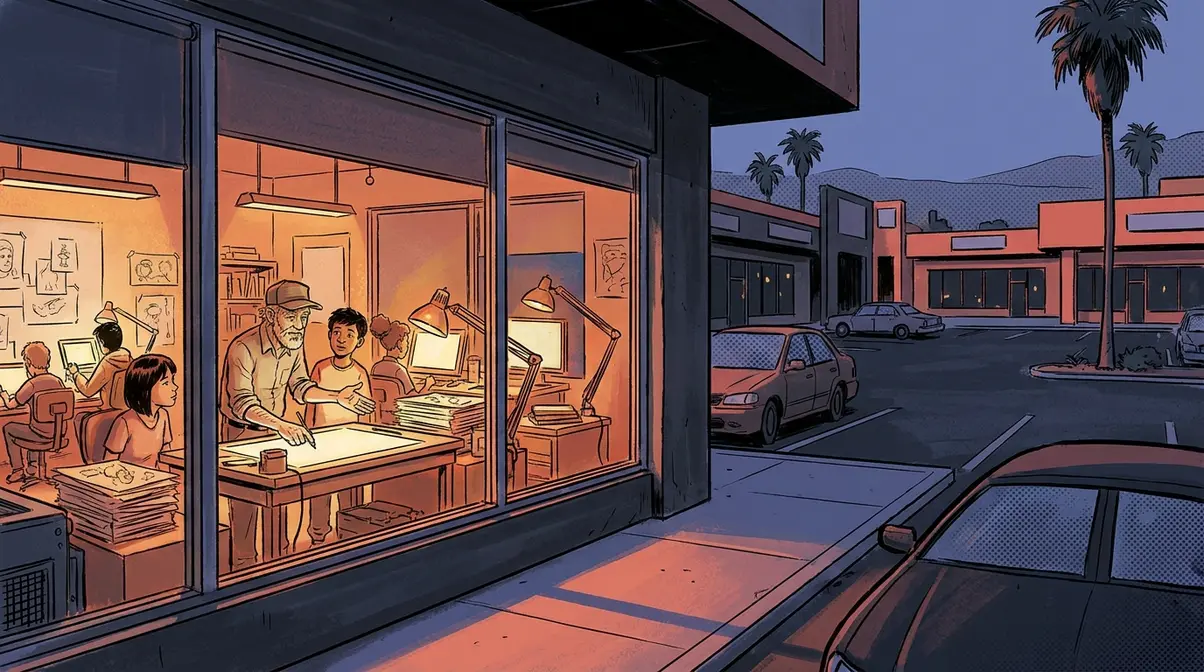
There is no backlot. No guard gate with a cartoon character waving you through. Don Bluth Studios is wedged into a strip mall called the Via Linda shopping center. It’s a community theatre located in the Via Linda shopping center. If you blinked while scanning the storefronts for a nail salon or a sandwich joint, you’d drive right past it. And that, I’d argue, is exactly the point.
Behind that door, three separate enterprises share one address: Don Bluth Studios, LLC, a newly formed animation company creating brand new content, establishing new characters and new ideas, starting as children’s books and then pitching to television networks and streaming services; Don Bluth University, offering a full year of animation training with an end-of-year Masterclass week in Scottsdale; and the Don Bluth Front Row Theatre, a nonprofit community theatre producing shows in an intimate 76-seat in-the-round venue. All of it orbiting one man, now 88 years old, who still believes pencil on paper can hold its own against render farms that cost hundreds of millions of dollars.
A Career in Three Acts
The short version: Donald Virgil Bluth, born September 13, 1937, is an American filmmaker, animator, video game designer, and author. In 1955, he graduated from high school and immediately took a portfolio of his drawings to the Disney studios in Burbank, where he landed a position as an in-betweener on Sleeping Beauty. He left, came back, left again. On his 42nd birthday in 1979, Bluth resigned from the studio to establish his own animation company, Don Bluth Productions, along with Gary Goldman, John Pomeroy, and nine fellow Disney animators.
What followed was a run of films that branded themselves permanently into the nervous systems of anyone born between roughly 1978 and 1992. Bluth is best known for directing The Secret of NIMH, An American Tail, The Land Before Time, All Dogs Go to Heaven, and Anastasia, and for his involvement in the well-known Laserdisc game Dragon’s Lair. Anastasia, produced at Fox Animation Studios in Phoenix, Arizona, grossed nearly US$140 million worldwide. But there were lows, too. The Bluth Group filed for bankruptcy on March 1, 1985, and films like Rock-a-Doodle, Thumbelina, A Troll in Central Park, and The Pebble and the Penguin were all critical and box office failures.
Fans in online animation communities remain painfully aware of this boom-bust cycle. “Love the man, fear the business model” sums up the prevailing mood. The split between skeptics and supporters is real, and it’s generational.
The Strip-Mall Renaissance
So what does a “renaissance” actually look like when it starts from a 76-seat room off Shea Boulevard? It looks, to me, like a man stubbornly building three things at once and refusing to wait for permission.
In the 1990s, Bluth began hosting youth theater productions in the living room of his Scottsdale home. As the popularity of these productions grew and adults expressed their wishes to become involved, Bluth formed a theatre troupe called Don Bluth Front Row Theatre, whose productions were presented in his home until 2012, when they leased a space and converted it into a small theater. From a living room to a storefront. The ambition scaled; the intimacy didn’t. As Bluth told Images Arizona while directing the 2024 Anastasia musical: “If you talk about the human condition, and the audience feels that, it doesn’t matter how big or small the space is.”
That Anastasia production ran September 12 through October 26, 2024, with Bluth directing the Broadway musical inspired by his own animated film. DBFRT stated it was proud to be the first community theatre in Arizona to present an adult cast production of the show. In my view, there’s something quietly radical about an animation legend staging a live-theater adaptation of his own work, in his own 76-seat house, with local Arizona actors. It inverts every Hollywood instinct about scale.
The Studio and the School
In 2017, Lavalle Lee brought the idea of creating a school to Don Bluth, and Don Bluth University was born. After a decade of learning from Don Bluth and working together on multiple pitches and business ventures, Lee accepted the position as Vice President of Don Bluth Studios. Lee’s partnership with Bluth began when he championed the Dragon’s Lair Indiegogo campaign as lead project manager, editor, voice actor, and in-betweener, with the campaign raising over $731,000 to produce a pitch video.
The university is lean. Tuition for the full year is $10,000, and that includes all online live classes and the end-of-year Masterclass in Scottsdale, Arizona, a full year learning from Don Bluth himself. Enrollment is capped at twenty students per session. The next cohort runs September 2026 through September 2027. The curriculum covers draftsmanship, intro to animation, animation timing, storyboarding, layout, principles of acting, script writing, and more. Students work with pencil, paper, a flatbed scanner, and timeline software. A metronome. The tools are deliberately analog.
On the production side, Yuki, Star of the Sea, Bluth’s first children’s book, was painted fully traditional using gouache paint, with almost everything done with physical media. It is Bluth’s debut as a children’s author and the first of a planned series of “fables” from Don Bluth Studios, which specializes in hand-drawn illustrations and animation. The studio’s mission statement is unambiguous: “We believe the public is craving another renaissance of hand drawn animation. Our goal is to make that dream become a reality.”
The Documentary and the Archive
The documentary Don Bluth: Somewhere Out There, directed by Dave LaMattina and Chad N. Walker of Copper Pot Pictures, had its premiere at the 2025 SCAD Savannah Film Festival. Weaving intimate conversations with hundreds of hours of never-before-seen archive and home video, the film draws a compelling portrait of an artist who spent his life battling his own ego and a career torn between art and commerce. The screening was part of the 20th anniversary of the Don Bluth Collection at SCAD , a massive archive Bluth and Gary Goldman donated in 2005.
Asked at the Collider-moderated SCAD Q&A which film someone should start with, Bluth didn’t hesitate: “I would say The Secret of NIMH. That’s the one. That was the movie that we made when we were the most innocent, when we didn’t know what we were doing, and so we tried harder.” Co-director LaMattina told Animation World Network that the project evolved in the making: “It started out as a story about the man who left Disney, and it became a story about a man’s love for animation and for the characters he created.”
Lee’s connection to Bluth runs deep: Lee’s daughter Anastasia is not only named after Bluth’s film but is also Bluth’s goddaughter. That’s not a business partnership. That’s family. And it reads like the kind of bond that keeps a small operation alive when the spreadsheets say it shouldn’t be.
Will It Work?
Online animation forums are split clean down the middle. Skeptics call the 2D revival “an old man’s dream.” Defenders fire back that hand-drawn animation never died overseas, and that the American industry simply chose to abandon it. Both sides have a point.
My take? The question is wrong. “Will it work?” assumes the goal is to compete with Pixar’s budget or Disney’s marketing machine. The studio’s own roadmap starts with children’s books and pitches to streaming services. That’s not a moonshot. That’s a seed bank. Bluth isn’t trying to outspend the majors. He’s trying to preserve a technique and pass it to twenty students at a time, in a strip mall in Scottsdale, while there’s still a living master who can teach it.
I’d argue the Scottsdale operation is less a studio in the traditional sense and more a monastery. A place where the old forms are practiced, taught, and documented before the last people who learned them firsthand are gone. The theatre, the school, the studio, the children’s books, the documentary. They’re all the same gesture: preservation through practice, at a scale small enough to actually sustain.
At 88, Bluth still believes in magic. Suite 118 is where he’s proving it, one gouache painting and one 76-seat curtain call at a time.

'%3e%3cg id='Final-Copy-2_2_' transform='translate(1275.000000, 200.000000)'%3e%3cpath class='st0' d='M7.4,12.8h6.8l3.1-11.6H7.4C4.2,1.2,1.6,3.8,1.6,7S4.2,12.8,7.4,12.8z'/%3e%3c/g%3e%3c/g%3e%3c/g%3e%3cg id='final---dec.11-2020'%3e%3cg id='_x30_208-our-toggle' transform='translate(-1275.000000, -200.000000)'%3e%3cg id='Final-Copy-2' transform='translate(1275.000000, 200.000000)'%3e%3cpath class='st1' d='M22.6,0H7.4c-3.9,0-7,3.1-7,7s3.1,7,7,7h15.2c3.9,0,7-3.1,7-7S26.4,0,22.6,0z M1.6,7c0-3.2,2.6-5.8,5.8-5.8 h9.9l-3.1,11.6H7.4C4.2,12.8,1.6,10.2,1.6,7z'/%3e%3cpath id='x' class='st2' d='M24.6,4c0.2,0.2,0.2,0.6,0,0.8l0,0L22.5,7l2.2,2.2c0.2,0.2,0.2,0.6,0,0.8c-0.2,0.2-0.6,0.2-0.8,0 l0,0l-2.2-2.2L19.5,10c-0.2,0.2-0.6,0.2-0.8,0c-0.2-0.2-0.2-0.6,0-0.8l0,0L20.8,7l-2.2-2.2c-0.2-0.2-0.2-0.6,0-0.8 c0.2-0.2,0.6-0.2,0.8,0l0,0l2.2,2.2L23.8,4C24,3.8,24.4,3.8,24.6,4z'/%3e%3cpath id='y' class='st3' d='M12.7,4.1c0.2,0.2,0.3,0.6,0.1,0.8l0,0L8.6,9.8C8.5,9.9,8.4,10,8.3,10c-0.2,0.1-0.5,0.1-0.7-0.1l0,0 L5.4,7.7c-0.2-0.2-0.2-0.6,0-0.8c0.2-0.2,0.6-0.2,0.8,0l0,0L8,8.6l3.8-4.5C12,3.9,12.4,3.9,12.7,4.1z'/%3e%3c/g%3e%3c/g%3e%3c/g%3e%3c/g%3e%3c/svg%3e) Your Privacy Choices
Your Privacy Choices