



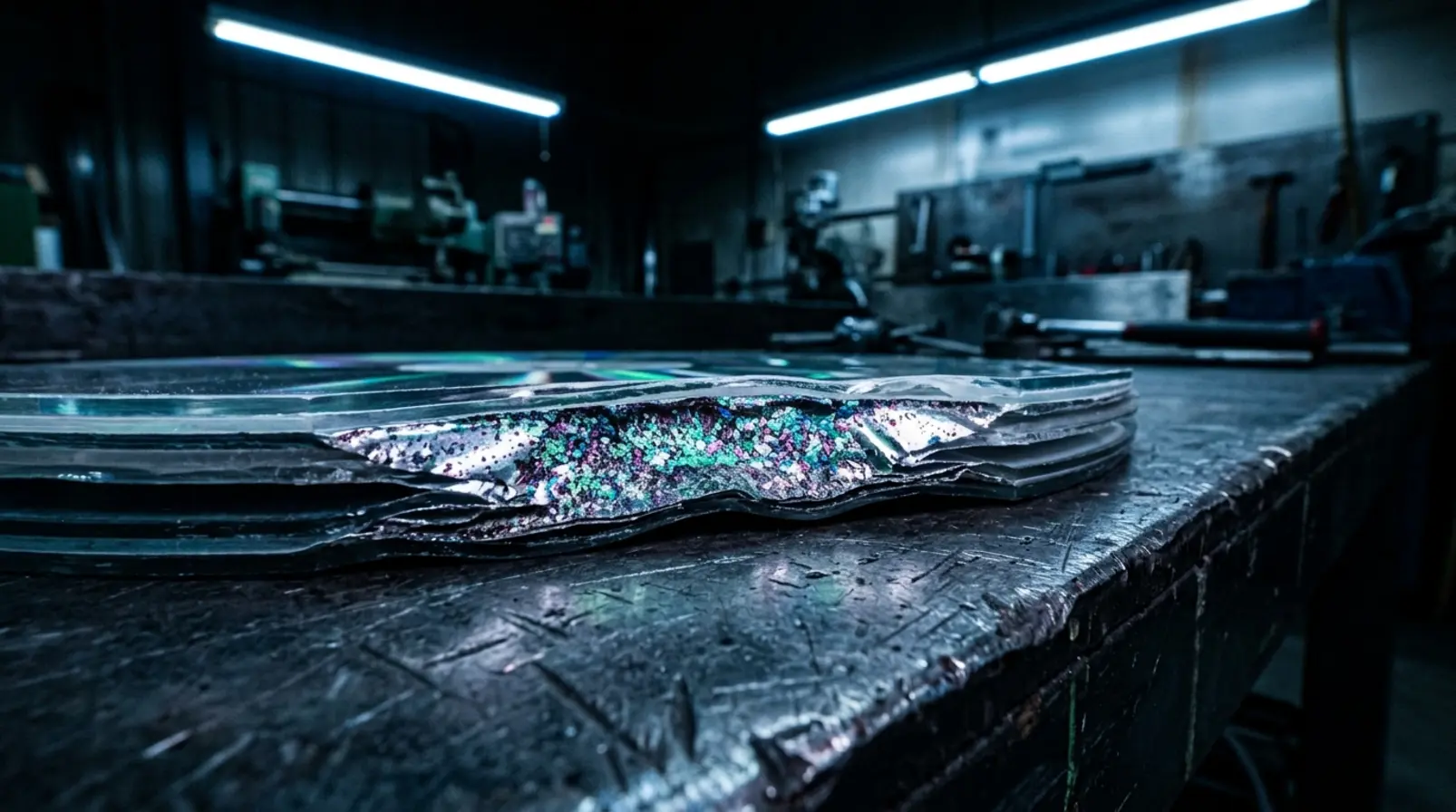
The Gimmick Pressing Arms Race
The gimmick pressing arms race refers to what many collectors describe as the escalating competition among vinyl labels and pressing operations to release increasingly elaborate limited-edition records, from multi-color splatter variants and hand-numbered collector editions to liquid-filled LPs sealed with vegetable-derived fluids. Driven by a vinyl market that surpassed $1 billion in U.S. revenue in 2025, this trend raises questions about whether novelty enhances the listening experience or simply fuels collector FOMO.
All Born Screaming and the Variant Avalanche
St. Vincent’s All Born Screaming is the seventh studio album by American rock musician Annie Clark, released on April 26, 2024, through her own Total Pleasure Records and distributed via Virgin Music Group. It is her first entirely self-produced record, mixed by Cian Riordan. The album features contributions from Dave Grohl and Josh Freese, Cate Le Bon, Justin Meldal-Johnsen, Stella Mozgawa, Rachel Eckroth, Mark Guiliana, and David Ralicke.
At the 2025 Grammys, Clark won three awards: Best Alternative Music Album for All Born Screaming, Best Rock Song for “Broken Man,” and Best Alternative Music Performance for “Flea.” Her accolades now include six Grammy Awards, three of which are for Best Alternative Music Album, tying the record for wins in that category.
The album also arrived in a blizzard of vinyl variants. The Blood Records edition comes as a colour-in-colour red and yellow LP with black splatter, limited to 1,000 copies and hand-numbered. A Spotify “Fans First” exclusive yellow vinyl was limited to 1,000 copies worldwide. There was also a Rough Trade exclusive white pressing, a Barnes & Noble black/white edge-splatter, a clementine orange marble, an indie-exclusive red, and standard black. That’s at least seven distinct vinyl SKUs for one album. Many collectors have argued that this kind of variant flood is less about audiophile care and more about turning a single record into a collectible trading-card game.
The Pressing Quality Roulette Nobody Asked For
Here’s where the variant strategy gets contentious. Not all pressings are created equal, and All Born Screaming is often cited by collectors as a case study.
The US indie-exclusive red edition, cut by Chris Bellman and pressed at RTI, earned praise from collectors on forums like Discogs: “Hard to go wrong with the CB/RTI combo. Excellent cut. Dead silent, flat pressing.” Meanwhile, the orange variant drew very different reports, with one reviewer describing it as “a terrible pressing” with “background noise throughout the quieter moments,” and another saying it sounded “muffled on the louder ones.”
The Blood Records splatter edition split opinions too, with one owner reporting a “terrible amount of pops and clicks in the beginning of Side A” and noting that “Hell Is Near is very noisy on my copy, a pop every 2 seconds.”
These reports are anecdotal and based on individual copies. Still, as some collectors describe it, this is the fundamental tension of the gimmick pressing economy: you’re paying a premium for visual spectacle, but the sonic outcome can feel like a coin flip. The record might look stunning on your shelf and, as one reviewer put it, sound like it was “pressed inside a bag of gravel.”
Blood Records, Bad World, and the Liquid-Filled LP Boom
Blood Records, the UK-based label behind the All Born Screaming splatter pressing, is also the parent operation of Bad World, a subsidiary “brought to you by the team behind Blood Records, a pioneering community dedicated to progressing special effect LPs.” Bad World is widely seen by collectors as playing a major role in turning liquid-filled vinyl from a fringe curiosity into a more scalable product line.
Bad World’s own site explains the history: “Liquid filled LPs are not new, but the existing production methods mean that very few people can actually own them.” Previous methods involved lathe-cut sides glued together by hand, which were “incredibly laborious to make, expensive and manufactured usually in very small runs of less than 50 units with worst sound quality than the existing format.” After 18 months of development, Bad World claims to have solved these problems using traditional presses and industrial sealing.
The breakout hit was the Saltburn soundtrack, pressed with cloudy white liquid inside to evoke the film’s most infamous scene. Craig Evans, Blood Records’ CEO, told NME the numbers were “pretty wild,” reporting 18,500 units at the time of the interview, with the biggest Blood Records run prior being 15,000 copies of an Oasis Masterplan reissue. Since Saltburn, the liquid-filled catalog has expanded aggressively, with releases tied to artists including Lady Gaga, The 1975, Kacey Musgraves, and The Last Dinner Party.
A Brief, Grotesque History of Things Pressed into Vinyl
The 12″ release of Jack White’s “Sixteen Saltines” in 2012 used a clear, hollow record filled with blue liquid, making it one of the first liquid-filled records to be publicly available. Walt Disney Productions had previously prototyped a liquid-filled disc for the 1979 film The Black Hole, but leakage problems prevented it from reaching market. White’s version also reportedly suffered from leakage issues over time.
The years that followed saw the novelty arms race escalate in increasingly unconventional directions. The Flaming Lips pressed human blood into a limited run of their 2012 collaborative album The Flaming Lips and Heady Fwends, selling ten copies for $2,500 each. Perfect Pussy’s Meredith Graves splattered her own blood across clear vinyl for 2014’s Say Yes to Love. Australian punk band Private Function sold 50 copies of their 2023 album filled with what they later revealed via Instagram to be urine.
Evans told NME about the liquid inside the Saltburn record: “I can’t say exactly what the liquid is in the middle, but it is derived from vegetables, so it is actually an organic material. I would not recommend it, but you could actually drink it…” As some observers have noted, the provocation itself can become part of the product, with the unboxing moment sometimes taking precedence over the listening experience.
The Longevity Problem Nobody Wants to Talk About
Liquid-filled records look extraordinary. They also come with a shelf life that nobody can confidently guarantee.
Some collectors have reported issues. One Saltburn collector on Discogs claimed that their copy “leaked an oily substance” within a couple of months, adding that it could have damaged nearby records if stored differently. Another noted that “the liquid can separate from the pigment if you go long periods without spinning.” These reports are anecdotal but frequently discussed in collector communities.
Bad World’s own guidance to customers acknowledges the maintenance required: “We would always advise to every now and again to spin it, move it and shake it to allow the liquid to move and remix.” In my view, a record that requires periodic agitation just to look right starts to resemble something closer to a snow globe that plays music than a traditional LP. That may be part of the appeal—but it’s a different proposition from a record you can file and forget for decades.
A $1 Billion Market Built on Spectacle
The RIAA’s 2025 year-end report confirmed that vinyl revenue surpassed $1 billion in the United States, with 19 years of consecutive growth and nearly 47 million copies sold. The average price of a mint vinyl record grew 24 percent to $37.22 from 2020 to 2025, per Discogs.
That price inflation is partly driven by rising production costs, but some analysts suggest it is also sustained by the variant economy. When a single album launches with multiple SKUs and deluxe editions, it may encourage buyers to treat records less like a single purchase and more like collectible drops.
Evans frames this as intentional: “I look at going into a retailer and buying a vinyl record like riverboating, and I want the experience that people have, when buying records off of me, to be like bungee jumping. I want it to be this adrenaline-fuelled experience.” That perspective highlights a gap between what drives these releases and what traditionally draws listeners to vinyl.
Meanwhile, GZ Media in the Czech Republic, which accounts for approximately 60% of total vinyl records produced globally, continues to draw complaints from users for inconsistent quality, with reported issues including warping, non-fill, scratches, and surface noise. These complaints are not universal but are frequently cited in collector discussions.
So Where Does This Leave the Listener?
I think the gimmick pressing arms race is here to stay—and that’s not necessarily a bad thing. Liquid-filled LPs, splatter variants, glow-in-the-dark wax, records with asteroid fragments baked in: they’re fun, they generate conversation, and they sell.
One collector reviewing Lady Gaga’s Bad World pressing of Mayhem captured the vibe: “This is my first Bad World pressing, and it sounds and looks awesome. I’m surprised at how good it sounds despite being such a gimmicky concept.”
But when a three-time Grammy-winning, self-produced record like All Born Screaming arrives in seven variants with widely varying reported pressing quality, the spectacle can start to overshadow the art. As Annie Clark herself put it: “If you’re born screaming, that’s a great sign, because it means you’re breathing. You’re alive. My god. It’s joyous. And then it’s also a protest.” That sentiment arguably deserves a pressing that does it justice every single time, not just when the QC lottery lands in your favor.

'%3e%3cg id='Final-Copy-2_2_' transform='translate(1275.000000, 200.000000)'%3e%3cpath class='st0' d='M7.4,12.8h6.8l3.1-11.6H7.4C4.2,1.2,1.6,3.8,1.6,7S4.2,12.8,7.4,12.8z'/%3e%3c/g%3e%3c/g%3e%3c/g%3e%3cg id='final---dec.11-2020'%3e%3cg id='_x30_208-our-toggle' transform='translate(-1275.000000, -200.000000)'%3e%3cg id='Final-Copy-2' transform='translate(1275.000000, 200.000000)'%3e%3cpath class='st1' d='M22.6,0H7.4c-3.9,0-7,3.1-7,7s3.1,7,7,7h15.2c3.9,0,7-3.1,7-7S26.4,0,22.6,0z M1.6,7c0-3.2,2.6-5.8,5.8-5.8 h9.9l-3.1,11.6H7.4C4.2,12.8,1.6,10.2,1.6,7z'/%3e%3cpath id='x' class='st2' d='M24.6,4c0.2,0.2,0.2,0.6,0,0.8l0,0L22.5,7l2.2,2.2c0.2,0.2,0.2,0.6,0,0.8c-0.2,0.2-0.6,0.2-0.8,0 l0,0l-2.2-2.2L19.5,10c-0.2,0.2-0.6,0.2-0.8,0c-0.2-0.2-0.2-0.6,0-0.8l0,0L20.8,7l-2.2-2.2c-0.2-0.2-0.2-0.6,0-0.8 c0.2-0.2,0.6-0.2,0.8,0l0,0l2.2,2.2L23.8,4C24,3.8,24.4,3.8,24.6,4z'/%3e%3cpath id='y' class='st3' d='M12.7,4.1c0.2,0.2,0.3,0.6,0.1,0.8l0,0L8.6,9.8C8.5,9.9,8.4,10,8.3,10c-0.2,0.1-0.5,0.1-0.7-0.1l0,0 L5.4,7.7c-0.2-0.2-0.2-0.6,0-0.8c0.2-0.2,0.6-0.2,0.8,0l0,0L8,8.6l3.8-4.5C12,3.9,12.4,3.9,12.7,4.1z'/%3e%3c/g%3e%3c/g%3e%3c/g%3e%3c/g%3e%3c/svg%3e) Your Privacy Choices
Your Privacy Choices