

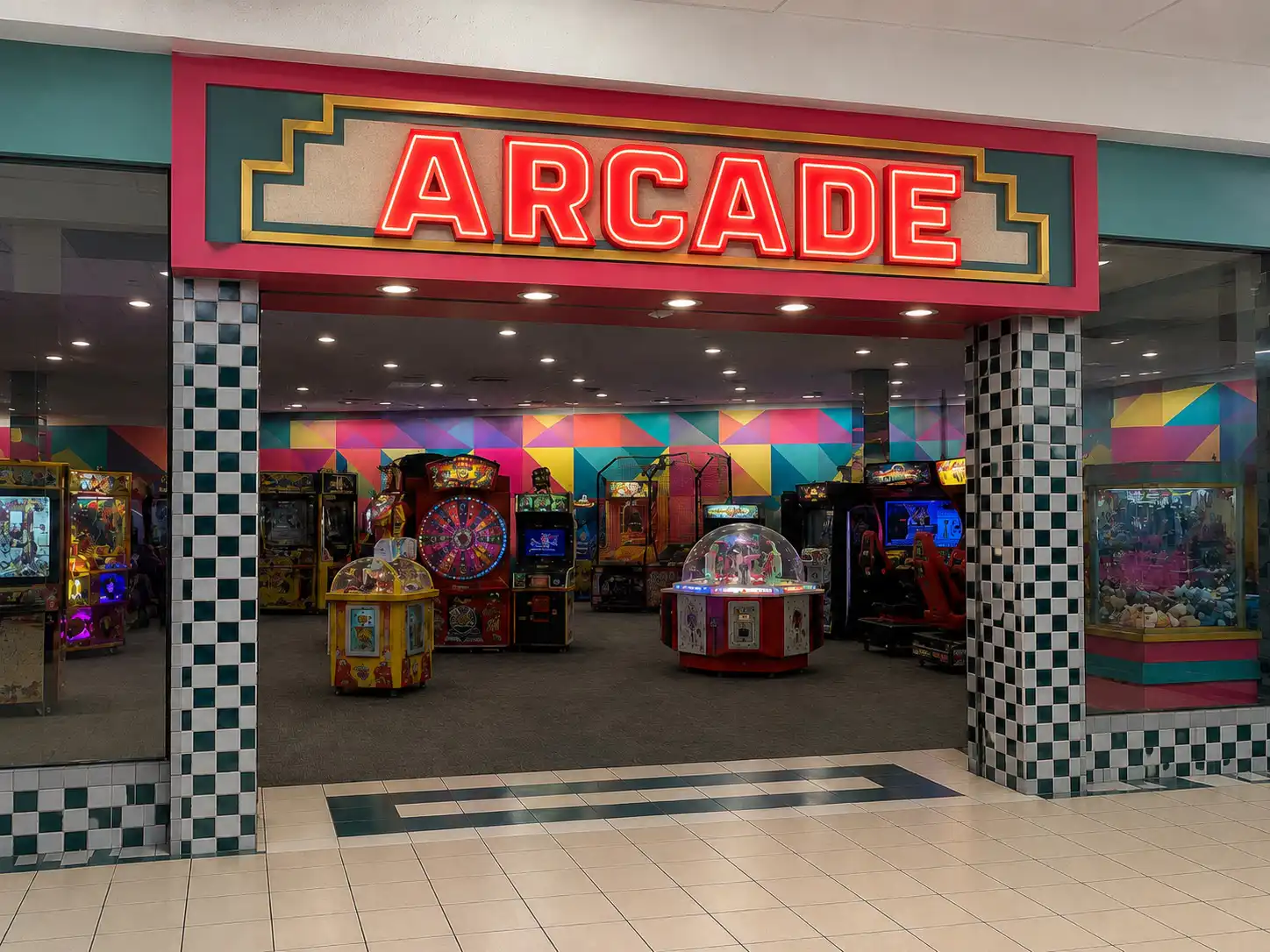


Walk through the right American mall in 2026 and the arcade glow is back. Claw-arcade chains are taking space in shopping centers, signing leases with major landlords, and selling inexpensive, social play as a reason to leave the house. CoStar has documented their expansion from niche storefronts into malls and major shopping centers. The cabinets are newer, but the proposition is familiar: quick rounds, no headset, no subscription, and a room full of strangers who came out to be around other people.
What disappears in the comeback story is the format underneath it. Decades before “experiential retail” became a leasing category, a Chicago-area operator named Jules Millman helped turn the arcade from a suspect corner business into a supervised, carpeted tenant that a mall developer could approve and replicate. Aladdin’s Castle did not merely sell access to games. It sold permission. The cabinets were the attraction. The controlled room around them was the product.
How the Mall Arcade Became a System
In the late 1960s, Millman was working for Chicago coin-op distributor World Wide Distributors when the growth of enclosed shopping malls caught his attention. RePlay Magazine places his first mall arcade around 1969 at Dixie Square Mall in Harvey, Illinois, and credits him within the amusement industry as a creator of the mall-arcade format.
The first room matters less than the system Millman built around it. Arcade historian Keith Smith, drawing on period trade reporting, describes Millman as frustrated by an industry that often made money without disciplined promotion, attentive staffing, or inviting locations. His alternative was a dedicated arcade with carpeting, deliberate lighting, full-time attendants, and rules against smoking and eating. The idea was to make the game room feel maintained, visible, and governable.
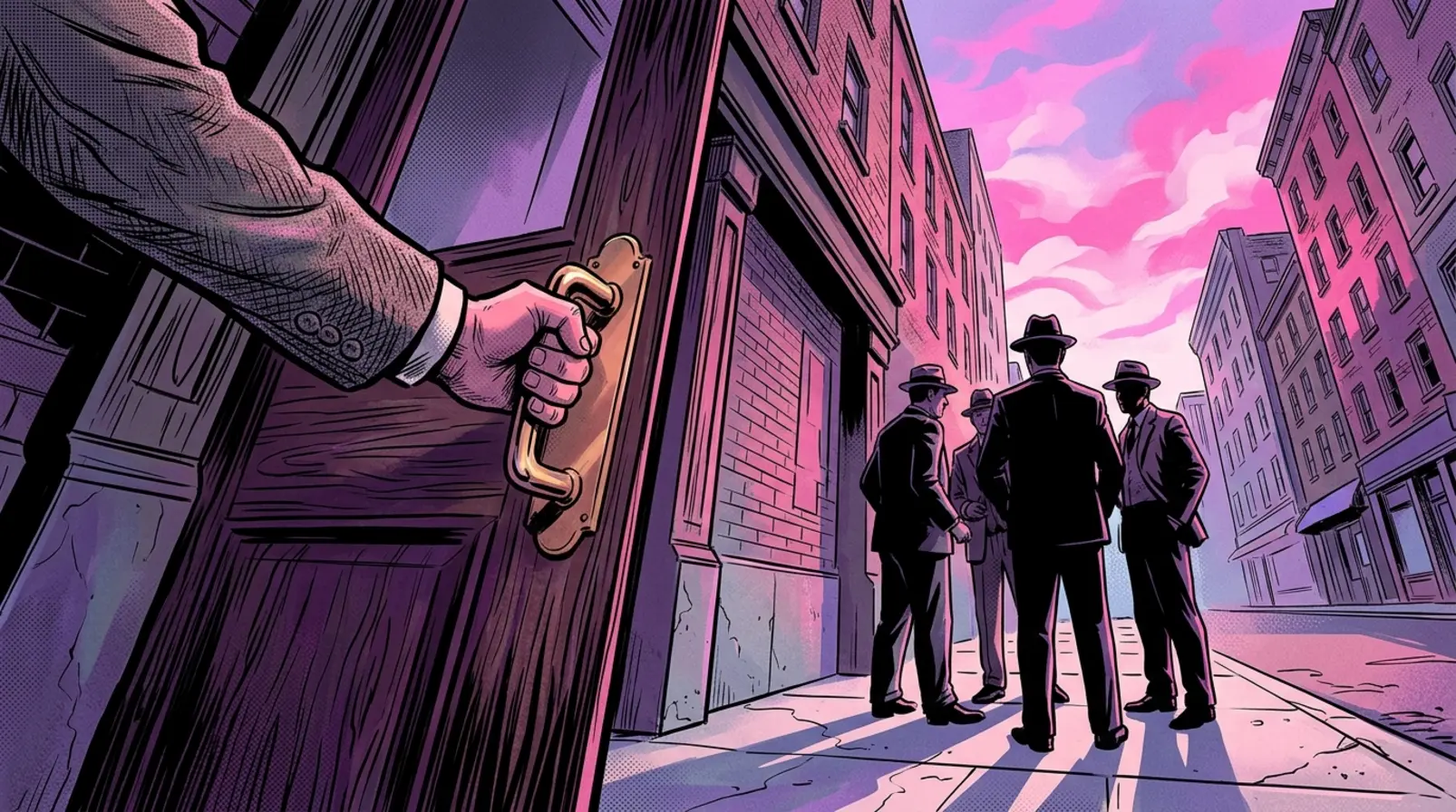
That was not just an aesthetic decision. It was risk management. Mall operators feared that arcades would become magnets for troublesome teenagers, so Millman’s pitch reversed the anxiety: the kids were already in the mall, and a supervised game room gave them somewhere controlled to gather. Later court records described Aladdin’s Castle centers as adult-supervised spaces with company rules against loitering, gambling, smoking, and the consumption of food or drink. Those operating rules were substantial enough to become part of the legal record.
The room was designed for two audiences at once: children who wanted games and adults who wanted control.
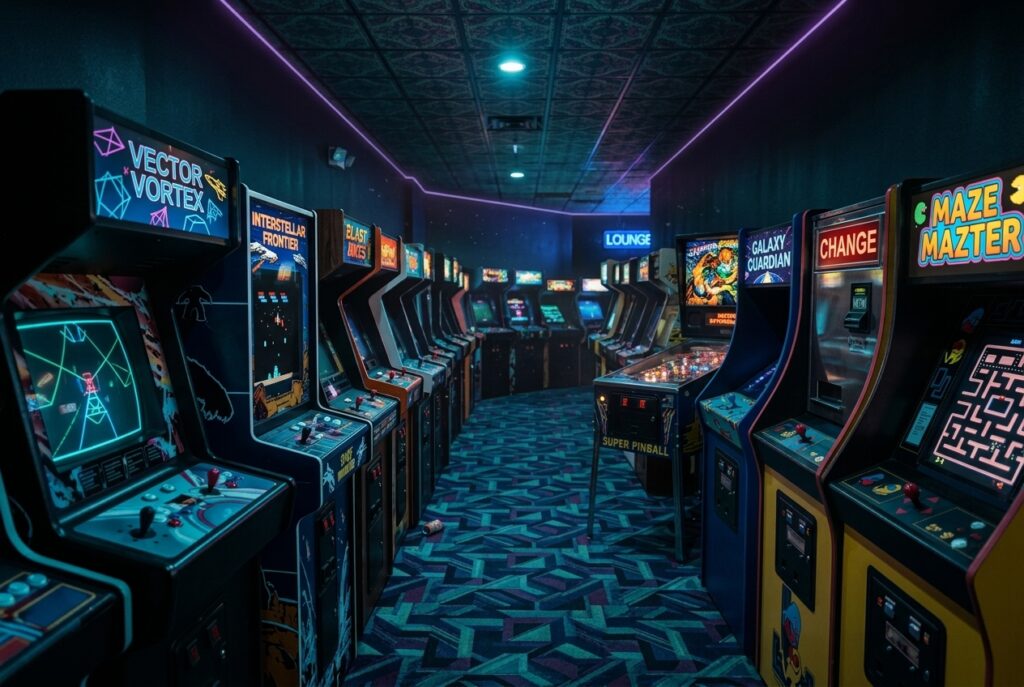
The carpet, lighting, and full-time staff were not decoration. They were the landlord pitch.
Bally Buys the System, Then Scales It
By April 1974, American Amusements had grown to roughly thirty locations. The surviving paper trail around American Amusements, Bally subsidiary Carousel Time, and the early use of the Aladdin’s Castle name is not perfectly clean. Period trade reports assembled by Smith nevertheless establish the core sequence: Bally acquired American Amusements, combined its operations with Carousel Time, and expanded the resulting chain under the Aladdin’s Castle banner. Smith’s reconstruction puts the chain at fifty locations by the end of 1974 and seventy-five by the end of 1975.
Then the video-game boom turned the format into a national machine. Smith’s reconstruction from period trade sources places Aladdin’s Castle at 221 locations across forty-one states in 1980, generating $38 million in revenue. By 1982, the broader operation reportedly reached roughly 450 locations when related concepts such as Pin Pan Alley, Pac-Man Palace, Bally’s Great Escape, and Bally’s LeMans Fun Centers were included.
The growth was not simply a matter of filling empty storefronts with cabinets. Bally had acquired a repeatable package: games, staff, carpet, rules, promotions, and a lease. What Millman had designed as reassurance became a national retail system.
The Post-Boom Contraction
The early-1980s video-game crash is often remembered as a home-console collapse, but the broader downturn hit arcade operators too. At Aladdin’s Castle, it arrived at chain scale. According to Smith’s history, Bally closed forty-six locations in 1984, eighty-eight in 1985, and forty-seven in 1986. The contraction was severe, although the same account notes that the smaller chain recorded its strongest profitability in 1986.
The lesson was stranger than simple collapse. Aladdin’s Castle could become more efficient while becoming less culturally dominant. The company was surviving by shedding the scale that had made it visible everywhere.
In 1989, Bally announced the sale of its interest in Aladdin’s Castle to Newcastle Holdings, exiting the arcade-center business. Namco acquired Aladdin’s Castle in 1993. Bandai Namco’s official corporate history records the acquisition in 1993 and the creation of Namco Cybertainment through the merger of two U.S. group companies in 1994.
The name survived, but the company around it kept changing. The mall arcade had become a transferable corporate asset, capable of outliving its founder while slowly losing the world that had made it legible.
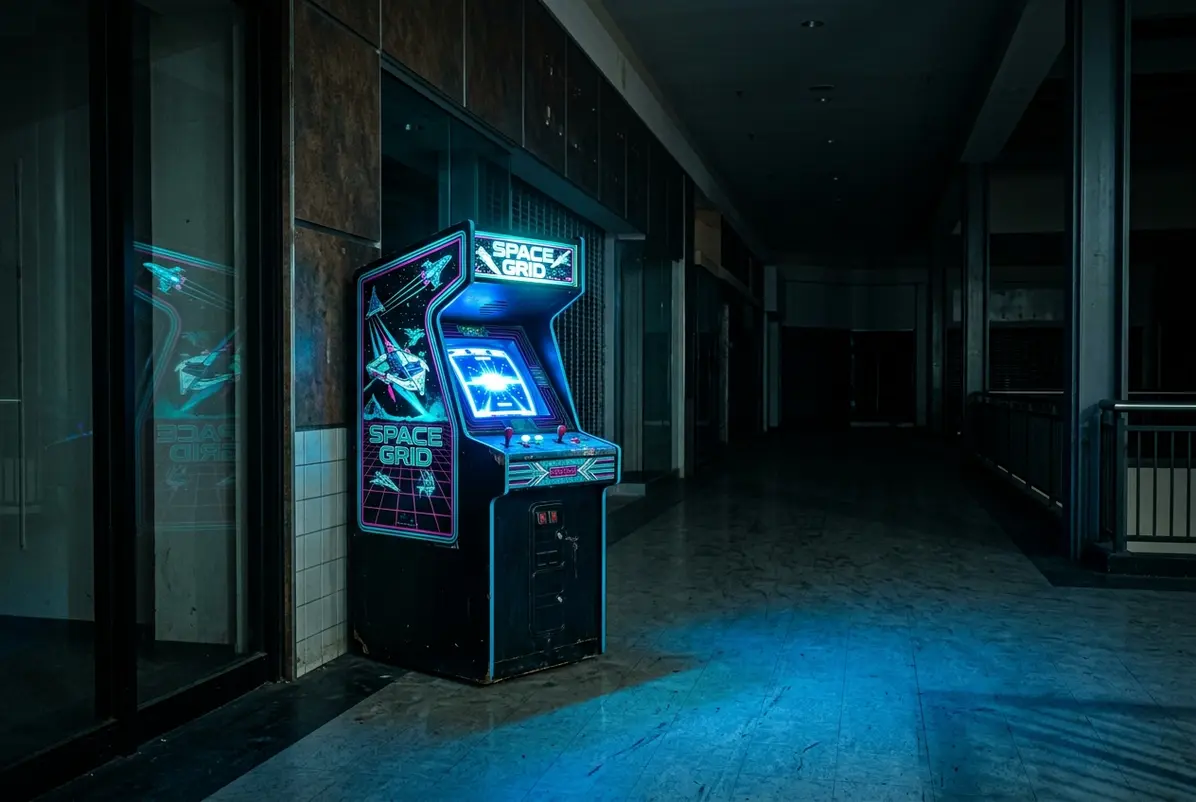
By the 2000s, the brand was surviving inside the kind of real estate it had once helped animate.
One Castle Left
The closures continued until the Aladdin’s Castle name was attached to a single arcade inside Quincy Town Center in Quincy, Illinois. Local coverage in June 2021 described the Quincy location as the last Aladdin’s Castle still operating.
Its final years unfolded during a larger corporate withdrawal. In March 2021, Bandai Namco announced that Namco USA would transfer its North American amusement-facility business and withdraw from operating those facilities. The announced transfer covered thirty-four directly owned stores, one large directly owned store, and hundreds of revenue-sharing locations.
CodeWritePlay reported in June 2022 that the Aladdin’s Castle signage in Quincy had been replaced by At The Pier Arcade branding. The later history is not a single uninterrupted rebrand. In July 2025, WGEM reported that Quarter Castle Arcade was taking over the former Aladdin’s Castle location under new owners. The current Quincy Town Center directory lists Quarter Castle as a quarter-based arcade in location 3423.
The careful conclusion is not that arcade play vanished from the building. It is that the Aladdin’s Castle name stopped labeling an operating U.S. arcade. The room survived. The sign did not.
The Idea Outlived the Real Estate
What makes the story worth retelling now is not merely that people remain nostalgic for mall arcades. It is how closely the current retail pitch echoes Millman’s original one. Modern arcade operators once again offer supervised, social, low-friction play: somewhere a customer can enter without preparation, play for ten minutes, and share a physical room with other people.
The difference is the real estate. Millman’s model fit the enclosed mall because the mall had already concentrated the foot traffic. Its descendants can now occupy a claw-arcade storefront, a bar back room, a converted warehouse, a standalone entertainment center, or a new leisure tenant inside a mall being rebuilt around something other than department stores.
Quincy itself reflects that shift. When Quincy Mall became Quincy Town Center in 2021, the property owner described a move away from the traditional shopping-center model toward a mixed-use place for shopping, dining, work, services, entertainment, and community events. Meanwhile, current retail reporting shows arcade operators returning to malls not as relics, but as tenants capable of generating visits.
Aladdin’s Castle disappeared because brands are mortal and retail formats migrate. The important thing survived: the arcade as a social machine disguised as a room full of games.
The cabinet was never the whole product. The room taught the mall how to trust it, and then outlived the mall that made it famous.

'%3e%3cg id='Final-Copy-2_2_' transform='translate(1275.000000, 200.000000)'%3e%3cpath class='st0' d='M7.4,12.8h6.8l3.1-11.6H7.4C4.2,1.2,1.6,3.8,1.6,7S4.2,12.8,7.4,12.8z'/%3e%3c/g%3e%3c/g%3e%3c/g%3e%3cg id='final---dec.11-2020'%3e%3cg id='_x30_208-our-toggle' transform='translate(-1275.000000, -200.000000)'%3e%3cg id='Final-Copy-2' transform='translate(1275.000000, 200.000000)'%3e%3cpath class='st1' d='M22.6,0H7.4c-3.9,0-7,3.1-7,7s3.1,7,7,7h15.2c3.9,0,7-3.1,7-7S26.4,0,22.6,0z M1.6,7c0-3.2,2.6-5.8,5.8-5.8 h9.9l-3.1,11.6H7.4C4.2,12.8,1.6,10.2,1.6,7z'/%3e%3cpath id='x' class='st2' d='M24.6,4c0.2,0.2,0.2,0.6,0,0.8l0,0L22.5,7l2.2,2.2c0.2,0.2,0.2,0.6,0,0.8c-0.2,0.2-0.6,0.2-0.8,0 l0,0l-2.2-2.2L19.5,10c-0.2,0.2-0.6,0.2-0.8,0c-0.2-0.2-0.2-0.6,0-0.8l0,0L20.8,7l-2.2-2.2c-0.2-0.2-0.2-0.6,0-0.8 c0.2-0.2,0.6-0.2,0.8,0l0,0l2.2,2.2L23.8,4C24,3.8,24.4,3.8,24.6,4z'/%3e%3cpath id='y' class='st3' d='M12.7,4.1c0.2,0.2,0.3,0.6,0.1,0.8l0,0L8.6,9.8C8.5,9.9,8.4,10,8.3,10c-0.2,0.1-0.5,0.1-0.7-0.1l0,0 L5.4,7.7c-0.2-0.2-0.2-0.6,0-0.8c0.2-0.2,0.6-0.2,0.8,0l0,0L8,8.6l3.8-4.5C12,3.9,12.4,3.9,12.7,4.1z'/%3e%3c/g%3e%3c/g%3e%3c/g%3e%3c/g%3e%3c/svg%3e) Your Privacy Choices
Your Privacy Choices