

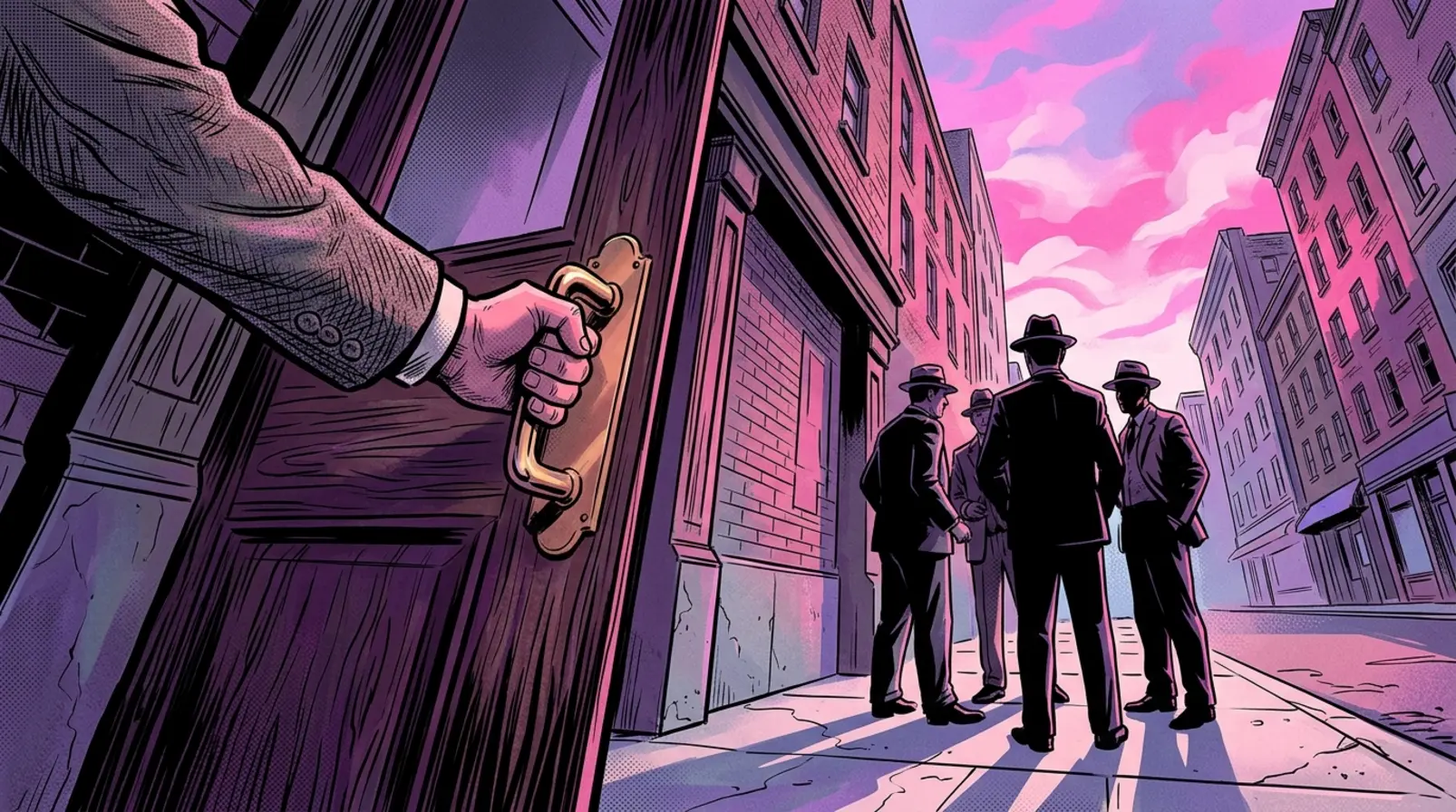

The first World Science Fiction Convention ran July 2 to 4, 1939, at Caravan Hall in New York. About 200 people attended. Six Futurians did not. Donald Wollheim, Frederik Pohl, John Michel, Robert Lowndes, Cyril Kornbluth and Jack Gillespie were refused admission after years of factional fighting among New York science-fiction fans. The argument the weekend left behind concerns the door more than the program. The surviving accounts do not produce one clean motive. They show something messier: a rule about who belongs and a grudge between factions can look much the same from the sidewalk.
Who the First Worldcon Kept Out
Sam Moskowitz chaired the convention, with William Sykora and James Taurasi forming the other two points of the organizing triumvirate. A 1944 Fancyclopedia reconstruction says the three had discussed whether the Futurians should be admitted because they feared a repeat of conflict at an earlier Newark gathering, although it says they reached no decision before the convention.
On convention morning, Wollheim, Lowndes, Kornbluth and Gillespie reached the hall first. Taurasi stopped them. Pohl and Michel arrived later. Fancyclopedia says some pushing and shoving occurred before Moskowitz came out and argued with the group for roughly fifteen minutes. Moskowitz offered admission if the Futurians promised not to do anything “to harm the progress of the Convention.” Wollheim refused that condition, while saying they could be ejected if they actually misbehaved. Ultimately all six were kept out.
The pamphlets make the episode less tidy. Fancyclopedia says Pohl and others had mimeographed material for distribution the night before. It separately describes a yellow warning pamphlet anonymously printed by David Kyle, apparently left behind a radiator and unknown to the six excluded fans. FANAC’s later summary gives a different version, saying Michel and other Futurians were distributing a brochure called A Warning when the organizers discovered it. Those accounts do not line up perfectly. What survives consistently is that anti-organizer material was circulating around the confrontation and became tangled with the decision at the door.
Inside, Kyle had been admitted. Later in the day he gained the floor on a pretext and moved that the six excluded Futurians be allowed in. According to Fancyclopedia, Sykora talked for a while and changed the subject.
Two Accounts of the Same Door
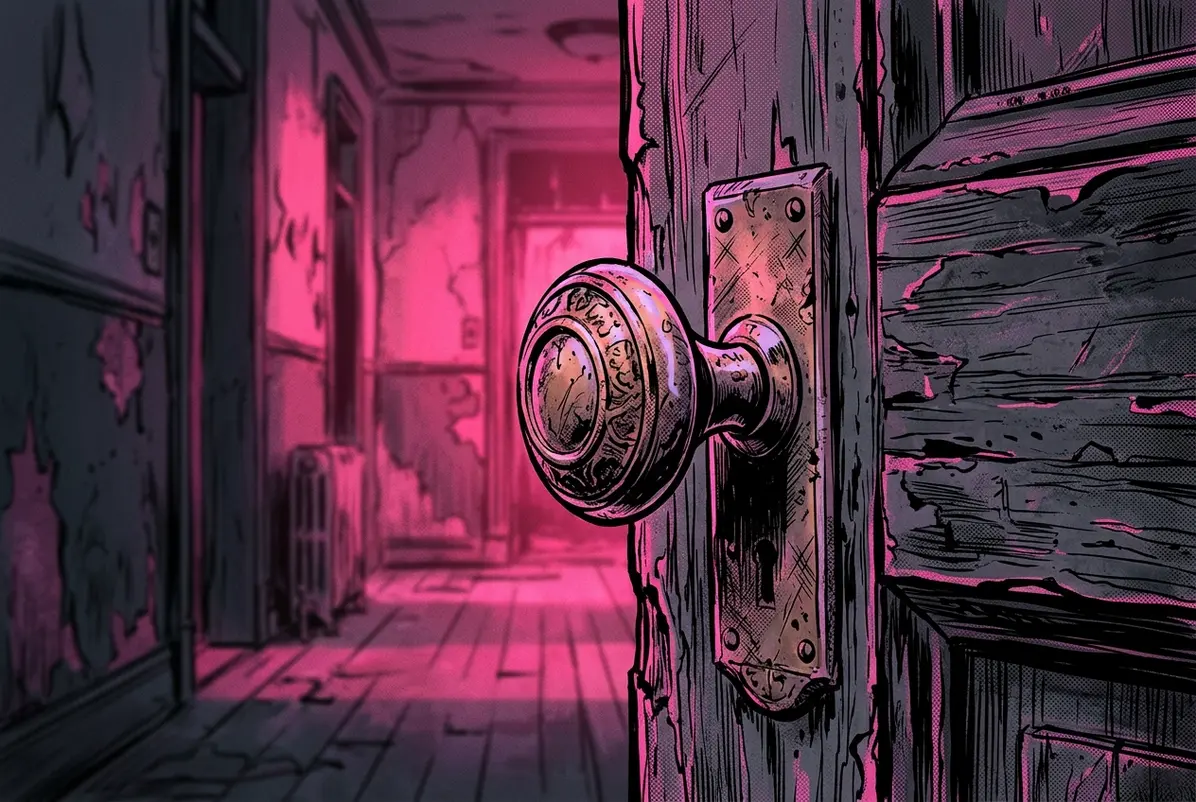
Fancyclopedia says Moskowitz finally published his side of the dispute at the Philadelphia conference that fall. He argued that the Futurians’ refusal to make the requested promise showed that they “wanted to be excluded” so exclusion could improve their strategic position in the fan feud. That was Moskowitz’s interpretation of the refusal, not an independently established motive.
Pohl remembered the fight differently in his 1978 autobiography, The Way the Future Was. He downplayed politics as the principal cause and described the conflict largely as personal. “We pretty nearly had it coming,” he wrote, adding that the Futurians had made it clear that “we thought we were better than they were.”
The explanations are not necessarily mutually exclusive. The organizers could have feared disruption while also carrying a long-running feud with the people they feared. The Futurians could have regarded the exclusion as unfair while also having spent months antagonizing the organizers. The important mechanical detail is the promise itself. It was not a convention-wide admission rule. It was a special condition imposed on one faction after the organizers had already discussed whether that faction should be admitted at all. That does not establish anyone’s private motive. It explains why later participants could look back at the same doorway and see different things.
What Outgrew the Triumvirate
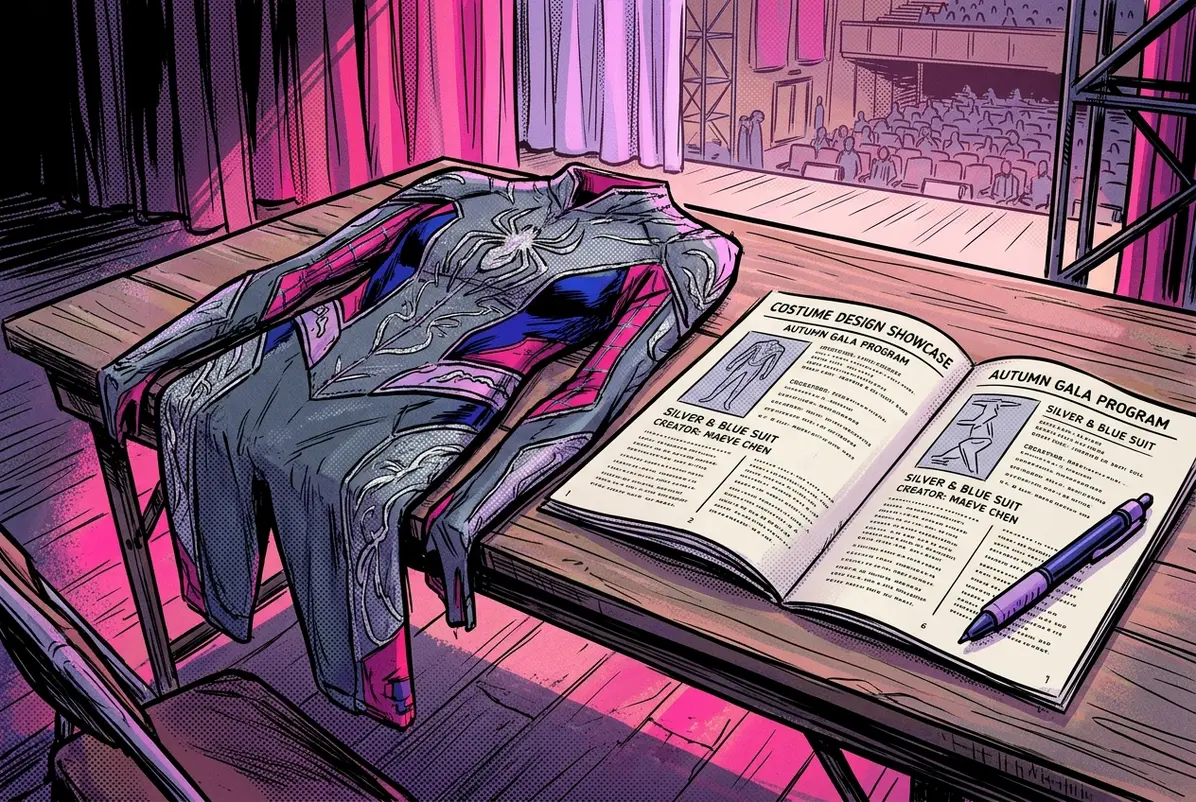
The same weekend produced a tradition that escaped the dispute entirely. Forrest J. Ackerman and Myrtle Douglas attended in costumes Douglas had made. The International Costumers’ Guild later recognized Ackerman as the “Father of Convention Costuming” in 1994 and Douglas as its “Mother” in 2016.
The first Worldcon also ended without a plan for another world convention. In October 1939, Mark Reinsberg and Erle Korshak traveled to the Philadelphia Conference to propose a second one in Chicago. During a business meeting, the proposal was approved by raised hands. The second Worldcon followed in Chicago in 1940.
The machinery for choosing future Worldcons eventually became much more formal. Under the current World Science Fiction Society constitution, the location and committee are chosen two years in advance by eligible WSFS members of the administering Worldcon. LAcon V, the 84th Worldcon, ran August 27 to 31, 2026, in Anaheim. Its Los Angeles bid had been the sole filed bidder for 2026 and received 452 of 531 votes cast in the 2024 site selection.
That system distributes one kind of authority: a small organizing trio no longer simply decides where the next Worldcon will go. Members vote. But site selection and admission are different problems, and a ballot for the next city does not answer what happens when someone at the current convention is treated as a threat.
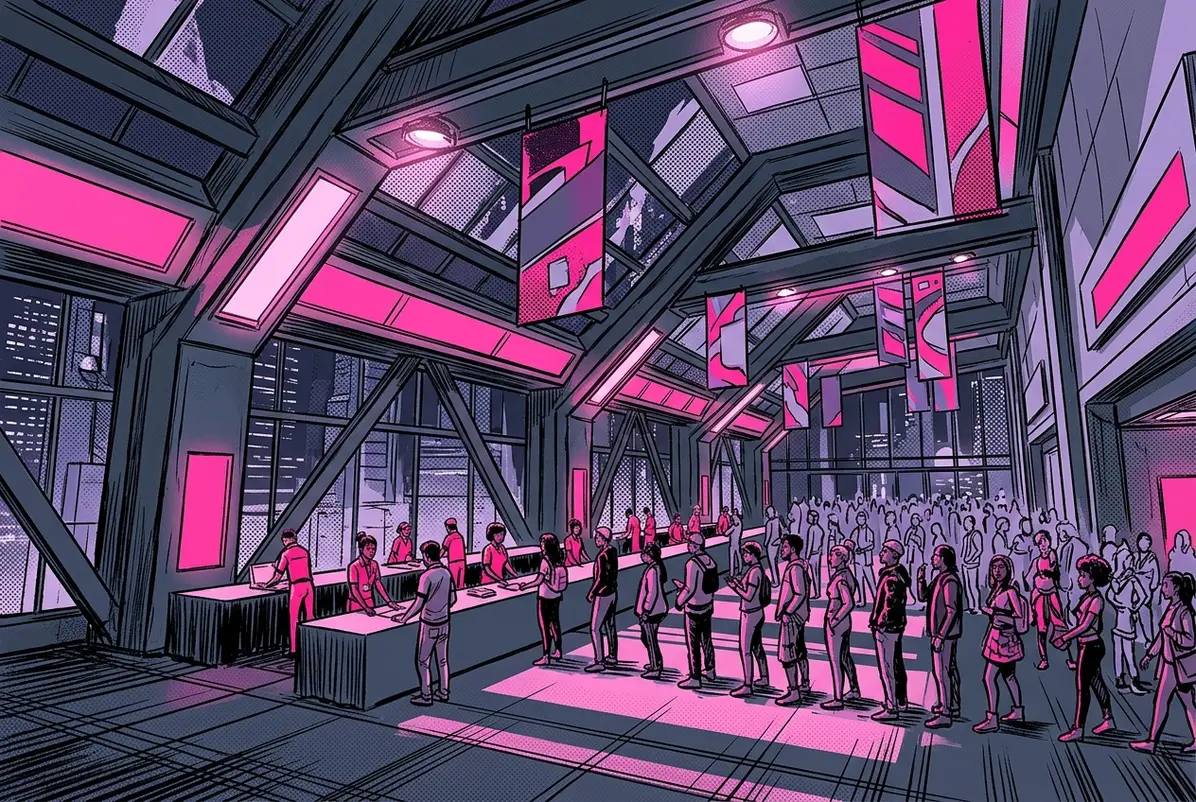
The first Worldcon’s door fight never produced a neat rule to inherit. It left something less comfortable. Once a small community has already decided that another faction might cause trouble, even an apparently simple condition at the entrance carries the history that produced it. By the time someone is asked to promise not to harm the room, the argument over who belongs inside has already begun.


'%3e%3cg id='Final-Copy-2_2_' transform='translate(1275.000000, 200.000000)'%3e%3cpath class='st0' d='M7.4,12.8h6.8l3.1-11.6H7.4C4.2,1.2,1.6,3.8,1.6,7S4.2,12.8,7.4,12.8z'/%3e%3c/g%3e%3c/g%3e%3c/g%3e%3cg id='final---dec.11-2020'%3e%3cg id='_x30_208-our-toggle' transform='translate(-1275.000000, -200.000000)'%3e%3cg id='Final-Copy-2' transform='translate(1275.000000, 200.000000)'%3e%3cpath class='st1' d='M22.6,0H7.4c-3.9,0-7,3.1-7,7s3.1,7,7,7h15.2c3.9,0,7-3.1,7-7S26.4,0,22.6,0z M1.6,7c0-3.2,2.6-5.8,5.8-5.8 h9.9l-3.1,11.6H7.4C4.2,12.8,1.6,10.2,1.6,7z'/%3e%3cpath id='x' class='st2' d='M24.6,4c0.2,0.2,0.2,0.6,0,0.8l0,0L22.5,7l2.2,2.2c0.2,0.2,0.2,0.6,0,0.8c-0.2,0.2-0.6,0.2-0.8,0 l0,0l-2.2-2.2L19.5,10c-0.2,0.2-0.6,0.2-0.8,0c-0.2-0.2-0.2-0.6,0-0.8l0,0L20.8,7l-2.2-2.2c-0.2-0.2-0.2-0.6,0-0.8 c0.2-0.2,0.6-0.2,0.8,0l0,0l2.2,2.2L23.8,4C24,3.8,24.4,3.8,24.6,4z'/%3e%3cpath id='y' class='st3' d='M12.7,4.1c0.2,0.2,0.3,0.6,0.1,0.8l0,0L8.6,9.8C8.5,9.9,8.4,10,8.3,10c-0.2,0.1-0.5,0.1-0.7-0.1l0,0 L5.4,7.7c-0.2-0.2-0.2-0.6,0-0.8c0.2-0.2,0.6-0.2,0.8,0l0,0L8,8.6l3.8-4.5C12,3.9,12.4,3.9,12.7,4.1z'/%3e%3c/g%3e%3c/g%3e%3c/g%3e%3c/g%3e%3c/svg%3e) Your Privacy Choices
Your Privacy Choices