



The concrete walls that once enclosed Santiago’s Baquedano monument came down in September. On Saturday, November 28, 2026, one of those walls will return in a different form: 50 screen prints made from a single photograph, each altered by a different graffiti writer.
The exhibition is called Desmonumentar. It runs from 6 to 11 p.m. at Estudio Mural, Santo Domingo 2276, in Santiago’s Barrio Brasil. Admission is free, and the participating artists come from Chile, Argentina, Brazil and Venezuela.
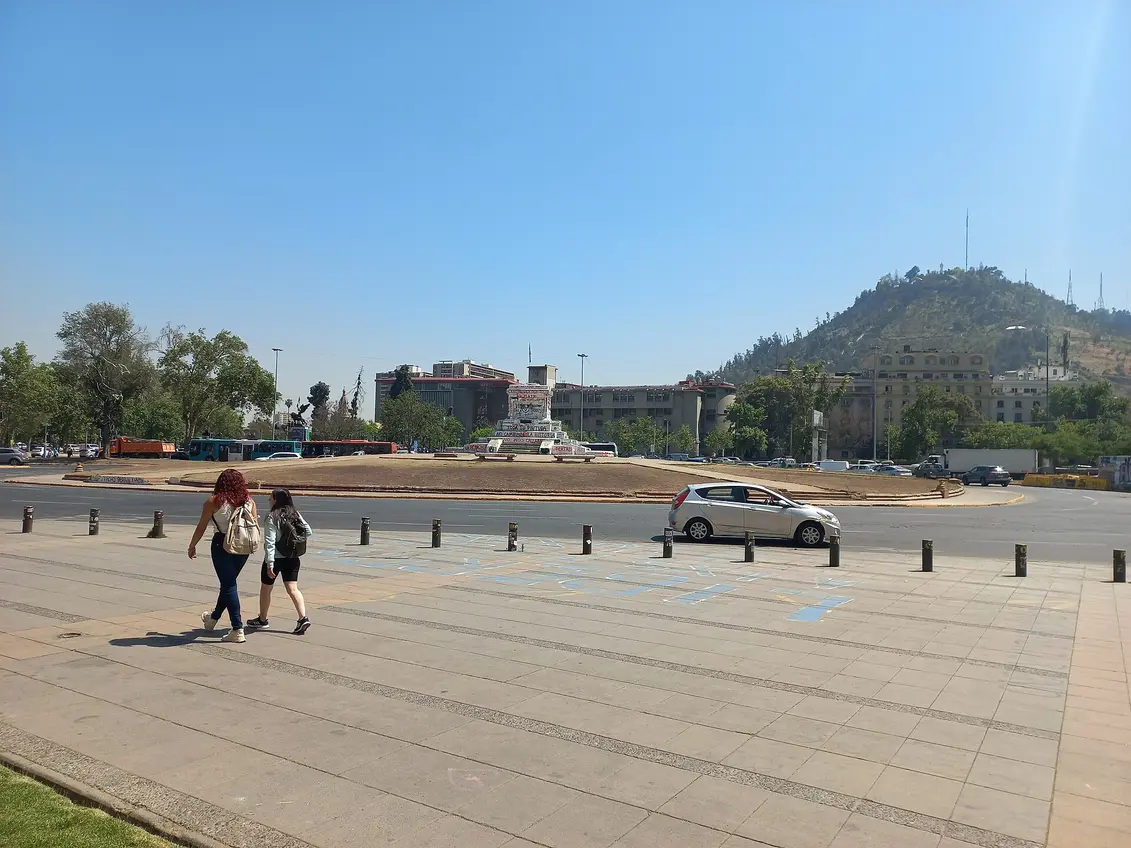
The original scene no longer exists. The equestrian statue of General Manuel Baquedano returned to its pedestal on March 10, 2026. Workers removed the surrounding concrete walls on September 17, although some safety fencing remained that day. Seventy-two days later, the enclosure will be back, multiplied across sheets of paper and covered with writing.
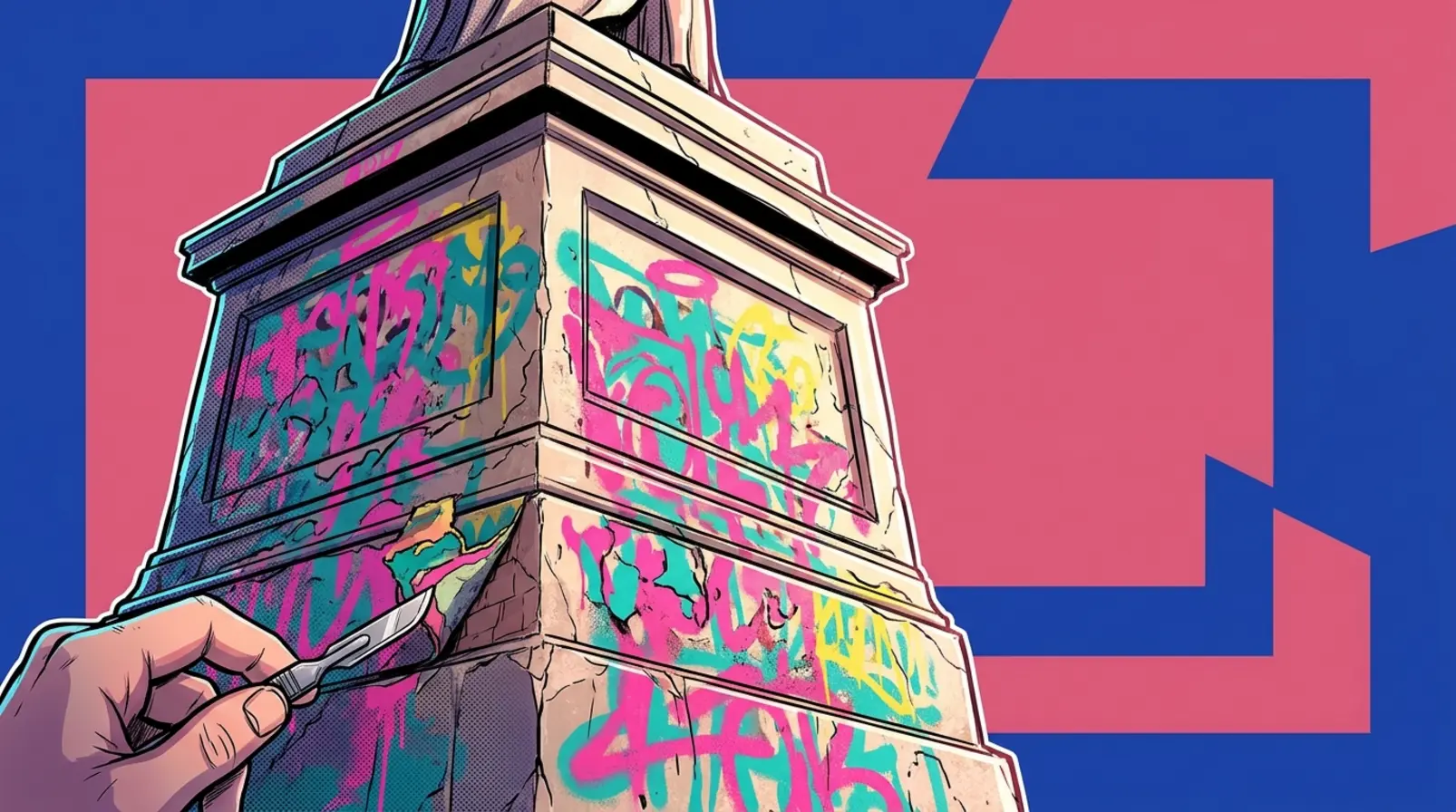
Twenty-Three Layers Came Off the Baquedano Plinth With Scalpels
The monument was inaugurated on September 18, 1928, in the roundabout that remains one of Santiago’s most recognizable public spaces. The complete work rises 10.4 meters, combining bronze sculptures by Virginio Arias with a stone pedestal designed by Gustavo García Postigo, according to the National Monuments Council’s January 2026 record.
That location became central to the demonstrations that erupted across Chile in October 2019. Protesters began calling the roundabout Plaza de la Dignidad, and the statue became a recurring surface for flags, paint and political messages. Demonstrators climbed its pedestal and repeatedly targeted the bronze figure of Baquedano on his horse.
By March 2021, the four-ton statue had been scratched, burned, painted and draped with protest flags. Attempts to topple it included using saws to cut through the structure, the Associated Press reported at the time.
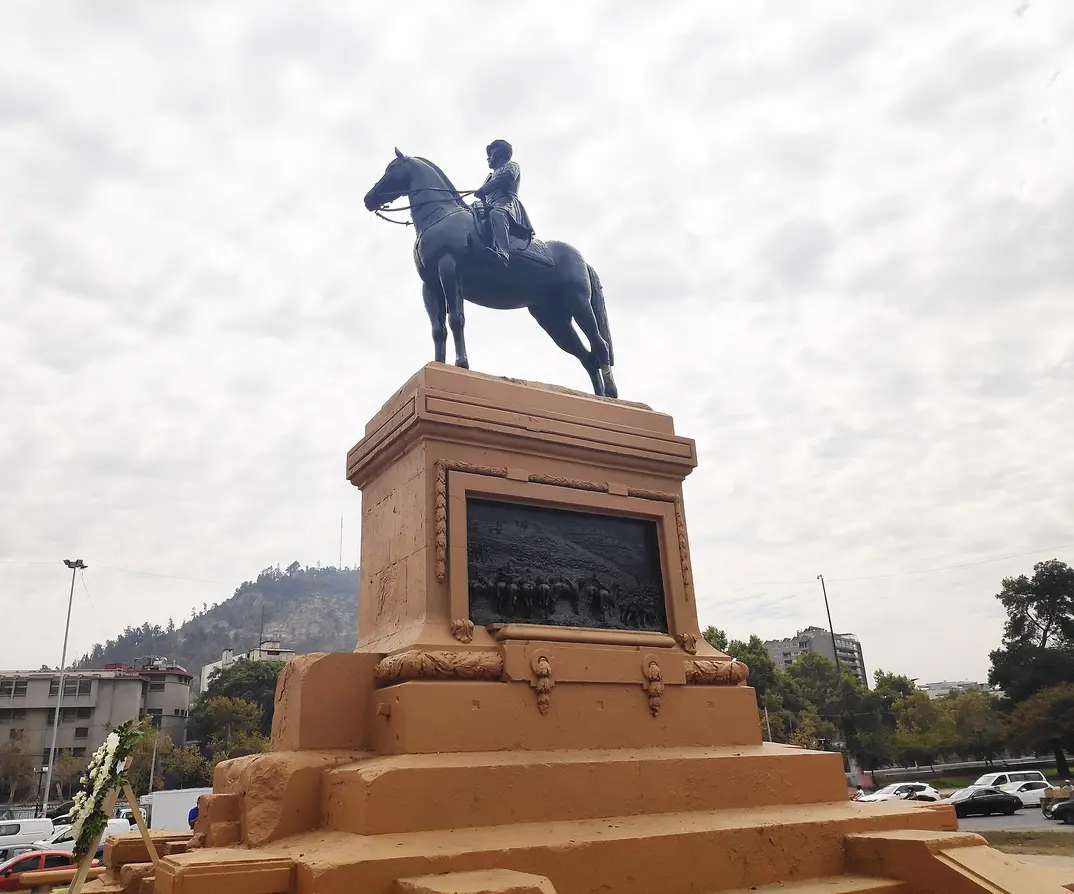
The National Monuments Council authorized the statue’s temporary removal on March 10, 2021. Crews carried out the operation over March 11 and 12. The stone pedestal remained in the plaza, while the bronze underwent restoration and eventually spent several years at the Museo Histórico y Militar. The empty plinth was later enclosed behind a protective wall.
Restoring the pedestal was a substantial job of its own. A team of roughly ten conservators spent four months removing 23 accumulated layers of paint and other material from the stone. Working for Massardo y Principios Patrimonio, they used scalpels and steam to recover the original green-gray surface of the andesite, which had been quarried near Talca. Some traces of the damage were deliberately left visible rather than removing more original material.
The restored surface received an anti-graffiti treatment intended to make subsequent cleaning easier. The objective was conservation, but it also introduced a practical difference between the plinth’s old and new lives: future writing should be easier to remove.
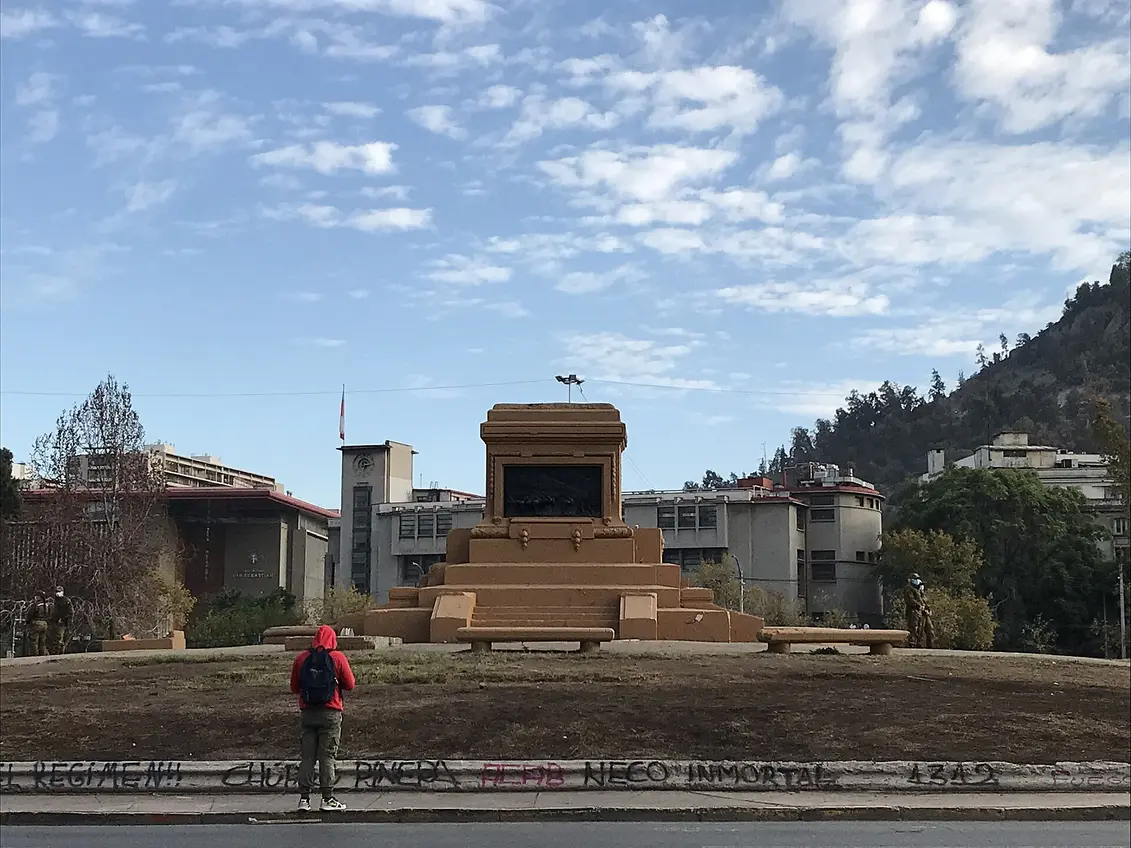
Even after the horse and rider returned, the monument remained incomplete. As of late October 2026, six bronze elements still required restoration, including the Chorrillos and Miraflores battle reliefs, La Gloria, El Centinela and elements associated with the Tomb of the Unknown Soldier. Providencia launched a campaign seeking 180 million Chilean pesos to finish the work.
A Photograph of the Baquedano Wall Became the Blank Sheet
While the statue was absent, Ignacio Rodríguez of Taller Bomboykajas photographed the enclosed pedestal with a guard standing beside the wall. He converted the photograph into a halftone image for screen printing, reproducing it in two ink colors on assorted papers measuring 35 by 45 centimeters.
Each invited graffiti writer received the same composition. Rather than being given an entirely blank sheet, the artists were asked to use the concrete wall inside the photograph as the surface for their interventions. The guard, the enclosure and the surrounding scene remained fixed. The writing would change.
There is one unresolved detail about the original photograph. The exhibition’s November 19 preview dates it to 2022. In a November 25 interview, curator Oficio Erico says Rodríguez took it in 2021. Neither account explains the difference, and the photograph’s precise date remains unconfirmed.
The first artist invited to intervene a print was Juana Pérez. She wrote Dignidad across the image in her own lettering and color. Rodríguez subsequently expanded the project, inviting other graffiti writers until the collection reached 50 works in 2026. Contributors include Ayseone, Yor, Otek, Vips, Splif, Palse, Agotok, Blah and Gómes.
Making the identical image available to dozens of writers required a different kind of production from painting a wall. Rodríguez translated a photograph into printable tones, prepared the screen and reproduced the image in two colors. Different papers provided the physical surfaces for each artist’s subsequent work. The result retains the repeated architecture of the original scene while allowing the individual pieces to diverge.
There is also a change in the conditions of the act itself. In Plaza Baquedano, the enclosure was protected and watched. In Desmonumentar, the same guarded surface becomes an invitation. The artists do not have to enter the plaza or approach the actual wall. They can cover it, alter it or write across it inside the fixed boundaries of the print.
The Desmonumentar Prints Preserve a Version of the Wall
The exhibition is organized by Taller Bomboykajas, with the curatorial work handled by Colección Calígrafo and Oficio Erico. Its proposition is more specific than simply displaying graffiti in a gallery.
The prints are not archival reproductions of tags that once appeared on the actual enclosure. They are new works made on reproductions of a photograph. That distinction matters. The series documents how contemporary writers respond to a controlled public surface, rather than attempting to reconstruct every mark the original wall once carried.
In his November 25 interview, Oficio Erico described the project as an attempt to preserve the ephemeral act of street writing through screen printing. The concern is not simply keeping an image of a wall. It is recognizing graffiti as part of the social history of a place, including writing that institutions and property owners would ordinarily remove.
The contrast with the monument’s restoration is difficult to miss. Conservators spent months taking accumulated paint off the stone, then protected its surface against future marks. Rodríguez reproduced the enclosure on paper and invited 50 writers to put the marks back, in forms that could be collected, exhibited and preserved.
Colección Calígrafo plans a printed edition featuring selected works and crediting every participating artist. The organizers also hope to bring the exhibition to other spaces after its one-day Santiago presentation. Those plans would extend the life of a project built around an object that has already disappeared from the plaza.
By the time Desmonumentar opens, the concrete walls around Baquedano will have been gone for 72 days. On each 35-by-45-centimeter sheet, the enclosure still stands, the guard remains beside it, and another writer has already found a way onto the wall.
Frequently asked questions
When and where is the Desmonumentar exhibition?
Desmonumentar runs on Saturday, November 28, 2026, from 6 to 11 p.m. at Estudio Mural, Santo Domingo 2276, in Santiago's Barrio Brasil. Admission is free.
What is Desmonumentar?
It is a series of 50 screen prints made from one photograph of the enclosed Baquedano plinth with a guard beside the wall. Each print was altered by a different graffiti writer, who used the pictured concrete wall as the surface for their work.
Who organized Desmonumentar?
The exhibition is organized by Taller Bomboykajas, whose Ignacio Rodríguez took the photograph and made the prints. Curatorial work was handled by Colección Calígrafo and Oficio Erico.
What happened to the Baquedano statue in Santiago?
After it became a focus of the 2019 protests, the statue was removed for restoration in March 2021. It returned to its pedestal on March 10, 2026, and the surrounding concrete walls were removed on September 17, 2026.
How was the Baquedano plinth restored?
About ten conservators spent four months removing 23 layers of paint and other material from the andesite stone using scalpels and steam. The surface then received an anti-graffiti treatment to make future cleaning easier.
Which artists took part in Desmonumentar?
Juana Pérez was the first invited artist and wrote Dignidad across her print. Other contributors include Ayseone, Yor, Otek, Vips, Splif, Palse, Agotok, Blah and Gómes.

'%3e%3cg id='Final-Copy-2_2_' transform='translate(1275.000000, 200.000000)'%3e%3cpath class='st0' d='M7.4,12.8h6.8l3.1-11.6H7.4C4.2,1.2,1.6,3.8,1.6,7S4.2,12.8,7.4,12.8z'/%3e%3c/g%3e%3c/g%3e%3c/g%3e%3cg id='final---dec.11-2020'%3e%3cg id='_x30_208-our-toggle' transform='translate(-1275.000000, -200.000000)'%3e%3cg id='Final-Copy-2' transform='translate(1275.000000, 200.000000)'%3e%3cpath class='st1' d='M22.6,0H7.4c-3.9,0-7,3.1-7,7s3.1,7,7,7h15.2c3.9,0,7-3.1,7-7S26.4,0,22.6,0z M1.6,7c0-3.2,2.6-5.8,5.8-5.8 h9.9l-3.1,11.6H7.4C4.2,12.8,1.6,10.2,1.6,7z'/%3e%3cpath id='x' class='st2' d='M24.6,4c0.2,0.2,0.2,0.6,0,0.8l0,0L22.5,7l2.2,2.2c0.2,0.2,0.2,0.6,0,0.8c-0.2,0.2-0.6,0.2-0.8,0 l0,0l-2.2-2.2L19.5,10c-0.2,0.2-0.6,0.2-0.8,0c-0.2-0.2-0.2-0.6,0-0.8l0,0L20.8,7l-2.2-2.2c-0.2-0.2-0.2-0.6,0-0.8 c0.2-0.2,0.6-0.2,0.8,0l0,0l2.2,2.2L23.8,4C24,3.8,24.4,3.8,24.6,4z'/%3e%3cpath id='y' class='st3' d='M12.7,4.1c0.2,0.2,0.3,0.6,0.1,0.8l0,0L8.6,9.8C8.5,9.9,8.4,10,8.3,10c-0.2,0.1-0.5,0.1-0.7-0.1l0,0 L5.4,7.7c-0.2-0.2-0.2-0.6,0-0.8c0.2-0.2,0.6-0.2,0.8,0l0,0L8,8.6l3.8-4.5C12,3.9,12.4,3.9,12.7,4.1z'/%3e%3c/g%3e%3c/g%3e%3c/g%3e%3c/g%3e%3c/svg%3e) Your Privacy Choices