

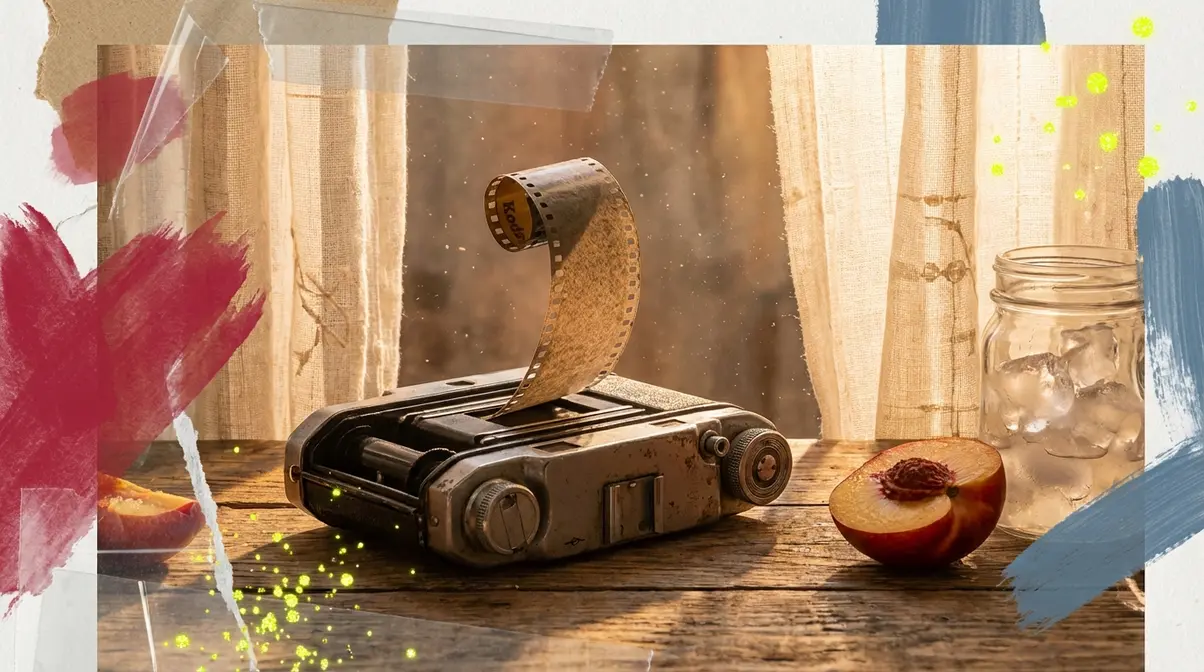

I taped the roll to my bathroom mirror in early June. Kodak Portra 400, 36 exposures, around $18-19 plus whatever developing would cost. The metal canister caught the morning light like a talisman. Or a dare.
The rules were simple: one frame per day, maximum. Some days, none at all. The roll stays in the camera until Labor Day or frame 36, whichever comes first. No do-overs, no second camera in the bag, no phone as backup. Just this.
I’m calling it 72 Frames of Grace, though I’m only shooting 36. The doubling is aspirational—each exposure needs to work twice as hard, carry twice the weight. In an era when my phone’s camera roll contains 47,000 images I’ll never look at again, the constraint feels less like limitation than relief.
The Scarcity Economy
Film photography is having what trend forecasters call “a moment,” though the numbers suggest something more durable. Kodak reported that over 20 million rolls of photographic film sold globally in 2023, a 15% jump from 2022. Leica has seen a 900 percent increase in film camera sales over eight years. These aren’t nostalgia spikes. They’re course corrections.
The Portra family—160, 400, and 800—dominates more than 40% of top posts in analog photography communities online. If you narrow it to color negative film only, that climbs past 50%. Portra 400 specifically has become shorthand for “the film look,” that ineffable quality of fine grain, neutral saturation, and skin tones that glow rather than pop. Kodak designed it originally for wedding photographers and portraitists, people who needed to beautify human subjects without making them look processed.
But there’s a backlash brewing in enthusiast forums. Some shooters argue Portra has become “just mid,” the default choice that everyone reaches for because everyone else does. Critics point out it’s the most digitally accurate color film available, which somewhat defeats the point of shooting analog. At nearly $19 per roll before development, it’s also become a luxury good in a market where Kodak Gold 200 delivers 80% of the aesthetic at 40% of the cost.
I chose it anyway. Partly for the latitude—Portra 400’s 12-stop dynamic range forgives my mistakes in ways cheaper stocks won’t. Partly for the challenge of using the most popular film in the least popular way.
The Intentionality Trap
Ask film photographers why they shoot analog in 2025, and “it makes me slow down” tops every list. The limitation of 24 or 36 frames forces deliberation. You can’t spray and pray. Each click costs roughly $1.50 when you factor in film and developing, which makes you reconsider that third angle of your coffee cup.
This narrative has become gospel in analog communities, but it deserves interrogation. Does scarcity actually breed better art, or does it just breed anxiety? Digital photographers counter, correctly, that intentionality should exist regardless of medium. You can be thoughtful with 1,000 frames or wasteful with 36. The format doesn’t determine the mindset.
Still, I notice something shift when I’m carrying the single-roll camera. It’s not just about being careful. It’s about permission to not photograph. On digital, I feel obligated to document everything remotely interesting because the cost is zero. With 36 frames for 90 days, I can walk past a dozen beautiful scenes and feel no guilt. Most moments don’t need to be captured. Most light is just light.
The photographer Bellamy Hunt noted in an interview that young people—Millennials and Gen Z—are driving the analog resurgence precisely because they grew up with infinite digital images. They’re seeking the opposite: finitude, texture, the weight of twelve to thirty-six frames in your hand. Photography becomes less about accumulation and more about curation before the fact.
What Gets Chosen
Three weeks in, I’ve shot nine frames. A friend’s hands rolling cigarettes at a rooftop party. My nephew’s profile backlit in a car window. The shadow of a fire escape at 7 a.m., coffee steam rising into the grid. Nothing Instagram would care about. Everything that mattered in the moment.
The waiting is the strangest part. With film, you don’t know how your photos turned out until you finish the roll and develop it. I won’t see any of these images until September at the earliest. By then, summer will be a memory I’m comparing against chemical evidence. The anticipation builds meaning into each shot retroactively. I remember the fire escape photo differently now because I used one of my 36 decisions on it.
This aligns with broader photography trends for 2026, which industry observers say will prioritize emotion over technical perfection. Factors like sharpness and ideal composition are taking a backseat to feeling. Light leaks, missed focus, unexpected color shifts—film teaches humility and acceptance. Sometimes the mistake is the photograph.
The One Roll Project, an annual contest celebrating analog’s “mystery and magic,” asks photographers to submit entire rolls without choosing which frame gets judged. Participants report that the unpredictability is what makes the challenge compelling, though many wish they had more photos to select from. That tension—wanting both constraint and abundance—defines the whole enterprise.
The Waiting Room
By June, I’m at frame 22. The roll is two-thirds exposed, a summer two-thirds remembered. I’ve become precious about the remaining 14 frames in ways that probably aren’t healthy. Do I save one for the last sunset? What if something better happens?
This is the part no one tells you about shooting one roll for a season: you start rationing experience itself. Not every beautiful thing gets photographed, which means not every beautiful thing gets the same quality of attention. I’m creating a hierarchy of moments in real-time, deciding what’s worth one thirty-sixth of my summer’s visual record.
Mindfulness teachers say photography can be a physical manifestation of presence—stopping, observing, framing, focusing, capturing. The practice becomes meditative when you can’t waste frames. But it can also become transactional, reducing lived experience to resource management. I’m not sure yet which side of that line I’m on.
What I do know: I’m looking more carefully. At light on water, at the geometry of ordinary rooms, at faces when they’re not performing for a lens. Whether that makes me a better photographer or just a more anxious one remains to be seen. The answer is probably on the roll, waiting in the dark.
Thirteen frames left. Forty-one days of summer. The math doesn’t quite work, which means some days will pass unrecorded. That used to feel like failure. Now it feels like the point.
'%3e%3cg id='Final-Copy-2_2_' transform='translate(1275.000000, 200.000000)'%3e%3cpath class='st0' d='M7.4,12.8h6.8l3.1-11.6H7.4C4.2,1.2,1.6,3.8,1.6,7S4.2,12.8,7.4,12.8z'/%3e%3c/g%3e%3c/g%3e%3c/g%3e%3cg id='final---dec.11-2020'%3e%3cg id='_x30_208-our-toggle' transform='translate(-1275.000000, -200.000000)'%3e%3cg id='Final-Copy-2' transform='translate(1275.000000, 200.000000)'%3e%3cpath class='st1' d='M22.6,0H7.4c-3.9,0-7,3.1-7,7s3.1,7,7,7h15.2c3.9,0,7-3.1,7-7S26.4,0,22.6,0z M1.6,7c0-3.2,2.6-5.8,5.8-5.8 h9.9l-3.1,11.6H7.4C4.2,12.8,1.6,10.2,1.6,7z'/%3e%3cpath id='x' class='st2' d='M24.6,4c0.2,0.2,0.2,0.6,0,0.8l0,0L22.5,7l2.2,2.2c0.2,0.2,0.2,0.6,0,0.8c-0.2,0.2-0.6,0.2-0.8,0 l0,0l-2.2-2.2L19.5,10c-0.2,0.2-0.6,0.2-0.8,0c-0.2-0.2-0.2-0.6,0-0.8l0,0L20.8,7l-2.2-2.2c-0.2-0.2-0.2-0.6,0-0.8 c0.2-0.2,0.6-0.2,0.8,0l0,0l2.2,2.2L23.8,4C24,3.8,24.4,3.8,24.6,4z'/%3e%3cpath id='y' class='st3' d='M12.7,4.1c0.2,0.2,0.3,0.6,0.1,0.8l0,0L8.6,9.8C8.5,9.9,8.4,10,8.3,10c-0.2,0.1-0.5,0.1-0.7-0.1l0,0 L5.4,7.7c-0.2-0.2-0.2-0.6,0-0.8c0.2-0.2,0.6-0.2,0.8,0l0,0L8,8.6l3.8-4.5C12,3.9,12.4,3.9,12.7,4.1z'/%3e%3c/g%3e%3c/g%3e%3c/g%3e%3c/g%3e%3c/svg%3e) Your Privacy Choices
Your Privacy Choices