

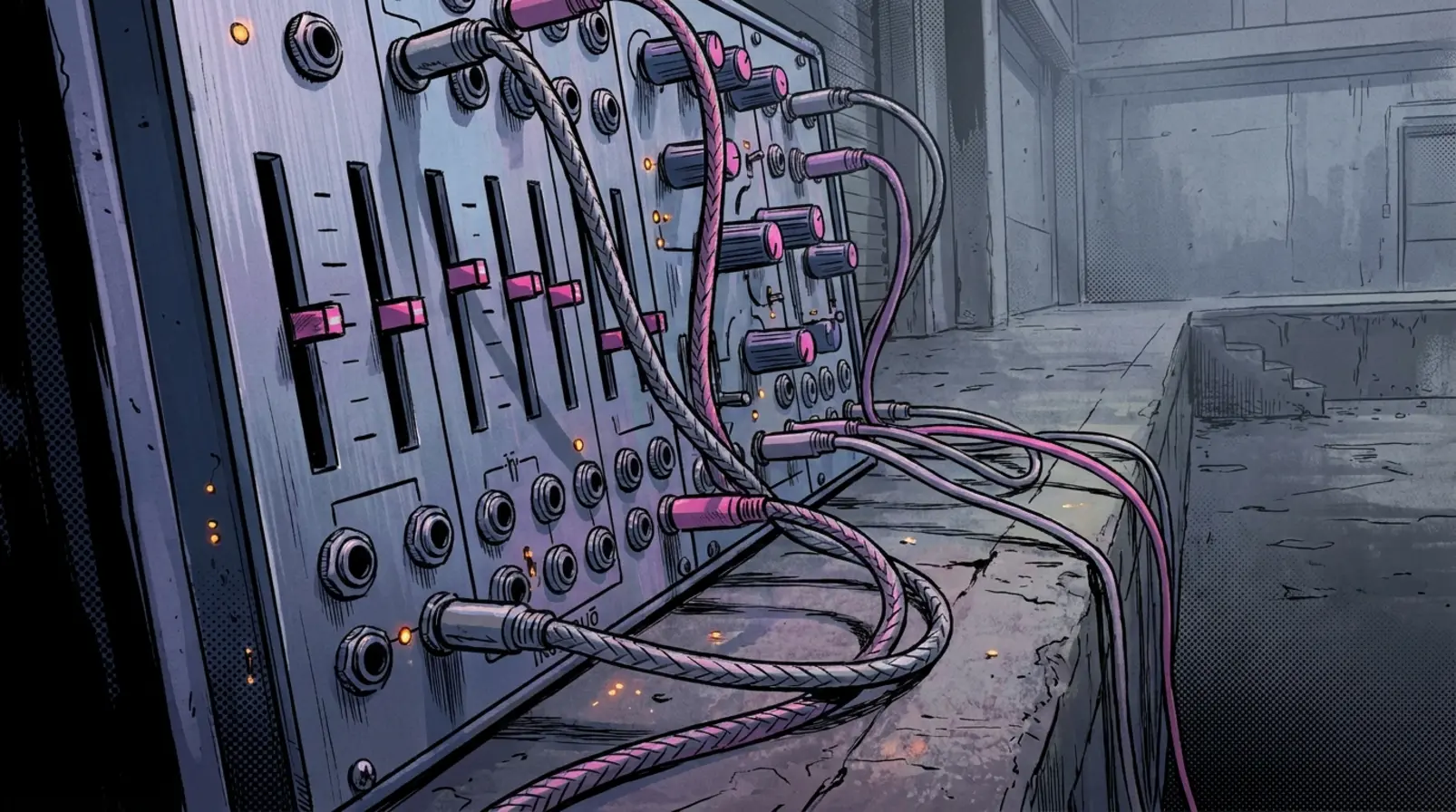


One Knob, No Screens, No Apologies
There is a module sitting in over 30,000 ModularGrid racks right now that has exactly one knob. No screen. No menu. No firmware updates. The Instruō øchd packs eight all-analogue LFOs into a convenient 4HP package, each independent core free-running with rates configured from fastest to slowest, top to bottom, with each range tuned by ear during development to give the optimum spread of control signals running in parallel. And now it has an expander that triples its output count without adding a single pixel. To me, this is one of the most quietly radical design statements in Eurorack right now.
The person responsible is Jason Lim, the Glasgow-based composer, educator, and instrument designer who founded Instruō. Lim trained as a classical violinist from the age of nine, self-taught bass guitar starting at thirteen when he acquired the instrument that belonged to his grandfather, James “Dinky” Spence, a Shetlander who played piano, bass, and trumpet. In 2009, he graduated from Perth College UHI’s popular music performance course and shortly after won a scholarship to Berklee College of Music as a guitar player. The path from highland strings to soldering iron was not a straight line, but it feels like it was always heading somewhere strange and specific.
Instruō, as Lim has explained in Sound on Sound, “was an unexpected restart after a pretty abrupt change of employment back in 2015.” He was actively studying more traditional analogue circuits and designed his Troika Triple Oscillator module, which became the original Instruō product. At first, he said in Disquiet, “it was me alone in the spare bedroom.” By 2024 the operation had grown to a team of 20 people, with Lim’s goal always being to function as a creative co-op. They actively profit-share from the product range, and developers retain personal ownership of what they create.
The Module That Breathes
The øchd arrived in 2019, designed in collaboration with Ben “DivKid” Wilson, and quickly set a standard for compact and versatile modulation sources visible across thousands of Eurorack systems. What strikes me about the øchd is how aggressively it refuses to be complicated. It’s a 4HP module with eight analogue triangle LFOs, outputs running fast at the top to slow at the bottom, deliberately not synced, free-running LFOs tuned by ear to be musically useful. Being 100% analogue, the LFOs phase organically with the ability to ebb and flow together with their global control.

Ben Wilson, the module’s co-designer, put it simply on his own site: “I often find I need more modulation, simple sources that will keep things moving and stop things getting repetitive. That’s why ochd was brought to life, to keep patches organically drifting and moving.” There’s a case to be made that this is the purest articulation of what Eurorack modulation should be: invisible complexity, fingertip simplicity.
To put the øchd’s popularity in context, according to Modular Bias, it was in over 30,200 ModularGrid racks, while Mutes, DivKid’s next most popular module, sat in just over 8,300. That’s not a gap. That’s a canyon. Lim’s overarching design philosophy, as he told Perfect Circuit, is to “design selfishly.” He explained: “It might sound oddly negative, but it’s something I embraced quite early on… I always try to design for myself. The module or instrument has to be something I personally want to play with.”
Twenty-Four Sources, Zero Screens
Then came the expander. Launched at ØCHD-OBER-FEST, an in-person event at Signal Sounds in Glasgow held by DivKid and Instruō , the øchd expander ([ø]4²) is a piece of engineering that reads like a deliberate provocation. An expansion module for one of Eurorack’s most beloved modulation sources, it adds 16 outputs and four new sets of functionality. Using øchd’s LFOs as signal sources, the expander provides full wave rectified unipolar positive LFOs, analogue diode logic for minimum and maximum voltage mixing, cascaded stochastic trigger signals for rhythmic patterns, and R-2R 4-bit random voltage sources for chaos.
The expander is available for $109 / £99. It draws just 5mA at +12V and -12V, in a 4HP, 32mm-deep package. In my view, the price and power draw alone are a statement: you can flood your rack with 24 modulation sources across 8HP total, and you never have to scroll, tap, or squint at a tiny OLED.
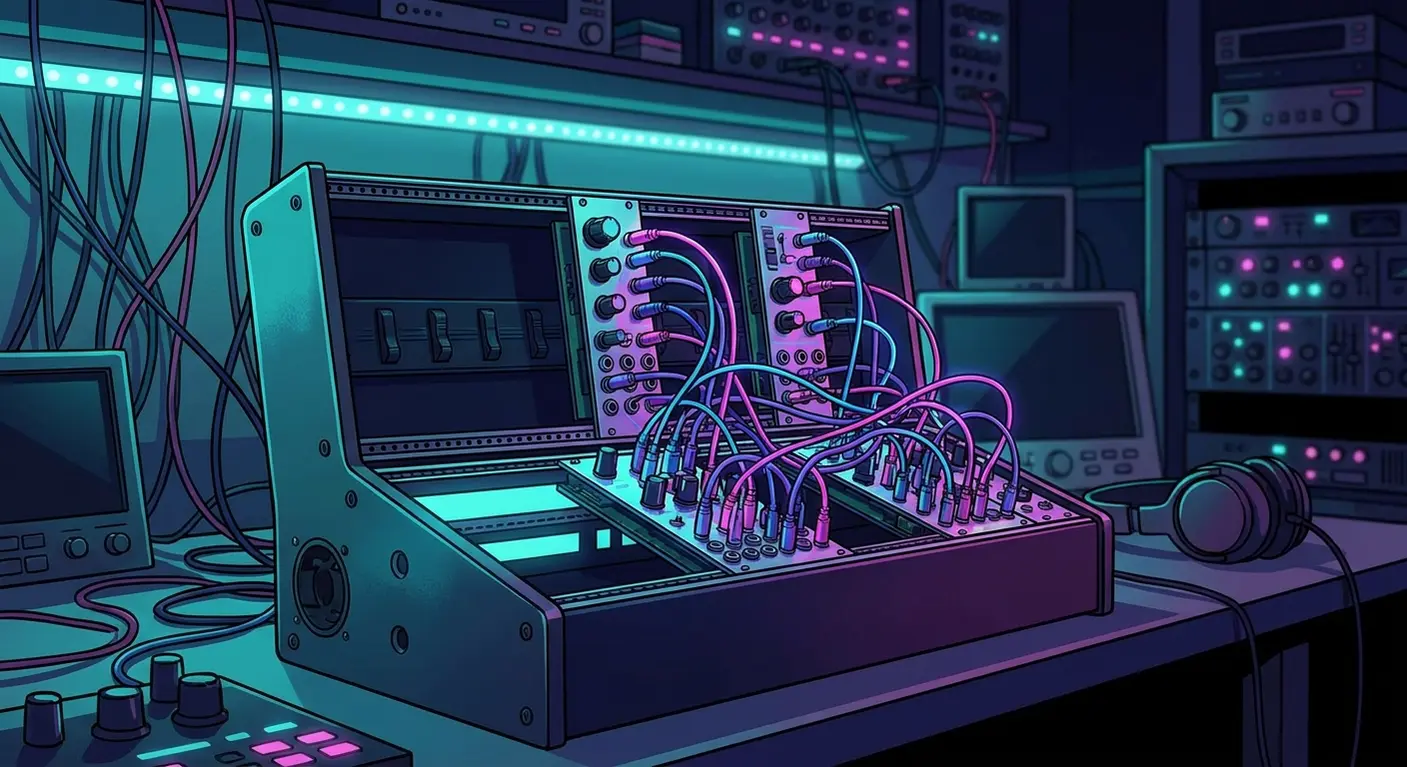
The community response was immediate and passionate. On forums, users called it “an instant buy” and expressed surprise at the creative direction. All outputs are derived from combinations of the eight analogue triangle LFO cores to produce what Instruō describes as flavours of “slow noise.” Perfect Circuit noted that the analogue diode logic section is “not to be confused with boolean or CMOS logic that would only generate on/off gate signals” but rather a Serge Peak & Trough-style approach great for creating complex modulation signals. It feels like the kind of module a circuit-obsessed engineer dreams up at 2 AM and a pragmatic product manager would normally kill before breakfast. Instruō shipped it anyway.
The Tension That Matters
Here’s where I need to be honest about the framing. Jason Lim has not declared a literal war on OLEDs. He has not issued manifestos against screens. His design choices speak for themselves, but the man is more nuanced than a headline. He’s said directly in Disquiet that many of his module designs are hybrid, using combinations of analogue cores with digital interfaces, and that future concepts would be “digital at their core but the interface will remain fundamentally analogue.” His newest product, the Seashell, is a semi-modular desktop synth that combines tactile analog hardware with deep digital control via an intuitive software interface. Its total recall functionality works with high-resolution 14-bit digital control over analog circuitry. And yet, even Seashell’s design omits a display entirely.
The broader tension is real, though, and it runs through the entire Eurorack ecosystem. As the design blog Horizontal Pitch observed: “While some car manufacturers keep moving more and more stuff to giant touch screens, musicians have been interacting with machines through tactile interfaces since electronic music was invented.”
My take is that the øchd and its expander represent something specific: proof that analog circuit design can still deliver density, surprise, and musical depth without defaulting to a screen. As Horizontal Pitch put it: “There is an inherent problem with anything electronic, be it analogue or digital: whatever happens in the circuit, or the software, is completely invisible and impalpable.” The øchd makes the invisible audible through eight jacks and one knob. The expander triples the vocabulary without adding a syllable of interface overhead.

Selfish Design as Radical Act
There’s a line Lim said on a Synth Design Podcast episode in 2022 that I keep coming back to. He described Instruō as operating “more like a music label than a conventional synth manufacturer.” I think that framing explains the øchd expander better than any spec sheet. A conventional manufacturer would have added a screen, a sync input, maybe an app. A music label puts out the weird thing its artists actually want to use, and trusts the audience to meet it there.
The no-sync debate is a perfect example. The øchd’s LFOs have no sync input. The default ranges are deliberately not synced. These are free-running LFOs tuned by ear to be musically useful. Organic animation, drifting, and musical phasing is the intention of the module. Some users wanted clock sync. Reasonable people might disagree, but to me, adding sync would have made the øchd a different instrument entirely. It would have traded its essential character for a checkbox feature.
The expander extends this philosophy without compromise. The cascading triggers section analyzes the rising edges of the left-side LFOs to create trigger signals, and if you leave the upper outputs unpatched, they normalize downward to create merged stochastic rhythms. It reads like a module that rewards curiosity over configuration. You don’t program it. You discover it.
It feels like Lim and Wilson understood something that a lot of the Eurorack world is still catching up to: the best interface for modulation is no interface at all. Just outputs. Just voltage. Just the slow, beautiful drift of analog circuits doing what analog circuits do when you stop trying to control them. That’s not a war on screens. It’s something quieter and more lasting. It’s a commitment to the idea that hands on jacks and knobs will always tell you more than eyes on pixels.

'%3e%3cg id='Final-Copy-2_2_' transform='translate(1275.000000, 200.000000)'%3e%3cpath class='st0' d='M7.4,12.8h6.8l3.1-11.6H7.4C4.2,1.2,1.6,3.8,1.6,7S4.2,12.8,7.4,12.8z'/%3e%3c/g%3e%3c/g%3e%3c/g%3e%3cg id='final---dec.11-2020'%3e%3cg id='_x30_208-our-toggle' transform='translate(-1275.000000, -200.000000)'%3e%3cg id='Final-Copy-2' transform='translate(1275.000000, 200.000000)'%3e%3cpath class='st1' d='M22.6,0H7.4c-3.9,0-7,3.1-7,7s3.1,7,7,7h15.2c3.9,0,7-3.1,7-7S26.4,0,22.6,0z M1.6,7c0-3.2,2.6-5.8,5.8-5.8 h9.9l-3.1,11.6H7.4C4.2,12.8,1.6,10.2,1.6,7z'/%3e%3cpath id='x' class='st2' d='M24.6,4c0.2,0.2,0.2,0.6,0,0.8l0,0L22.5,7l2.2,2.2c0.2,0.2,0.2,0.6,0,0.8c-0.2,0.2-0.6,0.2-0.8,0 l0,0l-2.2-2.2L19.5,10c-0.2,0.2-0.6,0.2-0.8,0c-0.2-0.2-0.2-0.6,0-0.8l0,0L20.8,7l-2.2-2.2c-0.2-0.2-0.2-0.6,0-0.8 c0.2-0.2,0.6-0.2,0.8,0l0,0l2.2,2.2L23.8,4C24,3.8,24.4,3.8,24.6,4z'/%3e%3cpath id='y' class='st3' d='M12.7,4.1c0.2,0.2,0.3,0.6,0.1,0.8l0,0L8.6,9.8C8.5,9.9,8.4,10,8.3,10c-0.2,0.1-0.5,0.1-0.7-0.1l0,0 L5.4,7.7c-0.2-0.2-0.2-0.6,0-0.8c0.2-0.2,0.6-0.2,0.8,0l0,0L8,8.6l3.8-4.5C12,3.9,12.4,3.9,12.7,4.1z'/%3e%3c/g%3e%3c/g%3e%3c/g%3e%3c/g%3e%3c/svg%3e) Your Privacy Choices
Your Privacy Choices