


ShortBox was a Yorkshire-based independent comics publisher founded in 2016 by critic-turned-curator Zainab Akhtar, known for its quarterly boxes of original, commissioned small-press comics. It closed its physical publishing operations on February 29, 2024, citing unsustainable international shipping costs and post-Brexit economics. Its closure marked the end of a wave of acclaimed micropublishers that shaped indie comics in the 2010s.
ShortBox’s Origins: From Comics Criticism to Curation
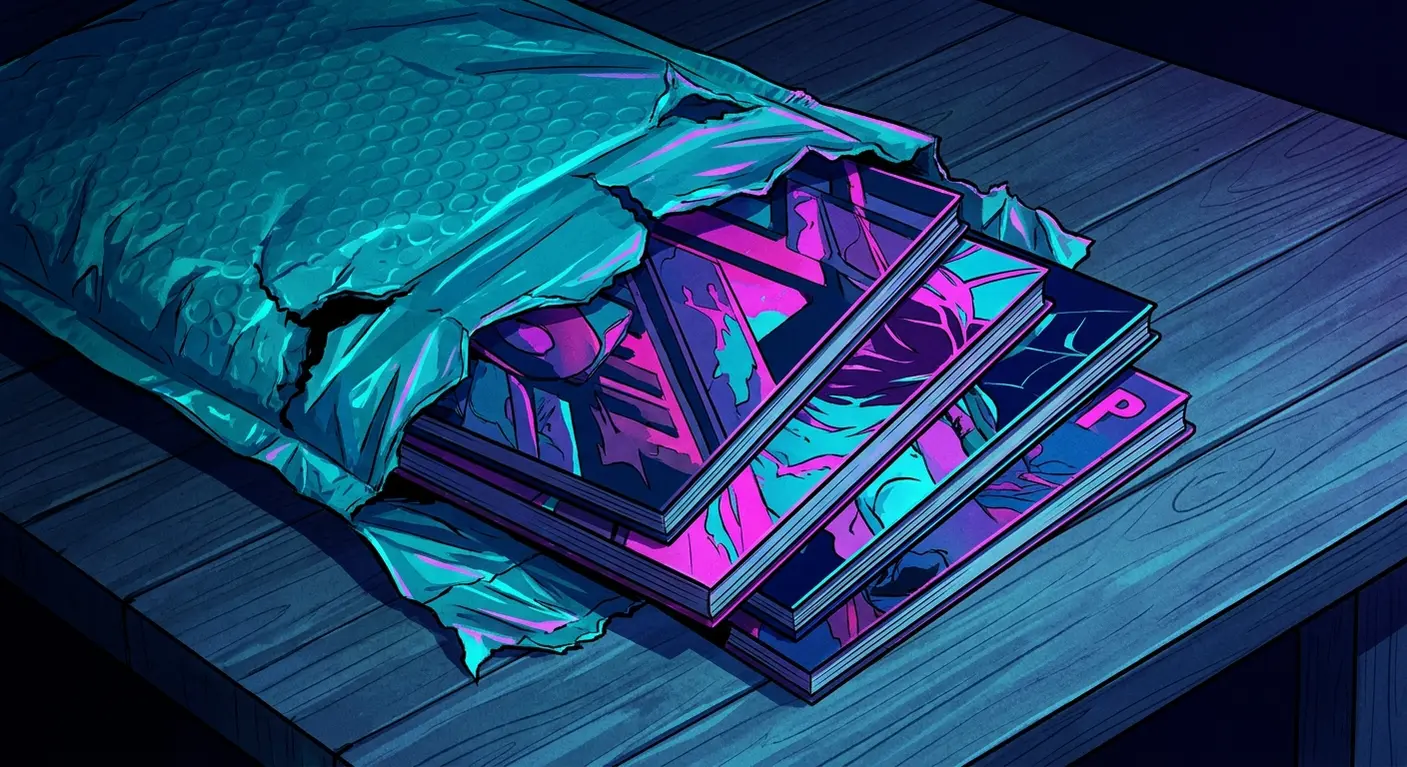
Akhtar ran the fantastic comics site, Comics and Cola, for five years before she closed up shop in April 2016. ShortBox was a quarterly box of independent comics and goodies that was founded and curated by Zainab Akhtar in collaboration with Thought Bubble’s Assistant Director Clark Burscough. The concept was disarmingly simple: five new, standalone comics per box, each commissioned specifically for ShortBox readers, packed in a teal padded envelope and shipped worldwide.
What strikes me is how quickly ShortBox became the most talked-about incubator in indie comics. As Popverse noted, years before they made their mark with projects at places like First Second, IDW Publishing, Drawn & Quarterly, or Farrar, Straus and Giroux, ShortBox was releasing work by creators including Emily Carroll, Aminder Dhaliwal, James Stokoe, and Rosemary Valero-O’Connell. As The White Space observed, among ShortBox’s many great achievements, one can easily add the discovery of the brilliant talent of Rosemary Valero-O’Connell, who gained recognition with this title and the previous What is Left, earning nominations for the Eisner and Ignatz Awards.
Production values were strikingly high for a one-person operation. As Matt Reads Comics documented, ShortBox’s print, binding, and paper qualities truly were some of the best encountered, especially for each book’s price. For example, at roughly $18, Don’t Go Without Me is perfect-bound, has multiple instances of gold embossing, and is printed on firm paper. In my view, Akhtar was running a boutique publishing house disguised as a subscription box, and that tension between ambition and scale is exactly what made it unsustainable.
What Killed ShortBox: Shipping, Brexit, and the Math That Didn’t Work
The economics were brutal and specific. Akhtar detailed the numbers publicly when she announced the end of the curated box in May 2021. Shipping a single box to North America cost £22, not including labor, packaging, or payment processing. The most she had previously charged for international shipping was £14. The box itself had held at £35 for five years. Raising the price to £38 would have meant asking customers to pay £60 total for a box of five short comics. The two reasons she cited were insane, ever-increasing international shipping prices and the rising costs of Brexit.
As the books grew in page count and physical thickness, they crossed a postal threshold. What had once shipped as a “large letter” at roughly £10 worldwide now qualified as a “small parcel” at around £22. That single reclassification was devastating. COVID compounded things: the cancellation of conventions and festivals wiped out a third of ShortBox’s 2020 expected income.
As Popverse reported, ShortBox’s closure wasn’t a shock; Akhtar actually announced that she would be winding down the publishing side of the company back in 2022, in order to concentrate on the annual ShortBox Comics Fair. In 2022, she announced on Twitter that she would be winding down ShortBox by the end of 2023. In February 2024, the small British publisher ShortBox officially closed its doors.
The Record-Breaking Funeral: ShortBox’s Final Kickstarter
There is a bitter irony that online comics communities have chewed over extensively. As Bleeding Cool reported, Zainab Akhtar’s final curated box of newly published small-press comic books ShortBox may be its most popular yet, approaching a thousand box pre-orders on Kickstarter. The final campaign closed with 1,441 backers pledging £68,116, far exceeding the £22,000 goal.
It feels like the cruelest possible validation. The audience existed. The demand was real. It simply wasn’t consistently activated until the closing-sale sign went up. This pattern is sickeningly familiar to anyone who has watched an independent record shop, a repertory cinema, or a zine distro announce its final day and suddenly find the line around the block.
A Systemic Extinction, Not an Isolated Closing
ShortBox’s end didn’t happen in a vacuum. Between 2018 and 2022, a cluster of the most critically respected micropublishers in comics all shut down within months of each other. In 2018, Koyama Press announced its intent to cease operations in 2021. Annie Koyama, a former film producer, founded her company in 2007, using money she had earned from investing in the stock market to publish works by various indie creators, including Michael DeForge, Jesse Jacobs, Rokudenashiko, and Julia Wertz. When explaining her decision, Koyama was direct: “But that money ran out about four years ago. I didn’t play the stock market again because I’m not risking what I have now… I don’t have unlimited resources.”
Peow Studio, founded in 2012 by Elliot Alfredius, Olle Forsslöf and Patrick Crotty in Stockholm, Sweden, announced its closure in June 2021. The loss of Peow acts as yet another wake-up call about the continued fragility and stresses of micropublishing. AdHouse Books, the award-winning and much admired small press run by Chris Pitzer, closed after 100 books published and 20 years in business. Pitzer acknowledged that Kickstarter might have kept AdHouse alive, but told The Comics Beat: “for some reason, I could never make the switch. It always felt like my putting my hand out and asking for alms.”
To me, the pattern is unmistakable. Four publishers. Four different countries. Four different funding models. All gone within three years. What they shared was a position in the ecosystem that no longer exists: too big to be zines, too small to be Fantagraphics, too good to compromise on production quality, and too principled to exploit their creators.
The Broader Cost Crisis Crushing Indie Comics
The structural forces that killed ShortBox are accelerating across the industry. For the past 12 years, standard 32-page comic titles were priced at $3.99, with some titles still at $2.99. But prices have been steadily rising; more than half of all new comics in 2024 cost $4.99, with some going up a dollar or two more. On the production side, Vault Comics CEO Damian Wassel told The A.V. Club that “the U.S. went through this massive run of paper plant consolidation and shutdowns. Then COVID happened, and comics sales skyrocketed in 2021, but nobody could get paper for them so costs went up. You’ve got some printers charging close to or more than 100% more than they charged in 2018.”
Meanwhile, creator pay hasn’t kept pace. As The Comics Beat’s Heidi MacDonald documented, people still get paid $150 per page for pencils, the same rate as 20 years ago. Using an inflation calculator, $150 in 2005 would be $240.93 in 2024. That’s how much earning power comics makers have lost. My take is that the indie middle class is being squeezed from both ends: printing costs going up, page rates staying flat, and the audience fragmenting across an overwhelming number of titles.
The ShortBox Comics Fair: Digital Survival, or Something More?
Akhtar didn’t disappear. She pivoted. The ShortBox Comics Fair, which she launched in October 2020 as a response to COVID lockdowns, has become what she has called “the biggest digital comics fair in the world.” The model is elegant: every October, over a hundred handpicked artists debut brand-new digital comics on the ShortBox Comics Fair website. For the 2025 fair, there were 1,975 applications, from which 183 artists were offered places, resulting in 145 final comics and exhibitors. Artists retain full ownership of their work and receive 100% of sales minus payment processing fees. There are no table fees for artists, and in 2023, the fair reportedly generated $400,000 in sales.
There’s a case to be made that the Fair is actually a purer expression of Akhtar’s curatorial vision than the physical boxes ever were. It strips away the shipping nightmare, the warehouse problem (at one point, a new release could mean 4,500 books stacked in her living room), and the postal bracket math. What remains is taste, curation, and connection. As The Comics Journal’s Hagai Palevsky wrote in his 2023 review: “I’d be hard-pressed to find someone doing a stronger, more confident job than Zainab Akhtar.”
But Akhtar revealed she’d be taking 2026 off from the ShortBox Comics Fair. She deserves the rest. The entire operation, as SKTCHD’s David Harper has noted, is run by Akhtar alone: submissions, curation, site management, promotion, all of it. Reasonable people might disagree about whether a digital-only future can fully replace what physical ShortBox offered, but the Fair’s survival depends on one person’s stamina and goodwill, and that is itself a structural fragility.
Who Fills the Gap Now?
Popverse’s Graeme McMillan put it bluntly in his February 2024 opinion piece: “The failure at the heart of ShortBox’s closure isn’t ShortBox’s, nor Akhtar’s, I hasten to add — it’s ours, as readers, as fans, and as people who love the comics medium: that more of us didn’t support ShortBox as a publisher enough, didn’t support new creators and talent enough.”
I think McMillan is half right. The audience bears some responsibility. But the real failure is structural. When a one-person publisher in Yorkshire can’t ship a £35 box to Brooklyn without losing money, that’s not a taste problem. That’s a trade policy problem, a logistics problem, and a market-design problem. Akhtar did everything right. She found the talent. She made the objects beautiful. She priced them fairly. She paid her creators. And the math still didn’t work.
What’s left behind is a gap shaped exactly like ShortBox, Koyama, Peow, and AdHouse. Bigger publishers will continue to absorb some of the talent these imprints discovered. The ShortBox Comics Fair will continue to surface new voices. But the physical incubator model, the place where a debut cartoonist gets a perfect-bound book with gold embossing and a global audience, feels like it belongs to a window that has closed. By our reckoning, the indie comics middle class didn’t die of a single wound. It was bled out by a thousand incremental cost increases, each one too small to protest and too large to absorb.
Frequently Asked Questions About ShortBox’s Closure
What was ShortBox and who ran it?
ShortBox was founded in 2016 by former critic Zainab Akhtar and was based in Yorkshire, England. It was a quarterly box of independent comics and goodies, curated by Akhtar in collaboration with Thought Bubble’s Assistant Director Clark Burscough. Each box contained five new, standalone comic books commissioned exclusively for ShortBox readers.
Why did ShortBox close?
Akhtar cited two primary reasons: spiraling international shipping costs and the added expenses of Brexit. Shipping a single box to North America cost £22 before any labor or packaging was factored in, making the £35 box price unsustainable. COVID-era convention cancellations also eliminated a third of the publisher’s expected 2020 income.
Is the ShortBox Comics Fair still running?
ShortBox Comics Fair, the innovative digital comics fair showcasing all-new, original comics from artists around the globe, hit its fifth year in 2025. However, Akhtar revealed she’d be taking 2026 off from the ShortBox Comics Fair. The Fair’s website confirms it will return in 2027.
What other indie comics publishers closed around the same time?
Koyama Press announced its closure in 2018 and ceased operations in 2021. Peow Studio announced its end in June 2021, and AdHouse Books closed after 20 years in July 2021. ShortBox ended its physical publishing in February 2024. All four publishers were critically acclaimed and operated with skeleton staffs.
Which notable creators got their start through ShortBox?
ShortBox published early or breakthrough work by Emily Carroll, Aminder Dhaliwal, James Stokoe, Rosemary Valero-O’Connell, Joe Sparrow, and many others. Valero-O’Connell won the Ignatz Award for Outstanding Artist and then took home Eisner Awards for Best Teen Publication and Best Penciller/Inker in 2020.
How much did ShortBox’s final Kickstarter raise?
1,441 backers pledged £68,116 to help bring the final ShortBox to life , far exceeding its £22,000 goal. It was the most successful ShortBox campaign ever, a fact that underscores the bittersweet nature of its closure.

'%3e%3cg id='Final-Copy-2_2_' transform='translate(1275.000000, 200.000000)'%3e%3cpath class='st0' d='M7.4,12.8h6.8l3.1-11.6H7.4C4.2,1.2,1.6,3.8,1.6,7S4.2,12.8,7.4,12.8z'/%3e%3c/g%3e%3c/g%3e%3c/g%3e%3cg id='final---dec.11-2020'%3e%3cg id='_x30_208-our-toggle' transform='translate(-1275.000000, -200.000000)'%3e%3cg id='Final-Copy-2' transform='translate(1275.000000, 200.000000)'%3e%3cpath class='st1' d='M22.6,0H7.4c-3.9,0-7,3.1-7,7s3.1,7,7,7h15.2c3.9,0,7-3.1,7-7S26.4,0,22.6,0z M1.6,7c0-3.2,2.6-5.8,5.8-5.8 h9.9l-3.1,11.6H7.4C4.2,12.8,1.6,10.2,1.6,7z'/%3e%3cpath id='x' class='st2' d='M24.6,4c0.2,0.2,0.2,0.6,0,0.8l0,0L22.5,7l2.2,2.2c0.2,0.2,0.2,0.6,0,0.8c-0.2,0.2-0.6,0.2-0.8,0 l0,0l-2.2-2.2L19.5,10c-0.2,0.2-0.6,0.2-0.8,0c-0.2-0.2-0.2-0.6,0-0.8l0,0L20.8,7l-2.2-2.2c-0.2-0.2-0.2-0.6,0-0.8 c0.2-0.2,0.6-0.2,0.8,0l0,0l2.2,2.2L23.8,4C24,3.8,24.4,3.8,24.6,4z'/%3e%3cpath id='y' class='st3' d='M12.7,4.1c0.2,0.2,0.3,0.6,0.1,0.8l0,0L8.6,9.8C8.5,9.9,8.4,10,8.3,10c-0.2,0.1-0.5,0.1-0.7-0.1l0,0 L5.4,7.7c-0.2-0.2-0.2-0.6,0-0.8c0.2-0.2,0.6-0.2,0.8,0l0,0L8,8.6l3.8-4.5C12,3.9,12.4,3.9,12.7,4.1z'/%3e%3c/g%3e%3c/g%3e%3c/g%3e%3c/g%3e%3c/svg%3e) Your Privacy Choices
Your Privacy Choices