


The Successful Inconvenience
The DeepComputing RISC-V mainboard is a bad laptop upgrade in the exact way it needs to be.
That sounds like an insult. It is closer to the point. The board is not fast enough to make Intel nervous. It is not polished enough to make AMD irrelevant. It does not turn the Framework Laptop 13 into some sudden open-hardware utopia. It asks the user to tolerate soldered memory, MicroSD or eMMC storage, a young software stack, and the kind of boot-media weirdness that makes normal people close the lid and go outside.
But the board matters because it exists where it should not yet exist: inside a polished, repairable, consumer-grade laptop chassis. It turns the Framework ecosystem into something more radical than an upgrade path. It turns the laptop into an argument about who gets to make the processor at the center of a personal computer.
The issue is not whether the first Framework-compatible RISC-V board is a good daily-driver laptop. Framework’s own product page says the DeepComputing RISC-V Mainboard is targeted at developers, tinkerers, and early adopters, warns that performance and peripheral capabilities are limited, and recommends waiting for future RISC-V products if someone wants a consumer-ready experience.
That caveat is not a footnote. It is the thesis.
This is not a failed consumer laptop board. It is a successful inconvenience.
How RISC-V Got Inside the Framework Laptop
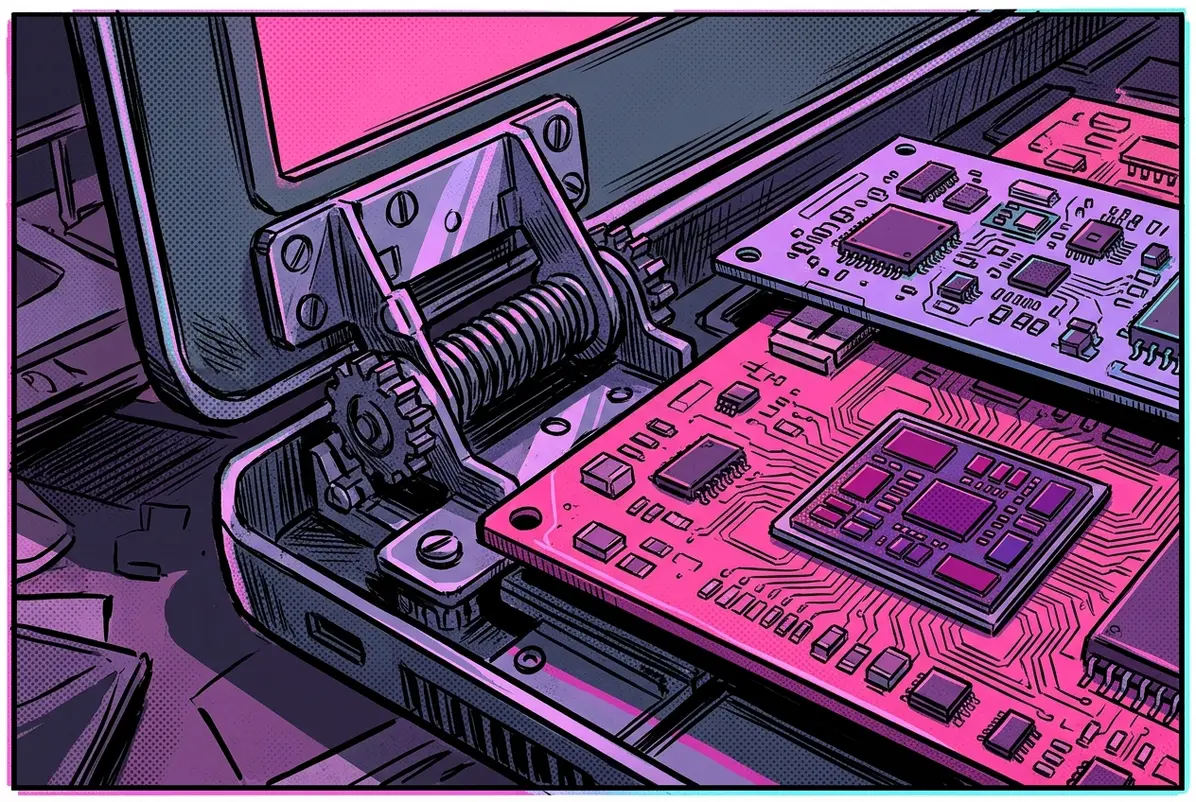
Framework has spent years making the laptop feel less sealed, less disposable, and less hostile to the person who owns it. The Framework Laptop 13’s interchangeable mainboard system lets users replace the processor board without throwing away the screen, keyboard, shell, battery, and ports. That architecture made the machine an obvious landing pad for an experiment that would be absurd inside a conventional ultrabook.
In June 2024, Framework previewed a RISC-V board from DeepComputing and described it as the company’s first partner-developed mainboard. In February 2025, Framework said the DC-ROMA RISC-V Mainboard for Framework Laptop 13 was in stock and shipping in the Framework Marketplace, while again framing it as a developer-focused board meant to help mature the RISC-V software ecosystem.
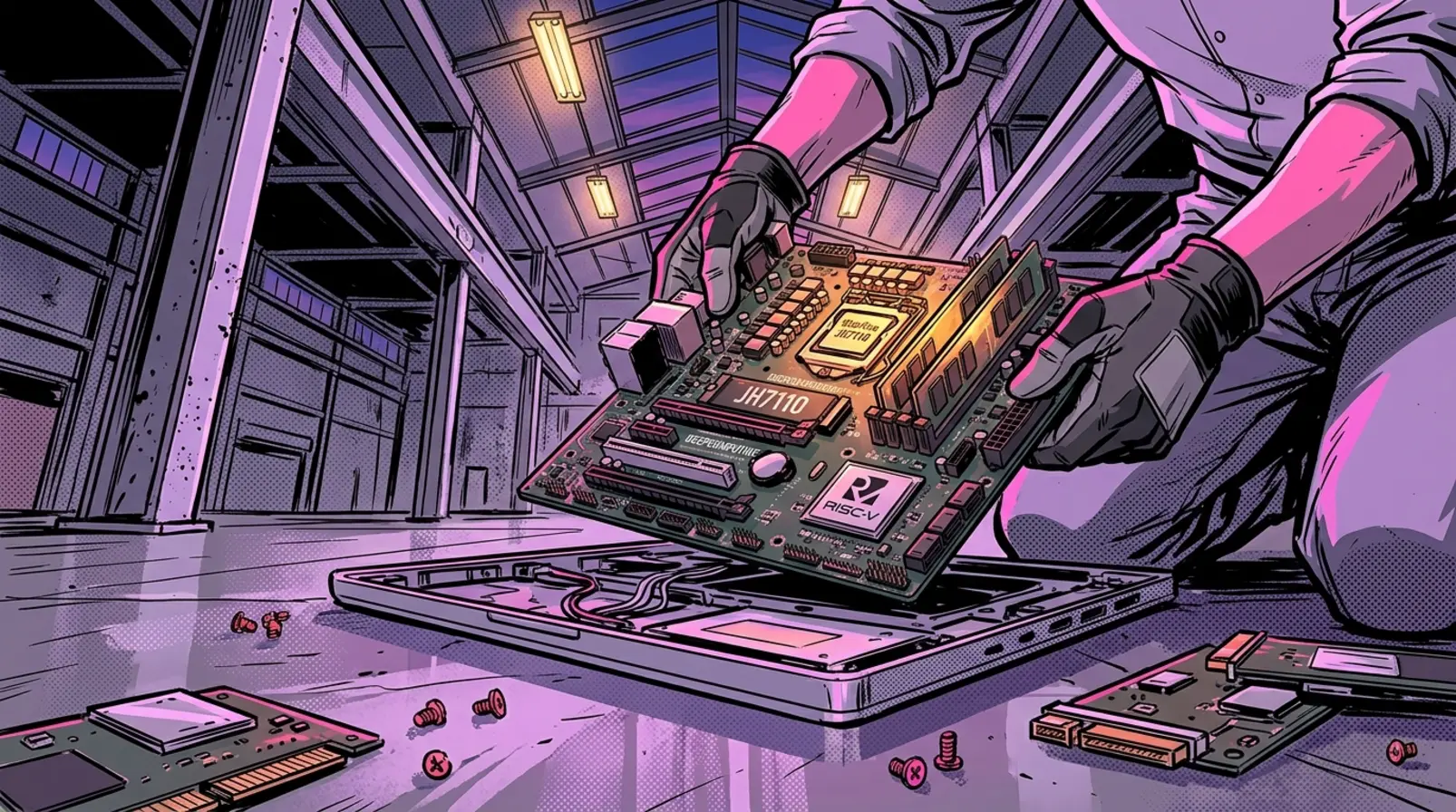
The hardware is humble. Framework lists the board with a StarFive JH7110 processor, four SiFive U74 RISC-V cores, 8GB of soldered LPDDR4 memory, and MicroSD or eMMC storage rather than a conventional M.2 NVMe setup. It fits the Framework Laptop 13 chassis and the Cooler Master Mainboard Case, and Framework says Linux support is provided through Ubuntu and Fedora.
That spec sheet is easy to dunk on if the wrong comparison is made. Measured against a modern x86 laptop mainboard, it looks underpowered and awkward. Measured against the history of open-standard processor architectures trying to climb out of dev boards and into everyday machines, it looks like a door cracked open.
The board is not impressive because it beats the old world. It is impressive because the old world had to make room for it.
The Architecture Argument Inside the Chassis
RISC-V began at the University of California, Berkeley in 2010, when Krste Asanović and graduate students Yunsup Lee and Andrew Waterman started the instruction set as part of the Parallel Computing Laboratory. RISC-V International describes the ISA and its ratified extensions as royalty-free, open building blocks available under globally accepted open licenses. The organization also makes an important distinction: RISC-V is an open standard, but companies can still build open or proprietary implementations, products, and services around it.
That distinction matters because RISC-V is often flattened into a folk slogan: open chips versus closed chips. The reality is stranger and more useful. RISC-V does not automatically make a computer fully open-source. It does not magically remove firmware blobs, immature drivers, business incentives, supply-chain constraints, or proprietary components. What it does is move the foundational instruction set out of a single vendor’s private garden.
x86 remains commercially dominated by Intel and AMD. Arm is licensed through Arm Holdings. RISC-V changes the relationship between software, silicon, and permission. Its promise is not purity. Its promise is architectural bargaining power.
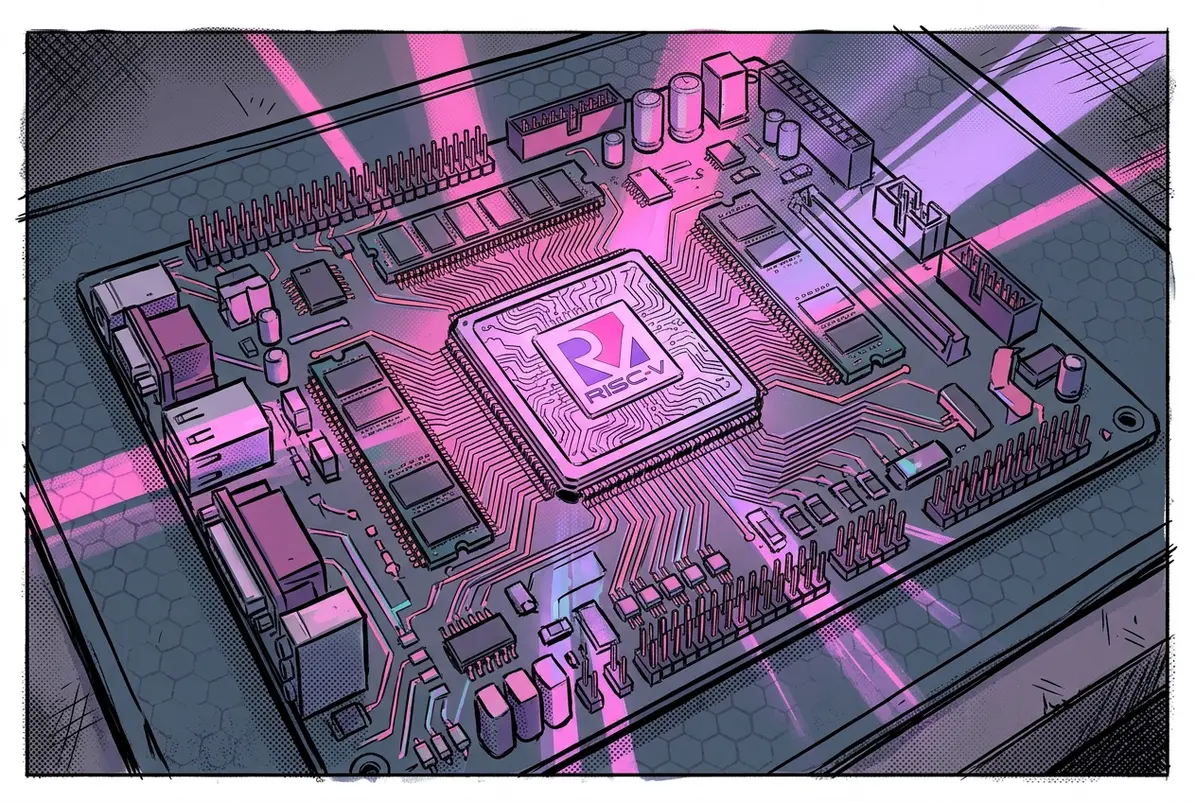
That is why the DeepComputing board is more interesting as a cultural object than as a benchmark result. It takes an ISA that has gained enormous traction in embedded systems, microcontrollers, research projects, and specialized hardware, then drops it into the familiar shape of a laptop. Not a science-fair slab. Not a single-board computer on a desk. A real laptop shell, with a real keyboard, a real screen, and real frustration.
The frustration is part of the experiment. Open architectures do not become normal by staying elegant in diagrams. They become normal by entering ugly rooms: bootloaders, browsers, Wi-Fi firmware, suspend states, graphics stacks, package repositories, and users who expect the lid to open and the machine to work.
The laptop is where ideals go to be humbled.
What Early Users Actually Run Into
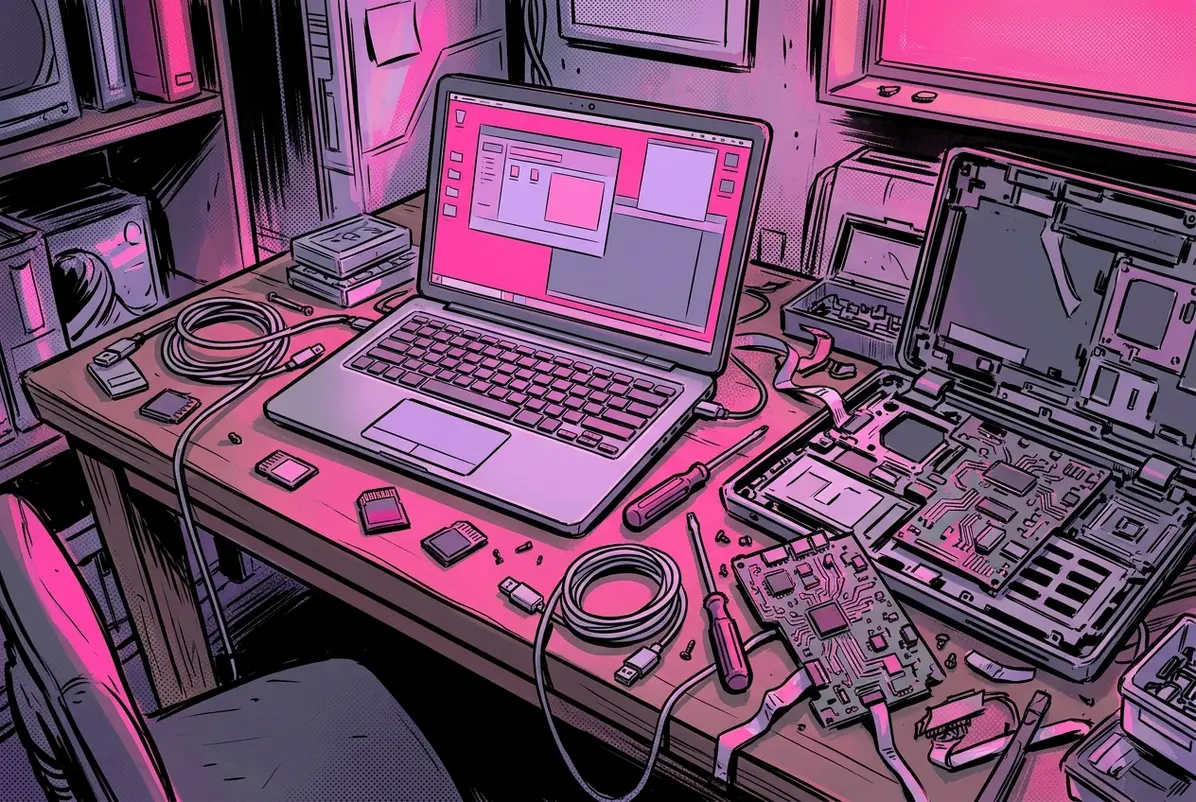
The first-generation board’s experience is exactly as tinkerer-coded as Framework’s warnings suggest. One early Framework Community thread reported that the board would not show signs of life unless an SD card with the appropriate image was installed. The same thread includes notes about manually resizing a root partition, avoiding generic images, display-output troubleshooting, unsupported screen configurations, Wi-Fi firmware issues, and the general sense that GNOME was too heavy for the hardware.
That does not mean every user will hit the same problems. It does mean the product behaves less like a normal laptop upgrade and more like an embedded development board that happens to have a keyboard attached.
That distinction is crucial. A normal laptop is supposed to disappear beneath the work. This board makes the machine visible again. The boot path becomes visible. The storage compromise becomes visible. The kernel becomes visible. The wireless card becomes visible. The user is forced to notice the stack that consumer computing usually hides.
For most people, that is a dealbreaker. For the right buyer, it is the reason to buy it.
Linux support on RISC-V is real, but uneven in the exact places that matter for laptop comfort. Debian announced riscv64 as an official architecture in 2023. Canonical provides Ubuntu images for selected RISC-V platforms. Fedora maintains a Fedora/RISC-V porting effort. Those milestones matter, but they are not the same thing as a frictionless desktop on every RISC-V laptop board.
The desktop is not one thing. It is a thousand tiny agreements between hardware and software. Browser performance. Video decode. GPU acceleration. Sleep. Resume. Wi-Fi. Touchpad behavior. Power management. Audio routing. Firmware updates. RISC-V does not need one heroic chip to become laptop-ready. It needs those thousand agreements to stop feeling heroic.
The DeepComputing board is where that work becomes visible.
The Modularity Contradiction
The most awkward detail is also the most revealing: soldered memory.
Framework’s appeal has always been partly emotional. The machine tells the user that the laptop is not a sealed prophecy. Parts can be replaced. Ports can move. Mainboards can become tiny desktops. Batteries, keyboards, bezels, screens, storage, and memory can enter the story as replaceable elements rather than dead ends.
So an 8GB soldered-memory RISC-V mainboard inside that ecosystem feels like a contradiction. It is not the kind of contradiction that destroys the product. It is the kind that exposes the limits of the present. Framework’s June 2024 preview was unusually clear that the board’s soldered memory and MicroSD/eMMC storage were tied to the processor and that its peripheral set and performance were not competitive with Intel and AMD Framework mainboards.
That honesty makes the product more defensible, not less. The board is not pretending to be a perfect expression of Framework’s modular dream. It is showing what happens when that dream meets an immature laptop-class RISC-V platform.
The chassis is ready for architectural plurality. The silicon is still catching up.
That is the tension. The polished laptop shell makes the board feel closer to normal than it is. The board, in turn, reveals how much work “normal” actually requires.
Why Buying One Can Still Make Sense
The strongest defense of the DeepComputing board is not that it is secretly fast. It is that speed is the wrong first question.
For kernel developers, driver authors, distribution maintainers, compiler people, hardware experimenters, and obsessive tinkerers, the board’s value is not comfort. It is target reality. Software ecosystems do not mature in abstraction forever. They need machines people can actually touch, break, patch, document, and compare.
That is why the board’s inconvenience has economic and cultural meaning. A purchase does not merely acquire a slow laptop part. It signals demand, gives developers a shared target, gives distributions a reason to care, and gives future silicon vendors evidence that the audience is not imaginary.
None of that makes the board a good buy for ordinary users. It should not be sold to ordinary users as a lifestyle object or an ethical shortcut. A person who wants a reliable laptop should buy a reliable laptop. Framework says as much.
But for the right kind of buyer, the roughness is not a betrayal. It is participation.
This is where the board starts to feel spiritually closer to zine culture than consumer electronics. Zines were not powerful because they had perfect binding, glossy paper, or mass distribution. They were powerful because they proved that publication did not need permission from the institutions that had professionalized the act of speaking in public. The DeepComputing board has a similar charge. It is not the best laptop mainboard. It is proof that laptop mainboards do not have to come only from the dominant ISA empires.
That proof is messy. So were the zines.
The Next Board Is Already the Real Rebuttal
The first DeepComputing RISC-V mainboard may be remembered less as a destination than as a first visible rung. DeepComputing has already listed the DC-ROMA RISC-V Mainboard III for the Framework Laptop 13, describing it as a Framework-compatible board powered by the SpacemiT K3, with an 8-core RVA23 CPU up to 2.5GHz, an 8-core RVA22 AI-specialized CPU, 16GB or 32GB of LPDDR5 memory, and M.2 2280 Key-M storage supporting SATA or NVMe.
In May 2026, DeepComputing announced the Mainboard III as starting at $699 and positioned it as a step toward practical, developer-ready RISC-V laptop computing. That does not retroactively make the first JH7110 board powerful. It makes the first board legible. It was not the answer. It was the pressure that helps produce better questions.
This is how strange hardware categories mature. First the device proves the shape. Then the software learns the shape. Then the second or third device arrives and everyone pretends the early pain was obvious, quaint, and necessary.
Framework’s role in that process is unusual. It does not need to build every mainboard itself for the platform to matter. If the chassis can host Intel, AMD, RISC-V, and eventually stranger architectures, then the Framework Laptop becomes more than a repairable computer. It becomes a socketed argument against processor monoculture.
That is the real promise. Not that every user will run RISC-V. Not that open-standard silicon automatically wins. Not that the first board is secretly a good laptop. The promise is that a laptop can become architecturally plural — a machine whose identity is not permanently welded to one processor lineage.
The Future Has to Be Annoying First
The DeepComputing RISC-V mainboard is easy to criticize because most of the criticisms are true. It is slow by modern laptop standards. It is limited. It is niche. It is developer hardware wearing the clothes of a consumer machine. It asks for patience and then spends that patience quickly.
But some technologies only become culturally meaningful when they are irritating enough to reveal what the old system had hidden. The first Linux desktops were not beloved because they were frictionless. They were beloved because the friction had a politics. The user could see the seams, curse the seams, and then change them.
The Framework RISC-V board belongs to that lineage. It is not a product of convenience. It is a product of possibility.
The future of open-standard laptop hardware will not arrive as a smooth aluminum miracle with perfect battery life, flawless graphics, and universal software support. It will arrive first as a weird mainboard that needs the right SD card before the screen wakes up.
That is not glamorous. It is better than glamorous.
It is how the door opens.
Frequently Asked Questions About the DeepComputing RISC-V Framework Mainboard
Can the DeepComputing RISC-V mainboard run Linux as a daily driver?
Not comfortably for most users. Framework says the board is developer-focused, has limited performance and peripheral capabilities, and is not recommended for buyers who want a consumer-ready experience. Early user reports also describe setup and compatibility issues that make it feel more like a development platform than a normal laptop upgrade.
What processor does the DeepComputing RISC-V mainboard use?
The first Framework-compatible DeepComputing RISC-V mainboard uses a StarFive JH7110 processor with four SiFive U74 RISC-V cores. Framework also lists 8GB of soldered LPDDR4 memory and MicroSD/eMMC storage.
Is the DeepComputing RISC-V mainboard compatible with the Framework Laptop 13?
Yes. Framework says the board is compatible with the Framework Laptop 13 chassis and the Cooler Master Mainboard Case. That compatibility should not be confused with a normal plug-and-play consumer upgrade, since setup and software support remain developer-oriented.
What makes RISC-V different from Intel, AMD, or Arm processors?
RISC-V is an open-standard, royalty-free instruction set architecture. Unlike x86, which is commercially dominated by Intel and AMD, or Arm, whose architecture is licensed by Arm Holdings, RISC-V lets organizations build processor implementations around an open ISA. Those implementations can still be open or proprietary.
Is the DeepComputing RISC-V board fully open-source?
No, not by default. The RISC-V ISA is an open standard, but that does not mean every chip, firmware component, driver, or board design in a finished laptop platform is fully open-source. The DeepComputing board should be understood as access to RISC-V laptop development hardware, not as a completely open-source laptop stack.
Who should buy the DeepComputing RISC-V mainboard?
The board makes the most sense for kernel developers, distribution maintainers, driver authors, hardware hackers, and RISC-V enthusiasts who want a real laptop-shaped target for experimentation. It is not a good fit for someone who simply wants a reliable everyday laptop.
Are more powerful RISC-V Framework mainboards coming?
DeepComputing has already announced and listed the DC-ROMA RISC-V Mainboard III for the Framework Laptop 13. That newer board is based on the SpacemiT K3 and lists major upgrades, including 16GB or 32GB of LPDDR5 memory and M.2 2280 SATA or NVMe storage support.


'%3e%3cg id='Final-Copy-2_2_' transform='translate(1275.000000, 200.000000)'%3e%3cpath class='st0' d='M7.4,12.8h6.8l3.1-11.6H7.4C4.2,1.2,1.6,3.8,1.6,7S4.2,12.8,7.4,12.8z'/%3e%3c/g%3e%3c/g%3e%3c/g%3e%3cg id='final---dec.11-2020'%3e%3cg id='_x30_208-our-toggle' transform='translate(-1275.000000, -200.000000)'%3e%3cg id='Final-Copy-2' transform='translate(1275.000000, 200.000000)'%3e%3cpath class='st1' d='M22.6,0H7.4c-3.9,0-7,3.1-7,7s3.1,7,7,7h15.2c3.9,0,7-3.1,7-7S26.4,0,22.6,0z M1.6,7c0-3.2,2.6-5.8,5.8-5.8 h9.9l-3.1,11.6H7.4C4.2,12.8,1.6,10.2,1.6,7z'/%3e%3cpath id='x' class='st2' d='M24.6,4c0.2,0.2,0.2,0.6,0,0.8l0,0L22.5,7l2.2,2.2c0.2,0.2,0.2,0.6,0,0.8c-0.2,0.2-0.6,0.2-0.8,0 l0,0l-2.2-2.2L19.5,10c-0.2,0.2-0.6,0.2-0.8,0c-0.2-0.2-0.2-0.6,0-0.8l0,0L20.8,7l-2.2-2.2c-0.2-0.2-0.2-0.6,0-0.8 c0.2-0.2,0.6-0.2,0.8,0l0,0l2.2,2.2L23.8,4C24,3.8,24.4,3.8,24.6,4z'/%3e%3cpath id='y' class='st3' d='M12.7,4.1c0.2,0.2,0.3,0.6,0.1,0.8l0,0L8.6,9.8C8.5,9.9,8.4,10,8.3,10c-0.2,0.1-0.5,0.1-0.7-0.1l0,0 L5.4,7.7c-0.2-0.2-0.2-0.6,0-0.8c0.2-0.2,0.6-0.2,0.8,0l0,0L8,8.6l3.8-4.5C12,3.9,12.4,3.9,12.7,4.1z'/%3e%3c/g%3e%3c/g%3e%3c/g%3e%3c/g%3e%3c/svg%3e) Your Privacy Choices
Your Privacy Choices