


Imagine spending nearly $10 million and three years hand-painting 160,000 individual animation frames. Now imagine Hollywood executives like Steven Spielberg and George Lucas turning it down, claiming it would never work for Western audiences. That’s exactly what happened with Akira in 1987, and those executives couldn’t have been more wrong.
When Roger Ebert selected this Japanese cyberpunk epic as his “Video Pick of the Week” on Siskel & Ebert in the early 1990s, he wasn’t just recommending another movie. He was introducing American audiences to a film that would fundamentally reshape what animation could be, proving that cartoons weren’t just for kids anymore.
The Technical Revolution Nobody Saw Coming
What made Akira special wasn’t just its story about biker gangs and telekinetic powers in dystopian Neo-Tokyo. Director Katsuhiro Otomo did something no anime had done before: he recorded all the dialogue first, then animated the characters’ lip movements to match. This technique, called pre-scoring, was standard in Western animation but revolutionary for anime. The result? Characters that felt alive in ways Japanese animation never had before.
The numbers tell an incredible story. While typical animated features used around 50,000 to 70,000 cels, Akira employed over 160,000. The production team invented 50 new colors specifically for the film, bringing the total palette to 327 distinct shades. Every single light source in Neo-Tokyo was hand-painted individually, making the city pulse with an almost tangible energy.
In online communities and collector circles, fans still marvel at one particular detail: not a single computer-assisted shot appears in the entire film. Every frame was drawn by hand, tested for fluidity, and often redrawn if it didn’t meet Otomo’s exacting standards.
When Critics Saw What Studios Missed
Ebert’s endorsement came at a pivotal moment. Anime was virtually unknown in mainstream American culture. Most animated content marketed to adults was either comedic or experimental. Here was something different: violent, philosophical, visually stunning, and unapologetically Japanese. Ebert compared it to Mad Max, calling it “very gory, very gruesome, but entertaining in its own demented way.”
This wasn’t typical critic-speak. It was a recognition that animation could tackle mature themes without compromise, something Western studios were still hesitant to embrace.
The VHS That Became Legend
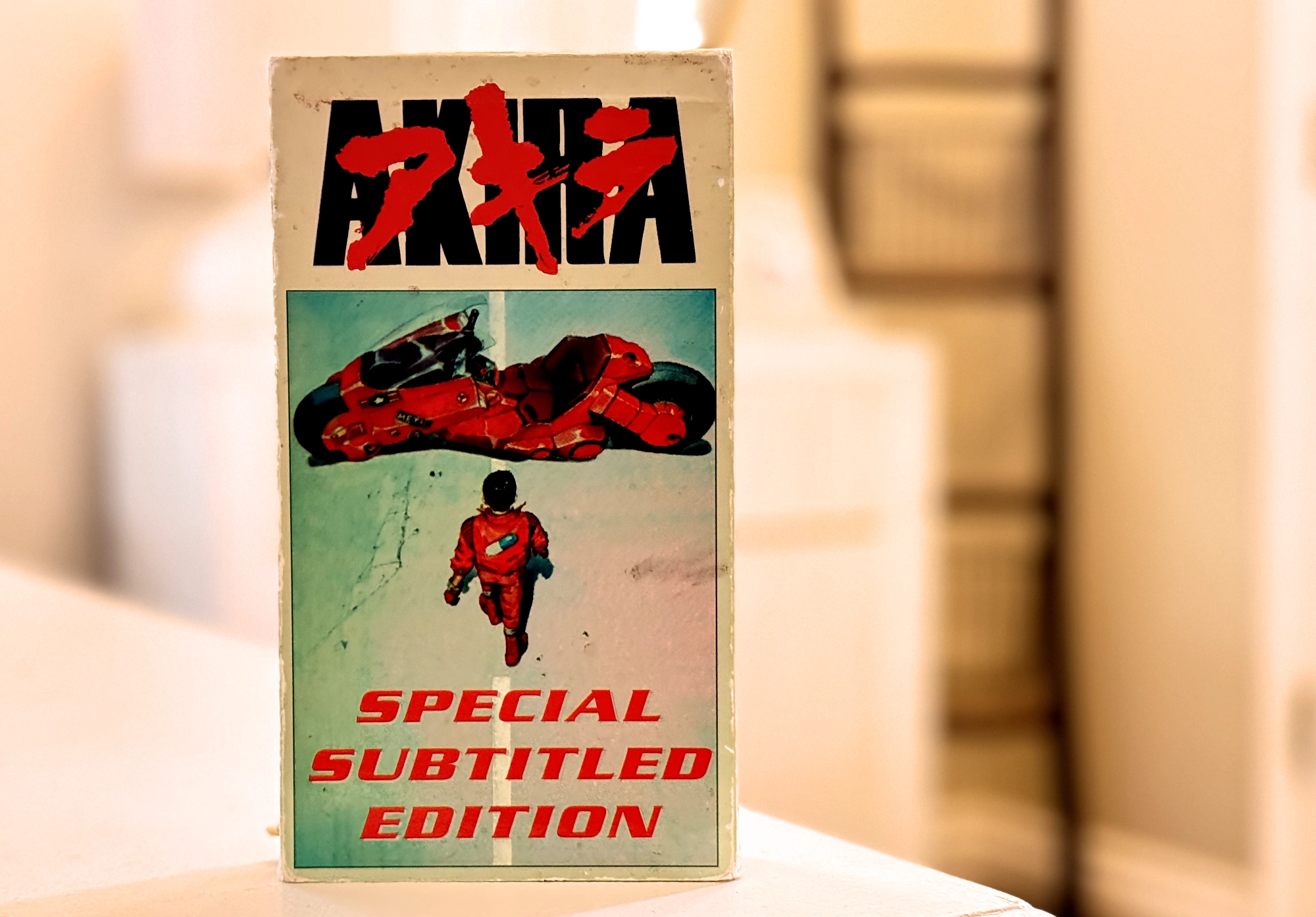
Enthusiast groups often debate the various VHS releases of Akira, but the Special Subtitled Edition from 1993 holds particular significance. Unlike the more common dubbed version distributed by Orion Home Video, this edition preserved the original Japanese audio with accurate English subtitles, a rarity at the time when most anime was heavily edited or dubbed-only for Western markets.
The film spread through bedrooms across America like what one critic called “a software virus.” Without massive marketing budgets or theatrical releases, Akira became a phenomenon through word of mouth and VHS trading. Generation X discovered it, shared it, and made it theirs. By 1993, it had sold 100,000 tapes in both the United States and Europe, impressive numbers for a foreign animated film with minimal promotion.
Today, that Special Subtitled Edition is highly sought after in collector circles, representing one of the first major anime releases to offer subtitle options in the US market and preserve the uncompromised artistic vision that made the film special.
A Legacy That Never Stops Growing
Akira didn’t just succeed; it opened floodgates. Filmmakers from James Cameron to the Wachowskis cite it as inspiration. Kanye West based his “Stronger” music video entirely on its imagery. The famous “Akira slide” (where protagonist Kaneda stops his motorcycle in a dramatic sideways skid) has been recreated in everything from Batman to Neon Genesis Evangelion.
Fan forums frequently point out that without Akira’s success, Western audiences might never have embraced Pokémon, Dragon Ball, or the entire wave of Japanese pop culture that followed. It proved animation could be art, that foreign films didn’t need to be watered down, and that audiences were hungry for something bold and different.
If you’re ready to experience the film that changed animation forever, track down Akira and see why it still holds up more than three decades later. Just don’t expect anything you’ve seen before.

'%3e%3cg id='Final-Copy-2_2_' transform='translate(1275.000000, 200.000000)'%3e%3cpath class='st0' d='M7.4,12.8h6.8l3.1-11.6H7.4C4.2,1.2,1.6,3.8,1.6,7S4.2,12.8,7.4,12.8z'/%3e%3c/g%3e%3c/g%3e%3c/g%3e%3cg id='final---dec.11-2020'%3e%3cg id='_x30_208-our-toggle' transform='translate(-1275.000000, -200.000000)'%3e%3cg id='Final-Copy-2' transform='translate(1275.000000, 200.000000)'%3e%3cpath class='st1' d='M22.6,0H7.4c-3.9,0-7,3.1-7,7s3.1,7,7,7h15.2c3.9,0,7-3.1,7-7S26.4,0,22.6,0z M1.6,7c0-3.2,2.6-5.8,5.8-5.8 h9.9l-3.1,11.6H7.4C4.2,12.8,1.6,10.2,1.6,7z'/%3e%3cpath id='x' class='st2' d='M24.6,4c0.2,0.2,0.2,0.6,0,0.8l0,0L22.5,7l2.2,2.2c0.2,0.2,0.2,0.6,0,0.8c-0.2,0.2-0.6,0.2-0.8,0 l0,0l-2.2-2.2L19.5,10c-0.2,0.2-0.6,0.2-0.8,0c-0.2-0.2-0.2-0.6,0-0.8l0,0L20.8,7l-2.2-2.2c-0.2-0.2-0.2-0.6,0-0.8 c0.2-0.2,0.6-0.2,0.8,0l0,0l2.2,2.2L23.8,4C24,3.8,24.4,3.8,24.6,4z'/%3e%3cpath id='y' class='st3' d='M12.7,4.1c0.2,0.2,0.3,0.6,0.1,0.8l0,0L8.6,9.8C8.5,9.9,8.4,10,8.3,10c-0.2,0.1-0.5,0.1-0.7-0.1l0,0 L5.4,7.7c-0.2-0.2-0.2-0.6,0-0.8c0.2-0.2,0.6-0.2,0.8,0l0,0L8,8.6l3.8-4.5C12,3.9,12.4,3.9,12.7,4.1z'/%3e%3c/g%3e%3c/g%3e%3c/g%3e%3c/g%3e%3c/svg%3e) Your Privacy Choices
Your Privacy Choices