

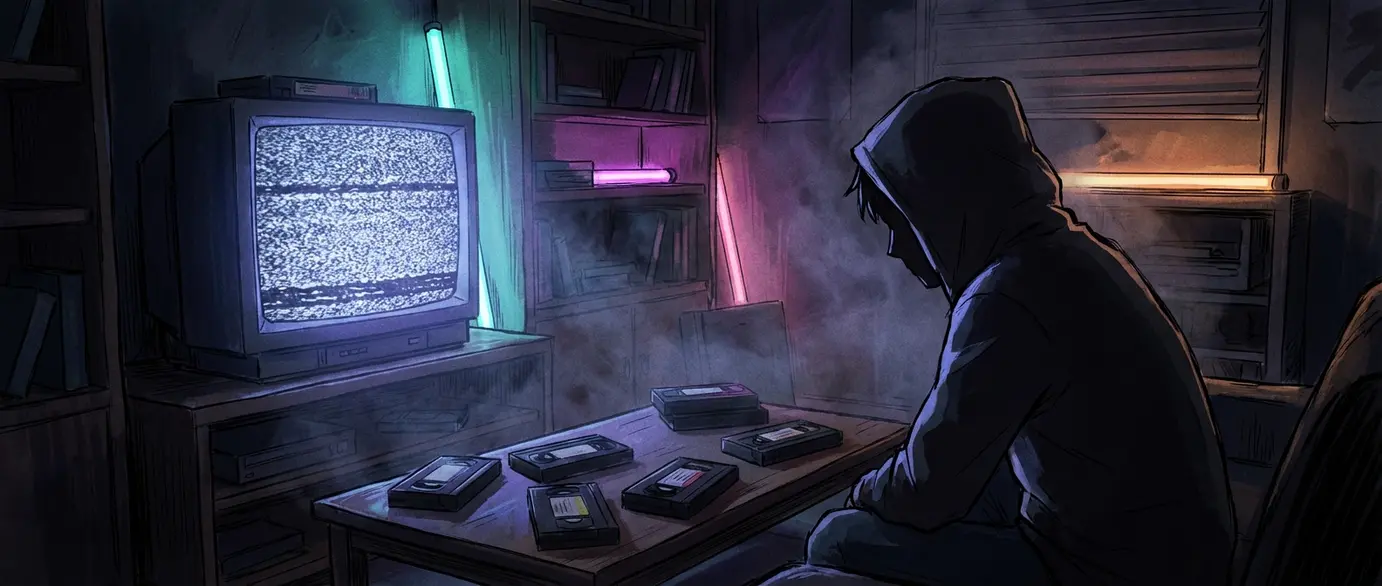

There’s a moment that happens when you watch old VHS footage. Not the content itself, but the medium. The tracking lines that roll across the screen. The color bleeding at the edges. That particular grain that sits between the image and your eye. Something happens in that space—something the 4K revolution forgot to account for: memory doesn’t render in high definition.
In 2026, we’re witnessing something remarkable. While AI perfects every pixel and algorithms smooth every edge, creators are deliberately reaching backward—not out of nostalgia (that cheap currency), but because they’ve discovered something essential in the static. VHS aesthetics aren’t having a moment. They’re answering a question we didn’t know we were asking.
The Memory Filter
Our brains don’t archive experiences like digital files. They compress, distort, color-shift, and blur. When you remember your childhood, you’re not recalling 1080p footage. You’re accessing something closer to a worn tape that’s been recorded over, paused too long, left in the sun. The imperfections aren’t bugs. They’re features of how consciousness actually works.
This is why VHS static resonates so deeply in 2026. Enthusiast communities have been exploring this idea intensely, noting how these “flaws” create an aura of authenticity that pristine digital footage can never achieve. One collector captured it perfectly: watching VHS feels like how nostalgia actually feels—that exact emotional texture overlaid onto memory.
The aesthetic works because it mirrors our internal experience. Scanlines become the way light fragments in recollection. Color distortion becomes emotional temperature. Grain becomes the texture of time itself. This isn’t about replicating the past. It’s about finding a visual language for how we process experience.
Digital Detox Through Digital Means
Here’s the beautiful paradox: we’re using digital tools to create analog friction. Creators apply VHS overlays in After Effects. They add tracking distortion to pristine 4K footage. They deliberately degrade what technology spent decades trying to perfect.
This isn’t contradiction. It’s resistance.
In fan forums and creator circles, there’s a growing conversation about “friction-maxxing”—the practice of intentionally adding obstacles to smooth digital experiences. VHS aesthetics function as visual friction, a way to slow down the algorithmic feed, to make viewers pause and feel something besides the scroll reflex.
The data tells the story: 60% of Gen Z wishes they could return to a time before everyone was “plugged in.” Yet they’re the generation that never knew that time. What they’re longing for isn’t a specific era, but a quality of attention that analog technology enforced by its very limitations. You couldn’t skip through a VHS tape at 2x speed. You had to wait. You had to be present.
Imperfection as Evidence of Soul
When everything can be perfected, perfection loses meaning. AI can generate flawless faces, remove every blemish, optimize every composition. The result is technically immaculate and emotionally vacant. The soul lives in the mistakes.
Online communities passionate about analog formats have articulated this instinctively. They point out that VHS imperfections tell a story. Each glitch artifact, each moment of signal loss, each tracking error is evidence of a physical medium that existed in time and space. The tape sat in someone’s living room. It was touched. It degraded. It lived.
This matters more in 2026 than it did in 1986. Back then, we tolerated VHS limitations because we had no choice. Now, choosing those limitations is a statement. It says: I value the evidence of human touch over algorithmic optimization. I want to see the seams. I trust imperfection because it can’t be faked by a machine.
The Analog Horror Connection
There’s a reason analog horror has exploded as a genre. The format itself creates unease. VHS behaves irrationally, unpredictably. Tapes degrade in ways digital files don’t. They warp. They ghost. They fail in organic, almost biological ways.
Horror communities have embraced this deeply, recognizing that VHS is uniquely suited to unsettling narratives. The medium carries an inherent wrongness for viewers who grew up digital. It’s alien technology that doesn’t follow modern rules. For older viewers, it taps into something even more primal: the childhood memory of rewatching a favorite tape, only to discover it’s changed, degraded, become something other than what you remembered.
But this horror aesthetic works because it’s built on a foundation of comfort. VHS signifies “home video,” “family memory,” “safe nostalgia.” When that safety is violated, the contrast creates genuine dread. The static becomes a space where anything can hide.
The 2026 Context
This isn’t random timing. The VHS aesthetic surge in 2026 corresponds directly with AI saturation. As generative tools perfect every visual medium, as deepfakes make reality negotiable, as algorithms curate every feed, people are craving markers of authenticity. They need visual proof that something existed before the algorithm touched it.
Design trends reflect this hunger. The broader retro tech movement supports this reading. Sales of vinyl players, instant cameras, and even VHS players are climbing. People aren’t just consuming retro aesthetics digitally. They’re buying physical objects that enforce analog limitations. They want the friction, the waiting, the imperfection.
What Lives in the Static
So what is it, exactly, that makes VHS static the ultimate 2026 aesthetic? It’s not the look itself. It’s what the look represents: proof of passage through time, evidence of physical existence, the visual signature of human experience unoptimized by machine learning.
Every grain is a timestamp. Every tracking error is a memoir. Every color shift is an emotion that can’t be quantified. The static isn’t noise. It’s signal. It’s the soul of the image—the part that survived the recording process, the degradation, the years.
In creator communities and collector circles, there’s a recognition that we’re not just playing with an aesthetic. We’re developing a visual language for resistance, for humanity, for memory in an age that wants to perfect all three out of existence.
The VHS aesthetic works in 2026 because it’s honest about what it is: a recording of a recording, a copy that admits it’s a copy, an image that wears its history on its surface. In a world where AI can generate perfect fakes, that honesty is revolutionary.
This is why the static matters. This is why the tracking lines, the grain, the color bleed all resonate so deeply. They’re not decorative choices. They’re philosophical statements. They say: I was there. This happened. Time touched this. A human made this.
And in 2026, when everything else can be generated, optimized, and perfected by machines, that statement is the most radical thing you can make.
'%3e%3cg id='Final-Copy-2_2_' transform='translate(1275.000000, 200.000000)'%3e%3cpath class='st0' d='M7.4,12.8h6.8l3.1-11.6H7.4C4.2,1.2,1.6,3.8,1.6,7S4.2,12.8,7.4,12.8z'/%3e%3c/g%3e%3c/g%3e%3c/g%3e%3cg id='final---dec.11-2020'%3e%3cg id='_x30_208-our-toggle' transform='translate(-1275.000000, -200.000000)'%3e%3cg id='Final-Copy-2' transform='translate(1275.000000, 200.000000)'%3e%3cpath class='st1' d='M22.6,0H7.4c-3.9,0-7,3.1-7,7s3.1,7,7,7h15.2c3.9,0,7-3.1,7-7S26.4,0,22.6,0z M1.6,7c0-3.2,2.6-5.8,5.8-5.8 h9.9l-3.1,11.6H7.4C4.2,12.8,1.6,10.2,1.6,7z'/%3e%3cpath id='x' class='st2' d='M24.6,4c0.2,0.2,0.2,0.6,0,0.8l0,0L22.5,7l2.2,2.2c0.2,0.2,0.2,0.6,0,0.8c-0.2,0.2-0.6,0.2-0.8,0 l0,0l-2.2-2.2L19.5,10c-0.2,0.2-0.6,0.2-0.8,0c-0.2-0.2-0.2-0.6,0-0.8l0,0L20.8,7l-2.2-2.2c-0.2-0.2-0.2-0.6,0-0.8 c0.2-0.2,0.6-0.2,0.8,0l0,0l2.2,2.2L23.8,4C24,3.8,24.4,3.8,24.6,4z'/%3e%3cpath id='y' class='st3' d='M12.7,4.1c0.2,0.2,0.3,0.6,0.1,0.8l0,0L8.6,9.8C8.5,9.9,8.4,10,8.3,10c-0.2,0.1-0.5,0.1-0.7-0.1l0,0 L5.4,7.7c-0.2-0.2-0.2-0.6,0-0.8c0.2-0.2,0.6-0.2,0.8,0l0,0L8,8.6l3.8-4.5C12,3.9,12.4,3.9,12.7,4.1z'/%3e%3c/g%3e%3c/g%3e%3c/g%3e%3c/g%3e%3c/svg%3e) Your Privacy Choices
Your Privacy Choices