

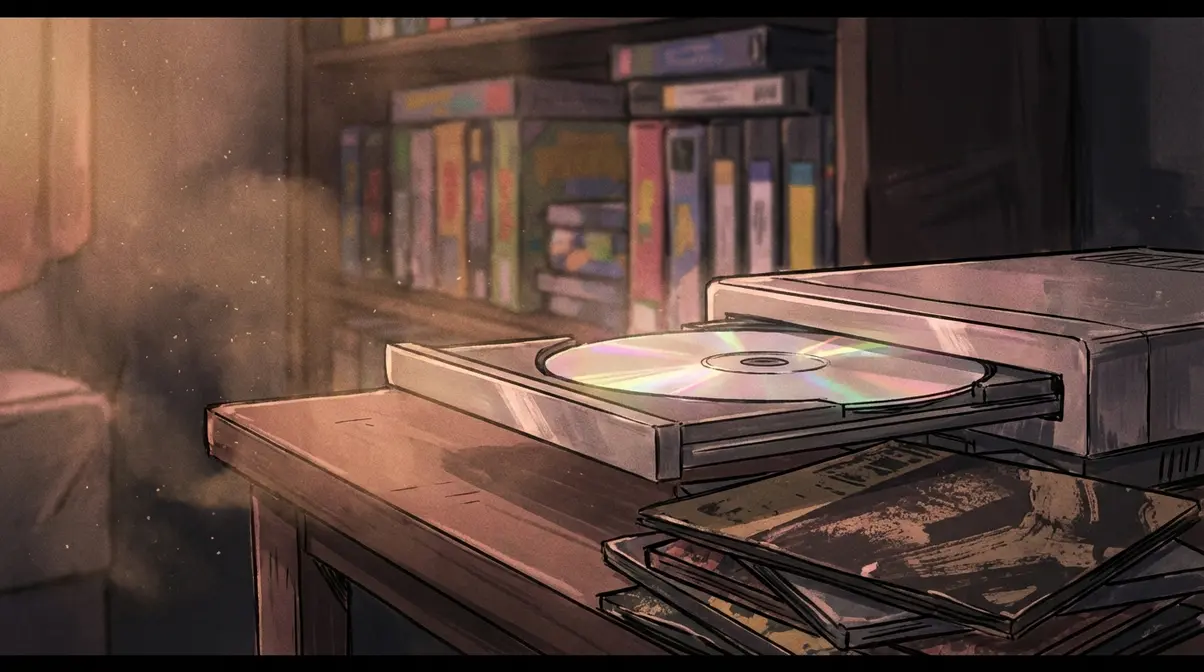

LaserDisc is a 12-inch optical disc format, first sold commercially in 1978, that stores analog video and digital audio. It was the first commercial optical disc medium for home video, predating the CD by four years and the DVD by nearly two decades.
Developed by Philips, Pioneer, and MCA, LaserDisc was initially marketed in the United States in 1978 under the name DiscoVision.
It never conquered the mainstream, but it built something more durable: a legacy.
LaserDisc Was Not a Giant CD. Here’s Why That Matters.
Pick up a LaserDisc and you’d swear you were holding an oversized compact disc. Same silver sheen, same rainbow refraction. But the resemblance is surface-level.
Unlike most later optical disc formats, LaserDisc is not fully digital; it stores an analog video signal.
The pits and lands etched into a LaserDisc look binary, but they aren’t. The length of each pit is a continuous variable. The video signal is FM-encoded, and the varying pit lengths represent that signal’s modulation. On a CD, a few nanometers of variation in pit length mean nothing. On a LaserDisc, they change the picture.
So is LaserDisc the vinyl of video? The analogy works, but not how most people assume. Vinyl is to CD what LaserDisc is to DVD: an analog format stored on physical media, read optically (or mechanically, in vinyl’s case), carrying a signal that has never been compressed, quantized, or reduced to a bitstream.
The discs typically have a diameter of 300 millimeters, similar in size to the 12-inch phonograph record. They weigh about 250 grams each. Like a good gatefold LP, they demand shelf space and reward it with presence.
Audio was a different story. Early discs carried analog stereo sound, but later pressings introduced 16-bit/44.1 kHz PCM digital audio.
Many titles featured CD-quality digital audio, and LaserDisc was the first home video format to support surround sound.
By the 1990s, titles shipped with Dolby Digital and DTS tracks. The format was a hybrid creature, analog picture married to digital sound, and that combination gave it a character no purely digital format has replicated.
What Made LaserDisc Special: The Format That Invented Bonus Features
If you’ve ever listened to a director’s commentary, watched a behind-the-scenes featurette, or admired a deluxe box set, you owe a debt to LaserDisc.
LaserDisc’s support for multiple audio tracks allowed for vast supplemental materials to be included on-disc and made it the first available format for “Special Edition” releases; the 1984 Criterion Collection edition of Citizen Kane is generally credited as being the first “Special Edition” release to home video.
The Criterion Collection began its life on LaserDisc in 1984. Its second title, King Kong (1933), debuted the scene-specific audio commentary, recorded by film historian Ronald Haver. Martin Scorsese later recorded commentaries for Criterion’s Taxi Driver and Raging Bull LaserDiscs. These weren’t afterthoughts. They were blueprints for how home video would work for the next forty years.
The packaging went further than anything DVD or Blu-ray has matched. Collectors talk about lifting the lid of a 12-by-12-inch box and finding liner notes, bound hardcover books, animation cels, actual frames of film, and CD soundtracks nestled in velveteen cradles. Of the 307 films Criterion released on LaserDisc between 1984 and 1999, 224 have since been re-released on DVD, Blu-ray, or UHD. The remaining 83 exist only on those silver platters.
Why LaserDisc Lost the War But Won the Argument
LaserDisc delivered roughly 425 to 440 horizontal lines of resolution, crushing VHS’s 240 or so lines. The picture was sharper. The sound was better. It had no copy protection, no user-prohibited operations, no unskippable warnings. You pressed play, and it played.
None of that mattered to the mass market.
In the United States, about 2% of households (roughly two million) owned a player.
In Japan, market penetration reached approximately 10% of households by 1999.
The discs were heavy, fragile, and had to be flipped halfway through a movie. They couldn’t record, which was a dealbreaker for consumers taping soap operas off broadcast TV. Players launched at $749 in 1978.
The last LaserDisc title released in North America was Paramount’s Bringing Out the Dead on October 3, 2000.
Pioneer ceased manufacturing players in January 2009 and stopped offering maintenance services on September 30, 2020, when its remaining parts inventory ran out. A total of 16.8 million players were sold worldwide. For perspective, that’s roughly one-tenth the number of Walkman units Sony shipped in its first decade alone.
The Star Wars Problem: LaserDisc as Accidental Archive
For decades, the 1993 widescreen LaserDisc “Definitive Collection” of the original Star Wars trilogy represented the closest thing to the unaltered theatrical cuts available on home video. With the exception of a new THX audio mix, scratch removal, and color balance changes, it matched what audiences saw in 1977, 1980, and 1983. When Lucasfilm released the 2006 DVD bonus discs of the theatrical cuts, they used the same unrestored masters from that 1993 LaserDisc release.
Fan preservationist Petr Harmáček (known as “Harmy”) used the 1993 LaserDisc releases as a visual reference for his “Despecialized Edition” project, painstakingly reconstructing the original films from multiple sources. That grassroots effort helped keep pressure alive for an official release.
In June 2025, the British Film Institute screened the original film in its unaltered form at a film festival. In December 2025, Lucasfilm announced that a restoration of the unaltered original film would return to theaters on February 19, 2027, in celebration of its 50th anniversary.
A newly restored version of the classic Star Wars (1977) theatrical release will play in theaters for a limited time.
This is the version LaserDisc collectors spent three decades protecting. Whether a home video release follows remains unknown, but the announcement validates what the format’s community always argued: preservation matters, and sometimes the “obsolete” medium holds the only surviving copy of what’s real.
The Future of LaserDisc: Preservation, Collecting, and the Domesday Duplicator
Nobody is pressing new LaserDiscs. Nobody is manufacturing new players. The format’s future is entirely about what happens to the discs that already exist.
Thanks to the rise of collectors and a healthy dose of nostalgia, LaserDiscs are still being sought after today despite the rise of formats like Blu-ray and 4K Ultra HD.
A Japanese copy of Arnold Schwarzenegger’s The Sixth Day sold for $2,250 in May 2023, and a sealed copy of the original Scream sold for $499.95 in March 2023.
Disney’s Song of the South, a Japan-only LaserDisc release, has never been released on DVD or Blu-ray, making the LaserDisc a highly valuable item.
The collector market is bifurcated:
rare and valuable discs are flying, common titles are bombing.
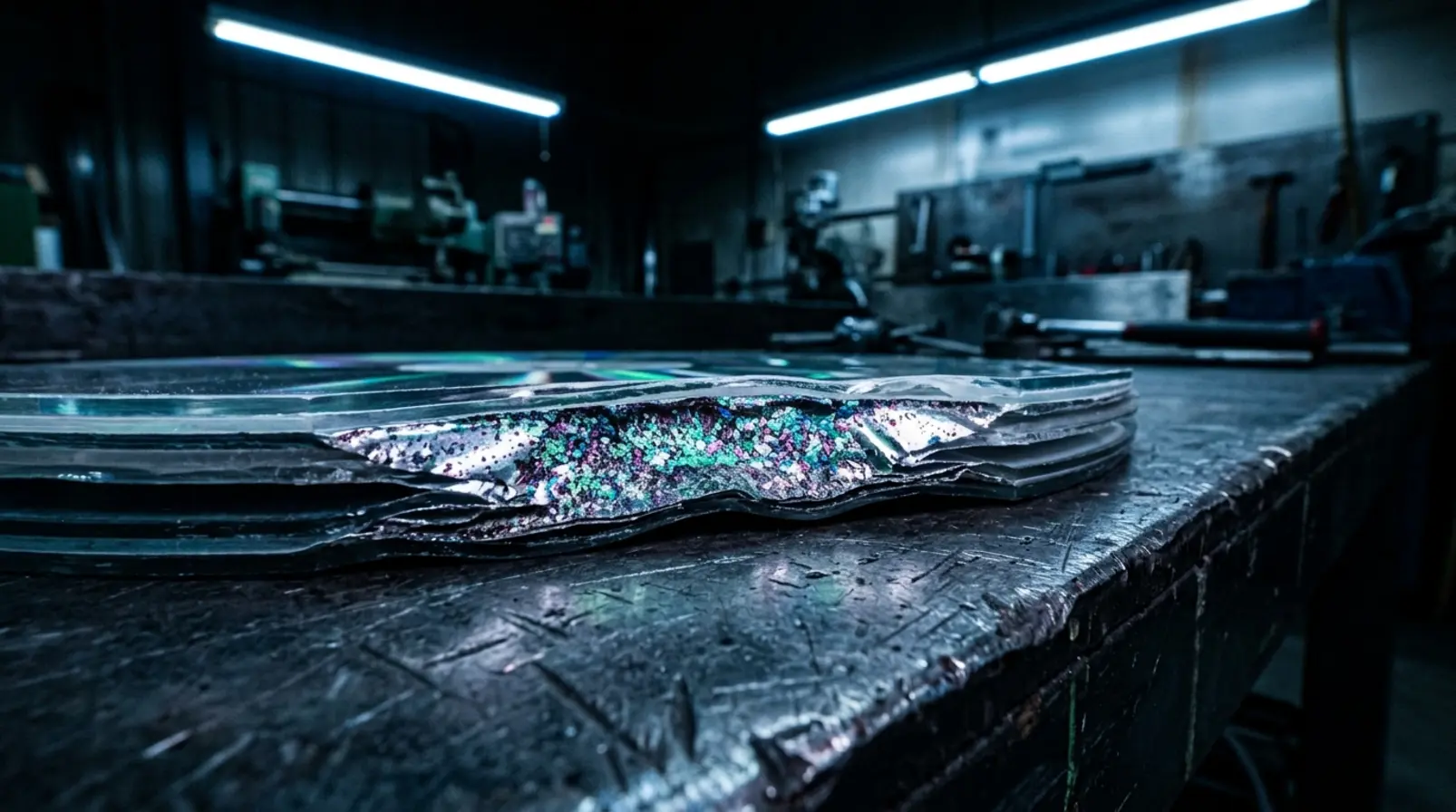
The existential threat is laser rot. Oxidation of the aluminum signal layer can render a disc unplayable, and certain pressing plants produced more vulnerable discs than others. Players are aging out. Pioneer stopped servicing them. Every working unit is one stuck tray mechanism away from becoming a shelf ornament.
Which is why the Domesday Duplicator project may be the most important thing happening in the LaserDisc world right now.
The Domesday Duplicator is a LaserDisc capture-focused, USB 3.0-based DAQ capable of 40 million samples per second acquisition of analogue RF data at 10-bit resolution.
It captures the raw RF signal from a LaserDisc player’s laser.
This effectively turns the laserdisc player into a highly accurate optical scanner.
The resulting capture preserves everything on the disc, even data that current software can’t decode yet.
Originally developed to capture the BBC’s 1980s Domesday LaserDiscs, the project’s decoding abilities have broadened to include VHS, S-VHS, U-Matic, Betamax, Video8, and Hi8.
This is not nostalgia as decoration. It is archival work with real stakes. Unique audio mixes, unreleased deleted scenes, rare concert performances, and entire films exist only on LaserDisc.
The format was home to exclusive music releases, blockbuster hits, and ultra-rare titles that never made it to DVD or Blu-ray.
When those discs rot, that content vanishes. The Domesday Duplicator is a race against chemistry.
Dealers like Hollywood LaserDisc, a one-woman operation owned by Maxeene Davlin, a LaserDisc enthusiast and musician, keep the marketplace alive. The LaserDisc Database tracks titles, pressings, and average sale prices. The community is small but precise, more concerned with provenance than hype.
Frequently Asked Questions About LaserDisc
Is LaserDisc digital or analog?
Unlike most later optical disc formats, LaserDisc is not fully digital; it stores an analog video signal.
Later discs added digital audio tracks, making the format a hybrid of analog video and digital sound.
When was the first LaserDisc released?
The format was initially marketed in the United States in 1978 under the name DiscoVision.
The first title released in North America was the MCA DiscoVision edition of Jaws on December 15, 1978.
Are LaserDiscs worth anything today?
Thanks to the rise of collectors and a healthy dose of nostalgia, LaserDiscs are still being sought after today.
Rare titles and sealed copies can sell for hundreds or even thousands of dollars, though common titles may only fetch a few dollars each.
What is laser rot?
Laser rot is the oxidation of the aluminum signal layer inside a LaserDisc. When the protective seal breaks down, the aluminum loses its reflectivity and the playback signal degrades, sometimes becoming irretrievable. Certain pressing plants produced discs more susceptible to this problem than others.
Can you still buy a LaserDisc player?
Pioneer ceased production of LaserDisc players in January 2009 and ended maintenance services in September 2020. Players are available only on the secondhand market, and working units in good condition are increasingly difficult to find.
What is the Domesday Duplicator?
The Domesday Duplicator captures raw RF signals from LaserDiscs, VHS tapes, and other analog media for digital preservation. This open-source hardware enables archivists and enthusiasts to create bit-perfect captures that can be decoded using the ld-decode software suite.
'%3e%3cg id='Final-Copy-2_2_' transform='translate(1275.000000, 200.000000)'%3e%3cpath class='st0' d='M7.4,12.8h6.8l3.1-11.6H7.4C4.2,1.2,1.6,3.8,1.6,7S4.2,12.8,7.4,12.8z'/%3e%3c/g%3e%3c/g%3e%3c/g%3e%3cg id='final---dec.11-2020'%3e%3cg id='_x30_208-our-toggle' transform='translate(-1275.000000, -200.000000)'%3e%3cg id='Final-Copy-2' transform='translate(1275.000000, 200.000000)'%3e%3cpath class='st1' d='M22.6,0H7.4c-3.9,0-7,3.1-7,7s3.1,7,7,7h15.2c3.9,0,7-3.1,7-7S26.4,0,22.6,0z M1.6,7c0-3.2,2.6-5.8,5.8-5.8 h9.9l-3.1,11.6H7.4C4.2,12.8,1.6,10.2,1.6,7z'/%3e%3cpath id='x' class='st2' d='M24.6,4c0.2,0.2,0.2,0.6,0,0.8l0,0L22.5,7l2.2,2.2c0.2,0.2,0.2,0.6,0,0.8c-0.2,0.2-0.6,0.2-0.8,0 l0,0l-2.2-2.2L19.5,10c-0.2,0.2-0.6,0.2-0.8,0c-0.2-0.2-0.2-0.6,0-0.8l0,0L20.8,7l-2.2-2.2c-0.2-0.2-0.2-0.6,0-0.8 c0.2-0.2,0.6-0.2,0.8,0l0,0l2.2,2.2L23.8,4C24,3.8,24.4,3.8,24.6,4z'/%3e%3cpath id='y' class='st3' d='M12.7,4.1c0.2,0.2,0.3,0.6,0.1,0.8l0,0L8.6,9.8C8.5,9.9,8.4,10,8.3,10c-0.2,0.1-0.5,0.1-0.7-0.1l0,0 L5.4,7.7c-0.2-0.2-0.2-0.6,0-0.8c0.2-0.2,0.6-0.2,0.8,0l0,0L8,8.6l3.8-4.5C12,3.9,12.4,3.9,12.7,4.1z'/%3e%3c/g%3e%3c/g%3e%3c/g%3e%3c/g%3e%3c/svg%3e) Your Privacy Choices
Your Privacy Choices