

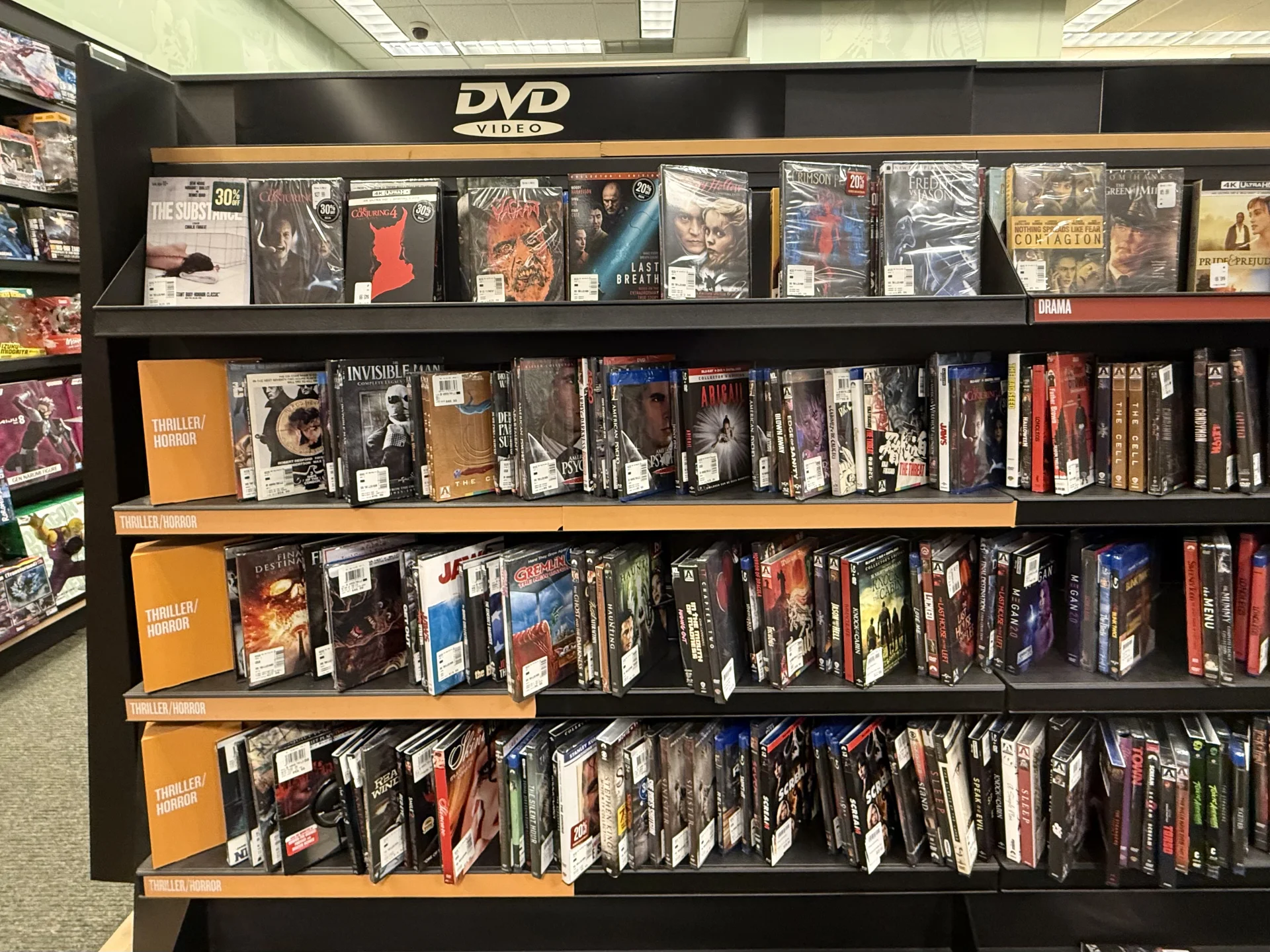

Last week I was browsing a vintage shop in Orange County, flipping through a crate of DVDs, when the guy behind the counter told me that physical media has been making a serious comeback lately. I told him I work at Hyperlific, and we ended up talking for about forty minutes. He’s been watching his DVD sales climb for over a year now, and the customers driving it aren’t who most people would expect.
That conversation got me thinking about the bigger picture, because the data backs up what he’s seeing on the ground. And the story it tells is one that matters to anyone who cares about owning the things they love.
The Mainstream Numbers Are Misleading
If you just look at the top-line stats, physical media looks finished. DVD sales peaked at $16 billion in 2005 and fell to under $1 billion by 2024. Streaming accounts for roughly 90% of home entertainment spending now. On paper, the format is dead.
But those numbers describe the mass market, and the mass market was never the whole story. Physical media collections grew 15% year over year recently. Collectors now represent 40% of worldwide DVD sales. On eBay, DVD and Blu-ray listings jumped 30% annually, making it one of the platform’s top-selling categories. Reddit communities dedicated to DVD collecting have crossed 400,000 members.
What’s happening isn’t a mainstream revival. It’s a collector-driven resurgence. A community of people who value ownership, curation, and the physical object itself, and that community is getting bigger every year.
Gen Z Gets It
The salesman told me his fastest-growing customer base is young. That tracks with everything we’ve been seeing. Gen Z, people who grew up entirely inside the streaming ecosystem, are now the ones hunting through thrift stores and posting their DVD and VHS hauls online.
And when you talk to them about why, it makes complete sense. Streaming is built on access, not ownership. Services pull titles without warning. They edit content. They cancel shows that vanish completely. If you fell in love with something on a platform last year, there’s no guarantee it exists there next year. Or anywhere.
A DVD or a Blu-ray doesn’t have that problem. You buy it, you own it, and no one gets to decide later whether you can watch it again. That kind of permanence used to be the default. Now it feels almost countercultural.
There’s also the collection itself. A shelf full of physical media tells people who you are in a way a streaming queue never will. It’s your taste made visible, made tangible. You can walk into someone’s place and learn something real about them from what’s on their shelf. We’ve always believed in that at Hyperlific. It’s part of why we do what we do. It’s good to see a whole new generation arriving at the same feeling on their own.
The Economics Make More Sense Than People Think
The average American household spends over $600 a year on streaming subscriptions now, and that number keeps going up. Every service raises prices. Every service adds an ad tier. Every service gates features behind a more expensive plan. You pay more and more for the right to temporarily access a shifting library someone else controls.
The salesman I talked to was ringing up DVDs at two dollars each. Some were a quarter. Even premium editions like Criterion releases are a one-time purchase. You pay once, it’s yours, forever.
And this isn’t an either/or situation. Over half of DVD buyers still have streaming subscriptions. Physical media hasn’t replaced streaming for these people. It’s become the thing they turn to when they want to actually own something instead of renting access to it month by month. It’s a natural response to subscription fatigue, and anyone paying attention to how people feel about their sixth or seventh streaming bill can see why.
The Experience Is Half the Point
This is what the big retailers got wrong when they cleared out their physical media sections. Buying DVDs and VHS tapes at a vintage shop or a thrift store isn’t the same as adding something to a digital cart. It’s a completely different experience.
You walk in without knowing what you’ll find. Maybe it’s a horror movie you haven’t thought about in years. Maybe it’s a director’s cut with commentary and extras that never made it to any streaming platform. Maybe it’s a steelbook edition you didn’t know existed. That feeling of discovery, of stumbling onto something unexpected, is part of what makes collecting physical media so satisfying. An algorithm recommending things based on your watch history will never replicate it.
Limited edition releases sell out in weeks now. Horror and kids’ titles move consistently. Collectors actively seek out special packaging, behind-the-scenes content, and all the bonus material that streaming platforms stripped away to save on bandwidth and licensing costs. The things the industry treated as disposable turned out to be exactly what people wanted to hold onto.
He Knew What He Was Talking About
I went back to that shop a few days later and picked up a small stack. Six dollars total. I could have streamed most of them, but that wasn’t the point.
The salesman was right, and not just about his own store. Vintage shops are sitting at the exact intersection of affordability, nostalgia, and a growing collector culture that’s only gaining momentum. They’re seeing real, measurable growth while the broader market keeps shrinking, because they understand something the industry spent years ignoring: people want to own things. They want to hold something in their hands, put it on a shelf, and know it’ll still be there tomorrow.
The future of entertainment is mostly digital. We know that. But physical media is becoming collectible again in a way that feels less like a throwback and more like a correction. The people buying DVDs and VHS tapes right now aren’t being sentimental. They’re making a practical choice about ownership in a world where access to the things you love has become increasingly temporary.
We think that’s worth paying attention to. Honestly, we think it’s worth celebrating.
'%3e%3cg id='Final-Copy-2_2_' transform='translate(1275.000000, 200.000000)'%3e%3cpath class='st0' d='M7.4,12.8h6.8l3.1-11.6H7.4C4.2,1.2,1.6,3.8,1.6,7S4.2,12.8,7.4,12.8z'/%3e%3c/g%3e%3c/g%3e%3c/g%3e%3cg id='final---dec.11-2020'%3e%3cg id='_x30_208-our-toggle' transform='translate(-1275.000000, -200.000000)'%3e%3cg id='Final-Copy-2' transform='translate(1275.000000, 200.000000)'%3e%3cpath class='st1' d='M22.6,0H7.4c-3.9,0-7,3.1-7,7s3.1,7,7,7h15.2c3.9,0,7-3.1,7-7S26.4,0,22.6,0z M1.6,7c0-3.2,2.6-5.8,5.8-5.8 h9.9l-3.1,11.6H7.4C4.2,12.8,1.6,10.2,1.6,7z'/%3e%3cpath id='x' class='st2' d='M24.6,4c0.2,0.2,0.2,0.6,0,0.8l0,0L22.5,7l2.2,2.2c0.2,0.2,0.2,0.6,0,0.8c-0.2,0.2-0.6,0.2-0.8,0 l0,0l-2.2-2.2L19.5,10c-0.2,0.2-0.6,0.2-0.8,0c-0.2-0.2-0.2-0.6,0-0.8l0,0L20.8,7l-2.2-2.2c-0.2-0.2-0.2-0.6,0-0.8 c0.2-0.2,0.6-0.2,0.8,0l0,0l2.2,2.2L23.8,4C24,3.8,24.4,3.8,24.6,4z'/%3e%3cpath id='y' class='st3' d='M12.7,4.1c0.2,0.2,0.3,0.6,0.1,0.8l0,0L8.6,9.8C8.5,9.9,8.4,10,8.3,10c-0.2,0.1-0.5,0.1-0.7-0.1l0,0 L5.4,7.7c-0.2-0.2-0.2-0.6,0-0.8c0.2-0.2,0.6-0.2,0.8,0l0,0L8,8.6l3.8-4.5C12,3.9,12.4,3.9,12.7,4.1z'/%3e%3c/g%3e%3c/g%3e%3c/g%3e%3c/g%3e%3c/svg%3e) Your Privacy Choices
Your Privacy Choices