

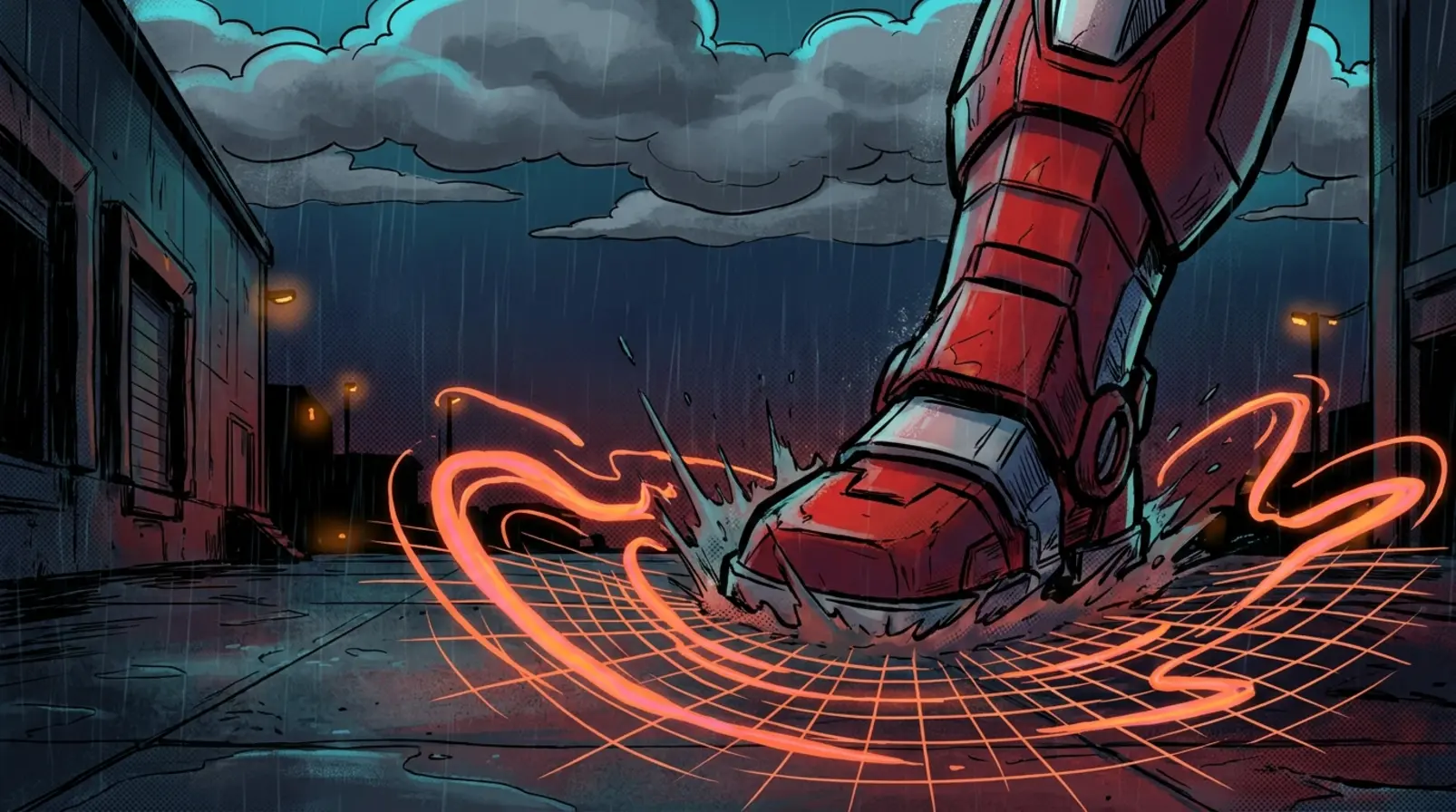

Ultraman: Rising is a 2024 3DCG-animated superhero film directed by Shannon Tindle and co-directed by John Aoshima, released on Netflix on June 14, 2024. Co-produced by Tsuburaya Productions and Industrial Light & Magic, the film follows baseball star Ken Sato as he inherits the Ultraman mantle and reluctantly raises a baby kaiju. Its manga-and-anime-inspired visual style stands as arguably the strongest argument that the post-Spider-Verse animation revolution was never about cloning one look.
Twenty-Three Years from Sketch to Screen
The story behind Ultraman: Rising is almost more improbable than its plot. As far back as 2001, Tindle had toyed with the idea of making an Ultraman-inspired film centered on a reluctant father to a baby kaiju, as he recounted to Netflix Tudum. The film began as an original idea conceived before Tindle joined the production team of Foster’s Home for Imaginary Friends in 2001. The project went through multiple names and studios. Tindle further developed the film, writing a script and creating art at Sony Pictures Animation from 2015 to 2018; at the time, the plot would have followed “a billionaire forced to grow up when he takes on the orphaned children of his former foe.”
After leaving Sony, Tindle moved to Netflix Animation to produce the live-action/animation hybrid series Lost Ollie with fellow Sony Animation director Peter Ramsey, where he had the opportunity to repurpose the plot for his film to fit with the Ultraman IP. The project was announced as a Netflix exclusive in May 2021, with Tindle and John Aoshima to co-direct. That’s two decades of a single creative vision bouncing between networks, studios, and IP frameworks before finally clicking into place. I’d argue that kind of obsessive gestation is exactly why the finished film feels so confident in its own skin.
ILM’s Return to Feature Animation with Ultraman: Rising
Netflix’s Ultraman: Rising marks the first fully animated feature production for Industrial Light & Magic since 2011’s Rango. The scale of the undertaking was enormous. All 165,169 frames of the entire 108-minute feature were created by over 650 ILM artists across three global studios in London, Vancouver, and Singapore, with ILM Vancouver contributing the majority of work with over 300 artists assigned to the project.
How did Tindle lure ILM back into animation? Producer Tom Knott “was seeing the dailies that were coming in from ILM for Lost Ollie, and he was blown away,” Tindle told Inverse. When ILM initially said they weren’t doing animated films, Tindle set what he called “a trap,” hosting a meeting about Ollie in the Ultraman room, which was covered in artwork for the film. For decades, ILM had been at the forefront of visual-effects-based animation, but Ultraman: Rising marked a shift, embracing stylization while maintaining strong, character-driven storytelling.
The Spider-Verse Revolution and Its Imitators
To understand what Ultraman: Rising accomplished visually, you have to understand the landscape it entered. Sony’s Spider-Man: Into the Spider-Verse grossed $394 million worldwide against a $90 million budget, won Best Animated Feature at the 91st Academy Awards, and is acknowledged by many in the film industry for its groundbreaking achievement in animation. The film’s hybrid of CG rendering, hand-drawn textures, Ben-Day dots, and animation on “twos” blew a hole in the wall that Pixar’s photorealistic orthodoxy had built.
What followed was a wave of films that absorbed those lessons with varying degrees of originality. In the wake of Sony Pictures Animation’s unprecedented success with Into the Spider-Verse, other major animation studios followed suit, such as DreamWorks’ Puss in Boots: The Last Wish (2022) and Nickelodeon’s Teenage Mutant Ninja Turtles: Mutant Mayhem (2023). Common among these films are unique animation styles. But what this new wave of animated films shows is that animation thrives on what is distinctly non-realistic, allowing room for artistic expression.
In my view, the problem wasn’t that studios were inspired by Spider-Verse. The problem was the growing audience expectation that every stylized CG film should look like Spider-Verse. Fan communities lit up with complaints when films like Kung Fu Panda 4 and Transformers One didn’t adopt the stepped-frame, comic-panel aesthetic. The revolution was calcifying into a new orthodoxy. And then Ultraman: Rising showed up.
Manga DNA, Not Comic-Book DNA: How Ultraman: Rising Broke the Mold
Having other hit animated superhero feature films already on the audience’s radars, such as Sony’s Spider-Man: Into the Spider-Verse, meant finding a new look for Ultraman. Ultimately, a painterly approach to shape the film’s aesthetic was decided upon. ILM acknowledged the comparison head-on, and then swerved hard in a different direction.
The visual grammar of Ultraman: Rising is rooted in Japanese visual traditions, not American comics. The marker renderings were inspired by particular manga cover illustrations. VFX Supervisor Hayden Jones told IndieWire they called them “Otomo moments, because when we first started talking to Shannon and the art department, they were looking at a lot of artwork from Katsuhiro Otomo, who created ‘Akira.’” These color-flood sequences punctuate the film’s emotional peaks with a technique that has no equivalent in the Spider-Verse playbook.
The team used Kuwahara filtering to make the shadow areas smooth and soft, producing a marker-pen watercolor finish that reads completely differently from Spider-Verse‘s halftone dots. Drawing inspiration from the lanky proportions of the gigantic mecha in the famous anime Neon Genesis Evangelion, Tindle accentuated the character’s alien nature, giving him long, sinewy limbs and a sleek, brushed-steel-looking exterior.
And then there’s the frame rate. Tindle remembered a conversation about whether to animate on “twos and threes.” He said that in American animation, it’s uncommon to animate on “threes,” but it’s quite common in anime. Early tests explored this method, but after extensive discussion, Tindle decided to use single-frame animation. This is a direct, deliberate departure from Spider-Verse‘s signature “on twos” stepped look. Where Sony’s film embraced choppiness as style, Tindle chose full 24fps fluidity.
Why Ultraman: Rising Killed the Clone Narrative
I’d argue the film’s visual identity holds together so well precisely because every choice traces back to a specific cultural reference rather than a generic “stylized CG” impulse. Tindle and Aoshima tried to create a new animation style by combining different influences instead of following just one. The team was inspired by the success of the Spider-Verse films, but planned the project with a new and unique visual style, mixing anime with classic American animation.
The Kuwahara filtering is manga. The Otomo color floods are manga. The Evangelion proportions are anime. The impact frames, where 3D snaps to hand-drawn 2D for a few frames during hits, are pulled from tokusatsu and anime fight choreography. None of this is Spider-Verse. It’s a parallel tradition, applied with equal rigor to the same underlying technology.
My take is that Ultraman: Rising proved something the best post-Spider-Verse films had been hinting at: the real lesson of Into the Spider-Verse was permission, not prescription. Permission to reject photorealism. Permission to let concept art drive the final image. Permission to make every frame look like it belongs to your source material, not someone else’s. As filmmakers who followed in Spider-Verse‘s wake have noted, Sony’s breakthrough showed that a movie can look like its concept artwork and still be critically and financially successful — and that opened a lot of doors for stylized animation.
The Numbers and the Nominations
The film performed well. It ranked #2 on Netflix’s global top 10 the week of June 17-23, 2024, with 7.9 million views. On the review aggregator website Rotten Tomatoes, 86% of 49 critics’ reviews are positive, with an average rating of 7.2/10.
The awards circuit took notice. Ultraman: Rising was nominated for Best Feature, Best FX, Best Production Design, and Best Editorial at the 52nd Annie Awards. It was also nominated for Outstanding Visual Effects in an Animated Feature and Outstanding Effects Simulations in an Animated Feature at the 23rd Annual VES Awards, and won Outstanding Animated Special at the 2025 Children’s & Family Emmys.
Tindle’s Industry and the Question of What Comes Next
Shannon Tindle’s career arc reads like a who’s-who of animation craftsmanship. He worked on such successful animated projects as the Oscar-nominated Coraline, the Emmy-winning Lost Ollie, and the twice Oscar-nominated Kubo and the Two Strings, as detailed by Netflix Tudum. Both Tindle and Aoshima are CalArts alumni, with Tindle graduating in 1999 and Aoshima in 2000.
On the animation industry’s current state, Tindle has been candid. At the VIEW Conference, he said: “We’re having a lull now, but that’s what this business is. It’s peaks and valleys, and we’re in a valley right now, but I think we’re all crawling our way out of it.”
As for a sequel, the outlook is uncertain. At the 2024 Lightbox Expo, Tindle revealed he had already started writing a potential sequel with a working title: Ultraman: Fallen, which would begin with Emiko Sato. But as of early 2025, he indicated on social media that a sequel isn’t currently in the cards. In my view, that’s a genuine loss. The film’s mid-credits scene, showing Emiko stranded on the Ultra’s home planet in Nebula M78, suggested a deeper dive into Ultraman mythology that could elevate the franchise into something truly special.
The Bigger Picture for Animation
The post-Spider-Verse landscape is now mature enough to evaluate honestly. The best entries, I’d argue, are the ones that treated Sony’s breakthrough as a starting gun, not a finish line. Puss in Boots: The Last Wish built a storybook watercolor world. TMNT: Mutant Mayhem went gritty and sketchbook-raw. Ultraman: Rising dove into manga and tokusatsu. Each found its own visual language rooted in its own source material.
The clone era, to me, is over. What killed it wasn’t a single film but a critical mass of proof that non-photorealistic CG can mean a hundred different things. Ultraman: Rising is the clearest, most technically documented case study of that principle in action. It took a VFX house that hadn’t made an animated feature in 13 years, a director who’d been chasing one idea for more than two decades, and a Japanese superhero who’s been defending Tokyo since 1966, and it made something that looks like nothing else on any streaming platform.
That’s the real inheritance of Spider-Verse. Not a style. A dare.
Frequently Asked Questions About Ultraman: Rising
What animation studio made Ultraman: Rising?
Ultraman: Rising was animated by Industrial Light & Magic (ILM), marking ILM’s first fully animated feature production since 2011’s Rango. It is a co-production between Netflix Animation Studios and Tsuburaya Productions.
How is Ultraman: Rising’s animation style different from Spider-Verse?
The film uses Kuwahara filtering for a marker-pen watercolor finish (versus Spider-Verse’s halftone/Ben-Day dots), animates on “ones” at full 24fps (versus Spider-Verse’s signature “on twos”), and draws its textures from manga traditions like Katsuhiro Otomo’s Akira and the proportions of Neon Genesis Evangelion, rather than American comic-book visual grammar.
How long did it take Shannon Tindle to make Ultraman: Rising?
Tindle had been working on Ultraman: Rising for over 20 years, first developing it as Made in Japan, a movie unrelated to the Ultraman franchise, as he told Inverse. Production on the final film began in the spring of 2021.
Did Ultraman: Rising win any awards?
The film was nominated for Best Feature, Best FX, Best Production Design, and Best Editorial at the 52nd Annie Awards. It was also nominated for Outstanding Visual Effects in an Animated Feature at the 23rd Annual VES Awards, won Outstanding Animated Special at the 2025 Children’s & Family Emmys, and won a 2024 HPA Award for Outstanding Visual Effects.
Will there be an Ultraman: Rising sequel?
Tindle revealed at the 2024 Lightbox Expo that he’d started writing a potential sequel titled Ultraman: Fallen, which would begin with Emiko Sato. However, as of early 2025, Tindle indicated on social media that a sequel is not currently greenlit.
Where can I watch Ultraman: Rising?
Ultraman: Rising was released worldwide on Netflix on June 14, 2024. It is available to stream on Netflix.
'%3e%3cg id='Final-Copy-2_2_' transform='translate(1275.000000, 200.000000)'%3e%3cpath class='st0' d='M7.4,12.8h6.8l3.1-11.6H7.4C4.2,1.2,1.6,3.8,1.6,7S4.2,12.8,7.4,12.8z'/%3e%3c/g%3e%3c/g%3e%3c/g%3e%3cg id='final---dec.11-2020'%3e%3cg id='_x30_208-our-toggle' transform='translate(-1275.000000, -200.000000)'%3e%3cg id='Final-Copy-2' transform='translate(1275.000000, 200.000000)'%3e%3cpath class='st1' d='M22.6,0H7.4c-3.9,0-7,3.1-7,7s3.1,7,7,7h15.2c3.9,0,7-3.1,7-7S26.4,0,22.6,0z M1.6,7c0-3.2,2.6-5.8,5.8-5.8 h9.9l-3.1,11.6H7.4C4.2,12.8,1.6,10.2,1.6,7z'/%3e%3cpath id='x' class='st2' d='M24.6,4c0.2,0.2,0.2,0.6,0,0.8l0,0L22.5,7l2.2,2.2c0.2,0.2,0.2,0.6,0,0.8c-0.2,0.2-0.6,0.2-0.8,0 l0,0l-2.2-2.2L19.5,10c-0.2,0.2-0.6,0.2-0.8,0c-0.2-0.2-0.2-0.6,0-0.8l0,0L20.8,7l-2.2-2.2c-0.2-0.2-0.2-0.6,0-0.8 c0.2-0.2,0.6-0.2,0.8,0l0,0l2.2,2.2L23.8,4C24,3.8,24.4,3.8,24.6,4z'/%3e%3cpath id='y' class='st3' d='M12.7,4.1c0.2,0.2,0.3,0.6,0.1,0.8l0,0L8.6,9.8C8.5,9.9,8.4,10,8.3,10c-0.2,0.1-0.5,0.1-0.7-0.1l0,0 L5.4,7.7c-0.2-0.2-0.2-0.6,0-0.8c0.2-0.2,0.6-0.2,0.8,0l0,0L8,8.6l3.8-4.5C12,3.9,12.4,3.9,12.7,4.1z'/%3e%3c/g%3e%3c/g%3e%3c/g%3e%3c/g%3e%3c/svg%3e) Your Privacy Choices
Your Privacy Choices