

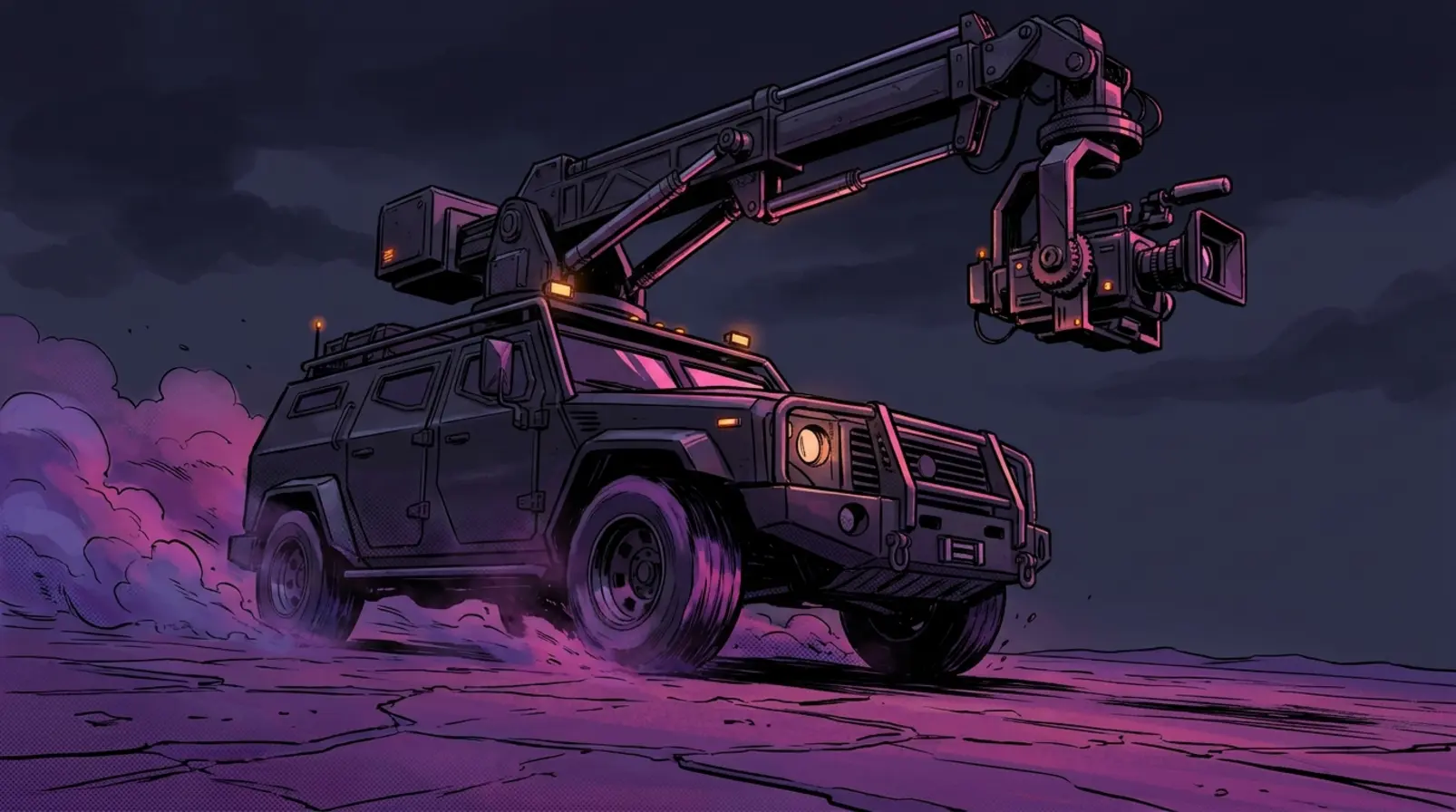

The Cranky Black is a heavily modified hot rod from Furiosa: A Mad Max Saga (2024), built from the cab, doors, and chassis of a 1931 Ford Model A and powered by a rear-mounted turbocharged V8 engine. Named after a line of dialogue spoken by the warlord Dementus, the vehicle has become a focal point in the ongoing debate over practical versus digital effects in modern action cinema and a symbol of director George Miller’s hybrid filmmaking philosophy.
What the Cranky Black Actually Is, and Why It Matters Beyond the Screen
Furiosa takes the car from Scrotus after War Boys repair it during the final day of the Forty-Day Wasteland War. Its name derives from a line spoken by Dementus to Furiosa: “We seek any sensation to wash away the cranky-black sorrow.” In the film’s mythology, it’s a weapon. In the wider conversation about how blockbuster action gets made, I’d argue it’s something more: an emblem of the tension between what’s real and what’s rendered.
As Miller himself told Hagerty, “Furiosa ultimately has that vehicle we call the Cranky Black that’s an expression of who she is at the end of the movie.” He says the cars themselves are characters, and “they’re extensions of the characters. You see it right through the ‘Mad Max’ films. The V-8 Interceptor is an extension of Max.” In my view, no other vehicle in the franchise carries as much thematic weight with so little screen time. The Cranky Black is grief with a harpoon gun.
Anya Taylor-Joy said, “I love the fact there are all these details in the filmmaking that you don’t even see as an audience member. Like, the Cranky Black has human teeth all along the inside, which is so cool.” That kind of obsessive physical detail is the reason Miller’s vehicles feel inhabited rather than animated. And yet, the Cranky Black also exists as a fully digital asset. According to VFX supervisor Josh Simmonds at Framestore, in an interview with AWN, “In the case of the Cranky Black, which is the hot rod that Furiosa is driving at the end, we built it completely” from scratch as a CG asset for certain shots. The car is simultaneously handcrafted and digital, practical and virtual. I’d argue that duality is the whole story.
The Cranky Black and the “90% Practical” Myth That Won’t Die
When Mad Max: Fury Road hit theaters in May 2015, the marketing leaned hard on one talking point: this was a real movie with real stunts. Prior to the film’s release, the production was promoted as being overwhelmingly practical in its effects approach. The production involved a six-month-long shoot in the Namibian desert, where DOP John Seale used multiple digital cameras to capture incredible practical stunts with more than 150 vehicles conceived by production designer Colin Gibson. The narrative calcified fast: Fury Road was pure, analog, unsullied by pixels.
The reality is considerably more complicated. As fxguide reported, VFX supervisor Andrew Jackson said: “I’ve been joking recently about how the film has been promoted as being a live action stunt driven film […] The reality is that there’s 2000 VFX shots in the film.” The film contained over 2,000 VFX shots out of an overall total of approximately 2,700. To put that in perspective, that means roughly three-quarters of the film’s shots involved some form of digital work — a ratio comparable to films widely considered CGI-heavy.
Miller himself eventually got more candid. As he told Vulture in 2022, “There was not one shot in that movie that wasn’t CGI in one way or another.” The genius was never the absence of digital work. It was the invisibility of it. As Jackson explained in an fxguide roundtable, the philosophy was grounded in two principles: “This film is firmly grounded in reality, all the things that happen are theoretically possible in the real world. The second point is that George was very keen to let the randomness of the real world determine, at least some of the outcome of each event. The combination of these two facts swung the decision towards practical effects wherever possible.”
How George Miller’s VFX Philosophy Evolved Between Fury Road and Furiosa
Nine years separated the two films. In that gap, the tools changed. Miller changed with them. Thanks to photorealistic tech advancements, George Miller evolved his approach to VFX on the Mad Max franchise. As IndieWire reported, he was much more comfortable using CG in post on Furiosa, where his stunt-driven chase sequences were shot in-camera with as many practical effects as possible, but CG enabled him to achieve greater dynamic energy.
Jackson confirmed the shift, saying that Furiosa “leans much more heavily [than Fury Road] on visual effects” and that Miller “completely embraced the idea that CG is the way to go to build worlds and do whatever we need to do in post.” The elaborate “Stowaway to Nowhere” sequence was planned using action designer Guy Norris’s PROXi virtual production system, which utilizes performance capture and real-time rendering of Unreal Engine, enabling them to plan the sequence’s 197 shots, filmed on 78 separate days.
The Lord of the Rings trilogy was a direct inspiration. During a special screening, as /Film reported, Miller talked about being inspired by how cinematographer Andrew Lesnie showed him motion capture footage from The Lord of the Rings and how the films’ use of motion capture for Gollum made him want to use the same tech for Happy Feet. That thread runs straight through to the Mad Max films: capture something real, then sculpt it digitally. My take is that Miller treats CGI the way a great producer treats a mixing board. You don’t hear the compression. You feel the song.
The Cranky Black and the “Weightless” Backlash Against Furiosa
When the Furiosa trailer dropped, the backlash was immediate and loud. Online communities lit up with complaints that the footage looked more synthetic than Fury Road. The first trailer made the film look more CGI and green-screen-heavy compared to Fury Road. From the early clips and posters, Furiosa looked like it lacked the gritty tactility of its predecessor, and this arguably hurt the film, as there was little social media buzz surrounding the release.
The box office told the rest of the story. Furiosa: A Mad Max Saga grossed $67.6 million in the United States and Canada, and $105.3 million in other territories, for a worldwide total of $174.4 million. The film’s box-office performance has been deemed a failure. In April 2025, Deadline Hollywood calculated the film lost the studio $119.6 million, when factoring together all expenses and revenues.
Was the CGI perception a meaningful factor? I think so, but it wasn’t the only one. From Solo: A Star Wars Story to The Hunger Games: The Ballad of Songbirds & Snakes, movie prequels have been known to underperform. The storied history of a world like Mad Max might seem like a big, untapped well of content, but prequel stories are rarely compelling, because the ending is predetermined. Still, the “it looks fake” conversation around Furiosa exposed something real about audience psychology: the mythologized purity of Fury Road had become a benchmark that no sequel could meet, because the benchmark itself was partly fiction.
Why “Weightless” CGI Remains the Unsolved Problem in Action Filmmaking
Miller articulated the core issue clearly in pre-release interviews: “We don’t defy the laws of physics. There are no flying humans. There’s no spacecraft. So it’s not a green screen, CG movie. It’s analog compared to digital. You go and crash a car, no matter what simulations you do, you are never going to get the detail of the fragments and the way the sand behaves. It will look fake.”
That statement is the philosophical spine of everything Miller does. Special effects supervisor Andy Williams confirmed in an fxguide roundtable: “George wanted every stunt and piece of SFX action to be prepped and rehearsed as a live action shot. Only if it was impossible to shoot safely did VFX department come to the rescue. In the end there was a mountain of VFX required, but never to completely replace live action.” In my view, this hierarchy of intent is what separates Miller from most contemporary action directors. The practical stunt is the foundation. The digital layer is the polish, not the structure.
On Furiosa, VFX artists allowed production to keep shooting in Australia even though the weather in New South Wales was not ideal for a desert-based film. Miller had to move the Fury Road shoot to Namibia because rain caused wildflowers to grow in the Australian desert. According to Framestore’s Josh Simmonds, during the opening chase, “we ended up pretty much having to replace all of the ground.” Colourist Eric Whipp noted that “a lot of the backgrounds in this film are full CG.” The irony is thick: the film that fans criticized for looking “too digital” was digital in large part because nature was too green.
The Cranky Black as a Symbol of Miller’s Filmmaking Contradiction
The physical Cranky Black is a heavily modified hot rod comprised of bits of the cab, doors, and chassis of a ’31 Ford Model A. It was built by hand, fitted with human teeth stitched into its leather interior, and given a rear-mounted turbocharged V8 for sand-dune climbing. It exists. You could sit in it. And yet Jackson used VFX for the final chase sequence, where a CGI version of Furiosa’s otherwise practical car was used to animate “things just far too dangerous to be doing with a real car, like side-swiping motorbikes.”
I’d argue the Cranky Black is the perfect metaphor for Miller’s entire approach. Build it for real. Give it teeth. Then, when physics says no, let the digital artists take over, seamlessly, so the audience never has to choose between believing and watching. The car is both artifact and illusion. The film is both practical and digital. The line between the two is, in Miller’s best work, invisible.
Like a dark little beetle scuttling and hurtling along the dunes, the Cranky Black embodies Furiosa’s pitch-black pain and anger. In this vehicle, the History Man calls her “the darkest of angels, the Fifth Rider of the Apocalypse.” That’s the character. But it’s also, to me, the franchise itself: hurtling forward, refusing to slow down, carrying grief and ambition and a turbocharged engine that runs on both gasoline and pixels.
Cranky Black FAQ
What is the Cranky Black in Furiosa: A Mad Max Saga?
Furiosa takes a car called the Cranky Black during the final day of the Forty-Day Wasteland War. Its name derives from a line spoken by Dementus: “We seek any sensation to wash away the cranky-black sorrow.” It is a heavily modified hot rod comprised of bits of the cab, doors, and chassis of a ’31 Ford Model A.
Was the Cranky Black a real car or CGI?
Both. A physical vehicle was built for production, complete with handcrafted details like human teeth in the interior. However, Framestore’s Josh Simmonds confirmed in an AWN interview that for certain shots, “the Cranky Black, which is the hot rod that Furiosa is driving at the end, we built it completely” from scratch as a digital asset. A CGI version was used to animate dangerous maneuvers like “side-swiping motorbikes.”
How much CGI was actually in Mad Max: Fury Road?
Though praised for its practical effects, Fury Road included over 2,000 VFX shots out of approximately 2,700 total. Miller told Vulture: “There was not one shot in that movie that wasn’t CGI in one way or another.” The practical stunts provided the foundation, but digital work was pervasive and essential.
Did Furiosa use more CGI than Fury Road?
VFX supervisor Andrew Jackson said that Furiosa “leans much more heavily [than Fury Road] on visual effects” and that Miller fully embraced CG for world-building and post-production work. Photorealistic tech advancements in the nine years since Fury Road allowed Miller to be much more comfortable using CG in post.
Why did Furiosa underperform at the box office?
Multiple factors contributed. Furiosa grossed $174.4 million worldwide and lost the studio an estimated $119.6 million. The trailer’s perceived over-reliance on CGI dampened enthusiasm. Prequels have historically underperformed, and waiting nine years to release another Mad Max movie after Fury Road undoubtedly affected its box office performance.
Will there be another Mad Max film after Furiosa?
In February 2025, Miller stated in an interview with Vulture that he was still interested in making The Wasteland despite Furiosa‘s underperformance, but admitted he wanted to focus on other projects first. The project’s future remains uncertain given the financial losses.

'%3e%3cg id='Final-Copy-2_2_' transform='translate(1275.000000, 200.000000)'%3e%3cpath class='st0' d='M7.4,12.8h6.8l3.1-11.6H7.4C4.2,1.2,1.6,3.8,1.6,7S4.2,12.8,7.4,12.8z'/%3e%3c/g%3e%3c/g%3e%3c/g%3e%3cg id='final---dec.11-2020'%3e%3cg id='_x30_208-our-toggle' transform='translate(-1275.000000, -200.000000)'%3e%3cg id='Final-Copy-2' transform='translate(1275.000000, 200.000000)'%3e%3cpath class='st1' d='M22.6,0H7.4c-3.9,0-7,3.1-7,7s3.1,7,7,7h15.2c3.9,0,7-3.1,7-7S26.4,0,22.6,0z M1.6,7c0-3.2,2.6-5.8,5.8-5.8 h9.9l-3.1,11.6H7.4C4.2,12.8,1.6,10.2,1.6,7z'/%3e%3cpath id='x' class='st2' d='M24.6,4c0.2,0.2,0.2,0.6,0,0.8l0,0L22.5,7l2.2,2.2c0.2,0.2,0.2,0.6,0,0.8c-0.2,0.2-0.6,0.2-0.8,0 l0,0l-2.2-2.2L19.5,10c-0.2,0.2-0.6,0.2-0.8,0c-0.2-0.2-0.2-0.6,0-0.8l0,0L20.8,7l-2.2-2.2c-0.2-0.2-0.2-0.6,0-0.8 c0.2-0.2,0.6-0.2,0.8,0l0,0l2.2,2.2L23.8,4C24,3.8,24.4,3.8,24.6,4z'/%3e%3cpath id='y' class='st3' d='M12.7,4.1c0.2,0.2,0.3,0.6,0.1,0.8l0,0L8.6,9.8C8.5,9.9,8.4,10,8.3,10c-0.2,0.1-0.5,0.1-0.7-0.1l0,0 L5.4,7.7c-0.2-0.2-0.2-0.6,0-0.8c0.2-0.2,0.6-0.2,0.8,0l0,0L8,8.6l3.8-4.5C12,3.9,12.4,3.9,12.7,4.1z'/%3e%3c/g%3e%3c/g%3e%3c/g%3e%3c/g%3e%3c/svg%3e) Your Privacy Choices
Your Privacy Choices