

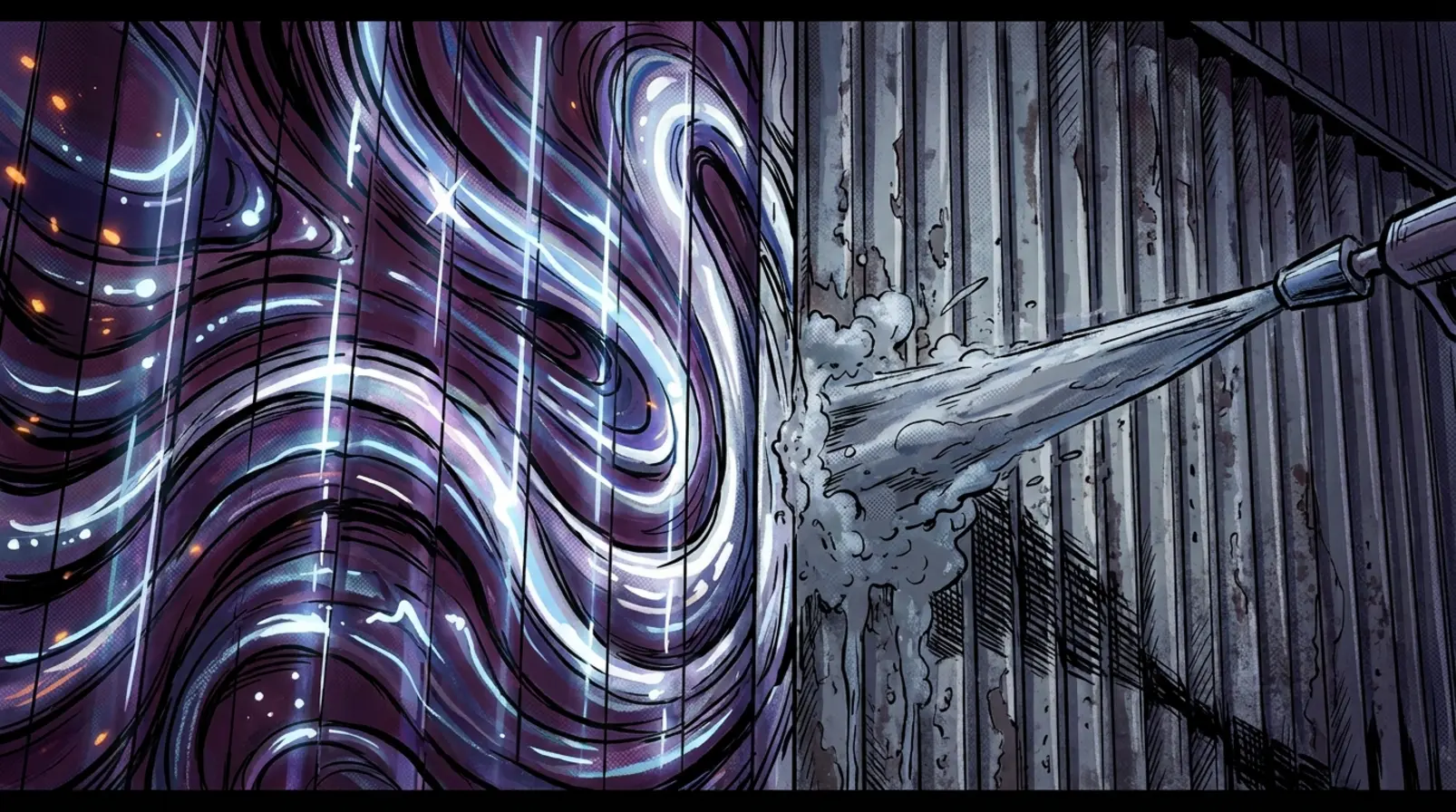

Philadelphia’s graffiti war is the escalating conflict between the city’s multimillion-dollar anti-graffiti abatement operation, known among writers as “the buff,” and the deeply rooted graffiti culture that has defined Philadelphia’s streetscape since the mid-1960s. With $11.5 million committed to the “Gateways to Philadelphia” beautification project ahead of the 2026 FIFA World Cup and the nation’s semiquincentennial, the city is waging its most aggressive cleanup campaign in decades. Writers are pushing back with rappel techniques, buff-resistant inks, and an unshakable conviction that the walls belong to them.
Philadelphia’s Graffiti War Didn’t Start in 2026
Darryl McCray, born in 1953 and better known by his tagging name Cornbread, is an American graffiti writer from Philadelphia who is widely considered the world’s first modern graffiti artist. In 1965, when McCray was a kid in Brewerytown, he was sent to juvenile detention for two years. He came out with a nickname and a compulsion. To win the attention of a girl named Cynthia Custuss, he wrote “Cornbread Loves Cynthia” all over North Philadelphia. When Philadelphia newspapers incorrectly identified him as dead in 1971, Cornbread decided to tag an elephant at the Philadelphia Zoo to attract media attention.
That gesture set the tone for six decades of writing culture. Philadelphia’s name writing in public spaces is an underrated gem in street penmanship and an underrepresented phenomenon in the cartography of American graffiti, boasting a highly autarkic and unique street tagging scene. French typographer François Chastanet, who studied Philly handstyles during a Villa Albertine residency in April and May 2023, documented how this handcrafted visual identity has remained stable over the years, despite some evolutions since its emergence in the mid-to-late 1960s.
I’d argue that Philadelphia’s writing culture is the most tenacious in America precisely because it never chased the New York model. The Philly “wicked” and “tall hand” styles evolved in relative isolation, a calligraphic dialect spoken fluently within city limits and mostly ignored outside them. That insularity is its strength.
How the Buff Became Philadelphia’s Biggest Crew
Launched in 1984 by former Mayor Wilson Goode, the Anti-Graffiti Network removes more than 100,000 graffiti pieces every year, clearing unwanted paint from corner mailboxes to expansive freeway walls. In 1986, another program began within PAGN, named The Mural Arts Project (MAP), headed by artist Jane Golden. Through the success of both programs, in 1991 the city of Philadelphia was awarded the Innovations in American Government Award.
That was the blueprint. But under Mayor Cherelle L. Parker, the machinery has been rebuilt at industrial scale. Director Carlton Williams currently leads the Office of Clean and Green Initiatives, which is responsible for developing a proactive and responsive citywide strategy that addresses quality of life issues including vacant lot cleaning, graffiti removal, and abandoned vehicle removal.
Whether it’s small tags on mailboxes, street signs, or warehouses, Williams said cleaning crews are dispatched within 24 to 48 hours of first spotting graffiti. The mission, Williams said, is to turn areas along I-95 and I-76 into “zero graffiti tolerance zones,” and according to data collected from January 2024 to January 2025, average graffiti complaints have gone down from around 1,500 per month to 800 per month.
To meet those requests, the city employs 11 graffiti removal crews and an abundance of tools. Most graffiti removal crews operate within a specific zip code, enabling them to become familiar with their coverage area, but Tim Farnon and Jonathan Heard work citywide, often tasked with removing larger graffiti tags in South Philly and Center City. Farnon completed overnight shifts clearing graffiti along I-95, where a bucket truck is needed, and work along the interstates often happens overnight so PennDOT can close a lane to help protect the workers.
In my view, the buff has become Philadelphia’s most prolific crew. It gets up more than any writer in the city. It never sleeps. It never runs out of paint.
$11.5 Million and Seven Gateways to Philadelphia
On January 9, 2026, Mayor Parker said officials are focusing their efforts on “key transportation gateways” by removing graffiti and enhancing the city’s landscape. Parker declared: “We’re going to get rid of that ugly moniker ‘Filthadelphia.’”
Work is underway for an $11.5 million beautification and anti-graffiti project ahead of Philly’s coming summer of major events. The project is led by a partnership between the city, Mural Arts Philadelphia, and the Pennsylvania Horticultural Society, funded by $6.5 million from the city, $3.5 million from the Pennsylvania Department of Transportation, private donations, and philanthropy.
In 2026, Philadelphia is projected to welcome over 1 million tourists and visitors from across the country and world to celebrate the United States’ semi-quincentennial, the FIFA World Cup, the Major League Baseball All-Star Game, and other marquee events. The Gateways to Philadelphia reimagines seven major gateways to the city. Work for the project began fall 2025 and will progress through May 2026, with improvements including ongoing graffiti abatement and litter cleanup, painting of walls, overpasses, and on and off-ramps, and visually striking landscaping.
Work began in the fall, including the planting of 95,000 bulbs in the green spaces alongside roadways that are normally barren or filled with weeds. As part of the initiative, artist Carlos Rosa will paint a mural over the CSX/Amtrak wall at Spring Garden Street that will welcome those who are visiting Philadelphia in 2026.
The Writers Hit Back Against the Buff
The cleanup campaign has not gone unanswered. In a November 2025 interview with Streets Dept, active Philadelphia graffiti writer REW described the intensity of the current buff. “Especially in Philadelphia, the way the buff is here now, dude, I mean I painted something last night and it’s probably gone already. It was a regular wall on the ground. They’re on a roll right now.”
REW is on the forefront of a technique that has recently made a big splash in Philadelphia: rappelling down from rooftops. By rappelling onto the middle of a wall, you gain access to completely new and highly visible spots to paint, and what previously made those spots inaccessible even to graffiti writers now also makes them extremely difficult to buff.
Even so, REW admitted he’s had over a dozen rappel pieces buffed in Philadelphia. The buff’s relentlessness has pushed him toward painting freight trains that carry his name out of the city entirely.
It feels like an arms race with no ceiling. Writers engineer inks formulated to resist chemical removal, targeting porous surfaces where pigment sinks into micro-textures and bleeds through fresh coats of paint. The city responds with hotter water, stronger solvents, sacrificial coatings. Online communities trade recipes for buff-proof formulas the way cooks swap sourdough starters.
The Chemical Battlefield on Philadelphia’s Walls
PennDOT spent more than $182,000 to remove graffiti from state highways last year, with more than 70% of that going toward removing taggings in and around the Philadelphia region. The city received more than 27,000 complaints about graffiti over the last 16 months, including more than two dozen that listed the “city morgue” as a troubled spot, per 311 data analyzed by Axios.
Mural Arts has been on both sides of the art versus vandalism debate as the organization spent about $50,000 to remove graffiti from more than 50 art projects tagged in 2023, and executive director Jane Golden saw a spike in the problem during the pandemic, with more artists turning to social media to grow popularity by posting pictures and videos of them brazenly tagging in public spaces.
Golden told KYW Newsradio that graffiti writers tend to avoid tagging murals, noting “the graffiti writers would tell me that they actually had a code where they wouldn’t write on a church or on a mural or sometimes even a private home, and that carried for many years. Then COVID came, and graffiti writers started writing everywhere.”
My take is that the pandemic broke something in the social contract between writers and the city. The old codes eroded. Social media turned every tag into content, every buff into engagement. The physical piece became secondary to the photograph of the piece, which lives forever regardless of what any city crew does to the wall the next morning.
Cornbread, the Godfather, Picks a Side
McCray, now 73, has positioned himself firmly with the city’s cleanup effort. Famed graffiti pioneer Darryl “Cornbread” McCray said the removal of unpermitted graffiti is a necessary step in beautifying Philadelphia.
But even he hedges. While McCray supports the city’s increased efforts, he isn’t sold on it deterring current or future wall writers from tagging. “I don’t condone graffiti, but it will never go away,” he said. “The mentality of graffiti writers doesn’t change. That will always be here.”
His “Cornbread: Legendary” exhibit, which ran through February 15 at the Paradigm Gallery + Studio, featured more than 100 of McCray’s greatest works, cementing his status as a pioneer who helped push graffiti from vandalism into legitimacy. There is something genuinely moving, I think, about a man who tagged an elephant in 1971 to prove he was alive now standing at a podium telling the next generation to put the cans down. Whether the next generation is listening is another question.
Mural Arts as Philadelphia’s Middle Path
The Mural Arts Program takes in prosecuted graffiti vandals at the rate of over 100 a year and involves them in the creation of murals. MAP is currently one of Philadelphia’s largest employers of artists, employing over 3,000 artists a year, and currently employs 36 former graffiti artists as staff members on permanent payroll and services over 300 children a year in their arts programs.
In partnership with the city, Mural Arts executive director Jane Golden wants to bring more graffiti writers into the folds of the public art program. “Mural Arts is eager to open our doors to people who have been writing on walls, who are interested in taking their talent and energy, and directing it in a positive, pro-mural direction,” she said.
Arguably, Mural Arts represents the most sophisticated attempt any American city has made to absorb graffiti culture rather than simply suppress it. The program has been running for over 40 years. Graffiti persists. That tells you something about the limits of co-optation as a strategy, and something about the depth of the impulse to write.
What Happens After the World Cup Leaves Philadelphia
While the project is happening largely because of visitors, speakers said they understood the need to maintain these new features for the city after the events end. PennDOT’s $3.5 million contribution is meant to cover long-term maintenance.
Tim Farnon and Jonathan Heard were clearing graffiti from a vandalized South Philadelphia building when they were acutely reminded that their persistence is matched by their counterparts. “They’re just going to spray paint it again,” hollered a woman parking a minivan alongside the graffiti-covered wall.
In my view, that woman nailed the central tension better than any press conference could. Philadelphia has been buffing since 1984. Philadelphia has been writing since 1965. The city is pouring $11.5 million into making its highway corridors gleam for the cameras this summer, and it will look tremendous in July. By September, the writers will be back. They always are. The question is not whether the buff can win. The question is what Philadelphia loses if it does.
Because Philly’s handstyles are not just vandalism or just art. The city boasts a highly autarkic and unique street tagging scene that represents an impressive, localized instance of a calligraphic school, and Philly handstyles exemplify the emergence of metropolitan collective identities rooted in letterforms. To erase them entirely, if that were even possible, would be to erase one of the last living calligraphic traditions in the Western world. That might not matter to the tourists driving in from the airport in July. It matters to anyone paying attention to what cities actually are.
FAQ: Philadelphia’s Graffiti War in 2026
What is “the buff” in Philadelphia graffiti culture?
“The buff” is the graffiti community’s term for the city’s official graffiti abatement operation. Launched in 1984 by former Mayor Wilson Goode, the Anti-Graffiti Network removes more than 100,000 graffiti pieces every year. Under Mayor Cherelle Parker, the city operates a “graffiti zero tolerance” policy, with Carlton Williams, director of the Office of Clean and Green Initiatives, stating: “We have a graffiti zero tolerance so when we see it, we will remove it immediately.”
How much is Philadelphia spending on graffiti removal in 2026?
City officials announced an $11.5 million initiative to clean graffiti and litter from seven high-traffic highway junctions, including the “Honeycomb Wall” near 30th Street Station and the CSX wall along the Schuylkill Expressway on Spring Garden Street. The project is funded with $6.5 million in city money, with the rest coming from the state and philanthropic groups.
Why is 2026 significant for Philadelphia’s graffiti cleanup?
Philadelphia is projected to welcome over 1 million tourists and visitors to celebrate the United States’ semi-quincentennial, the FIFA World Cup, the Major League Baseball All-Star Game, and other marquee events. The city’s leadership sees clean highways as critical to the international impression Philadelphia makes during these events.
Who is Cornbread and why does he matter to Philadelphia graffiti?
Darryl McCray, better known as Cornbread, is an American graffiti writer from Philadelphia who is widely considered the world’s first modern graffiti artist, and he pioneered the “tagging” element of hip-hop culture. In 1984, Mayor Wilson Goode recruited McCray to help him stop inner-city youth from tagging. Today he supports the city’s cleanup efforts while acknowledging graffiti will never fully disappear.
What is the Mural Arts Program’s role in Philadelphia’s graffiti war?
In 1984, the Anti-Graffiti Network hired artist Jane Golden to reach out to graffiti writers and redirect their talents into public art making. From the founding of these programs, over 2,500 murals have been created across the city and over 40,000 walls cleaned of graffiti. The program continues to serve as a bridge between the city’s enforcement goals and its writing community.
How are graffiti writers in Philadelphia adapting to the intensified buff?
Writers have adopted strategies including rappelling down buildings to reach spots the buff cannot easily access, targeting freight trains that carry their work out of the city, and using inks formulated to resist chemical removal. As writer REW told Streets Dept in November 2025: “The way the buff is here now, dude, I mean I painted something last night and it’s probably gone already. They’re on a roll right now.”
'%3e%3cg id='Final-Copy-2_2_' transform='translate(1275.000000, 200.000000)'%3e%3cpath class='st0' d='M7.4,12.8h6.8l3.1-11.6H7.4C4.2,1.2,1.6,3.8,1.6,7S4.2,12.8,7.4,12.8z'/%3e%3c/g%3e%3c/g%3e%3c/g%3e%3cg id='final---dec.11-2020'%3e%3cg id='_x30_208-our-toggle' transform='translate(-1275.000000, -200.000000)'%3e%3cg id='Final-Copy-2' transform='translate(1275.000000, 200.000000)'%3e%3cpath class='st1' d='M22.6,0H7.4c-3.9,0-7,3.1-7,7s3.1,7,7,7h15.2c3.9,0,7-3.1,7-7S26.4,0,22.6,0z M1.6,7c0-3.2,2.6-5.8,5.8-5.8 h9.9l-3.1,11.6H7.4C4.2,12.8,1.6,10.2,1.6,7z'/%3e%3cpath id='x' class='st2' d='M24.6,4c0.2,0.2,0.2,0.6,0,0.8l0,0L22.5,7l2.2,2.2c0.2,0.2,0.2,0.6,0,0.8c-0.2,0.2-0.6,0.2-0.8,0 l0,0l-2.2-2.2L19.5,10c-0.2,0.2-0.6,0.2-0.8,0c-0.2-0.2-0.2-0.6,0-0.8l0,0L20.8,7l-2.2-2.2c-0.2-0.2-0.2-0.6,0-0.8 c0.2-0.2,0.6-0.2,0.8,0l0,0l2.2,2.2L23.8,4C24,3.8,24.4,3.8,24.6,4z'/%3e%3cpath id='y' class='st3' d='M12.7,4.1c0.2,0.2,0.3,0.6,0.1,0.8l0,0L8.6,9.8C8.5,9.9,8.4,10,8.3,10c-0.2,0.1-0.5,0.1-0.7-0.1l0,0 L5.4,7.7c-0.2-0.2-0.2-0.6,0-0.8c0.2-0.2,0.6-0.2,0.8,0l0,0L8,8.6l3.8-4.5C12,3.9,12.4,3.9,12.7,4.1z'/%3e%3c/g%3e%3c/g%3e%3c/g%3e%3c/g%3e%3c/svg%3e) Your Privacy Choices
Your Privacy Choices