

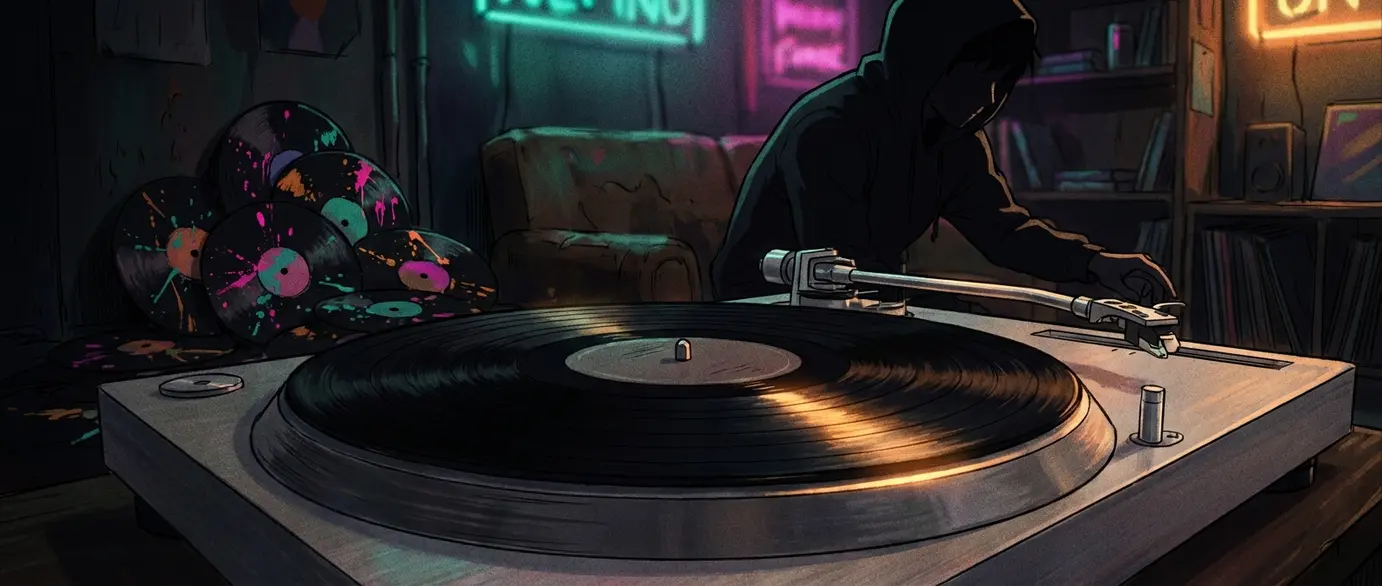

Something broke in 2025. Not suddenly, like a needle skipping across a warped groove, but slowly—the way a record wears out when you’ve played it too many times for the wrong reasons.
The Rolling Stones released Hackney Diamonds in 2023 in 43 different vinyl variations. Forty-three. Splatter patterns, alternate covers, individualized designs for every Major League Baseball team. The absurdity became impossible to ignore. What started as a celebration of vinyl’s tactile magic had mutated into something else entirely: a FOMO-fueled collector’s nightmare where the music itself became secondary to the packaging, where the frequency got drowned out by the noise.
At Hyperlific, we’re done with that frequency. We’re returning to black wax—and here’s why it matters.
The Variant Trap: When More Became Less
Walk through any record store in 2026 and you’ll see it everywhere. Limited edition this. Exclusive splatter that. Color variant number seven of twelve. The vinyl market hit $1.63 billion last year, marking the 19th consecutive year of growth. Colored vinyl now represents 22% of all production. These numbers tell a story of success, but they hide another narrative: collector fatigue.
Online communities have been wrestling with this for months. The sentiment keeps surfacing in enthusiast groups and collector circles: we’re exhausted. Not from buying records, but from the endless calculations—does this variant matter? Will that color appreciate? Are we being played by marketing departments that understand our psychology better than we do?
The truth is uncomfortable. Artists and labels know exactly what they’re doing. They understand that superfans will drain their wallets to complete collections, to own every variation. Meanwhile, smaller artists struggle to get pressing plant attention because those facilities are too busy running the same album in twelve different colors.
The Sound Quality Question Nobody Wanted to Ask
For years, audiophiles insisted black vinyl sounded better. The collector community pushed back, calling it snobbery, insisting the difference was negligible. Both sides dug in. But here’s what got lost in that argument: the question itself.
Black vinyl uses carbon black, a substance that improves PVC’s structural integrity. It increases durability, reduces static, enhances electromagnetic conduction. These aren’t subjective qualities. They’re measurable properties that affect how a record performs over time.
Splatter vinyl—particularly handmade art variants—introduces variables. Different colors mean different vinyl formulas mixing together. Fan forums frequently mention surface noise issues that standard pressings don’t exhibit. Some modern colored pressings rival black vinyl quality, absolutely. Manufacturing techniques have improved dramatically. But when you’re pressing 43 variants of the same album, when speed matters more than precision, quality control becomes a casualty.
The frustration echoes across collector circles: brand-new vinyl that sounds worse than a 40-year-old record. Warped discs. Distortion. Audible surface marks on never-played albums. The pressing plants are overwhelmed, and it shows.
The Frequency Gets Lost in the Noise
This isn’t about being purist or gatekeeping. It’s about remembering why we came back to vinyl in the first place. Not for Instagram-worthy shelf photos (though we took those too). Not for investment potential (though some records appreciate). We returned because vinyl carries a frequency that digital compression flattens. Because the ritual of playing a record creates space for focused listening. Because physical media demands intentionality.
Somewhere along the way, that frequency got buried under splatter patterns and variant numbering systems. The medium became the message—but the wrong message entirely.
Black Wax as Intentional Choice
Returning to black vinyl isn’t regression. It’s recalibration. When you strip away the color gimmicks and variant games, you’re left with a simple question: does this music matter enough to own physically?
That question has power. It forces prioritization. In collector communities, you’ll find a growing sentiment: only buy limited editions if the music is genuinely important—not just because of the vinyl color. It sounds obvious, but it represents a significant shift from the variant-chasing culture that dominated the past few years.
Black vinyl also carries historical weight. The classic albums we revere, the pressings that defined generations—they came in black. Not because color technology didn’t exist (it did), but because the focus was elsewhere. On the mastering. On the pressing quality. On the music itself.
The Environmental Elephant in the Room
Here’s something the industry doesn’t advertise: vinyl records are environmental nightmares. PVC is toxic and nearly impossible to recycle. Every additional variant means more resources consumed, more waste generated. The nostalgia-fueled exclusive splatter box set distracts from this reality, but it doesn’t change it.
If we’re going to press vinyl in 2026, we should do it intentionally. One excellent pressing beats twelve mediocre variants—environmentally and sonically.
What High-Fidelity Meaning Actually Means
Fidelity means faithfulness. In audio terms, it means faithful reproduction of the original recording. But there’s another kind of fidelity at play here: faithfulness to why we collect, to what we value, to the culture we’re building.
High-fidelity meaning requires asking harder questions. Does this variant exist because it enhances the art—or because it exploits the collector? Does this pressing prioritize sound quality or shelf appeal? Are we building a culture around music or around consumption?
The vinyl market in 2026 shows signs of maturation. Less hype. More selection. A stronger focus on quality and experience. This evolution feels right. It feels like coming home to a frequency we temporarily lost.
The Return to Black
At Hyperlific, we’re committing to black wax moving forward. Not as a statement against color (there’s nothing wrong with a well-pressed colored record), but as a statement for intentionality. For quality over quantity. For music over marketing.
This decision aligns with something larger happening in collector culture: a rejection of variant fatigue. A return to substance over style. A recognition that 43 versions of anything dilute rather than enhance value.
Black vinyl represents a choice—to prioritize the listening experience, to trust that great music doesn’t need gimmicks, to build collections based on what moves us rather than what might appreciate or complete a set.
The splatter era taught us something valuable. It showed us what happens when novelty overtakes purpose, when marketing psychology exploits genuine enthusiasm, when more becomes less. Now we take that lesson and move forward.
The frequency is still there, waiting. It never left. We just need to tune back in, strip away the noise, and remember what brought us here.
Black wax. High fidelity. Music that matters.



'%3e%3cg id='Final-Copy-2_2_' transform='translate(1275.000000, 200.000000)'%3e%3cpath class='st0' d='M7.4,12.8h6.8l3.1-11.6H7.4C4.2,1.2,1.6,3.8,1.6,7S4.2,12.8,7.4,12.8z'/%3e%3c/g%3e%3c/g%3e%3c/g%3e%3cg id='final---dec.11-2020'%3e%3cg id='_x30_208-our-toggle' transform='translate(-1275.000000, -200.000000)'%3e%3cg id='Final-Copy-2' transform='translate(1275.000000, 200.000000)'%3e%3cpath class='st1' d='M22.6,0H7.4c-3.9,0-7,3.1-7,7s3.1,7,7,7h15.2c3.9,0,7-3.1,7-7S26.4,0,22.6,0z M1.6,7c0-3.2,2.6-5.8,5.8-5.8 h9.9l-3.1,11.6H7.4C4.2,12.8,1.6,10.2,1.6,7z'/%3e%3cpath id='x' class='st2' d='M24.6,4c0.2,0.2,0.2,0.6,0,0.8l0,0L22.5,7l2.2,2.2c0.2,0.2,0.2,0.6,0,0.8c-0.2,0.2-0.6,0.2-0.8,0 l0,0l-2.2-2.2L19.5,10c-0.2,0.2-0.6,0.2-0.8,0c-0.2-0.2-0.2-0.6,0-0.8l0,0L20.8,7l-2.2-2.2c-0.2-0.2-0.2-0.6,0-0.8 c0.2-0.2,0.6-0.2,0.8,0l0,0l2.2,2.2L23.8,4C24,3.8,24.4,3.8,24.6,4z'/%3e%3cpath id='y' class='st3' d='M12.7,4.1c0.2,0.2,0.3,0.6,0.1,0.8l0,0L8.6,9.8C8.5,9.9,8.4,10,8.3,10c-0.2,0.1-0.5,0.1-0.7-0.1l0,0 L5.4,7.7c-0.2-0.2-0.2-0.6,0-0.8c0.2-0.2,0.6-0.2,0.8,0l0,0L8,8.6l3.8-4.5C12,3.9,12.4,3.9,12.7,4.1z'/%3e%3c/g%3e%3c/g%3e%3c/g%3e%3c/g%3e%3c/svg%3e) Your Privacy Choices
Your Privacy Choices