

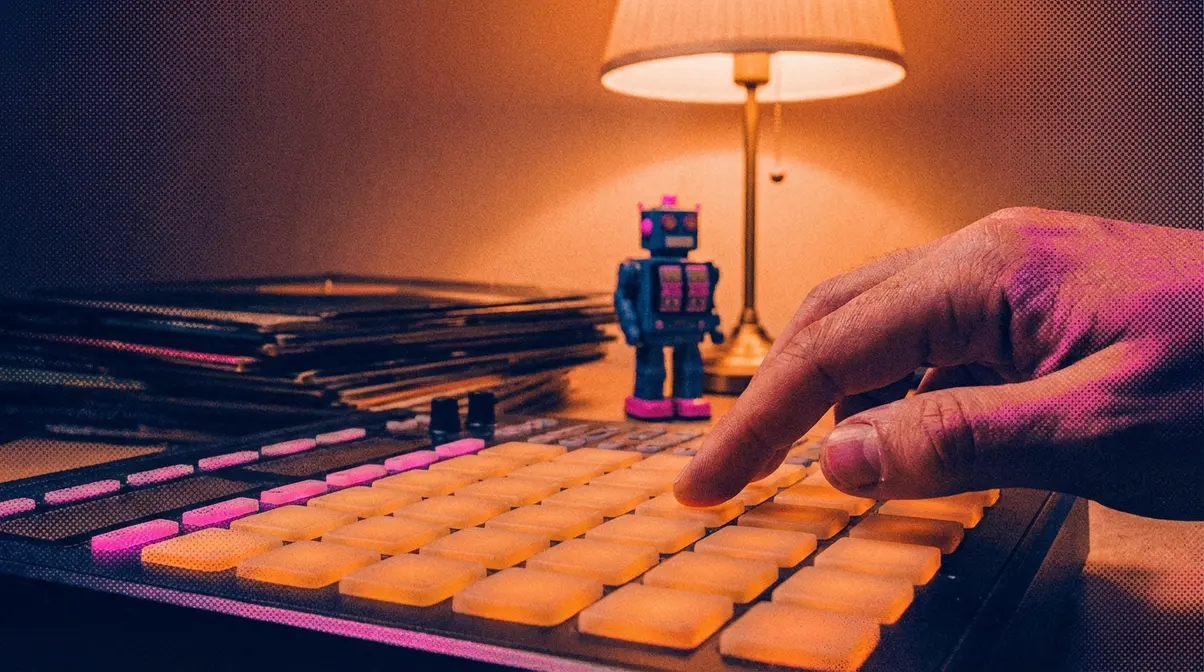

Six days from now, Akai will officially unveil the MPC Sample. American retailer Alto Music already leaked the device on eBay, priced at $399. Akai itself then began teasing the sampler, seemingly changing its marketing campaign due to the leaks, with an official reveal date of March 24, 2026. None of this should surprise anyone who follows the company. Akai can’t keep a secret. But what makes this particular leak so thrilling isn’t the price or the specs. It’s the philosophy.
With the MPC Sample, Akai is bringing out a complete counterpart to the actual MPC series. It’s entirely focused on sampling, without the DAW-like workflow and plugins. That sentence, buried in the product description, is the most exciting thing Akai has said in years.
The Weight of the Name
The MPC is not just a product line. It’s a cultural artifact with a body count of classics behind it. Roger Linn described the original MPC as an attempt to “properly re-engineer” the Linn 9000. He disliked reading instruction manuals and wanted to create an intuitive interface that simplified music production. The first model, the MPC60, was released on December 8, 1988, and retailed for $5,000.
Linn had no idea what he’d started. He anticipated that users would sample short sounds, such as individual notes or drum hits, to use as building blocks for compositions. However, users began sampling longer passages of music. In the words of Greg Milner, musicians “didn’t just want the sound of John Bonham’s kick drum, they wanted to loop and repeat the whole of ‘When the Levee Breaks’.”
DJ Shadow used an MPC60 II to create his influential 1996 album Endtroducing….. , composed entirely of samples. J Dilla disabled the quantize feature on his MPC to create his signature “off-kilter” sampling style. When Dilla became hospitalized in Los Angeles with lupus, one of the essential items he asked his mother to ship to him from Detroit was the MPC. It was with him on his deathbed, making beats until the end. That machine, an Akai MPC 3000 Limited Edition , now sits in the Smithsonian’s National Museum of African American History and Culture, donated by his mother Maureen Yancey in 2014.
An instrument doesn’t end up in the Smithsonian because it has good specs. It ends up there because it changed what people thought was possible.
The DAW-in-a-Box Problem
In recent years, the MPC line drifted. The machines got bigger, more powerful, more complicated. The MPC XL, released at NAMM 2026, is powered by a Gen 2 8-core processor and 16GB of RAM, offering up to four times the processing power of previous MPC models. It costs $2,899. It is, by any measure, a beast. But for a lot of people who fell in love with MPCs because of their directness, that beast feels like the wrong animal.
One long-time user on a gear forum put it plainly: every time he tries to use his modern MPC, he ends up turning it off because the workflow is “just too complicated.” A simplified portable version, he wrote, “sounds excellent to me.” Another called the MPC Sample “the MPC I always wanted. Even needed. Caveman MPC.” A third was less charitable, asking whether Akai is now owned by Mattel.
This tension between power and playability has been simmering for years. The MPC Sample is Akai’s acknowledgment that it exists.
The Super-Toy Moment
The MPC Sample doesn’t arrive in a vacuum. In recent years, there has been a renaissance of hardware samplers. The Roland SP-404Mk2 and the Teenage Engineering EP-133 K.O. II are huge successes. At NAMM 2026, Casio also surprisingly unveiled a new sampler going in the same direction. We are, to put it bluntly, flush with cute little samplers. And that’s a wonderful thing.
What unites these devices is a shared conviction that limitation is a feature, not a bug. The MPC Sample includes a sampler engine, sequencer, built-in microphone, speaker, and over 100 effect kits, and works entirely standalone, without a computer. Power comes from USB-C or a built-in rechargeable battery. You can take it to the park. You can take it to bed. You can hand it to a twelve-year-old and watch them make something you couldn’t.
I’m calling these devices super-toys, and I mean it with deep affection. They’re small, self-contained, battery-powered, and designed to make the act of capturing and reshaping sound feel like play. They inherit the legacy of instruments that cost five thousand dollars and weighed ten kilos, but they fit in a backpack. The Teenage Engineering EP-133 looks like a calculator from 1983. The MPC Sample positions itself squarely against the Roland SP-404MK2 and Teenage Engineering EP-133 K.O. II, compact, battery-powered devices designed for sampling and beat-making without the friction of a full studio setup.
Why This Matters
The MPC had a major influence on the development of electronic and hip-hop music. It led to new sampling techniques, with users pushing its technical limits to creative effect. It had a democratizing effect on music production, allowing artists to create elaborate tracks without traditional instruments or recording studios. That democratizing impulse is exactly what the super-toy generation carries forward, at a price point and form factor that would have made Roger Linn’s head spin in 1988.
Linn aimed to design an affordable user-friendly instrument that did not require extensive musical knowledge or studio equipment to use. The MPC Sample, nearly four decades later, is the purest expression of that original vision that Akai has attempted in a very long time. Whether it delivers remains to be seen on March 24. But the intention is clear, and the intention is beautiful: strip it back, make it portable, make it fun, and trust that the music will follow.
J Dilla’s MPC 3000 sits behind glass in Washington, D.C. As the museum’s popular music historian Timothy Anne Burnside said: “Everyone who pays attention to hip-hop has heard J Dilla’s work whether they realize it or not. In the very demanding world of hip-hop producers, he was one of the busiest and most sought-after.” He made those beats on a machine with 16 pads and a tiny screen. The MPC Sample has 16 pads and a small color screen. Some things don’t need to be bigger. They just need to be there.
'%3e%3cg id='Final-Copy-2_2_' transform='translate(1275.000000, 200.000000)'%3e%3cpath class='st0' d='M7.4,12.8h6.8l3.1-11.6H7.4C4.2,1.2,1.6,3.8,1.6,7S4.2,12.8,7.4,12.8z'/%3e%3c/g%3e%3c/g%3e%3c/g%3e%3cg id='final---dec.11-2020'%3e%3cg id='_x30_208-our-toggle' transform='translate(-1275.000000, -200.000000)'%3e%3cg id='Final-Copy-2' transform='translate(1275.000000, 200.000000)'%3e%3cpath class='st1' d='M22.6,0H7.4c-3.9,0-7,3.1-7,7s3.1,7,7,7h15.2c3.9,0,7-3.1,7-7S26.4,0,22.6,0z M1.6,7c0-3.2,2.6-5.8,5.8-5.8 h9.9l-3.1,11.6H7.4C4.2,12.8,1.6,10.2,1.6,7z'/%3e%3cpath id='x' class='st2' d='M24.6,4c0.2,0.2,0.2,0.6,0,0.8l0,0L22.5,7l2.2,2.2c0.2,0.2,0.2,0.6,0,0.8c-0.2,0.2-0.6,0.2-0.8,0 l0,0l-2.2-2.2L19.5,10c-0.2,0.2-0.6,0.2-0.8,0c-0.2-0.2-0.2-0.6,0-0.8l0,0L20.8,7l-2.2-2.2c-0.2-0.2-0.2-0.6,0-0.8 c0.2-0.2,0.6-0.2,0.8,0l0,0l2.2,2.2L23.8,4C24,3.8,24.4,3.8,24.6,4z'/%3e%3cpath id='y' class='st3' d='M12.7,4.1c0.2,0.2,0.3,0.6,0.1,0.8l0,0L8.6,9.8C8.5,9.9,8.4,10,8.3,10c-0.2,0.1-0.5,0.1-0.7-0.1l0,0 L5.4,7.7c-0.2-0.2-0.2-0.6,0-0.8c0.2-0.2,0.6-0.2,0.8,0l0,0L8,8.6l3.8-4.5C12,3.9,12.4,3.9,12.7,4.1z'/%3e%3c/g%3e%3c/g%3e%3c/g%3e%3c/g%3e%3c/svg%3e) Your Privacy Choices
Your Privacy Choices