

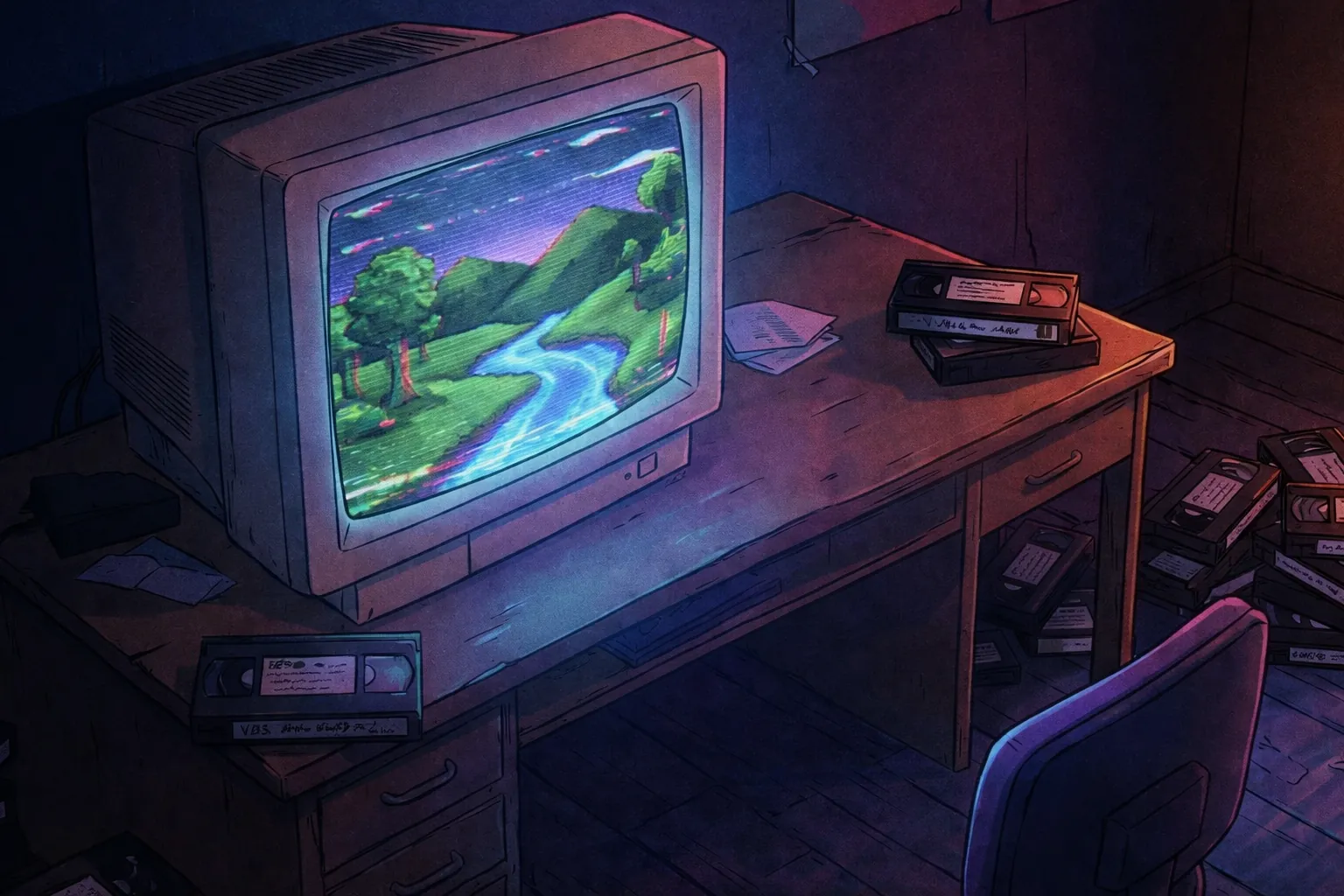

The Paradox at the Heart of Progress
In 1994, game developers were fighting tooth and nail against technical limitations. Every polygon counted. Every texture had to be compressed within an inch of its life. The goal was always more: more resolution, more colors, more frames per second. Get closer to reality. Escape the constraints.
Now, thirty years later, we’ve won that war. Modern engines can render scenes indistinguishable from photographs. So why are developers deliberately degrading their work?
Because somewhere between then and now, we discovered something unexpected. Those limitations we fought against? They were doing something we didn’t understand at the time. They were creating a specific frequency of experience that feels more real than reality itself.
Why Flaws Feel More Real
Modern digital video is too clean. Too perfect. When you see 4K footage with pristine color grading and stabilized camera movements, your brain immediately categorizes it as produced content. Fiction. Something made for you to consume.
But show that same scene through the degraded lens of VHS, with its tracking lines and color noise and slight motion blur, and something shifts. The imperfections don’t make it look fake. They make it look found.
This is what enthusiast communities have been dissecting for years: the authenticity paradox. The worse the technical quality, the more authentic it feels. Not because we’re fooled, but because those artifacts carry the weight of the real. They’re the visual equivalent of a coffee stain on a document or the creak in a floorboard. Proof that something existed in physical space, subject to entropy and time.
Horror developers understood this first. Games like Puppet Combo’s work and web series like Kane Parsons’ “The Backrooms” didn’t just use VHS aesthetics for style points. They weaponized the psychology of it. When your brain sees tracking errors and tape degradation, it doesn’t just see a visual effect. It sees evidence of recording, playback, physical media passing through mechanical systems. It sees something that was captured rather than created.
The Technical Challenge of Imperfection
Here’s where it gets interesting from a development perspective. Creating convincing VHS effects in Unreal Engine 5 isn’t about slapping a filter over your render. It’s about understanding the actual mechanics of analog video degradation and recreating each component.
We’re talking about chromatic aberration (the way magnetic tape separates color channels slightly). Tracking errors (those horizontal lines that appear when the playback head loses sync). Luma noise and chroma bleeding. The subtle ghosting that happens with lower-quality tape stock. Each element needs to be built as its own post-process material, layered and calibrated to look like authentic degradation rather than digital noise.
The goal, as developers in online forums often emphasize, is to make the best possible copy of the 1990s look. Not excessive glitching for effect, but the subtle imperfections that your brain remembers even if you can’t articulate them. Small distortions. Occasional tracking hiccups. The slight blur that came from analog recording systems that couldn’t quite capture all the detail.
This is where UE5’s capabilities become crucial. You need that underlying rendering power to create a convincing scene first. Then you deliberately break it in specific, controlled ways. It’s like being a master painter who learns perfect technique specifically so they can violate it with intention.
The Generational Divide
Something fascinating happens in community discussions about VHS aesthetics: a split between those who remember the format and those who don’t. For people who grew up with VHS, these visual artifacts trigger genuine memory. The tracking lines, the color bleeding, even the specific way tapes degraded over multiple viewings. It’s all encoded in their visual vocabulary.
But here’s what’s unexpected: younger creators and audiences respond to it just as strongly, maybe more so. For them, VHS isn’t a memory. It’s an alien technology that behaves in ways their digital-native brains find genuinely unsettling. A format where quality degrades with use, where physical damage affects playback, where the medium itself is unstable and unpredictable.
This creates a unique cultural moment. The aesthetic works as nostalgia for one generation and as uncanny strangeness for another. Both responses are valid. Both create emotional resonance.
Beyond Horror
While analog horror has dominated the conversation around VHS aesthetics in game development, the technique is spreading. Music videos are adopting it. Fashion campaigns are using it. Any medium that wants to signal authenticity, rawness, or emotional weight is reaching for those degraded visuals.
The data backs this up. Brands using 1990s-inspired content are seeing significant engagement increases. Consumers report being willing to pay more for products that evoke these aesthetics. It’s not just a trend; it’s a fundamental shift in how we signal authenticity in a digital-first world.
When everything can be photoshopped, filtered, and digitally perfected, imperfection becomes the ultimate signifier of the real.
The Uncanny Valley of Time
There’s a concept in robotics called the uncanny valley: the point where something becomes almost human enough to be disturbing. We’re discovering there’s a temporal equivalent. VHS aesthetics create a specific kind of temporal displacement. You’re watching something that looks like it was recorded decades ago, but the content is new. Your brain knows it’s contemporary, but your eyes are telling you it’s from 1994.
That cognitive dissonance creates a unique emotional space. You’re simultaneously present and distant. Watching and remembering. Experiencing and recalling. It’s a frequency that didn’t exist before because the technology to create it didn’t exist.
We needed modern rendering capabilities to accurately recreate vintage limitations. We needed to fully escape the constraints before we could understand their value.
Why This Matters Now
We’re not trying to go back. That’s the crucial distinction. This isn’t about rejecting modern tools or pretending the 1990s were better. It’s about understanding that different technologies create different emotional frequencies, and sometimes the older frequencies are the ones we need.
In a world of algorithmic feeds and infinite content, VHS aesthetics feel intentional. In an era of perfect digital reproduction, analog imperfection feels human. When everything is optimized for engagement, degraded visuals feel honest.
This is what Hyperlific has always understood: it’s not about nostalgia as commodity. It’s about recognizing that certain eras discovered frequencies worth preserving, worth studying, worth recreating with intention.
So yes, we’re using cutting-edge technology to recreate thirty-year-old flaws. Not because we’re looking backward, but because we’re looking for something that got lost in the rush forward. Something that lives in the space between perfect and broken, between memory and experience, between what was and what could be.
The beautiful glitch isn’t the tracking error on the screen. It’s the moment when imperfection becomes more powerful than perfection. When limitation becomes liberation. When the flaw becomes the feature.
That’s the frequency we’re tuning into. Join us there.

'%3e%3cg id='Final-Copy-2_2_' transform='translate(1275.000000, 200.000000)'%3e%3cpath class='st0' d='M7.4,12.8h6.8l3.1-11.6H7.4C4.2,1.2,1.6,3.8,1.6,7S4.2,12.8,7.4,12.8z'/%3e%3c/g%3e%3c/g%3e%3c/g%3e%3cg id='final---dec.11-2020'%3e%3cg id='_x30_208-our-toggle' transform='translate(-1275.000000, -200.000000)'%3e%3cg id='Final-Copy-2' transform='translate(1275.000000, 200.000000)'%3e%3cpath class='st1' d='M22.6,0H7.4c-3.9,0-7,3.1-7,7s3.1,7,7,7h15.2c3.9,0,7-3.1,7-7S26.4,0,22.6,0z M1.6,7c0-3.2,2.6-5.8,5.8-5.8 h9.9l-3.1,11.6H7.4C4.2,12.8,1.6,10.2,1.6,7z'/%3e%3cpath id='x' class='st2' d='M24.6,4c0.2,0.2,0.2,0.6,0,0.8l0,0L22.5,7l2.2,2.2c0.2,0.2,0.2,0.6,0,0.8c-0.2,0.2-0.6,0.2-0.8,0 l0,0l-2.2-2.2L19.5,10c-0.2,0.2-0.6,0.2-0.8,0c-0.2-0.2-0.2-0.6,0-0.8l0,0L20.8,7l-2.2-2.2c-0.2-0.2-0.2-0.6,0-0.8 c0.2-0.2,0.6-0.2,0.8,0l0,0l2.2,2.2L23.8,4C24,3.8,24.4,3.8,24.6,4z'/%3e%3cpath id='y' class='st3' d='M12.7,4.1c0.2,0.2,0.3,0.6,0.1,0.8l0,0L8.6,9.8C8.5,9.9,8.4,10,8.3,10c-0.2,0.1-0.5,0.1-0.7-0.1l0,0 L5.4,7.7c-0.2-0.2-0.2-0.6,0-0.8c0.2-0.2,0.6-0.2,0.8,0l0,0L8,8.6l3.8-4.5C12,3.9,12.4,3.9,12.7,4.1z'/%3e%3c/g%3e%3c/g%3e%3c/g%3e%3c/g%3e%3c/svg%3e) Your Privacy Choices
Your Privacy Choices