

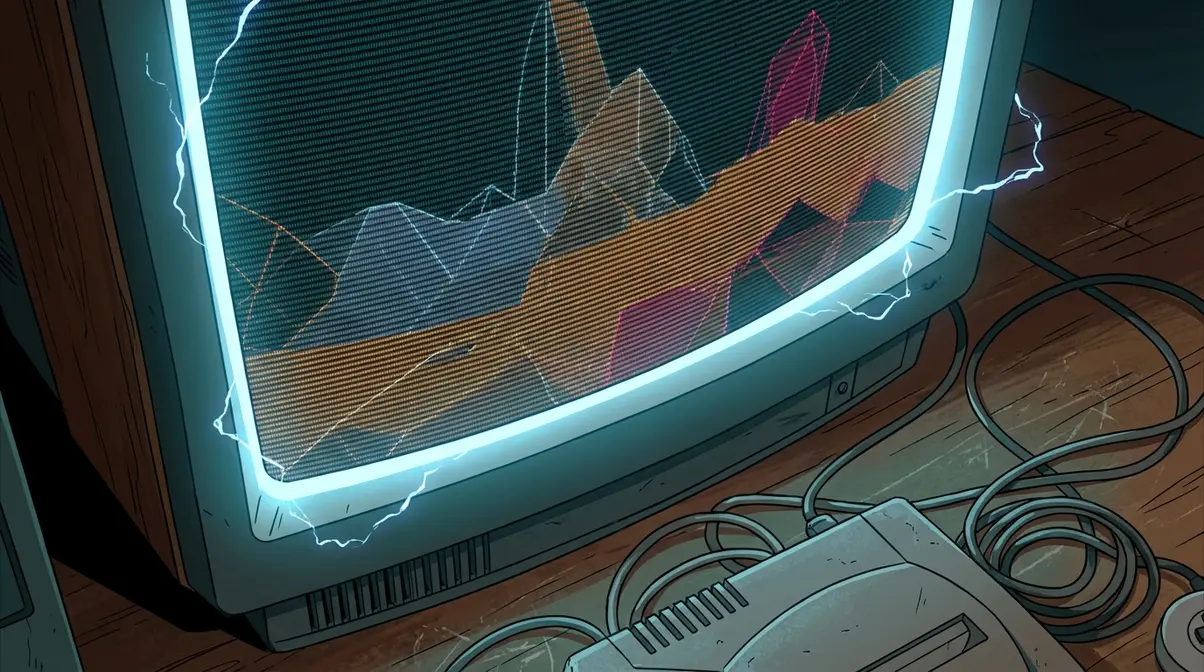

Something happened between 2020 and 2026 that nobody in the game industry saw coming. While triple-A studios kept pushing toward 8K textures and motion-captured eyelashes, a generation of indie developers started deliberately making their games look worse. Not just pixel art worse, which had its revival a decade earlier, but early 3D worse. PlayStation 1 worse. The kind of worse where vertices snap to a pixel grid and textures warp across polygons like melting ice cream.
The numbers tell part of the story. Between 2014 and 2018, 244 titles appeared on Steam tagged “low poly.” By 2024, that aesthetic had jumped from niche to cultural shorthand, with artists recreating scenes from classic films and anime as polygonal dioramas. Nirvana and Olivia Rodrigo album covers got the PS1 treatment. What started as nostalgia became something else entirely.
The Technical Accident That Became an Art Form
The original PlayStation could process 90,000 polygons per second with texture mapping and lighting enabled. That limitation forced a specific look: jittering vertices, affine texture warping, no subpixel precision. Every model felt like it was vibrating slightly, caught between dimensions. It was a bug that became a feature three decades later.
Modern developers aren’t just mimicking this aesthetic out of sentiment. There’s a practical argument here. In online communities dedicated to retro 3D graphics, creators talk about how freeing self-imposed constraints can be. One solo developer put it plainly: the style is easy to attain and adds to the creepy factor. Another perspective holds that low poly is about making players use their imagination, simplifying and clarifying instead of overwhelming with detail.
The horror game scene embraced this first. Silent Hill proved that low polygon counts could generate fear precisely because they obscured details. The uncanny valley works both ways. Too much realism can be sterile; too little becomes unsettling. PS1 graphics hit that sweet spot where your brain fills in the gaps with something worse than any 4K texture could render.
The Fatigue Nobody Talks About
There’s a term floating around enthusiast circles that captures what’s happening: photorealism fatigue. Not everyone agrees it’s real, but the symptoms are visible. Triple-A budgets ballooning into nine figures. Development cycles stretching to seven years. Teams of hundreds rendering individual beard hairs while gameplay loops stagnate. Some players describe modern releases as technically impressive but emotionally flat.
The counterargument is valid too. Plenty of people want their games to look cutting-edge. They paid for the hardware, they want it used. The PS1 aesthetic revival isn’t replacing high-fidelity graphics, it’s offering an alternative for those who find hyperrealism exhausting.
What’s interesting is how this maps onto broader design philosophy. Low poly connects directly to Modernism’s rejection of Realism, one analysis suggests. Clean lines, minimal textures, form following function. It’s the same impulse that made Bauhaus architects strip away ornament. Sometimes less information creates more meaning.
Room for Imagination
The most compelling defense of the aesthetic comes from developers who remember what games felt like before they showed everything. A significant part of gaming was always leaving room for your own imagination, one creator noted. If a game tells and shows every little detail, it becomes somewhat boring over time.
That’s the real shift here. It’s not about rescuing animation from anything, because animation doesn’t need rescuing. It’s about giving creators permission to stop chasing an impossible standard of realism. The PS1 look isn’t better than modern graphics. It’s just different, and in 2025, different matters more than perfect.
The movement (if you can call it that) remains deliberately outsider. It feels raw and unsterilized precisely because it exists apart from mainstream recognition. Whether it lasts or fades like every other aesthetic cycle is anyone’s guess. But right now, watching those shaky polygons and warped textures spread across indie showcases and art projects, it’s hard not to feel like something genuine is happening. Something that has less to do with nostalgia and more to do with exhaustion.
The pixels are shaking again. This time on purpose.

'%3e%3cg id='Final-Copy-2_2_' transform='translate(1275.000000, 200.000000)'%3e%3cpath class='st0' d='M7.4,12.8h6.8l3.1-11.6H7.4C4.2,1.2,1.6,3.8,1.6,7S4.2,12.8,7.4,12.8z'/%3e%3c/g%3e%3c/g%3e%3c/g%3e%3cg id='final---dec.11-2020'%3e%3cg id='_x30_208-our-toggle' transform='translate(-1275.000000, -200.000000)'%3e%3cg id='Final-Copy-2' transform='translate(1275.000000, 200.000000)'%3e%3cpath class='st1' d='M22.6,0H7.4c-3.9,0-7,3.1-7,7s3.1,7,7,7h15.2c3.9,0,7-3.1,7-7S26.4,0,22.6,0z M1.6,7c0-3.2,2.6-5.8,5.8-5.8 h9.9l-3.1,11.6H7.4C4.2,12.8,1.6,10.2,1.6,7z'/%3e%3cpath id='x' class='st2' d='M24.6,4c0.2,0.2,0.2,0.6,0,0.8l0,0L22.5,7l2.2,2.2c0.2,0.2,0.2,0.6,0,0.8c-0.2,0.2-0.6,0.2-0.8,0 l0,0l-2.2-2.2L19.5,10c-0.2,0.2-0.6,0.2-0.8,0c-0.2-0.2-0.2-0.6,0-0.8l0,0L20.8,7l-2.2-2.2c-0.2-0.2-0.2-0.6,0-0.8 c0.2-0.2,0.6-0.2,0.8,0l0,0l2.2,2.2L23.8,4C24,3.8,24.4,3.8,24.6,4z'/%3e%3cpath id='y' class='st3' d='M12.7,4.1c0.2,0.2,0.3,0.6,0.1,0.8l0,0L8.6,9.8C8.5,9.9,8.4,10,8.3,10c-0.2,0.1-0.5,0.1-0.7-0.1l0,0 L5.4,7.7c-0.2-0.2-0.2-0.6,0-0.8c0.2-0.2,0.6-0.2,0.8,0l0,0L8,8.6l3.8-4.5C12,3.9,12.4,3.9,12.7,4.1z'/%3e%3c/g%3e%3c/g%3e%3c/g%3e%3c/g%3e%3c/svg%3e) Your Privacy Choices
Your Privacy Choices