

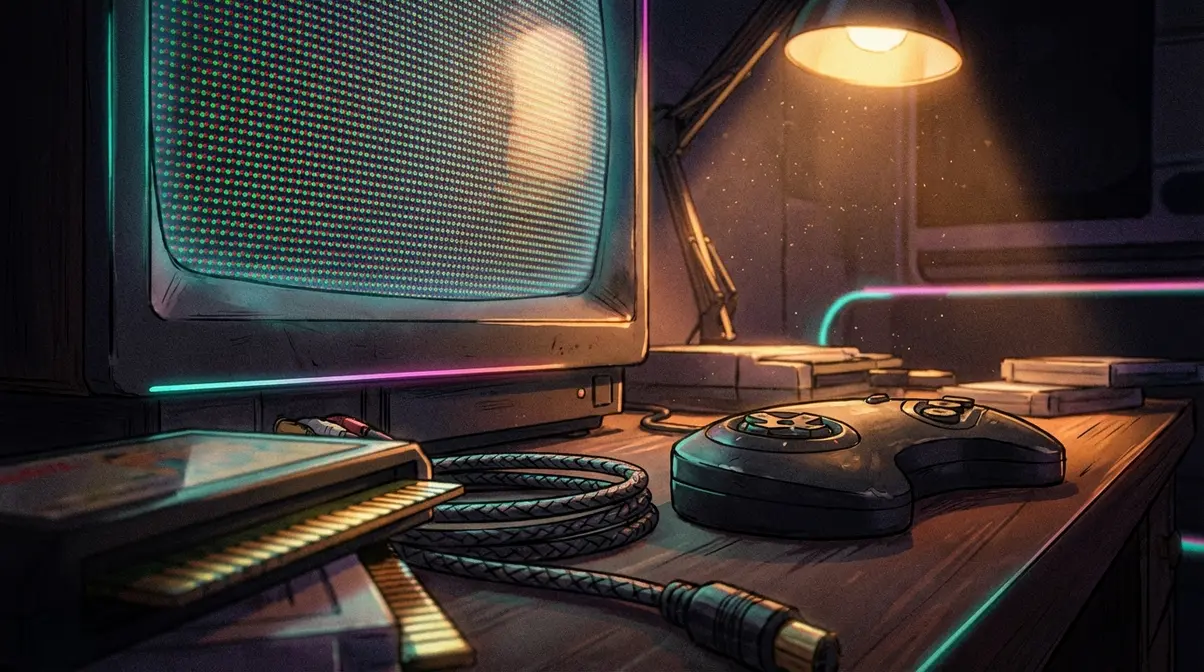

There’s a particular kind of irony in needing tomorrow’s technology to resurrect yesterday’s aesthetic. The Analogue 3D, shipping now after a year of delays and anticipation, represents something more philosophically complex than just another retro console. It’s a $270 time machine that uses a 220K LE Intel Cyclone 10GX FPGA chip to recreate not just the Nintendo 64’s silicon heart, but the very phosphor glow of the CRT screens that once illuminated basement rec rooms across America.
Let’s be clear about something upfront: there is no such thing as a 4K CRT. The highest-resolution cathode ray tubes ever manufactured topped out around 2048×1536 on massive 21-inch professional monitors. The physics of electron beams, phosphor precision, and glass curvature made true 4K impossible in analog display technology. When CRT manufacturing ceased entirely in 2015, that chapter closed for good.
So what does “4K CRT” actually mean? It’s the paradox at the heart of the Analogue 3D’s mission: using 4K resolution not to make games sharper, but to make them look authentically fuzzy.
The Resolution Paradox
The Analogue 3D renders N64 games at their original resolution, then upscales the image to 4K. This isn’t about pixel counts or marketing buzzwords (though enthusiast communities have noted the confusion this creates). The 4K output exists primarily to enable something far more sophisticated: Original Display Modes that simulate different classes of CRT and broadcast monitors with sub-pixel accuracy.
Each display mode features extensive customization options. Horizontal and vertical beam convergence. Edge overshoot and hardness. Image size and fit. These aren’t Instagram filters slapped onto old games. They’re meticulously engineered recreations of how electron guns painted images onto curved glass, how phosphors glowed and decayed, how the analog signal itself introduced artifacts that game developers learned to leverage as features rather than bugs.
Collectors often point out that N64 games look “wrong” on modern displays, and they’re absolutely right. Unlike 2D pixel art from earlier consoles, the N64’s 3D rendering engine was designed with CRT characteristics baked into its visual language. Texture filtering, polygon edges, color blending: all of it assumed the softening, the blur, the scanlines. Developers didn’t just accept these limitations. They composed with them.
FPGA: The Analog Philosophy in Digital Circuits
The Analogue 3D spent nearly four years in development, re-engineering the N64’s hardware at the circuit level. This matters because FPGA technology occupies a unique philosophical space between software emulation and original hardware. Instead of software attempting to mimic hardware behavior, the FPGA recreates the actual electronic pathways and timing.
Online communities have debated this distinction endlessly. Analogue’s marketing insists their devices aren’t emulators, which has drawn criticism from technical purists who correctly note that FPGA emulation is still emulation, just at a different abstraction layer. But the practical difference is real: no input lag, no audio sync issues, no timing problems that plague software emulators.
Recent testing by developers has shown the Analogue 3D achieves about 95% cycle accuracy compared to original hardware. That’s remarkable, though it falls short of Analogue’s “100% perfect” claims. Games remain perfectly playable. Most people won’t notice the discrepancies. But the gap between marketing promise and technical reality has become a recurring theme in enthusiast circles, tempering excitement with skepticism.
Why This Matters Now
Here’s the uncomfortable truth: an entire generation will never experience games on their intended displays. The knowledge of how CRTs actually looked, how they felt, the warmth of their glow and the geometry of their curves, this lived experience is evaporating. Memory is unreliable. Screenshots lie. YouTube compression destroys nuance.
The Analogue 3D represents something like a final frontier because it’s attempting to preserve not just software, but context. Not just games, but the medium through which they were meant to be experienced. Preservation doesn’t mean freezing artifacts in amber. It means providing accurate context so future audiences can understand not just what these games were, but how they felt.
Fan forums frequently mention the tactile satisfaction of inserting a 25-year-old cartridge and seeing it run better than it ever did originally. The Analogue 3D includes four original-style controller ports that accept authentic N64 controllers, Transfer Paks, Rumble Paks, the whole ecosystem. It even features an overclocking mode that lets sluggish games run at smoother framerates, though purists will note this transforms the experience into something the original developers never intended.
The Cost of Authenticity
At $270 (recently increased from $249.99 due to tariffs), the Analogue 3D isn’t cheap. Limited edition colorways inspired by unreleased N64 prototypes sold out within hours. Analogue’s business model, built on artificial scarcity and FOMO-driven drops, frustrates collectors who just want to buy a console without refreshing pre-order pages at midnight.
The value proposition depends entirely on what authenticity means to you. Software emulation is free and increasingly accurate. Original hardware can be found for less money. The RetroTINK 4K offers sophisticated upscaling for any retro console. But none of these options combine the tactile satisfaction of original cartridges with the visual accuracy of FPGA recreation and the convenience of modern HDMI output.
One significant disappointment: unlike the Analogue Pocket, the 3D doesn’t support OpenFPGA, meaning it can’t be expanded to play games from other systems. For a device built around such a powerful FPGA chip, this feels like a missed opportunity, a deliberate choice to keep the platform closed rather than opening it to the developer community.
The Frequency, Not the Nostalgia
There’s a broader cultural movement happening here. Vinyl records outsell CDs. Film photography experiences a renaissance. Mechanical keyboards click beneath the fingers of programmers who weren’t born when IBM Model Ms ruled office desks. These aren’t mere nostalgia trips. They’re searches for texture in an increasingly frictionless world.
The Analogue 3D taps into that same frequency. It’s not about returning to the past. It’s about refusing to accept that newer automatically means better, that convenience should always trump experience, that the way things look on a modern LCD is somehow more “real” than how they looked on the screens they were designed for.
The console arrives at a moment when the last generation to remember CRTs as everyday objects is entering middle age. Soon, the warm glow of curved glass will exist only in simulation, in digital recreations that approximate something no one alive has actually seen. The Analogue 3D might be the closest we get to bottling that lightning.
Is it perfect? No. Is it worth $270? That depends on whether you hear the frequency or just see the price tag. But as the final CRT factories closed nearly a decade ago and the knowledge of how to manufacture them fades into history, devices like this become less about playing old games and more about preserving a way of seeing. Not nostalgia. Context. The difference matters.
The future of the past requires the most advanced technology we can muster. That’s not irony. That’s just the cost of remembering accurately.


'%3e%3cg id='Final-Copy-2_2_' transform='translate(1275.000000, 200.000000)'%3e%3cpath class='st0' d='M7.4,12.8h6.8l3.1-11.6H7.4C4.2,1.2,1.6,3.8,1.6,7S4.2,12.8,7.4,12.8z'/%3e%3c/g%3e%3c/g%3e%3c/g%3e%3cg id='final---dec.11-2020'%3e%3cg id='_x30_208-our-toggle' transform='translate(-1275.000000, -200.000000)'%3e%3cg id='Final-Copy-2' transform='translate(1275.000000, 200.000000)'%3e%3cpath class='st1' d='M22.6,0H7.4c-3.9,0-7,3.1-7,7s3.1,7,7,7h15.2c3.9,0,7-3.1,7-7S26.4,0,22.6,0z M1.6,7c0-3.2,2.6-5.8,5.8-5.8 h9.9l-3.1,11.6H7.4C4.2,12.8,1.6,10.2,1.6,7z'/%3e%3cpath id='x' class='st2' d='M24.6,4c0.2,0.2,0.2,0.6,0,0.8l0,0L22.5,7l2.2,2.2c0.2,0.2,0.2,0.6,0,0.8c-0.2,0.2-0.6,0.2-0.8,0 l0,0l-2.2-2.2L19.5,10c-0.2,0.2-0.6,0.2-0.8,0c-0.2-0.2-0.2-0.6,0-0.8l0,0L20.8,7l-2.2-2.2c-0.2-0.2-0.2-0.6,0-0.8 c0.2-0.2,0.6-0.2,0.8,0l0,0l2.2,2.2L23.8,4C24,3.8,24.4,3.8,24.6,4z'/%3e%3cpath id='y' class='st3' d='M12.7,4.1c0.2,0.2,0.3,0.6,0.1,0.8l0,0L8.6,9.8C8.5,9.9,8.4,10,8.3,10c-0.2,0.1-0.5,0.1-0.7-0.1l0,0 L5.4,7.7c-0.2-0.2-0.2-0.6,0-0.8c0.2-0.2,0.6-0.2,0.8,0l0,0L8,8.6l3.8-4.5C12,3.9,12.4,3.9,12.7,4.1z'/%3e%3c/g%3e%3c/g%3e%3c/g%3e%3c/g%3e%3c/svg%3e) Your Privacy Choices
Your Privacy Choices