


The Kid With the Soldering Iron
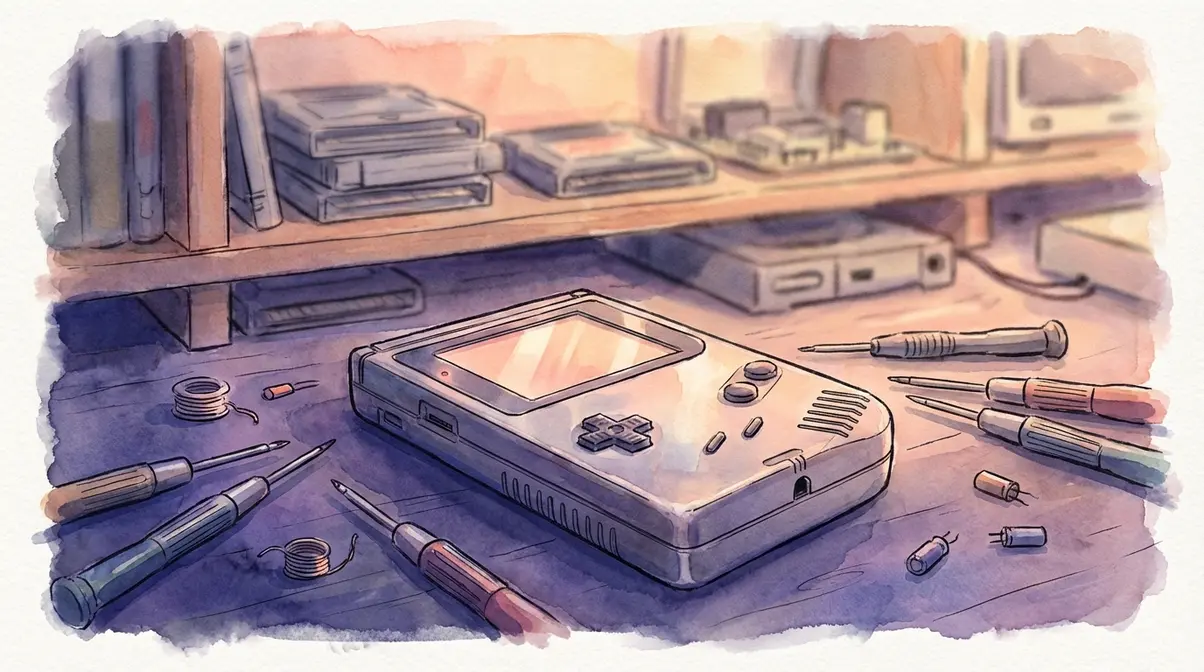
In 2009, Palmer Luckey founded the ModRetro Forums with a friend, creating an online community for “portabilization,” a hobby that revolves around turning old hardware devices such as game consoles and PCs into self-contained portable units mixing new and old technology. He was sixteen. Living in Long Beach, California. During his childhood and teenage years, Luckey experimented with a variety of complex electrical projects including railguns, Tesla coils, and lasers, with some of these projects resulting in serious injuries. He built a PC gaming “rig” worth tens of thousands of U.S. dollars with an elaborate six-monitor setup. The kid wasn’t playing games so much as disassembling them, rewiring them, figuring out what made the signal sing.
Those forum years matter. They’re the origin story that doesn’t get told enough. ModRetro actually came before Oculus and Anduril. Luckey had founded the ModRetro Forums when he was just 16. Before virtual reality, before defense contracts, before the billions, there was a teenager on a message board talking about which capacitors to pull from a dead N64 motherboard. That impulse never left.
In June 2024, Luckey reestablished ModRetro as a video game console company. Its first product, the ModRetro Chromatic, is a handheld retrogaming device capable of playing original games designed for the Game Boy. Not a multi-system Swiss Army knife. Not a ROM-dumping emulation box. A Game Boy Color, rebuilt from silicon up, with the kind of obsessive material science you’d expect from a man who also builds autonomous drones for a living.
Torin Herndon and the 160×144 Problem
The Chromatic isn’t a solo act. The company is now led by former Anduril and Oculus engineer Torin Herndon. Herndon got into Stanford by writing an essay on escapism in classic games and leveraged that degree to work at Oculus VR and now ModRetro. He’s the one who made the call that sounds insane on paper and brilliant in practice: manufacture a brand-new display nobody asked for.
Herndon says the custom-made display is something “nobody in their right mind would tackle when digital upscaling is accepted, and one can simply buy any display off the shelf.” ModRetro did it anyway, creating the only newly manufactured 160×144 color backlit IPS display in existence. The screen measures 2.56 inches diagonal. It is sunlight-readable. It is, by every credible account, pixel-perfect and stunningly color-accurate.
You can spec it with a Gorilla Glass lens for $199.99 or go sapphire for $299.99. The Gorilla Glass variants give gamers on a budget a chance to experience the brilliance of the Chromatic with a screen that will be perfect for most people who are only planning on playing their Chromatic at home. Sapphire is for the ones who want to throw it in a bag and forget about it for twenty years. Both options feel like they were designed by someone who thinks in decades.
What’s Inside, and What It Owes
The Chromatic runs on FPGA hardware, not software emulation. This project builds upon the open source work provided by the Game Boy MiSTer project. The Chromatic’s FPGA is a Gowin GW5A-25. The entire FPGA codebase is open source on GitHub, which is rare for a commercial product in this space and worth noting.
It’s also worth noting the tension. RetroRGB’s Bob observed that ModRetro never once mentioned MiSTer in its marketing or helped promote the original devs, and that the creator spends a lot of time bragging about how much time and money was spent developing it. They’ve complied with the open source terms, so they certainly didn’t do anything wrong. But the optics left a mark in the FPGA community. Credit where credit is due is a currency that costs nothing to spend.
The shell is thixomolded magnesium alloy. The buttons are PBT plastic, the same material favored by mechanical keyboard enthusiasts. It runs on three AA batteries, which gets you roughly six hours on lower brightness. You can ditch the batteries with a rechargeable Power Core for $29.99. The AA choice is deliberate. Rechargeable lithium cells degrade. AAs are immortal. It’s a preservation argument dressed as a battery compartment.
A Publishing House With a D-Pad
Hardware is only half the story. ModRetro is publishing new Game Boy cartridges. Physical cartridges, boxed, with manuals and charms, priced at $39.99. All of the new handhelds come bundled with Tetris as standard, and ModRetro announced five new games joining the Chromatic’s catalogue: Gravitorque, Sabrina: The Animated Series – Zapped!, Wicked Plague, Self-Simulated, and First Contact Protocol. They’re working with studios like WayForward and the revived Argonaut Games. New cartridges work on original GB and GBC hardware too.
The Chromatic can now stream gameplay natively to Discord, Mac, and PC, no extra hardware required. A Cart Clinic tool allows ModRetro cartridges to receive updates and new content without having to replace the physical cart. That last detail is quietly radical. A Game Boy cartridge that gets patched over USB-C. The past and the future shaking hands across thirty years of silicon.
The Elephant With the Defense Contract
You can’t write about the Chromatic without writing about Anduril Industries. Palmer Luckey is best known as the founder of Oculus VR and designer of the Oculus Rift. In 2017, Luckey was fired from Facebook and founded Anduril Industries, a military technology company focused on autonomous drones and sensors for military applications. As of February 2026, Forbes valued his net worth at $3.5 billion.
In December 2025, ModRetro announced a limited-edition Anduril-branded Chromatic. It utilizes the magnesium-aluminium alloy found in Anduril’s attack drones and has a ceramic coating from Ghost X. The main screen is a lab-grown sapphire crystal with titanium-nitride accents, and the chassis is laser-etched on all six sides. Proceeds benefit Stack Up, a veterans’ mental health charity. It sold out in eight minutes.
The reaction was swift and sharp. While developers seem able to look beyond Luckey’s involvement, it clearly remains an insurmountable barrier for many consumers. Time Extension and Retro Dodo, two of the most prominent retro gaming outlets, both announced they would change or cease coverage of ModRetro products. In my view, the Anduril Edition was a provocation, whether intended as one or not. It collapsed the distance between a Game Boy and a weapons manufacturer in a way that made a lot of people deeply uncomfortable, and I think that discomfort is legitimate.
Where This Goes
ModRetro is in talks to raise funding at a $1 billion valuation, according to Financial Times. The company is preparing to launch its second product, a retro gaming console known as the M64, in spring 2026. High-volume production is reportedly underway. The M64 is an FPGA-based Nintendo 64, priced at $199, built on an AMD FPGA running a modified MiSTer N64 core. That’s a $70 undercut on the Analogue 3D.
But the Chromatic remains the statement piece. It is a machine that does exactly one thing. It plays Game Boy and Game Boy Color cartridges with zero input latency, through a screen that was manufactured specifically and solely for the purpose of displaying 160 by 144 pixels of backlit color. Although Luckey isn’t the CEO of ModRetro, he is the figurehead and heavily involved in the concept and design part of the company. The product reflects his oldest instinct: take old technology, cut out the parts that aged badly, replace them with something better, and make it feel like it always should have.
Whether you can separate the craft from the craftsman is a question only you can answer. The Chromatic doesn’t make that question easier. It just makes it louder, because the thing in your hands is so clearly, almost painfully, made with love. That’s what makes it complicated. That’s what makes it worth talking about.
The ModRetro Chromatic is available at modretro.com and in GameStop stores nationwide. FPGA source code is available on GitHub.

'%3e%3cg id='Final-Copy-2_2_' transform='translate(1275.000000, 200.000000)'%3e%3cpath class='st0' d='M7.4,12.8h6.8l3.1-11.6H7.4C4.2,1.2,1.6,3.8,1.6,7S4.2,12.8,7.4,12.8z'/%3e%3c/g%3e%3c/g%3e%3c/g%3e%3cg id='final---dec.11-2020'%3e%3cg id='_x30_208-our-toggle' transform='translate(-1275.000000, -200.000000)'%3e%3cg id='Final-Copy-2' transform='translate(1275.000000, 200.000000)'%3e%3cpath class='st1' d='M22.6,0H7.4c-3.9,0-7,3.1-7,7s3.1,7,7,7h15.2c3.9,0,7-3.1,7-7S26.4,0,22.6,0z M1.6,7c0-3.2,2.6-5.8,5.8-5.8 h9.9l-3.1,11.6H7.4C4.2,12.8,1.6,10.2,1.6,7z'/%3e%3cpath id='x' class='st2' d='M24.6,4c0.2,0.2,0.2,0.6,0,0.8l0,0L22.5,7l2.2,2.2c0.2,0.2,0.2,0.6,0,0.8c-0.2,0.2-0.6,0.2-0.8,0 l0,0l-2.2-2.2L19.5,10c-0.2,0.2-0.6,0.2-0.8,0c-0.2-0.2-0.2-0.6,0-0.8l0,0L20.8,7l-2.2-2.2c-0.2-0.2-0.2-0.6,0-0.8 c0.2-0.2,0.6-0.2,0.8,0l0,0l2.2,2.2L23.8,4C24,3.8,24.4,3.8,24.6,4z'/%3e%3cpath id='y' class='st3' d='M12.7,4.1c0.2,0.2,0.3,0.6,0.1,0.8l0,0L8.6,9.8C8.5,9.9,8.4,10,8.3,10c-0.2,0.1-0.5,0.1-0.7-0.1l0,0 L5.4,7.7c-0.2-0.2-0.2-0.6,0-0.8c0.2-0.2,0.6-0.2,0.8,0l0,0L8,8.6l3.8-4.5C12,3.9,12.4,3.9,12.7,4.1z'/%3e%3c/g%3e%3c/g%3e%3c/g%3e%3c/g%3e%3c/svg%3e) Your Privacy Choices
Your Privacy Choices