

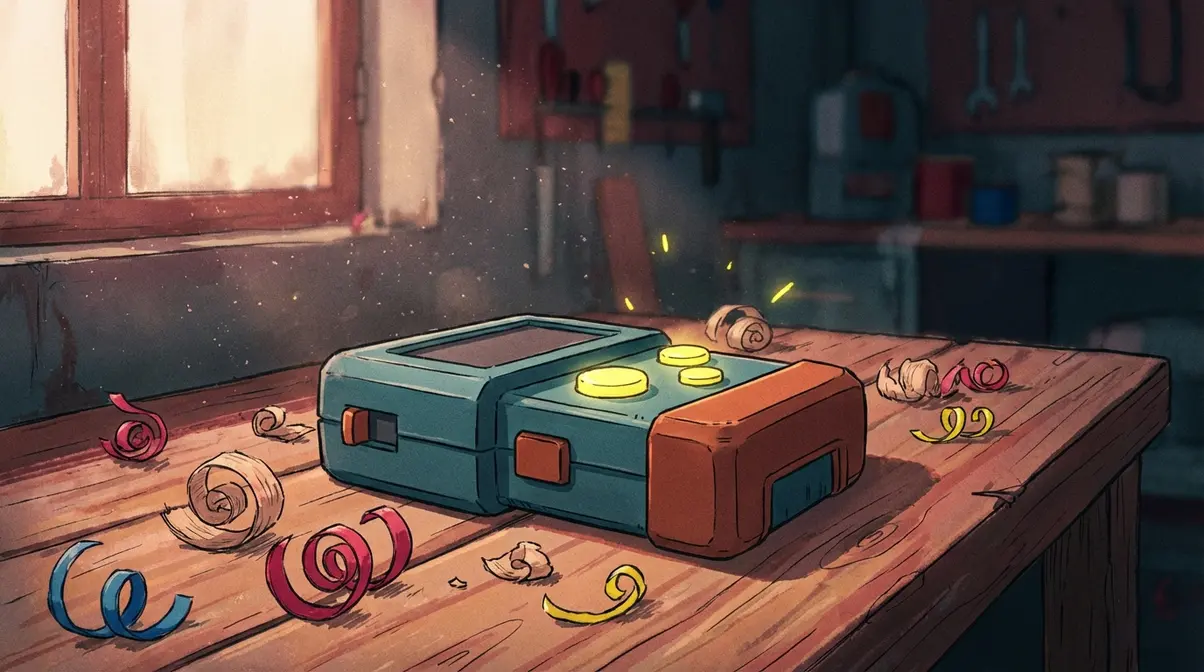

Picture a Penn Engineering fabrication lab in the spring of 2022. Kausi Raman is hunched over a table, guiding a sheet of corrugated cardboard through a contraption held together with duct tape. She is building a machine that doesn’t exist yet. It will look like a miniature table saw, but it won’t have a blade. It won’t have any spinning parts at all.
Raman was taking a course for her master’s in Integrated Product Design at Penn when she was tasked with identifying a growing trend in the education space. While speaking with teachers, she learned about the push toward teaching design thinking skills, but noticed a major challenge during prototyping: cardboard was everywhere, but cutting it required adult help.
That gap between a kid’s ambition and a kid’s grip strength became the entire premise of ChompShop.
The Prototype Years
Raman double-majored in economics and design at UC Davis, and served as the student lead at the UC Davis Institute for Innovation and Entrepreneurship. She came east for Penn’s Integrated Product Design program. She has said the reason she came to Penn was to gain the engineering skills to do physical design, but she started the program having hardly ever held a hammer or used tools before. That late encounter with fabrication tools shaped everything that followed. She learned Arduino through a month-long intensive, ran CNC jobs for other students, operated laser cutters. She used SolidWorks, Rhino, OnShape, and Fusion 360 to create 3D models, printing them on her own Ender 3 and the Penn maker space’s Stratasys.
She wanted to create a toy that encourages kids to get hands-on with projects from an early age. To bring her prototype beyond the cardboard and duct tape phase, Raman enlisted co-founder and CTO Max Liechty, along with his one-year-old toddler, for months of testing and design iterations.
The result is a clever reinvention of a woodworking router table: the ChompSaw works like a high-speed hole punch, enabling kids to cut through cardboard effortlessly, without any risk to fingers, clothing, or hair. The cutting area is limited to cardboard about “two pennies tall.” The torque is low enough that small fingers aren’t in danger, but strong enough to zip through a cereal box panel.
From Kickstarter to Shark Tank
By September 2023 the project hit Kickstarter, drawing viral attention and funding in the platform’s top 0.1 percent of campaigns. The campaign raised $1.2 million in one month after repeatedly going viral on Instagram and TikTok.
Then came the television pitch. Lori Greiner joined Mark Cuban for a combined offer, and the entrepreneurs took the deal for $250K at 15% equity, split 7.5% each between the two Sharks. Six days after the episode aired, the company received around 2,500 orders for the ChompSaw.
The feedback wasn’t all glowing. Some early buyers were disappointed with the quality, complaining that the cardboard didn’t go through well, wishing the company had stated that thin cardboard was needed. ChompShop was proactive in responding, with many reporting they had been offered replacements. That’s a very maker-culture trajectory: ship, listen, iterate.
Recognition and Scale
Within a year ChompShop had moved from prototype to full production, with the founders featured on ABC’s Shark Tank and the product crowned by TIME’s Best Inventions 2025 and Fast Company’s Innovation by Design Winner. They’ve since sold 32,000-plus units in the U.S. and Canada, earned $8.5 million in sales, launched internationally, and grown to seven employees, with Raman as CEO, Liechty as CTO, and his four-year-old son the “Chief Testing Officer.”
I think what makes this story worth telling at length is how thoroughly it was shaped by maker infrastructure. Raman learned to prototype in a university fab lab. She 3D-printed on a $200 Ender 3. She launched through Kickstarter, a platform that still functions as the primary funding mechanism for physical-product startups that don’t fit neatly into the VC pipeline. The whole arc, from duct-tape mockup to TIME magazine, ran on tools and communities that the maker movement spent two decades building.
The Bigger Picture: March 2026
ChompShop’s story lands at an interesting moment. The maker ecosystem is in the middle of several tectonic shifts, all happening at once.
At Embedded World 2026 last week, Qualcomm announced the Arduino VENTUNO Q, a new AI- and robotics-optimized board that starts with the Arduino form factor and extends it significantly. “Ventuno” means twenty-one in Italian, and the board celebrates Arduino’s 21st anniversary. It’s a powerful piece of hardware. It includes a Qualcomm Dragonwing IQ8 Series processor with NPU acceleration delivering up to 40 dense TOPS, and a dedicated STM32H5 microcontroller for low-latency actuation and motor control. This is Arduino’s second board since Qualcomm acquired the company last October, and the community reaction has been split. It remains to be seen whether this board will catch on with Arduino fans, or whether Qualcomm’s goal is more to break into whole new markets under the Arduino brand.
Meanwhile, Maker Faire’s 2026 schedule is stacked with global events from Laos to the Czech Republic, and the flagship Bay Area faire returns this September for the first time in years. A brand-new event called DIY CON, organized by the company behind New York Comic Con, launches in Dallas this November. And Right to Repair legislation now covers more than a quarter of the U.S. population, with Connecticut and Texas laws set to take effect later this year.
These are all structural changes. Better boards, more events, stronger legal protections for tinkerers. But they’re abstract until someone actually makes something with them.
What Raman Understands
Raman and Liechty’s advice to aspiring inventors: “If you’ve got an idea that you think has legs, don’t play your cards close to your chest. Put it in front of people and see what they say. Test whether people would actually buy it, and if they wouldn’t, why not?”
That’s not motivational poster wisdom. It’s a design methodology. Raman and Liechty tested prototypes with hundreds of kids before they ever planned a Kickstarter page. Looking ahead, ChompShop has set its sights on STEM education, hosting a Cardboard Genius Contest, launching an Inventors Club monthly subscription, and working on curricula for schools. “That’s what we’re most excited about,” says Raman. “Being able to bring in more of an educational component in terms of engineering, spatial reasoning and invention to make a real difference in how kids are taught.”
There’s a vigorous, sometimes heated debate right now across online maker communities about whether AI-assisted design “counts” as real making, whether circuit bending has been rendered obsolete by eurorack, whether modding vintage hardware is preservation or vandalism. These are good arguments to have. But they all orbit the same question: what does it mean to build something with your hands in 2026?
Kausi Raman’s answer is disarmingly literal. You give a five-year-old a safe power tool and a shipping box and you get out of the way. The rest is just cardboard.
'%3e%3cg id='Final-Copy-2_2_' transform='translate(1275.000000, 200.000000)'%3e%3cpath class='st0' d='M7.4,12.8h6.8l3.1-11.6H7.4C4.2,1.2,1.6,3.8,1.6,7S4.2,12.8,7.4,12.8z'/%3e%3c/g%3e%3c/g%3e%3c/g%3e%3cg id='final---dec.11-2020'%3e%3cg id='_x30_208-our-toggle' transform='translate(-1275.000000, -200.000000)'%3e%3cg id='Final-Copy-2' transform='translate(1275.000000, 200.000000)'%3e%3cpath class='st1' d='M22.6,0H7.4c-3.9,0-7,3.1-7,7s3.1,7,7,7h15.2c3.9,0,7-3.1,7-7S26.4,0,22.6,0z M1.6,7c0-3.2,2.6-5.8,5.8-5.8 h9.9l-3.1,11.6H7.4C4.2,12.8,1.6,10.2,1.6,7z'/%3e%3cpath id='x' class='st2' d='M24.6,4c0.2,0.2,0.2,0.6,0,0.8l0,0L22.5,7l2.2,2.2c0.2,0.2,0.2,0.6,0,0.8c-0.2,0.2-0.6,0.2-0.8,0 l0,0l-2.2-2.2L19.5,10c-0.2,0.2-0.6,0.2-0.8,0c-0.2-0.2-0.2-0.6,0-0.8l0,0L20.8,7l-2.2-2.2c-0.2-0.2-0.2-0.6,0-0.8 c0.2-0.2,0.6-0.2,0.8,0l0,0l2.2,2.2L23.8,4C24,3.8,24.4,3.8,24.6,4z'/%3e%3cpath id='y' class='st3' d='M12.7,4.1c0.2,0.2,0.3,0.6,0.1,0.8l0,0L8.6,9.8C8.5,9.9,8.4,10,8.3,10c-0.2,0.1-0.5,0.1-0.7-0.1l0,0 L5.4,7.7c-0.2-0.2-0.2-0.6,0-0.8c0.2-0.2,0.6-0.2,0.8,0l0,0L8,8.6l3.8-4.5C12,3.9,12.4,3.9,12.7,4.1z'/%3e%3c/g%3e%3c/g%3e%3c/g%3e%3c/g%3e%3c/svg%3e) Your Privacy Choices
Your Privacy Choices