



A Confession, and a Correction
I wanted to write the story everyone’s been passing around online: that the Zelda Reverse Engineering Team had completed a full decompilation of Oracle of Ages. It would have been a clean narrative, a triumphant headline. But I went looking for the receipts, and they don’t exist. Zelda Reverse Engineering Team has 16 repositories available on GitHub, and their active projects include The Wind Waker, Twilight Princess, Skyward Sword, Breath of the Wild, Ocarina of Time, Majora’s Mask, The Minish Cap, and Phantom Hourglass . Oracle of Ages isn’t among them. Not even close.
The real story is quieter, stranger, and in some ways more impressive. It belongs to a developer known as Stewmath, who has spent years building something almost no one asked for and almost everyone who loves these games needs.
The Lonely Work
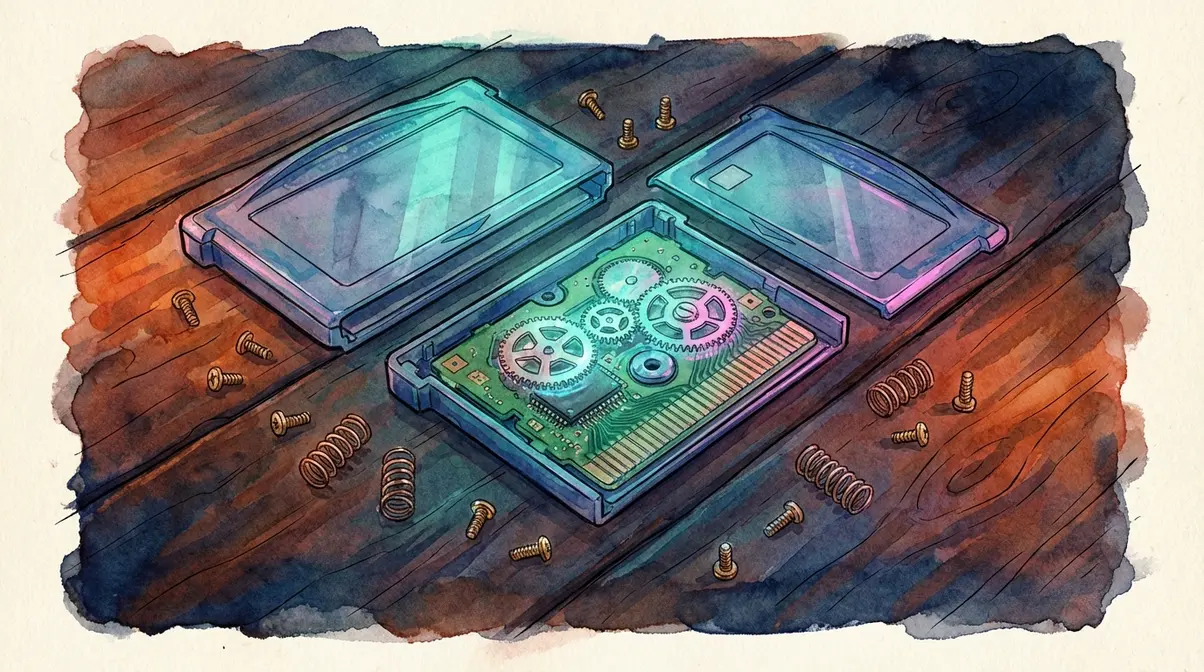
What Stewmath has built is not a decompilation. The distinction matters. As a game which was written in assembly, with no C compilers involved, it’s entirely possible to construct a reasonable approximation of how the source might have looked. The Oracle games ran on the Game Boy Color’s Sharp LR35902, a Z80-derived chip that spoke only in assembly language. There is no C to recover. There was never any C. So what Stewmath created is a disassembly: a complete, documented reconstruction of the assembly code that makes both Oracle of Ages and Oracle of Seasons tick.
This is a complete, documented disassembly of Oracle of Ages and Seasons for the Gameboy Color. When combined with LynnaLab, it is a level editing suite. One repository. Both games. The disassembly is a single repository which builds both games, since they share a lot of code.
Think about that for a moment. Two full Game Boy Color adventures, sharing a codebase like conjoined twins, painstakingly separated and labeled and made legible by what has been, for most of its life, a single person’s obsession. This work isn’t completely done, but it’s close. Stewmath estimated it was over 90% done for Oracle of Ages, and perhaps 70% done for Oracle of Seasons. Those numbers are from the project’s five-year anniversary post. The repository’s last update came in December 2025.
Why These Two Games
After experimenting with porting the original Legend of Zelda to the Game Boy Color, Capcom’s Flagship team, supervised by Yoshiki Okamoto, began developing three interconnected Zelda games that could be played in any order. That’s the origin story of the Oracle duology. Three games became two when the limitations of the password system and the difficulty of coordinating three games proved too complicated, so the project was scaled back to two games at Miyamoto’s suggestion.
Oracle of Seasons and Oracle of Ages are two action-adventure games developed by Flagship, a subsidiary of Capcom, and published by Nintendo. The two games were released on February 27, 2001 in Japan, May 14, 2001 in North America, and October 5, 2001 in Europe. They arrived at the twilight of the Game Boy Color’s life, a pair of games so dense and interlocking that they felt like a magic trick performed on hardware that was already being replaced. Oracle of Ages and its counterpart were said to “send the Game Boy Color out with a bang.”
I remember the password system. I remember writing those symbols down on notebook paper, checking each glyph twice, then entering them into the other cartridge like feeding coordinates into a machine I didn’t fully understand. The linked game unlocked a true ending. It felt like a secret handshake between two cartridges.
What the Disassembly Unlocks
Stewmath’s motivation is disarmingly practical. His motivation boils down to simplifying the process of ROM hack creation, wanting to see people design new games with the Zelda Oracles engine. Unlike a Mario game, where level editors like Lunar Magic let you drag and drop your way to a new world, a Zelda game has more specific needs. In order to create new and interesting puzzles and mechanics, writing some code is a necessity. Rather than trying to hide the complexity of the code with a fancy editor, Stewmath wants to expose the code as painlessly as possible, documenting it and making it easy to modify.
The results are already tangible. LynnaLab is an editor for Oracle of Ages and Seasons, based on oracles-disasm. You can collaborate with friends by starting a LynnaLab server and having clients connect to it, allowing multiple people to edit data simultaneously. There’s a randomizer that shuffles item locations across both games. There are quality-of-life hacks. The ecosystem is small but alive, built on the foundation of one person’s meticulous labor.
The Bigger Picture, Honestly Told
ZRET’s confirmed completed decompilations tell their own story of escalating ambition. ZRET finished decompiling and translating the code for Ocarina of Time. The two-year long project was initiated in the hopes of preserving the first 3D Zelda game for posterity. The Minish Cap reached 100% in late 2023. Majora’s Mask followed in December 2024. The team’s current workload spans half a dozen titles simultaneously, from the GameCube to the Switch.
But the Oracle games sit in a different category entirely. They were written in raw assembly for 8-bit hardware. The ZRET approach of decompiling C or C++ code back into readable source simply doesn’t apply. Stewmath’s project was inspired by the pokered project, which is similarly a disassembly of Pokemon Red and Blue versions. It belongs to a parallel tradition, one rooted in the Game Boy hacking community rather than the N64/GCN decompilation scene.
Online forums light up every time a ZRET milestone drops. People ask what decompilation even means. They debate legality. They dream of combined Oracle ports, of a combined Oracle of Seasons/Oracle of Ages port, with a 3rd quest for Farore. That third game, Mystical Seed of Courage, the one Capcom cancelled a quarter century ago, still haunts the community like a phantom limb.
The Sound of One Person Typing
Stewmath loves the Oracle games. He used to have speedrun records for both, though his only record still standing is his 100% record. He also participated in Google Summer of Code to work on ScummVM, reverse-engineering Star Trek: 25th Anniversary and rewriting the game’s code in C++. This is someone for whom taking apart old software is not a stunt. It is a practice. A discipline.
There is something I find genuinely moving about this kind of work. It doesn’t trend. It doesn’t go viral. Stewmath has never talked about it much publicly outside of a few tweets. He just kept going, commit after commit, year after year, mapping the invisible architecture of two games that were already considered minor entries in a major franchise.
The purpose of this project is to research the inner workings of the Zelda Oracle games and facilitate the creation of non-commercial ROM hacks. That’s the README. No manifestos. No Discord drama. Just the work.
What I’m Actually Telling You
The headline you may have seen elsewhere is wrong, or at least premature. ZRET did not complete an Oracle of Ages decompilation. What exists is something different and, I’d argue, just as remarkable: a years-long, largely solo disassembly of two interconnected Game Boy Color games, built with enough care and precision that the disassembly is complete enough to be reassembled with ROM addresses shifted around arbitrarily, fairly well tested through the randomizer.
If you love these games, if you remember the Harp of Ages and the way Labrynna looked different in the past, if you ever wrote down a 20-character password and prayed you got the symbols right, then this work was done for you. Not by a team. By one person, mostly. In the quiet. For the love of it.
That’s a better story than the one I was asked to write.

'%3e%3cg id='Final-Copy-2_2_' transform='translate(1275.000000, 200.000000)'%3e%3cpath class='st0' d='M7.4,12.8h6.8l3.1-11.6H7.4C4.2,1.2,1.6,3.8,1.6,7S4.2,12.8,7.4,12.8z'/%3e%3c/g%3e%3c/g%3e%3c/g%3e%3cg id='final---dec.11-2020'%3e%3cg id='_x30_208-our-toggle' transform='translate(-1275.000000, -200.000000)'%3e%3cg id='Final-Copy-2' transform='translate(1275.000000, 200.000000)'%3e%3cpath class='st1' d='M22.6,0H7.4c-3.9,0-7,3.1-7,7s3.1,7,7,7h15.2c3.9,0,7-3.1,7-7S26.4,0,22.6,0z M1.6,7c0-3.2,2.6-5.8,5.8-5.8 h9.9l-3.1,11.6H7.4C4.2,12.8,1.6,10.2,1.6,7z'/%3e%3cpath id='x' class='st2' d='M24.6,4c0.2,0.2,0.2,0.6,0,0.8l0,0L22.5,7l2.2,2.2c0.2,0.2,0.2,0.6,0,0.8c-0.2,0.2-0.6,0.2-0.8,0 l0,0l-2.2-2.2L19.5,10c-0.2,0.2-0.6,0.2-0.8,0c-0.2-0.2-0.2-0.6,0-0.8l0,0L20.8,7l-2.2-2.2c-0.2-0.2-0.2-0.6,0-0.8 c0.2-0.2,0.6-0.2,0.8,0l0,0l2.2,2.2L23.8,4C24,3.8,24.4,3.8,24.6,4z'/%3e%3cpath id='y' class='st3' d='M12.7,4.1c0.2,0.2,0.3,0.6,0.1,0.8l0,0L8.6,9.8C8.5,9.9,8.4,10,8.3,10c-0.2,0.1-0.5,0.1-0.7-0.1l0,0 L5.4,7.7c-0.2-0.2-0.2-0.6,0-0.8c0.2-0.2,0.6-0.2,0.8,0l0,0L8,8.6l3.8-4.5C12,3.9,12.4,3.9,12.7,4.1z'/%3e%3c/g%3e%3c/g%3e%3c/g%3e%3c/g%3e%3c/svg%3e) Your Privacy Choices
Your Privacy Choices