

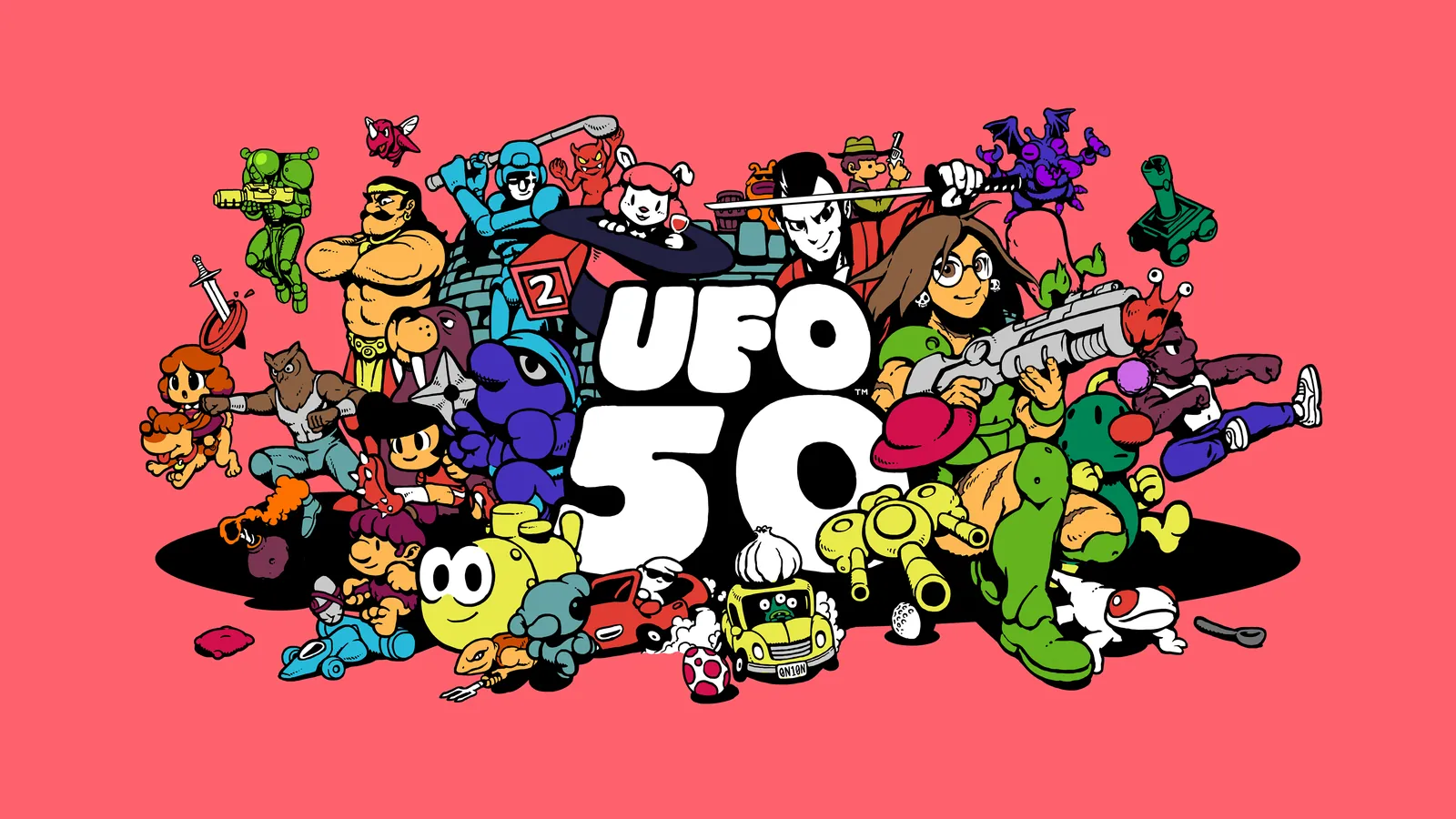


In September 2024, a game appeared on Steam that looked like a forgotten archive from another timeline.
UFO 50 contains fifty complete games, each supposedly released between 1982 and 1989 by a fictional developer called UFO Soft for an equally fictional console, the LX series. The premise sounds like a joke. Derek Yu, Jon Perry, Eirik Suhrke, Paul Hubans, Tyriq Plummer, and Ojiro Fumoto spent nearly a decade building an alternate history of gaming that never happened.
The games share a 32-color palette, identical screen resolution, and sound capabilities designed to mimic the limitations of early 8-bit hardware. Every title boots to a title screen and rolls credits. None of it is real.
And yet players report experiencing what one community member described as “nostalgia for a time that technically didn’t exist, while also being an homage to a time that really did exist.” UFO 50 does not resemble the polished sheen of a remaster, and it is not careful historical preservation. Instead, it feels like stumbling across a lost library of games that somehow slipped through history.
The Company That Never Was
UFO Soft’s fictional timeline unfolds with unglamorous specificity. Within the collection’s lore, the studio begins as a business software company before pivoting toward games in the early 1980s. Individual titles reference technical breakthroughs, internal experimentation, and the slow evolution of a small development team learning what games could be.
The collection’s opening game, Barbuta, drops players directly into gameplay with no music and immediate danger. Online communities noted “the enviable confidence it takes to lead off your highly anticipated game collection” this way. Some players complained about “getting a bad impression off the first several,” but that roughness is part of the point. Early LX games feature only stationary backgrounds because the fictional developers have not yet figured out scrolling.
Across the fifty titles, developer credits appear and reappear as if charting careers inside the company. Each game includes trivia notes describing how ideas were conceived or how technical obstacles were solved. A mechanic might originate from a programmer experimenting late at night, or from a breakthrough that allowed the fictional hardware to be pushed a little further.
What Modernization Means
The developers made deliberate choices about what to preserve and what to improve. Composer Eirik Suhrke explained that releasing all fifty games at once was meant to recreate “the feeling of picking through shareware titles or demo discs.” At the same time, the team chose not to restrict themselves entirely to the genres and design conventions of the 1980s.
That decision creates an interesting tension. Some players argue that the games feel too polished, noting that “literally all of them have more substance than, say, an earlier NES title.” Others point out that several genres represented in the collection did not truly exist in the eighties.
The result sits somewhere between nostalgia and contemporary design. Controls feel precise. Difficulty is present but rarely punishing in the way early console games could be. Critics praised the experiment widely. Christian Donlan at Eurogamer called the project “a dazzling piece of creative audacity,” while Simon Parkin wrote in The Guardian that it was “a preposterously ambitious undertaking.”
The Remaster Problem
Discussions around UFO 50 often drift into a broader anxiety about gaming history. Older games are increasingly difficult to access in their original form. Many titles survive only through remasters or re-releases that replace the originals rather than preserve them.
UFO 50 approaches the problem from the opposite direction. Instead of preserving real games, it invents new ones that feel like they could have existed.
The experience recreates something remasters often cannot: discovery. Players rarely know what they are about to start. Each title feels like it might belong to a different forgotten corner of gaming history.
Some players describe the experience as asking, “what if every game in that FuncoLand bargain bin was a banger?” Others compare it to scrolling through an emulator loaded with games you have never heard of but suddenly feel compelled to try.
Not everyone finds the approach equally compelling. Some worry nostalgia may be the main appeal, questioning whether players who did not grow up with 1980s games will connect with the collection in the same way. Others report that only a portion of the fifty titles truly held their attention. The collection rewards curiosity and patience. One of its largest games, Grimstone, can take dozens of hours to complete.
The Hidden Layer
Beyond the main library lies a deeper layer of secrets connected to Miasma Tower. Players access it through commands entered into an in-game terminal. Codes hidden within multiple games appear to unlock fragments of a larger puzzle.
What initially looks like a straightforward collection slowly reveals something stranger. Players debate whether the system represents a hidden game, a meta narrative about UFO Soft itself, or simply an elaborate mystery designed to reward obsessive exploration.
The obsession extends beyond the screen. A modder named Luke even built a physical LX console designed to run UFO 50. The project, he admitted, had “taken over his life.” When the system finally booted, he reported simply: “It lives. Everything works. It is a disaster inside, but it works.”
The Economics of Fiction
UFO 50 launched at $25. The price reflects eight years of development by six creators and results in fifty playable games. The collection quickly earned strong critical reception and became the highest-rated PC exclusive of 2024 on Metacritic.
Players frequently describe the value proposition as unusual. Many call it a once-in-a-lifetime release that few developers would attempt because of the sheer volume of work involved.
Rather than selling nostalgia through remasters, UFO 50 constructs an entire fictional past and invites players to explore it.
Half the games include two-player modes. All fifty are unlocked from the beginning, with no progression barriers. The collection presents itself as a recovered artifact, supposedly discovered in a storage unit and ported to modern systems by archivists.
None of that story is real, yet the specificity of the fiction makes the illusion convincing.
The fictional LX-II console sits in the middle of UFO Soft’s imagined hardware history. It exists after the earliest technical limitations but before modern conveniences. That middle ground, where constraint encouraged experimentation, is where UFO 50 lives. Not in 1985, but in the idea of what 1985 could have been.


'%3e%3cg id='Final-Copy-2_2_' transform='translate(1275.000000, 200.000000)'%3e%3cpath class='st0' d='M7.4,12.8h6.8l3.1-11.6H7.4C4.2,1.2,1.6,3.8,1.6,7S4.2,12.8,7.4,12.8z'/%3e%3c/g%3e%3c/g%3e%3c/g%3e%3cg id='final---dec.11-2020'%3e%3cg id='_x30_208-our-toggle' transform='translate(-1275.000000, -200.000000)'%3e%3cg id='Final-Copy-2' transform='translate(1275.000000, 200.000000)'%3e%3cpath class='st1' d='M22.6,0H7.4c-3.9,0-7,3.1-7,7s3.1,7,7,7h15.2c3.9,0,7-3.1,7-7S26.4,0,22.6,0z M1.6,7c0-3.2,2.6-5.8,5.8-5.8 h9.9l-3.1,11.6H7.4C4.2,12.8,1.6,10.2,1.6,7z'/%3e%3cpath id='x' class='st2' d='M24.6,4c0.2,0.2,0.2,0.6,0,0.8l0,0L22.5,7l2.2,2.2c0.2,0.2,0.2,0.6,0,0.8c-0.2,0.2-0.6,0.2-0.8,0 l0,0l-2.2-2.2L19.5,10c-0.2,0.2-0.6,0.2-0.8,0c-0.2-0.2-0.2-0.6,0-0.8l0,0L20.8,7l-2.2-2.2c-0.2-0.2-0.2-0.6,0-0.8 c0.2-0.2,0.6-0.2,0.8,0l0,0l2.2,2.2L23.8,4C24,3.8,24.4,3.8,24.6,4z'/%3e%3cpath id='y' class='st3' d='M12.7,4.1c0.2,0.2,0.3,0.6,0.1,0.8l0,0L8.6,9.8C8.5,9.9,8.4,10,8.3,10c-0.2,0.1-0.5,0.1-0.7-0.1l0,0 L5.4,7.7c-0.2-0.2-0.2-0.6,0-0.8c0.2-0.2,0.6-0.2,0.8,0l0,0L8,8.6l3.8-4.5C12,3.9,12.4,3.9,12.7,4.1z'/%3e%3c/g%3e%3c/g%3e%3c/g%3e%3c/g%3e%3c/svg%3e) Your Privacy Choices
Your Privacy Choices