



HYPERLIFIC BLASTER
SCORE 0000
LIVES ♥♥♥
WAVE 1
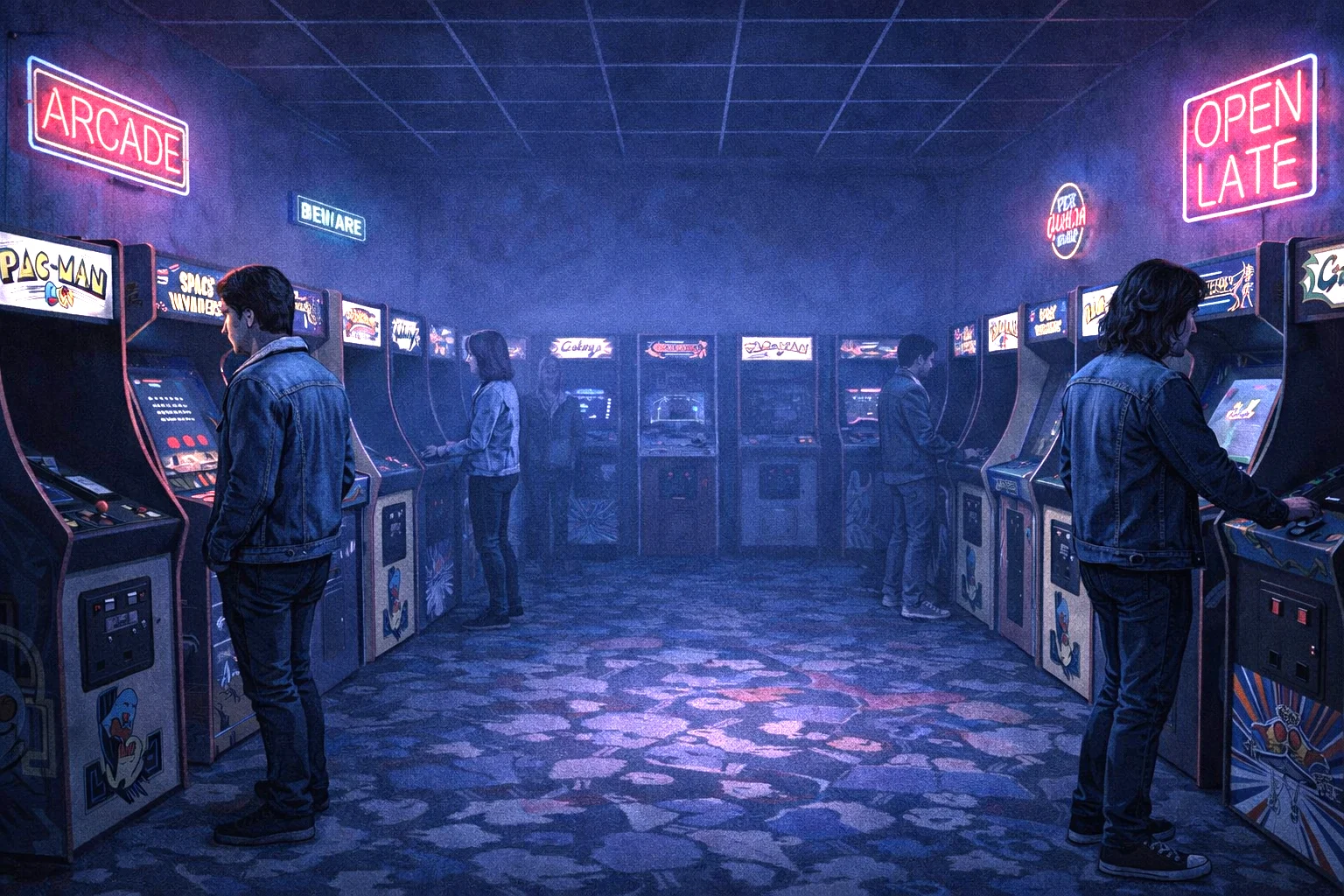
Picture this: it's 1982, and you're standing in a dimly lit arcade, surrounded by the hypnotic glow of CRT screens and the symphony of bleeps, bloops, and electronic melodies. The air smells like popcorn and possibility. You've got a pocket full of quarters and an entire evening ahead of you. This was the golden age of arcade gaming, a period so culturally and financially dominant that the video game industry earned more than Hollywood and the music industry combined.
The numbers tell an incredible story. By 1982, arcade games were generating over $8 billion annually in the United States alone (that's over $20 billion in today's dollars). Worldwide, the industry was worth an estimated $35 billion, equivalent to more than $118 billion today. These weren't just games; they were cultural phenomena that shaped how we think about competition, design, and interactive entertainment.
But here's what makes this era truly special: while everyone knows about Pac-Man and Space Invaders, the 1980s arcade scene was filled with innovative, boundary-pushing titles that never got their proper recognition. Let's dive deep into both the legendary classics and the hidden gems that deserve massive street cred.
The Titans: Games That Defined a Generation
Pac-Man (1980): The $2.5 Billion Phenomenon
When Namco released Pac-Man in 1980, they didn't just create a game. They created the first true gaming mascot, a character so universally beloved that it transcended the arcade and became a cultural icon. With over 400,000 cabinets sold worldwide and an estimated $2.5 billion in quarters earned by the 1990s, Pac-Man remains the highest-grossing arcade game of the 1980s.
What made Pac-Man revolutionary wasn't just its addictive gameplay. It introduced power-ups that temporarily shifted the power dynamic, making the hunted become the hunter. It told a story through cutscenes (a first for arcade games). Most importantly, it opened gaming to female audiences in a way no previous title had managed. The simple maze-chase mechanic was easy to understand but incredibly difficult to master, creating that perfect balance that would define the era's best games.
Space Invaders (1978): The Game That Started It All
Though technically released in 1978, Space Invaders defined the early 1980s arcade landscape. It generated over $2 billion in quarters by 1982 and introduced a concept that would become fundamental to gaming culture: the high score. Suddenly, gaming wasn't just about playing; it was about competing, about proving yourself against everyone who came before you.
Technology journalist Jason Whittaker credits Space Invaders with launching the golden age of arcade gaming. Its simple premise (defend Earth from descending alien invaders) created an escalating tension that kept players coming back, desperately trying to survive just one more wave.
Donkey Kong (1981): When Arcades Started Telling Stories
Before Donkey Kong, arcade games rarely bothered with narrative. You shot things, you ate dots, you avoided ghosts. Nintendo's breakthrough hit changed everything by introducing narrative structure, character identity, and cinematic progression. Players weren't just controlling a sprite; they were Jumpman (later renamed Mario), a carpenter trying to rescue his girlfriend from a giant ape.
The game established Nintendo as a major player in the video game industry and proved that arcade games could be about more than reflexes. They could have personality, humor, and heart. This single title influenced game design in ways we're still feeling today.
The Design Philosophy That Made Them Great
What separated the classics from the forgettable? It comes down to a deceptively simple philosophy: easy to learn, difficult to master. These games could be understood in seconds but took months or years to truly conquer. That accessibility combined with depth created a skilled community of players who gathered around machines, sharing tips and competing for bragging rights.
There's also a darker, more calculated aspect to their design. As enthusiast communities often point out, these games were intentionally designed with escalating difficulty for two key reasons: to limit play time per quarter (ensuring profitable turnover) and to create competition among players via high score tables. Arcade operators needed machines that could generate revenue, and the best games balanced challenge with fairness. Players had to feel like they could improve, that the next quarter might be the one where they finally beat their personal best.
According to Eugene Jarvis, legendary designer of Defender and Robotron: 2084, there was a fundamental difference between American and Japanese design philosophies. Japanese games favored "more deterministic, scripted, pattern-type" gameplay, while American developers emphasized "algorithmic generation of backgrounds and enemy dispatch" with "an emphasis on random-event generation, particle-effect explosions and physics." Both approaches created classics, but they felt distinctly different to play.
The Overlooked Masterpieces: Hidden Gems That Deserve Street Cred
Now we get to the really interesting part. While Pac-Man and Donkey Kong deservedly dominated the spotlight, the 1980s arcade scene was filled with innovative, brilliant games that never achieved mainstream recognition. Online communities and collector circles have been championing these titles for years, and it's time they got their due.
Robotron: 2084 (1982): The Twin-Stick Prophet
Robotron: 2084 essentially invented the twin-stick shooter genre, a format that would later influence everything from Smash TV to modern titles like Geometry Wars. Its premise was brilliantly simple: you're the last hope for humanity, trying to save the last human family from relentless robots in the year 2084. The innovation was in the controls: one joystick for movement, another for firing direction. This allowed for unprecedented freedom of movement and created gameplay that felt genuinely frantic and challenging.
Fan forums consistently rank Robotron among the most influential arcade games ever made, yet it never achieved the household name status of its contemporaries. Its hectic action remains fun and challenging even today, a testament to timeless game design.
Joust (1982): The Party Game Before Party Games
Imagine a game where you ride an ostrich (or stork) as a knight, bouncing around platforms and colliding with enemies in mid-air. The higher rider wins the collision. That's Joust, and as enthusiast groups often note, it feels like an indie party game that could have been released today. Its simultaneous two-player mode created genuine moments of cooperation and betrayal, making it a social experience in ways most arcade games weren't.
Joust has been referenced in pop culture countless times (including prominently in the Ready Player One novel) and influenced Nintendo's Balloon Fight, yet it remains criminally underappreciated outside collector circles.
Defender (1981): The Complexity King
Defender is often considered one of the first major arcade hits of the decade, yet its reputation for brutal difficulty kept it from achieving Pac-Man-level popularity. With complex controls featuring five buttons and a joystick, Defender demanded commitment from players. Those who put in the time discovered one of the most rewarding shooters ever created, with strategic depth that most games couldn't match.
Online communities frequently debate Williams games like Defender and Stargate, with many noting they "had the quickest ramp-up in difficulty" and were designed to "suck quarters out of your pocket with extreme frequency." Yet that difficulty is precisely what makes them legendary among serious players.
Centipede (1981): Breaking Down Barriers
Released by Atari in 1981, Centipede was one of the few games programmed with no specific gender demographic target. It would go on to become one of the most played arcade games among women gamers, with Pac-Man coming in second. The trackball controls felt intuitive and precise, while the destructible mushroom field created strategic possibilities that rewarded planning as much as reflexes.
Centipede proved that arcade games could appeal to everyone, not just teenage boys. Its success helped expand the entire industry's audience.
The Deep Cuts: Games Only Hardcore Collectors Know
Quantum (1982): The Trackball Vector Beauty
Designed by Betty Tylko of General Computer Corporation (one of the few female game designers of the era), Quantum combined a trackball with a color vector monitor to create something genuinely unique. Players used the trackball to draw circles around floating particles while avoiding obstacles. It's abstract, hypnotic, and completely unlike anything else from the period.
Enthusiast communities often cite Quantum as a perfect example of innovation that was too ahead of its time. It never found commercial success, but those who've played it remember it vividly.
Zoo Keeper (1982): The Forgotten Taito Classic
In Zoo Keeper, your girlfriend Zelda is kidnapped by a rogue monkey who releases all the animals in the zoo. You earn points by jumping over escaped animals while rebuilding their enclosures. Released by Taito in 1982, it wasn't ported to any console system until 2005's Taito Legends compilation, meaning an entire generation of gamers missed this charming gem.
Collector circles frequently mention Zoo Keeper as one of those "you had to be there" experiences that never got a second chance.
I, Robot (1983): The 3D Pioneer
I, Robot was one of the first arcade games (possibly the very first) to use flat-shaded polygons for 3D graphics instead of wireframe. It was a technical marvel that looked unlike anything else in 1983. More importantly, it was actually a great game, with clever puzzle-platforming that challenged players to think as much as react.
Despite its innovation, I, Robot was a commercial failure. As one enthusiast forum member noted, it "went completely unnoticed" during the period, but MAME emulation has allowed a new generation to discover its brilliance.
Major Havoc (1983): The Atari Mystery
Many arcade enthusiasts admit they "never even heard of Major Havoc until seeing it in early MAME." This Atari release combined vector graphics with a unique control scheme (a spinner knob) and gameplay that mixed shooting with platforming. It was ambitious, beautiful, and completely overlooked during its original run.
Today, Major Havoc cabinets are prized by collectors who appreciate its unique blend of mechanics and its gorgeous vector aesthetic.
The Late-80s Renaissance: When Technology Caught Up to Ambition
There's an ongoing debate in enthusiast communities about whether the early 1980s or late 1980s produced better games. One common sentiment is that focusing only on early-80s classics ignores how "videogames evolved very quickly and most titles produced by the end of that decade made the ones listed here look like stone age artifacts."
Games from the second half of the decade include powerhouses like Double Dragon, Contra, R-Type, Shinobi, Final Fight, Golden Axe, Bubble Bobble, and Outrun. These titles featured more sophisticated graphics, deeper gameplay, and production values that earlier games couldn't match. They represent the arcade industry at its technical peak, right before home consoles would begin to catch up.
Gauntlet (1985): The Social Revolution
Gauntlet allowed up to four people to play simultaneously, turning arcades into true social spaces. At the peak of its popularity, the average Gauntlet cabinet earned an estimated $900 per week (an astronomical figure). The four-player cabinet was eye-catching and irresistible, creating a shared experience that felt genuinely cooperative.
Fan communities consistently rank Gauntlet as one of the most important multiplayer games ever created, establishing conventions that would define co-op gaming for decades.
Why These Games Still Matter
The influence of 1980s arcade games extends far beyond nostalgia. Many modern video games, particularly indie titles, incorporate elements that were originally innovated by those early developers: skill-based gameplay, straightforward objectives, and rewarding feedback loops. The aesthetic and audiovisual elements of countless indie games draw heavily from the 8-bit and 16-bit styles that arcades popularized.
Games like Undertale and Shovel Knight utilize retro-inspired soundtracks to evoke nostalgia and pay tribute to the arcade era. Modern twin-stick shooters owe everything to Robotron. Battle royale games with their escalating difficulty and elimination mechanics? They're spiritual descendants of arcade design philosophy.
The barcade phenomenon proves that these games remain relevant. Children who grew up in the 1980s and 1990s have fond memories of visiting arcades, and now they're opening their own establishments for friends and fellow enthusiasts. These adult-oriented arcades (serving alcohol alongside classic games) are thriving in major cities worldwide, demonstrating that great game design is truly timeless.
The Authentic Experience: Why Nothing Compares
As one passionate community member put it, "nothing compares to standing at an arcade machine wiggling joysticks" compared to emulators or consoles. There's something about the physical presence of these machines, the tactile feedback of the controls, the glow of the CRT screen, and the social atmosphere that can't be replicated.
Home collections reveal interesting patterns about which games have lasting appeal. Enthusiasts report that Galaga, Ms. Pac-Man, Pole Position, and Centipede remain "hits with guests," while more challenging titles like Robotron, Stargate, and Tempest are "not really hits with guests." For kids and casual players, "Donkey Kong or Super Mario Bros, always a hit. Galaga, always a hit. Asteroids, always a hit."
This split between hardcore appreciation and casual appeal reveals something important: the best arcade games worked on multiple levels. They could entertain anyone for a few minutes, but they also offered depth for those willing to commit.
Your Quest Begins Here
The golden age of arcade gaming wasn't just about entertainment. It was about community, competition, and the pure joy of mastering something difficult. These games were systems of mastery, built to challenge reflexes, memory, and patience. They shaped how games are designed today and why difficulty, clarity, and mechanical depth still matter.
Whether you're discovering these classics through emulation, hunting down original cabinets, or visiting a local barcade, you're connecting with a pivotal moment in gaming history. The seminal arcade games from the 1980s weren't perfect, but they were pure. They knew exactly what they wanted to be and executed that vision with laser focus.
So here's your call to action: seek out these games. Play the classics everyone knows, but also dig deeper. Find a Robotron cabinet. Try Joust with a friend. Experience the trackball magic of Centipede or Quantum. Discover why collectors get passionate about Zoo Keeper and Major Havoc. These games earned their street cred through brilliant design, innovation, and the countless hours players invested in mastering them.
The golden age may have ended in the mid-1980s, but its legacy lives on in every game that values skill, every high score table, every moment of "just one more try." These weren't just games. They were the foundation of everything that came after, and they remain as challenging and rewarding today as they were when they first lit up those darkened arcades decades ago.
Now grab some quarters (metaphorical or otherwise) and start playing. Or play the game we created at the top of this post. The leaderboard is waiting for your initials.


'%3e%3cg id='Final-Copy-2_2_' transform='translate(1275.000000, 200.000000)'%3e%3cpath class='st0' d='M7.4,12.8h6.8l3.1-11.6H7.4C4.2,1.2,1.6,3.8,1.6,7S4.2,12.8,7.4,12.8z'/%3e%3c/g%3e%3c/g%3e%3c/g%3e%3cg id='final---dec.11-2020'%3e%3cg id='_x30_208-our-toggle' transform='translate(-1275.000000, -200.000000)'%3e%3cg id='Final-Copy-2' transform='translate(1275.000000, 200.000000)'%3e%3cpath class='st1' d='M22.6,0H7.4c-3.9,0-7,3.1-7,7s3.1,7,7,7h15.2c3.9,0,7-3.1,7-7S26.4,0,22.6,0z M1.6,7c0-3.2,2.6-5.8,5.8-5.8 h9.9l-3.1,11.6H7.4C4.2,12.8,1.6,10.2,1.6,7z'/%3e%3cpath id='x' class='st2' d='M24.6,4c0.2,0.2,0.2,0.6,0,0.8l0,0L22.5,7l2.2,2.2c0.2,0.2,0.2,0.6,0,0.8c-0.2,0.2-0.6,0.2-0.8,0 l0,0l-2.2-2.2L19.5,10c-0.2,0.2-0.6,0.2-0.8,0c-0.2-0.2-0.2-0.6,0-0.8l0,0L20.8,7l-2.2-2.2c-0.2-0.2-0.2-0.6,0-0.8 c0.2-0.2,0.6-0.2,0.8,0l0,0l2.2,2.2L23.8,4C24,3.8,24.4,3.8,24.6,4z'/%3e%3cpath id='y' class='st3' d='M12.7,4.1c0.2,0.2,0.3,0.6,0.1,0.8l0,0L8.6,9.8C8.5,9.9,8.4,10,8.3,10c-0.2,0.1-0.5,0.1-0.7-0.1l0,0 L5.4,7.7c-0.2-0.2-0.2-0.6,0-0.8c0.2-0.2,0.6-0.2,0.8,0l0,0L8,8.6l3.8-4.5C12,3.9,12.4,3.9,12.7,4.1z'/%3e%3c/g%3e%3c/g%3e%3c/g%3e%3c/g%3e%3c/svg%3e) Your Privacy Choices
Your Privacy Choices