

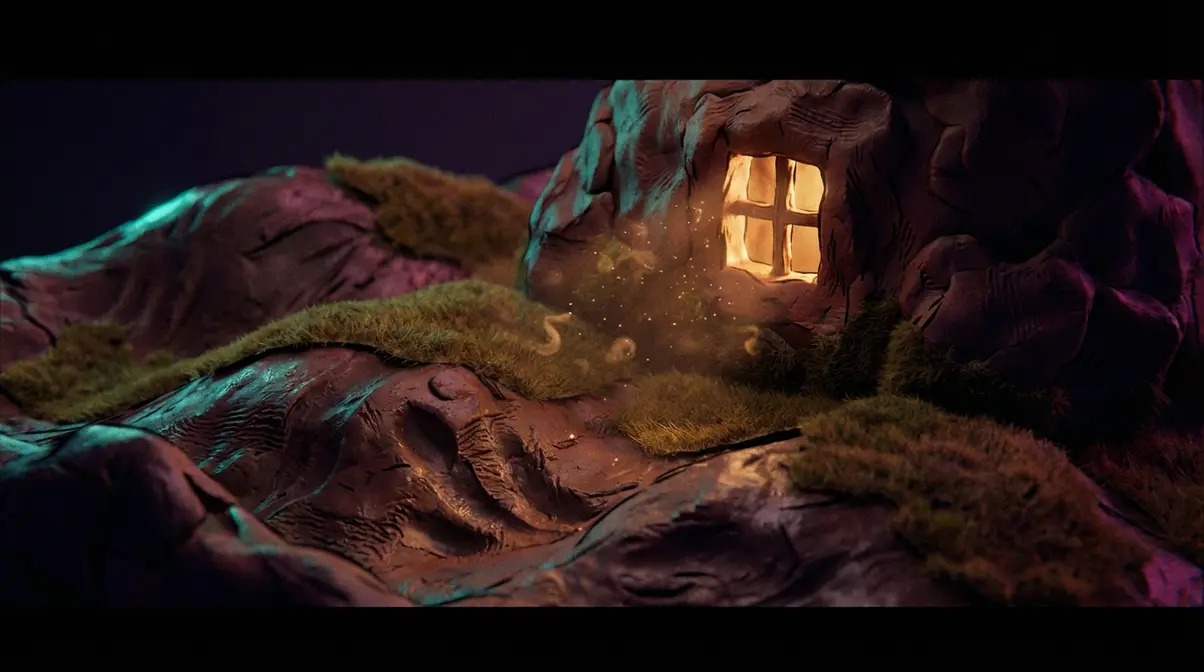

Something shifted in 2024 when The Midnight Walk appeared at PlayStation’s State of Play showcase. Not another tech demo flexing ray-traced puddles or follicle-perfect hair strands. Instead, audiences saw clay. Actual, physical clay that had been sculpted by human hands, scanned into Unreal Engine 5, and animated with stop-motion soul. IGN gave it a 9/10. Players called it the standout of the entire showcase. And suddenly, the industry’s decade-long sprint toward photorealism felt like running in the wrong direction.
We’re watching a frequency change in real time. Not a trend. Not a nostalgia play. A fundamental recalibration of what game visuals should accomplish.
The Photorealism Plateau
Here’s what nobody wants to admit: we hit the ceiling years ago. Horizon Forbidden West looks stunning. The Last of Us Part II is a technical marvel. But neither achieves actual photorealism, and according to industry veterans, we won’t see true photorealism until tenth-generation hardware at the earliest. Meanwhile, the chase has created a different problem entirely.
Games pursuing hyperrealism now look soft and blurry because they render at low resolutions before being upscaled. They demand top-tier GPUs and CPUs, alienating players on anything less than cutting-edge hardware. Performance gets compromised. Art direction becomes homogenized. Every forest looks like every other forest. Every city street reflects the same puddles.
Enthusiast communities have been vocal about this for months. The consensus? Graphics are already very good. Nobody needs to play a game while marveling at how much it resembles a film. The highest-rated games of 2023 (Tears of the Kingdom, Baldur’s Gate 3) prioritized systems and imagination over pixel-perfect realism. That wasn’t an accident.
When Clay Beats Polygons
The Midnight Walk represents something deeper than aesthetic preference. Every asset was sculpted in physical clay, then 3D scanned with meticulous detail. The result carries a tactile weight that pure digital modeling can’t replicate. You can feel the thumbprints. The imperfections aren’t bugs; they’re signatures of human presence.
This matters because audiences are starving for authenticity in an increasingly AI-assisted production landscape. Claymation and stop-motion aesthetics offer proof of human craft. They create what developers call “the handmade advantage,” where organic imperfections generate more emotional resonance than technical perfection ever could.
The lineage runs deep. From The Neverhood in 1996 through Harold Halibut to today’s clay renaissance, these projects tap into something primal. Childhood memories of Gumby and Wallace & Gromit. The uncanny warmth of objects that exist in physical space before they exist on screen. Horror games especially benefit from this approach. Little Nightmares understood it. The Midnight Walk proved it. Clay-based terror hits different because it activates the same neural pathways as our earliest nightmares.
UE5’s Beautiful Irony
Unreal Engine 5 was built for photorealism. Nanite handles billions of polygons. Lumen simulates real-time global illumination. Epic Games marketed these tools as the future of lifelike graphics. Yet some of the most distinctive work emerging from the engine completely ignores that promise.
Developer forums are filled with questions about whether Nanite and Lumen even matter for non-photorealistic projects. The answer reveals UE5’s true strength: it’s an incredibly capable engine for lean teams pursuing stylized visions. The technical horsepower that could render every pore on a character’s face instead gets redirected toward artistic expression, performance optimization, and visual clarity.
Stylized games built in UE5 run smoothly on wider hardware ranges. They maintain higher, more consistent framerates. Most importantly, they age gracefully. A stylized game from 2016 still looks fresh today. A photorealistic title from the same year already feels dated. This isn’t subjective. It’s the documented reality of how our visual perception processes abstraction versus attempted realism.
The Accessibility Equation
Independent developers have figured out what AAA studios are slowly learning: stylization is democratization. Smaller teams can’t compete with Naughty Dog’s rendering budgets. They can absolutely create distinctive visual identities that cut through market saturation.
The numbers support this. Independent games became the only category to grow among American gamers from 2021 to 2022. These aren’t players rejecting quality. They’re embracing games that prioritize art direction over raw polygon counts.
Stylized visuals require fewer resources while delivering more personality. They enable faster iteration cycles. They solve the uncanny valley problem where almost-real becomes creepier than obviously-artificial. When realistic graphics aren’t perfect, human brains notice every stiff facial animation and odd eye movement. Stylization sidesteps that entirely by establishing different visual rules from frame one.
Breaking the Right Rules
Art directors working on stylized projects emphasize a crucial advantage: permission to break rules. Photorealism demands adherence to physical laws. Light behaves a certain way. Skin has specific subsurface scattering properties. Deviate from reality and the illusion shatters.
Stylization offers freedom. Colors can be impossibly saturated. Proportions can stretch and compress for emotional effect. Textures can mix painting techniques with sculptural depth. This isn’t limitation; it’s liberation.
The 2025 game showcases at PlayStation State of Play and Xbox Games demonstrated this shift clearly. The number of strictly photorealistic games was remarkably low. Instead, developers offered cutting-edge graphics with all that computational power turned toward artistic expression. Not realism for realism’s sake, but visuals in service of vision.
The Frequency, Not the Nostalgia
This isn’t about romanticizing the past. Claymation’s resurgence in 2025 and 2026 isn’t nostalgia; it’s recognition of a frequency that never stopped resonating. The handcrafted aesthetic offers contrast to digital perfection precisely because imperfection carries meaning. Stop-motion artistry reminds us that animation is transformation, not simulation.
Online communities celebrating this shift aren’t rejecting technology. They’re rejecting the idea that technology’s ultimate purpose is mimicking reality. By the 17th century, painters were already abandoning photorealism as a style. They’d mastered it and moved on to more interesting questions. Game development is having its own reckoning with that lesson.
What we’re witnessing is studios realizing they’ve been chasing the wrong goal. Graphics are good enough. Performance matters more than another percentage point of realism. Artistic identity trumps technical specs. Players don’t need photorealism. They need worlds that feel alive, which has nothing to do with polygon density and everything to do with soul.
Building With Clay in a Digital Age
The future belongs to hybrid approaches. Stop-motion aesthetics created with 3D tools. Claymation charm balanced with digital precision. UE5 giving small teams the power to realize visions that would have required Hollywood budgets a decade ago.
This is the moment. Not to choose sides between stylized and photorealistic, but to recognize that the most exciting work happens when craft drives technology instead of the other way around. When human hands sculpt clay that becomes game assets. When imperfection becomes signature. When the tools serve the vision rather than dictating it.
The claymation soul of UE5 isn’t killing photorealism. It’s reminding us what we lost while chasing it. And that’s worth more than all the ray-traced reflections in the world.


'%3e%3cg id='Final-Copy-2_2_' transform='translate(1275.000000, 200.000000)'%3e%3cpath class='st0' d='M7.4,12.8h6.8l3.1-11.6H7.4C4.2,1.2,1.6,3.8,1.6,7S4.2,12.8,7.4,12.8z'/%3e%3c/g%3e%3c/g%3e%3c/g%3e%3cg id='final---dec.11-2020'%3e%3cg id='_x30_208-our-toggle' transform='translate(-1275.000000, -200.000000)'%3e%3cg id='Final-Copy-2' transform='translate(1275.000000, 200.000000)'%3e%3cpath class='st1' d='M22.6,0H7.4c-3.9,0-7,3.1-7,7s3.1,7,7,7h15.2c3.9,0,7-3.1,7-7S26.4,0,22.6,0z M1.6,7c0-3.2,2.6-5.8,5.8-5.8 h9.9l-3.1,11.6H7.4C4.2,12.8,1.6,10.2,1.6,7z'/%3e%3cpath id='x' class='st2' d='M24.6,4c0.2,0.2,0.2,0.6,0,0.8l0,0L22.5,7l2.2,2.2c0.2,0.2,0.2,0.6,0,0.8c-0.2,0.2-0.6,0.2-0.8,0 l0,0l-2.2-2.2L19.5,10c-0.2,0.2-0.6,0.2-0.8,0c-0.2-0.2-0.2-0.6,0-0.8l0,0L20.8,7l-2.2-2.2c-0.2-0.2-0.2-0.6,0-0.8 c0.2-0.2,0.6-0.2,0.8,0l0,0l2.2,2.2L23.8,4C24,3.8,24.4,3.8,24.6,4z'/%3e%3cpath id='y' class='st3' d='M12.7,4.1c0.2,0.2,0.3,0.6,0.1,0.8l0,0L8.6,9.8C8.5,9.9,8.4,10,8.3,10c-0.2,0.1-0.5,0.1-0.7-0.1l0,0 L5.4,7.7c-0.2-0.2-0.2-0.6,0-0.8c0.2-0.2,0.6-0.2,0.8,0l0,0L8,8.6l3.8-4.5C12,3.9,12.4,3.9,12.7,4.1z'/%3e%3c/g%3e%3c/g%3e%3c/g%3e%3c/g%3e%3c/svg%3e) Your Privacy Choices
Your Privacy Choices