


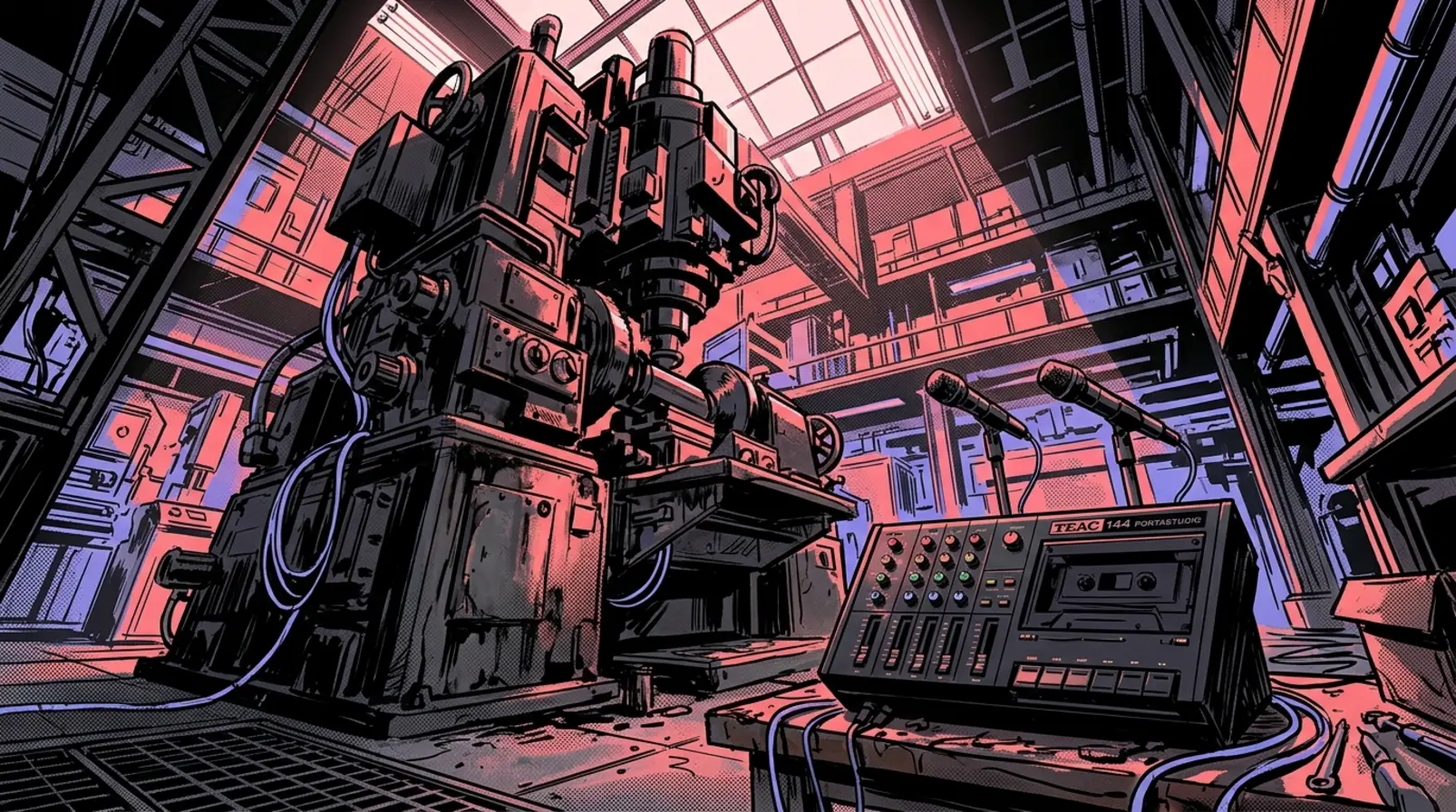
There’s a moment in every musician’s journey when you realize the tools have become too perfect. Too polished. Too predictable. The plugins sound flawless, the digital synths offer infinite possibilities, and yet something fundamental is missing. That thing you can’t quite name but know when you feel it: the sense that your instrument is alive.
Korg’s Phase8 isn’t trying to solve that problem with more features or better algorithms. It’s solving it by going somewhere synthesis hasn’t really gone before, into a space that designer Tatsuya “Tats” Takahashi calls “beyond electronics altogether.”
What Happens When You Turn a Synthesizer Inside Out
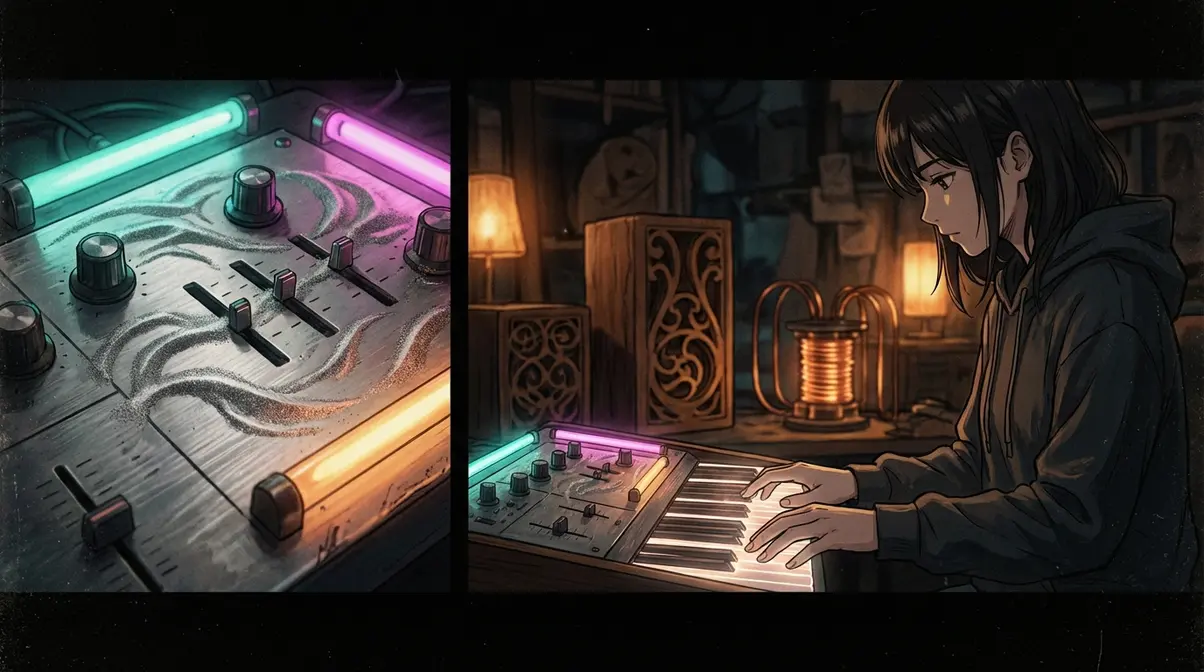
The Phase8 looks like it arrived from a parallel timeline where someone asked, “What if we built a synth that you could actually touch to change the sound?” Not touch a screen or turn a knob, but physically interact with the thing that’s making the noise. The result is something that occupies the strange territory between a Fender Rhodes, a kalimba, and a modular synthesizer that escaped from the lab.
At its core are eight independent electromechanical voices, each built around chromatically tuned steel resonators. An electromagnet vibrates these resonators, which are picked up by a capacitive sensor and fed into the synthesis engine. But here’s where it gets interesting: you can reach out and touch them, pluck them, mute them, or even place found objects on them to reshape the sound in real time.
This isn’t a gimmick. It’s a fundamental rethinking of what synthesis can be.
Seven Years of Breaking Rules
The Phase8’s journey started in 2019 when Takahashi founded Korg Berlin. The same mind behind the accessible, beloved Volca series decided to go in the opposite direction: not smaller and cheaper, but stranger and more experimental. Four years of development led to the Phase5 prototype at Superbooth 2023. A year later, it evolved into the Phase8. By NAMM 2026, the commercial version was ready.
That timeline matters. In an industry obsessed with quarterly releases and feature creep, Korg gave Takahashi the space to develop something genuinely new. Online communities have been tracking this evolution with a mix of excitement and skepticism. Some enthusiasts immediately declared “shut up and take my money,” while others wondered about the practical scope of an instrument this unconventional.
The debates in modular synthesis circles reveal the tension: is this a niche curiosity or the beginning of something bigger? The answer might be both.
The Anti-Plugin Philosophy
Takahashi told audiences at NAMM that the Phase8 was inspired by a desire to create something that feels “organic” and “alive” in a market flooded with feature-laden synthesizers. That statement resonates because it names something many musicians feel but struggle to articulate. When every sound is possible, nothing feels necessary.
The Phase8 pushes back against that infinite possibility by embracing limitation and physicality. You get 13 chromatically tuned resonators, but only eight can be installed at once. The sequencer supports both step programming and live recording, with each voice offering step skip for polymetric patterns. There’s an AIR slider that lets you boost or quiet the acoustic response. Three amplitude modulation effects: tremolo and two audio rate, pitch-dependent modulation types.
These aren’t random constraints. They’re carefully chosen boundaries that force creativity rather than option paralysis.
What the Communities Are Saying
In enthusiast forums, the conversation splits along interesting lines. Techno producers immediately saw the potential, noting that the limitations of the sequencer and the finite number of resonators are actually advantages in that context. The unpredictability, the organic variation, the way each performance is slightly different because you’re interacting with physical objects: these are features, not bugs.
Experimental musicians started planning their signal chains before the units even shipped. “Waiting for mine to arrive,” one commenter wrote, “definitely looking forward to plugging it into Enner, Clouds, Analog Heat and a bit of Mercury 7.” The Phase8 becomes a sound source that’s alive in a way that sample libraries and oscillators aren’t.
There’s also healthy skepticism. Some see it as a passion project that won’t find a wide audience. Others worry about practical concerns like dust getting into the mechanism or the learning curve of an instrument that doesn’t work like anything else. These aren’t invalid criticisms. The Phase8 isn’t trying to replace your main synth. It’s trying to be something your main synth could never be.
Beyond the Binary
The analog versus digital debate has dominated synthesis discussions for decades, but it’s always been a false choice. The Phase8 demonstrates why by refusing to participate. It uses electromagnetic stimulation of physical resonators controlled by digital sequencing and modulation. It’s acoustic and electronic. It’s percussive and melodic. It’s an instrument and an experiment.
One observer described it as “a clever rebellion against the menu-diving and screen-staring that defines so much modern gear.” That’s part of it, but the deeper point is about the relationship between musician and instrument. When you can physically touch the thing making the sound and hear it change under your fingers, you’re not programming. You’re playing.
The Frequency of Now
At $1,149, the Phase8 isn’t an impulse purchase. It’s an investment in a different way of thinking about synthesis. Pre-orders have been described as “very high,” suggesting there’s real appetite for instruments that break conventions rather than refine them.
The first units ship in April 2026. What happens next depends on whether the broader music community is ready for synthesis that you can feel, not just hear. The modular scene seems primed for it. Electronic experimentalists are already planning their setups. But the real test will be whether the Phase8 inspires a new generation of instruments that prioritize physicality and unpredictability over feature lists and preset banks.
Maybe the revolution isn’t about haptic feedback in the technical sense. Maybe it’s about remembering that music is a physical act, that the best instruments push back, that limitation breeds creativity, and that sometimes the most innovative thing you can do is build something that feels alive.
The Phase8 isn’t trying to be the future of synthesis. It’s trying to be a future of synthesis, one where touching your instrument isn’t just about turning knobs. It’s about shaping sound with your hands, in real time, with all the beautiful unpredictability that comes from interacting with physical objects that vibrate and resonate and respond.
That’s not nostalgia. That’s a frequency worth tuning into.


'%3e%3cg id='Final-Copy-2_2_' transform='translate(1275.000000, 200.000000)'%3e%3cpath class='st0' d='M7.4,12.8h6.8l3.1-11.6H7.4C4.2,1.2,1.6,3.8,1.6,7S4.2,12.8,7.4,12.8z'/%3e%3c/g%3e%3c/g%3e%3c/g%3e%3cg id='final---dec.11-2020'%3e%3cg id='_x30_208-our-toggle' transform='translate(-1275.000000, -200.000000)'%3e%3cg id='Final-Copy-2' transform='translate(1275.000000, 200.000000)'%3e%3cpath class='st1' d='M22.6,0H7.4c-3.9,0-7,3.1-7,7s3.1,7,7,7h15.2c3.9,0,7-3.1,7-7S26.4,0,22.6,0z M1.6,7c0-3.2,2.6-5.8,5.8-5.8 h9.9l-3.1,11.6H7.4C4.2,12.8,1.6,10.2,1.6,7z'/%3e%3cpath id='x' class='st2' d='M24.6,4c0.2,0.2,0.2,0.6,0,0.8l0,0L22.5,7l2.2,2.2c0.2,0.2,0.2,0.6,0,0.8c-0.2,0.2-0.6,0.2-0.8,0 l0,0l-2.2-2.2L19.5,10c-0.2,0.2-0.6,0.2-0.8,0c-0.2-0.2-0.2-0.6,0-0.8l0,0L20.8,7l-2.2-2.2c-0.2-0.2-0.2-0.6,0-0.8 c0.2-0.2,0.6-0.2,0.8,0l0,0l2.2,2.2L23.8,4C24,3.8,24.4,3.8,24.6,4z'/%3e%3cpath id='y' class='st3' d='M12.7,4.1c0.2,0.2,0.3,0.6,0.1,0.8l0,0L8.6,9.8C8.5,9.9,8.4,10,8.3,10c-0.2,0.1-0.5,0.1-0.7-0.1l0,0 L5.4,7.7c-0.2-0.2-0.2-0.6,0-0.8c0.2-0.2,0.6-0.2,0.8,0l0,0L8,8.6l3.8-4.5C12,3.9,12.4,3.9,12.7,4.1z'/%3e%3c/g%3e%3c/g%3e%3c/g%3e%3c/g%3e%3c/svg%3e) Your Privacy Choices
Your Privacy Choices