


The Red Panel
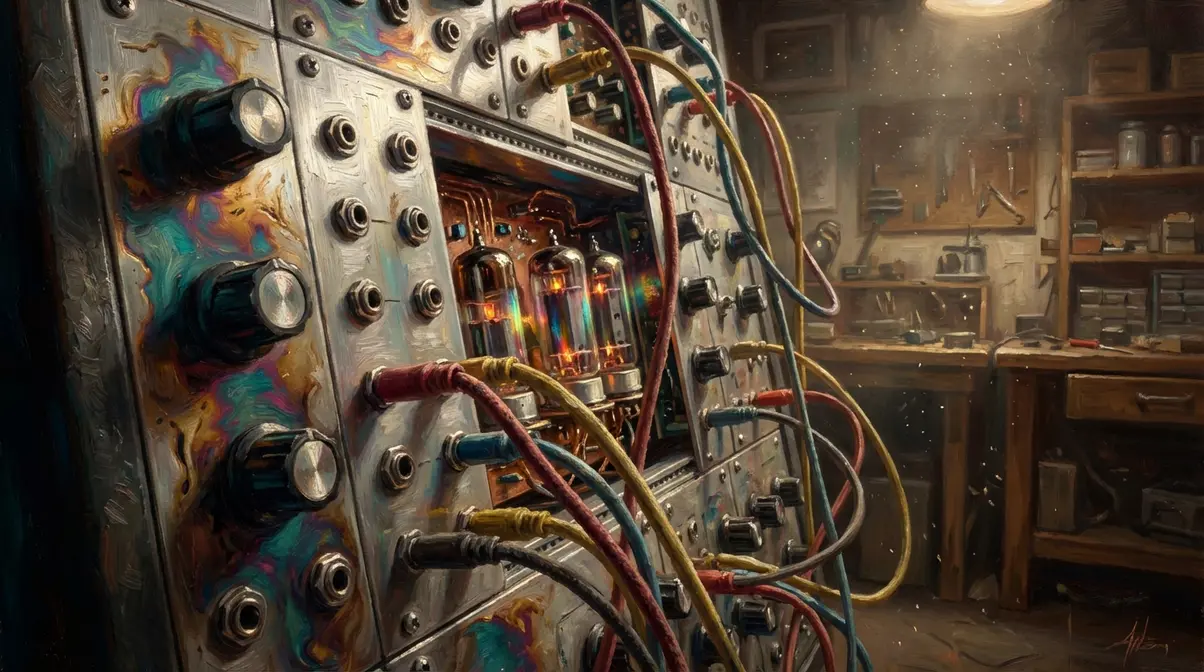
In 2019, a technician named Eliot Curtis opened a vintage Buchla Model 100 synthesizer that had been sitting in a dark room at Cal State University East Bay since the 1960s. He was there to restore it. Clean decades of dust and dormancy from circuits that once shaped the sound of West Coast psychedelia.
Curtis spotted crystallized residue under a knob on one of the red modules. He brushed it away with his finger.
Forty-five minutes later, his body started tingling. Nine hours after that, the trip finally ended. Three chemical tests confirmed what his nervous system already knew: vintage LSD, still potent after half a century in the dark.
The legend was true. Buchla’s infamous “Red Panel” oscillators weren’t just touched by the counterculture. They were dipped in it.
What Don Built in Berkeley
Don Buchla studied physics, physiology, and music at UC Berkeley, graduating in 1959. By 1962, he’d started Buchla and Associates. In 1963, he was commissioned by composers Ramon Sender and Morton Subotnick, who in 1964 gave him $500 from a Rockefeller Foundation grant and a simple brief: build us something new.
Not an instrument that mimicked existing sounds. Not a keyboard pretending to be an orchestra. Something that created sounds no one had heard before.
Buchla delivered the Model 100 in 1965. It landed at the San Francisco Tape Music Center on Divisadero Street, where electronic music, light shows, and LSD converged into a single scene. The system was one of the first voltage-controllable modular synthesizers ever made, developed simultaneously but independently from Robert Moog’s East Coast designs.
The difference? Moog gave you keyboards. Buchla gave you chaos.
“A keyboard is dictatorial,” Buchla said. “When you’ve got a black and white keyboard there, it’s hard to play anything but keyboard music. But when there’s not a keyboard, you get into the knobs and the wires and the interconnections and timbres. It’s a far more experimental way.”
He didn’t even like calling them synthesizers. That word implied imitation. His instruments were for discovery, not performance.
The Bus, The Pranksters, The Acid Tests
Don Buchla was friends with Owsley Stanley. Yes, that Owsley. The clandestine chemist behind the Grateful Dead’s sound system and some of the era’s most legendary LSD. Buchla showed up at places with his instruments, took some acid, and played.
In 1966, some Buchla modules ended up on Further, the converted school bus owned by Ken Kesey and his Merry Pranksters. The same bus immortalized in Tom Wolfe’s The Electric Kool-Aid Acid Test. At the final acid test at Winterland on Halloween 1966, electronic sounds, possibly from the Buchla, punctured the air.
This wasn’t academic music happening in isolation. The Buchla 100 was wired directly into the counterculture’s central nervous system. Pauline Oliveros used it. Suzanne Ciani learned on it. Morton Subotnick composed Silver Apples of the Moon on his own Model 100 in 1967, the first electronic album commissioned specifically for vinyl release. The Library of Congress added it to the National Recording Registry in 2009.
Ciani later recalled how the Buchla 100 emerged from Berkeley during peak political and social chaos. “It’s no accident that he developed his unique ideas in this crucible of upset and chaos.”
Where They Went
Here’s the thing about Buchla 100s: there aren’t many. Never were. Each system cost around $20,000 in today’s money. They were handbuilt, modular, and temperamental. You couldn’t just order one from a catalog.
The original San Francisco Tape Music Center Buchla lives at Mills College, where the Tape Music Center relocated in 1966. Morton Subotnick’s personal unit, the one he used for Silver Apples and The Wild Bull, ended up at the Library of Congress around 2008. In March 2024, technicians finally restored it. Subotnick, now 91, got to play it again in December.
Austrian composer Ernst Krenek owned another Model 100. It’s now at the Ernst Krenek Forum in Krems, Austria, where visitors can see it and occasionally hear it during workshops.
The rest are scattered. A few universities. The Audities Collection. Private owners who guard them like religious artifacts. Online, enthusiasts trade schematics and stories. The MEMS Project documents and recreates vintage Buchla designs. DIY builders chase the sound with clones, the first PCB replicating Buchla circuitry appearing in 2011.
Don Buchla thought resurrecting old tech was “wrongheaded,” but he gave permission anyway. He understood the hunger.
The Mystery Remains
Nobody knows for certain how LSD ended up crystallized inside that red module. Was it Buchla himself, adding chemical inspiration as a feature? Owsley, leaving his signature? Some student hiding their stash decades later? The technician who discovered it didn’t get answers, just an unexpected trip.
The instrument has since been thoroughly cleaned. The LSD is gone. But the question lingers in forums where modular heads debate the 100 versus the 200 series, where someone always mentions the “nasal” sound of later models versus the raw, unrefined character of the original.
One user on a synthesis forum tried dismissing the Buchla as “a far out music box that hippies, tripped out on LSD, would have fun with.” The community pushed back hard. These weren’t toys. They were radical instruments built by academic experimental musicians and countercultural eccentrics who believed music could sound completely different.
The East Coast versus West Coast synthesis debate never ends. Moog’s keyboards won commercially. But Buchla’s knobs and patch cables won philosophically. Today’s modular renaissance, the Eurorack explosion, the rejection of preset-driven music production? That’s Buchla’s legacy.
What Survived
Don Buchla died in 2016 at 79, complications from cancer, back in Berkeley where it started. His instruments remain impossibly rare and expensive. You probably won’t ever touch a real Model 100.
But you can hear what it meant. That insistence on experimentation over execution. That belief that electronic instruments should open doors, not replicate existing rooms. That willingness to take the trip, literally and figuratively, to find sounds hiding in the voltage.
The crystallized LSD is gone from the circuits. The ideology never left.
'%3e%3cg id='Final-Copy-2_2_' transform='translate(1275.000000, 200.000000)'%3e%3cpath class='st0' d='M7.4,12.8h6.8l3.1-11.6H7.4C4.2,1.2,1.6,3.8,1.6,7S4.2,12.8,7.4,12.8z'/%3e%3c/g%3e%3c/g%3e%3c/g%3e%3cg id='final---dec.11-2020'%3e%3cg id='_x30_208-our-toggle' transform='translate(-1275.000000, -200.000000)'%3e%3cg id='Final-Copy-2' transform='translate(1275.000000, 200.000000)'%3e%3cpath class='st1' d='M22.6,0H7.4c-3.9,0-7,3.1-7,7s3.1,7,7,7h15.2c3.9,0,7-3.1,7-7S26.4,0,22.6,0z M1.6,7c0-3.2,2.6-5.8,5.8-5.8 h9.9l-3.1,11.6H7.4C4.2,12.8,1.6,10.2,1.6,7z'/%3e%3cpath id='x' class='st2' d='M24.6,4c0.2,0.2,0.2,0.6,0,0.8l0,0L22.5,7l2.2,2.2c0.2,0.2,0.2,0.6,0,0.8c-0.2,0.2-0.6,0.2-0.8,0 l0,0l-2.2-2.2L19.5,10c-0.2,0.2-0.6,0.2-0.8,0c-0.2-0.2-0.2-0.6,0-0.8l0,0L20.8,7l-2.2-2.2c-0.2-0.2-0.2-0.6,0-0.8 c0.2-0.2,0.6-0.2,0.8,0l0,0l2.2,2.2L23.8,4C24,3.8,24.4,3.8,24.6,4z'/%3e%3cpath id='y' class='st3' d='M12.7,4.1c0.2,0.2,0.3,0.6,0.1,0.8l0,0L8.6,9.8C8.5,9.9,8.4,10,8.3,10c-0.2,0.1-0.5,0.1-0.7-0.1l0,0 L5.4,7.7c-0.2-0.2-0.2-0.6,0-0.8c0.2-0.2,0.6-0.2,0.8,0l0,0L8,8.6l3.8-4.5C12,3.9,12.4,3.9,12.7,4.1z'/%3e%3c/g%3e%3c/g%3e%3c/g%3e%3c/g%3e%3c/svg%3e) Your Privacy Choices
Your Privacy Choices