

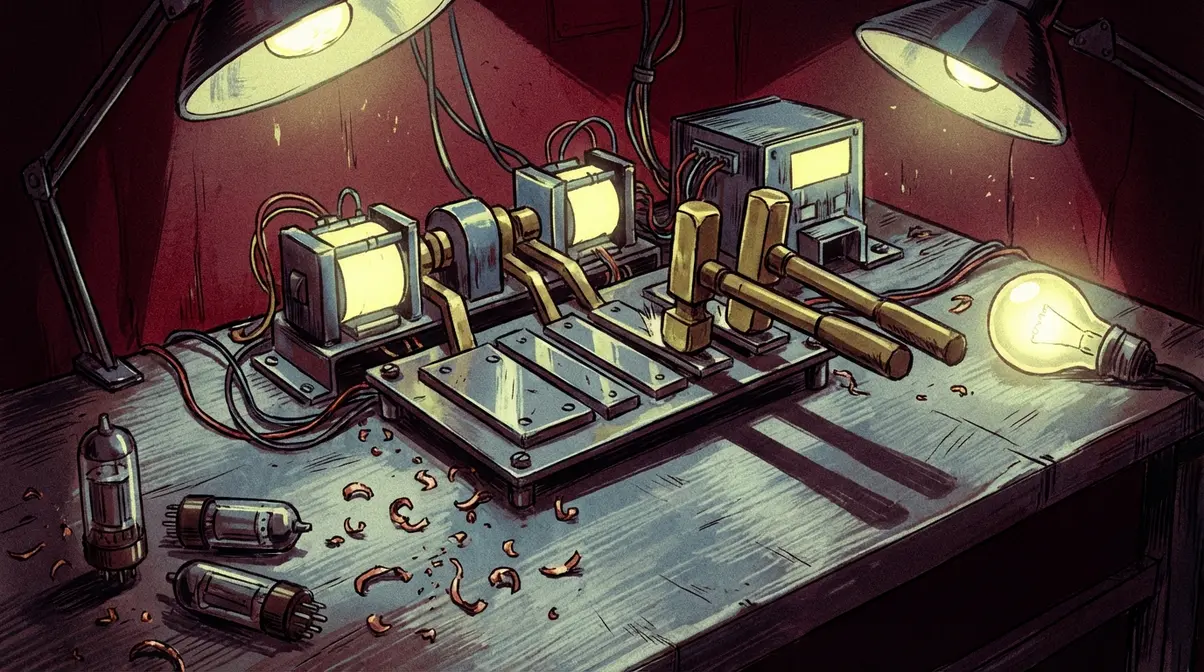

In a Berlin workshop, eight steel tines hang suspended like a deconstructed kalimba. Touch them and they ring. Pluck them and they sing. Feed them voltage and they become something else entirely. This is the Phase 8, and despite what you’ve heard, it isn’t Tatsuya Takahashi’s love letter to acoustic instruments. It’s his assassination attempt.
The narrative writes itself: legendary synth designer goes analog purist, builds mechanical instrument, rejects screens and software. The community eats it up. Another victory in the war against virtual instruments. Another craftsman choosing wood and metal over ones and zeros. Except that’s not what’s happening here.
Takahashi spent years at Korg building the Volcas, the Minilogue, the modern classics that supposedly saved hardware synthesis. Each one smaller, cheaper, more democratic than the last. The press called it a revolution. Musicians called it accessible. But Takahashi called it something else: not good enough.
The Instrument That Plays Itself
“I play the guitar probably ten times more often than I spend time with a synthesizer,” Takahashi admitted in 2023. Not because guitars sound better. Not because they’re more expressive. Because guitars don’t need defending. Nobody writes think pieces about the tactile superiority of frets over piano keys. Nobody champions the democratization of six strings.
The guitar simply exists. You pick it up at a party. You learn three chords badly. You make music anyway. No manual required. No philosophy needed. This mundane dominance haunted Takahashi more than any software synthesizer ever could.
So he built the Phase 8. Not to preserve acoustic sound. Not to reject digital technology. But to make both irrelevant.
Watch the demonstration videos carefully. Yes, you can touch the resonators. Yes, you can “play” them like an instrument. But that’s the trap. The Phase 8 doesn’t need you to touch it. The sequencer strikes the tines. The modulation shapes the harmonics. The acoustic properties create the complexity. You’re not playing an instrument. You’re directing one.
Beyond the False War
The hardware versus software debate misses what Takahashi actually achieved. While forums argued about analog warmth and digital precision, he was asking different questions. Not “how does it sound?” but “what does it enable?” Not “is it authentic?” but “does it generate joy?”
His Volca series proved the point. Critics called them toys. Limited. Compromised. But musicians from Aphex Twin to bedroom producers coaxed extraordinary sounds from boxes that cost less than a decent distortion pedal. The limitations weren’t bugs. They were the entire operating system.
The Phase 8 extends this logic to its breaking point. Eight voices. Eight tines. No hidden menus. No endless possibilities. Just physics and voltage locked in conversation. It’s not minimalism. It’s maximalism through constraint.
The price tells the real story. Under 1000 Euro for an instrument four years in development. Not because Takahashi believes in charity. Because accessibility isn’t philosophy. It’s tactics. Every kid who picks up a Phase 8 instead of a guitar is a small victory in a war most people don’t realize is being fought.
The Violence of Simplicity
Traditional instruments demand apprenticeship. Years of scales. Decades of muscle memory. Generations of tradition. Electronic instruments promised liberation from this tyranny, then promptly created their own. Synthesis theory. Signal flow. Modulation matrices. The freedom to make any sound became the prison of infinite choice.
Takahashi’s instruments refuse both traditions. A Volca Bass has fewer controls than a professional toaster. The Minilogue presents exactly enough options to be dangerous. The Phase 8 turns physics itself into a control surface. This isn’t dumbing down. It’s burning down.
“You first recognize what it is, then learn what it can do, and then you have fun with it,” Takahashi explained his design philosophy. Notice what’s missing. No mention of mastery. No path to expertise. Just recognition, exploration, joy. The loop closes before technique can colonize it.
This is why calling Takahashi a craftsman misses the point. Craftsmen preserve traditions. They pass down knowledge. They maintain standards. Takahashi builds instruments designed to make craftsmanship irrelevant. Every knob labeled clearly. Every function immediate. Every sound accessible to anyone with functioning fingers and 300 dollars.
The Quiet Radicalism
The Phase 8 represents the logical endpoint of this destruction. It’s not acoustic. It’s not electronic. It’s not hybrid. These categories assume music comes from controlling instruments. The Phase 8 suggests music comes from setting up conditions and letting physics sort out the details.
Touch the resonators or don’t. Add found objects or don’t. Let the sequencer play itself while you drink coffee. The instrument doesn’t care about your intentions. It just vibrates according to laws older than music itself.
This terrifies purists more than any software ever could. Virtual instruments can be dismissed as fake. The Phase 8 can’t be dismissed as anything. It simply exists, making sound, indifferent to your philosophy about how sound should be made.
Takahashi never called it a war on the virtual. He didn’t need to. While everyone else fought about authenticity, he built instruments that made the question irrelevant. The Phase 8 doesn’t replace synthesizers or acoustic instruments. It suggests both were asking the wrong questions all along.
The guitar remains undefeated. For now. But in a Berlin workshop, eight steel tines hang waiting. Not for musicians. Not for non-musicians. Just for anyone who wants to make sound. The revolution already happened. Most people just haven’t noticed yet.
'%3e%3cg id='Final-Copy-2_2_' transform='translate(1275.000000, 200.000000)'%3e%3cpath class='st0' d='M7.4,12.8h6.8l3.1-11.6H7.4C4.2,1.2,1.6,3.8,1.6,7S4.2,12.8,7.4,12.8z'/%3e%3c/g%3e%3c/g%3e%3c/g%3e%3cg id='final---dec.11-2020'%3e%3cg id='_x30_208-our-toggle' transform='translate(-1275.000000, -200.000000)'%3e%3cg id='Final-Copy-2' transform='translate(1275.000000, 200.000000)'%3e%3cpath class='st1' d='M22.6,0H7.4c-3.9,0-7,3.1-7,7s3.1,7,7,7h15.2c3.9,0,7-3.1,7-7S26.4,0,22.6,0z M1.6,7c0-3.2,2.6-5.8,5.8-5.8 h9.9l-3.1,11.6H7.4C4.2,12.8,1.6,10.2,1.6,7z'/%3e%3cpath id='x' class='st2' d='M24.6,4c0.2,0.2,0.2,0.6,0,0.8l0,0L22.5,7l2.2,2.2c0.2,0.2,0.2,0.6,0,0.8c-0.2,0.2-0.6,0.2-0.8,0 l0,0l-2.2-2.2L19.5,10c-0.2,0.2-0.6,0.2-0.8,0c-0.2-0.2-0.2-0.6,0-0.8l0,0L20.8,7l-2.2-2.2c-0.2-0.2-0.2-0.6,0-0.8 c0.2-0.2,0.6-0.2,0.8,0l0,0l2.2,2.2L23.8,4C24,3.8,24.4,3.8,24.6,4z'/%3e%3cpath id='y' class='st3' d='M12.7,4.1c0.2,0.2,0.3,0.6,0.1,0.8l0,0L8.6,9.8C8.5,9.9,8.4,10,8.3,10c-0.2,0.1-0.5,0.1-0.7-0.1l0,0 L5.4,7.7c-0.2-0.2-0.2-0.6,0-0.8c0.2-0.2,0.6-0.2,0.8,0l0,0L8,8.6l3.8-4.5C12,3.9,12.4,3.9,12.7,4.1z'/%3e%3c/g%3e%3c/g%3e%3c/g%3e%3c/g%3e%3c/svg%3e) Your Privacy Choices
Your Privacy Choices