


The Cooperative That Wouldn’t Quit
Fabrice Debarge built tools for traditional animators at TVPaint Développement—the kind who still think in frames, not polygons. In 2018, he founded Praxinos as a cooperative, which means the company belongs to the artists who understand what’s being lost. The mission statement reads like a manifesto: make software that serves graphic artists, not the other way around.
Five years of development later, Praxinos released Odyssey in February 2024. Not as a standalone application, but as something stranger—a plugin that embeds traditional 2D animation directly into Unreal Engine 5. The tool launched at €1,200 for a perpetual license. Then in June 2025, Epic Games made it completely free on their Fab marketplace. That shift signals something: either desperation or conviction that the idea matters more than the revenue model.
The pitch sounds simple. Draw watercolor inside a real-time 3D engine. But the technical reality required hacking Unreal’s blueprint system to build a paint engine from scratch, then convincing the Sequencer—designed for cinematic cameras and lighting—to accommodate storyboarding workflows. According to Praxinos’s development notes, integrating their vision into Unreal’s editor “was hard but so much worth it.”
258 Brushes, One Argument
Odyssey ships with 258 brush presets. Crayon. Grease pencil. Watercolor. Speedlines. The library reads like a catalog of every technique photorealism made obsolete. You can paint directly on 3D meshes in three different modes, or ignore the geometry entirely and animate on 2D planes floating in 3D space. The system supports both raster and vector layers in the same scene, which shouldn’t work but does.
There’s a philosophical stance embedded in that brush count. Unreal Engine’s entire architecture pushes toward Nanite geometry and Lumen lighting—technologies that make virtual worlds look like surveillance footage. Odyssey proposes the opposite: make your 3D scenes look hand-touched. The workflow allows artists to focus on drawing animation rather than troubleshooting. That’s the promise—traditional craft without traditional limitations.
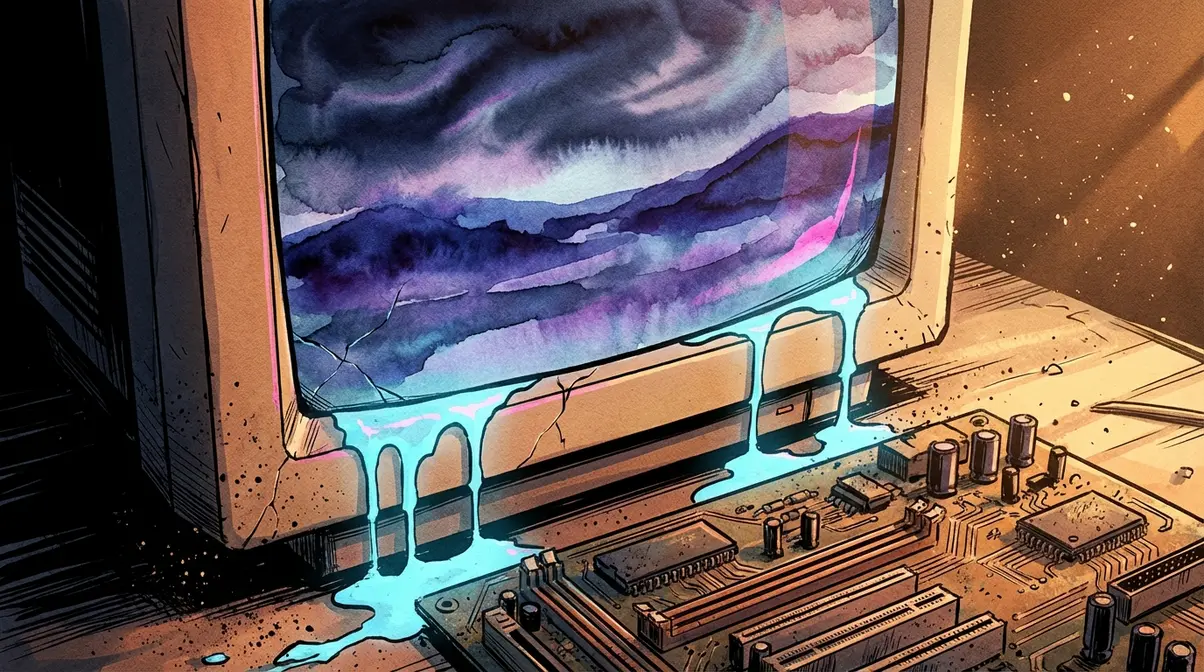
The watercolor brushes specifically feel like an argument about memory. Not nostalgia, which commodifies the past. Something closer to frequency—the visual texture of hand-drawn animation from the era before studios decided everything needed subsurface scattering. Studio Ghibli’s work gets cited constantly in online animation communities as the aesthetic ideal, but few tools actually support that workflow at scale. Odyssey suggests you can have painterly spontaneity and real-time rendering in the same pipeline.
The Hybrid Problem
Most 2D animation software treats 3D as an afterthought. Most 3D engines treat 2D as a UI layer. Praxinos built Odyssey to collapse that distinction, which creates new problems. The system requirements tell the story: 16GB RAM and a Quadro P1000 for pure 2D work, but 32GB and an RTX 1080 minimum if you want to mix in 3D environments. That’s a steep floor for indie animators, even with the free price tag.
The use cases feel genuinely experimental. Storyboarding inside Sequencer means your previz exists in the same file as your final renders. Animators can draw directly in 3D space, then isolate the 2D layer when needed. Game developers could theoretically use it for stylized cutscenes that share assets with gameplay. But the tool also feels like it’s still searching for its ideal workflow—powerful enough to be interesting, not yet standardized enough to be essential.
Some technical artists in online communities have questioned whether embedding 2D workflows into a 3D engine actually solves problems or just creates new dependencies. Fair criticism. Unreal’s update cycle moves fast, and plugins break. Odyssey now requires Unreal Engine 5.6 minimum, which means older projects need migration. That’s the bargain—you get Epic’s rendering tech, but you’re also married to Epic’s roadmap.
What Gets Preserved
The cooperative structure matters here. Praxinos isn’t venture-backed, which means they’re not optimizing for acquisition or scale. The company is owned by “experts of the animation industry,” according to their materials, which suggests the decisions get made by people who still think in frames per second, not quarterly growth targets. That’s rare enough to be notable.
Elodie Moog, one of the founders, describes Odyssey as “a top-notch 2D animation plugin for Unreal Engine.” The language is careful—not revolutionary, not disruptive, just top-notch. There’s confidence in that restraint. The tool doesn’t promise to replace your workflow. It offers an alternative frequency for artists who feel trapped by photorealism’s dominance.
The free model creates different pressures. Epic’s support means Odyssey gets visibility, but it also means the project’s survival depends on maintaining compatibility with Unreal’s core architecture. If Epic decides to restructure their plugin API, Praxinos has to follow. That’s the tension—independence through cooperation, but cooperation that limits independence.
The Frequency Question
Walk through Odyssey’s feature list and you’ll find tools designed to preserve specific kinds of mark-making. Vector warp grids. Indexed palettes. Line thickness control. These aren’t innovations—they’re translations of analog techniques into digital space. The watercolor brushes don’t simulate wetness; they capture the visual rhythm of watercolor without the drying time.
That’s what makes the project compelling. It’s not trying to resurrect 1994 or any other specific year. It’s trying to maintain access to a visual language that modern rendering tech systematically erases. Photorealism is the default now, which means anything that looks hand-drawn requires active resistance. Odyssey provides the tools for that resistance, but it can’t force studios to value the aesthetic.
The question isn’t whether Odyssey succeeds. It’s whether enough artists care about preserving hand-touched visuals to build workflows around it. The plugin is free now, which removes the financial barrier. What remains is the cultural one—convincing an industry optimized for photorealism that watercolor still has signal worth transmitting.


'%3e%3cg id='Final-Copy-2_2_' transform='translate(1275.000000, 200.000000)'%3e%3cpath class='st0' d='M7.4,12.8h6.8l3.1-11.6H7.4C4.2,1.2,1.6,3.8,1.6,7S4.2,12.8,7.4,12.8z'/%3e%3c/g%3e%3c/g%3e%3c/g%3e%3cg id='final---dec.11-2020'%3e%3cg id='_x30_208-our-toggle' transform='translate(-1275.000000, -200.000000)'%3e%3cg id='Final-Copy-2' transform='translate(1275.000000, 200.000000)'%3e%3cpath class='st1' d='M22.6,0H7.4c-3.9,0-7,3.1-7,7s3.1,7,7,7h15.2c3.9,0,7-3.1,7-7S26.4,0,22.6,0z M1.6,7c0-3.2,2.6-5.8,5.8-5.8 h9.9l-3.1,11.6H7.4C4.2,12.8,1.6,10.2,1.6,7z'/%3e%3cpath id='x' class='st2' d='M24.6,4c0.2,0.2,0.2,0.6,0,0.8l0,0L22.5,7l2.2,2.2c0.2,0.2,0.2,0.6,0,0.8c-0.2,0.2-0.6,0.2-0.8,0 l0,0l-2.2-2.2L19.5,10c-0.2,0.2-0.6,0.2-0.8,0c-0.2-0.2-0.2-0.6,0-0.8l0,0L20.8,7l-2.2-2.2c-0.2-0.2-0.2-0.6,0-0.8 c0.2-0.2,0.6-0.2,0.8,0l0,0l2.2,2.2L23.8,4C24,3.8,24.4,3.8,24.6,4z'/%3e%3cpath id='y' class='st3' d='M12.7,4.1c0.2,0.2,0.3,0.6,0.1,0.8l0,0L8.6,9.8C8.5,9.9,8.4,10,8.3,10c-0.2,0.1-0.5,0.1-0.7-0.1l0,0 L5.4,7.7c-0.2-0.2-0.2-0.6,0-0.8c0.2-0.2,0.6-0.2,0.8,0l0,0L8,8.6l3.8-4.5C12,3.9,12.4,3.9,12.7,4.1z'/%3e%3c/g%3e%3c/g%3e%3c/g%3e%3c/g%3e%3c/svg%3e) Your Privacy Choices
Your Privacy Choices