

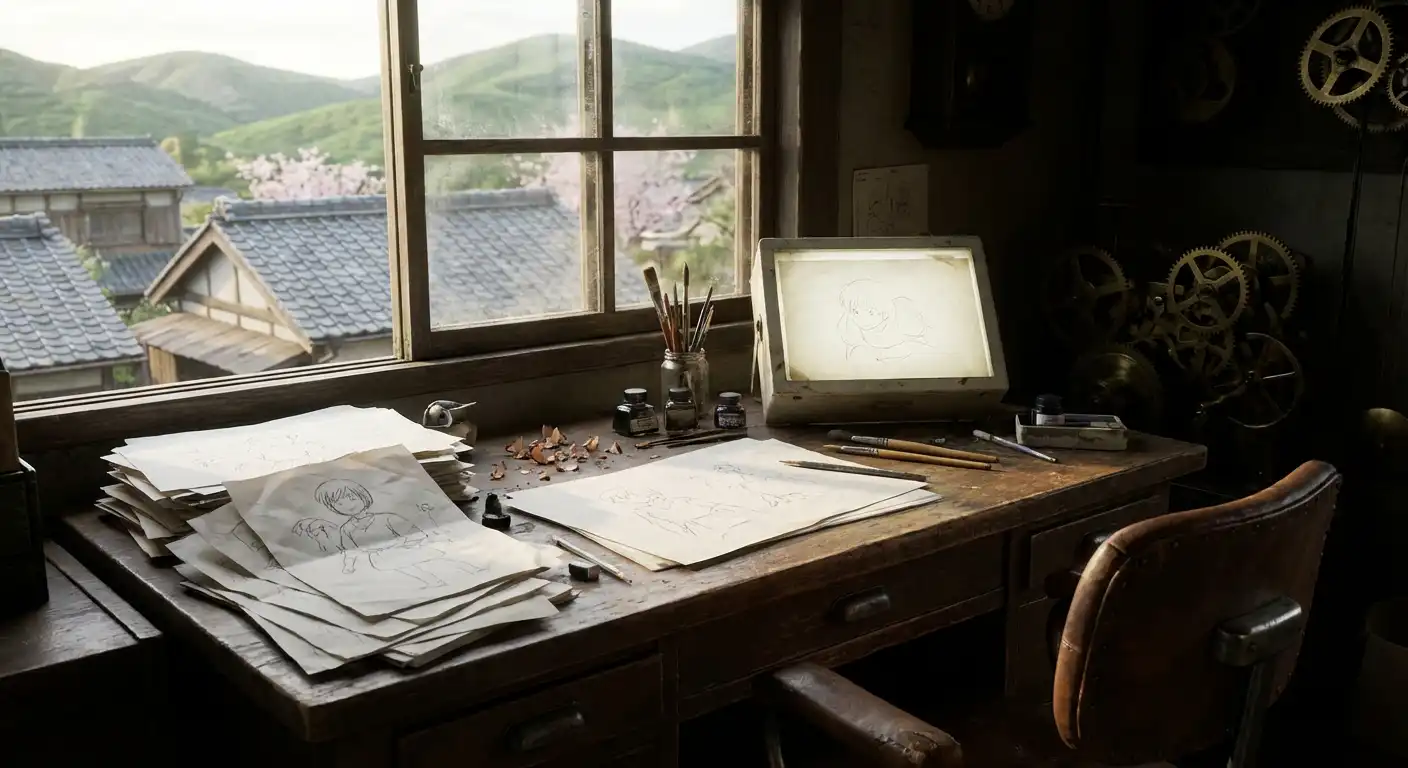


In an era where artificial intelligence threatens to automate every creative pursuit, Hayao Miyazaki’s Starting Point reads less like a memoir and more like a prophetic warning. This collection of essays, interviews, and reflections spanning 1979 to 1996 captures the master animator at a crucial juncture: building Studio Ghibli while the Japanese animation industry raced toward industrialization and efficiency. What emerges is not just a behind-the-scenes look at beloved films, but a philosophical manifesto about what we risk losing when machines replace human hands.
For anyone serious about understanding animation, anime, or the creative philosophy that built one of the world’s most revered studios, this book is essential reading. Yet it demands patience. Online communities of animation enthusiasts consistently describe the experience as dense and thought-provoking, with readers spending days contemplating a single observation about nature or society. Miyazaki doesn’t offer easy answers. Instead, he jumps between topics with the restlessness of a curious mind: weather patterns, architecture, his children, plants, sociology, scriptwriting, world-building. The effect is both exhausting and exhilarating.
The Central Paradox: A Machine Lover Who Rejects Machine-Made Art
Perhaps the most fascinating tension in Starting Point is Miyazaki’s complex relationship with technology itself. His films overflow with lovingly rendered machines: the fantastical flying contraptions in Castle in the Sky, the meticulously detailed aircraft in Porco Rosso, the bathhouse mechanisms in Spirited Away. He personally draws up to 70 percent of individual frames in his movies, often depicting 80,000 out of 140,000 frames himself, as he did for Princess Mononoke.
Yet when it comes to machines creating art, Miyazaki draws an uncompromising line. His 2016 statement calling AI-generated animation “an insult to life itself” has become legendary in animation circles, sparking passionate debates across fan forums and professional communities. What many miss is that this wasn’t a throwaway comment. It represents a philosophy Miyazaki developed decades earlier, documented throughout Starting Point.
The book reveals his reasoning: machines lack the capacity to understand pain, to empathize with suffering, to draw from lived experience. When shown AI animation, Miyazaki referenced a friend with disabilities, noting that a machine could never comprehend that person’s struggle. This isn’t technophobia; it’s a deeply humanistic conviction that art must emerge from consciousness, from feeling, from the messy complexity of being alive.
Theme Over Technique: Miyazaki’s Revolutionary Approach
One of the most valuable lessons in Starting Point addresses aspiring animators directly. Miyazaki argues that the most critical element in creating animated work is knowing what you want to say. You must have a theme. People overlook this basic fact, he insists, and overemphasize technique instead. When creators who know what they want to communicate make films with modest technical skill, audiences still appreciate them because there’s genuine substance.
This philosophy directly challenged the 1980s Japanese animation industry, which was experiencing what scholars call a “visual quality renewal” but often prioritized spectacle over meaning. The decade marked anime’s so-called golden age, with Japan’s economic boom fueling a Cambrian explosion of genres and franchises. Yet Miyazaki observed an industry increasingly focused on what he called “infantile infatuation with power,” particularly the popular mecha trend.
Studio Ghibli was founded in 1985 as a deliberate countermovement. The name itself, taken from the Italian word for “hot desert wind,” signaled Miyazaki and co-founder Isao Takahata’s intention to blow a whirlwind through a stagnating industry. They chose to create original, high-quality feature films that prioritized story and emotion over commercial formulas.
The gamble was enormous. Animation enthusiasts often discuss how precarious those early years were. The studio didn’t gain solid financial footing until My Neighbor Totoro in 1988, and even then, it was merchandise sales (particularly of the now-iconic Totoro character) that kept them afloat. Miyazaki himself has acknowledged that they bet everything on 1997’s Princess Mononoke. Had it flopped, Studio Ghibli would likely have closed.
The 1980s Economic Bubble and Its Creative Aftermath
Understanding the historical context of Starting Point is crucial to appreciating its insights. The book spans a period of dramatic economic and cultural transformation in Japan. The 1980s asset price bubble created unprecedented wealth, fueling consumer culture and rapid technological adoption. The animation industry benefited from this prosperity, with robust budgets and growing audiences.
Yet Miyazaki viewed this era with deep ambivalence. Spirited Away, though released in 2001, directly critiques the greed and excess of the bubble economy through its bathhouse setting and themes of consumption. Even in the late 1980s and early 1990s, as documented in Starting Point, Miyazaki was questioning whether economic growth was worth the environmental and spiritual costs.
His decision to shift toward Japanese settings during this period reflects this concern. Before My Neighbor Totoro, most of his works were set in foreign or fictional countries. During the production announcement for Totoro and Grave of the Fireflies, Miyazaki spoke of feeling he had accumulated a “debt to Japan” by continuously creating works set elsewhere. This return to Japanese landscapes and folklore wasn’t nostalgia; it was an attempt to reconnect with something authentic amid rapid modernization.
The 1990s brought economic recession and cultural uncertainty, yet this decade proved to be Studio Ghibli’s defining period. Films like Porco Rosso (1992), Whisper of the Heart (1995), and Princess Mononoke (1997) explored increasingly complex themes. Animation communities frequently rank these films among Ghibli’s finest, appreciating their moral ambiguity and refusal to provide easy villains or simple solutions.
The Painstaking Process: One Month Per Minute
Perhaps nothing illustrates Miyazaki’s commitment to human craft more than Studio Ghibli’s production timeline. Producer Toshio Suzuki revealed that creating one minute of animation required a team of 60 animators working for one month. For Miyazaki’s recent film How Do You Live?, it took 12 months to produce just 12 minutes.
This approach seems absurd in an industry increasingly driven by efficiency and cost-cutting. Yet it explains why Ghibli films possess a quality that computer-generated animation struggles to replicate. Every frame contains intentionality, human decision-making, the subtle imperfections that signal a person’s hand at work.
Enthusiast communities often point out details that demonstrate this care: the way wind moves through grass in Nausicaä, the attention to real-world physics in The Secret World of Arrietty, the countless Easter eggs hidden throughout the films (like the Kiki’s Delivery Service reference in Spirited Away‘s tapestry). These aren’t happy accidents. They’re the result of artists who have time to think, to observe, to infuse their work with life.
The Ethical Foundation: More Than Just Beautiful Animation
Starting Point also reveals the ethical framework underlying Studio Ghibli’s operations. Miyazaki emerged from a left-leaning union movement in the 1960s, and he deliberately structured his studio differently from industry norms. Ghibli includes a daycare center and bicycle parking, small touches that reflect Miyazaki’s belief that treating workers humanely produces better art.
This stands in stark contrast to the broader anime industry, notorious for exploiting young animators with poverty wages and brutal schedules. Discussion forums regularly highlight this difference, with industry observers noting that Miyazaki’s ethical stance wasn’t just moral posturing. It was practical philosophy: exhausted, demoralized artists cannot create work that celebrates life and beauty.
The book documents Miyazaki’s frustrations with manga and animation industries that “suffocate creativity,” his criticism of commercial pressures that reduce art to product. He even put his own reputation on the line to secure funding for Isao Takahata’s Only Yesterday after studios refused to back the director (Takahata had a reputation for missing deadlines and exceeding budgets, but Miyazaki valued his artistic vision).
What Starting Point Teaches Us About Genre and Craft
For students of animation and anime, Starting Point offers several enduring lessons that transcend its historical moment:
- Substance precedes style: Master technique, but only after you know what you want to say. The most technically proficient animation means nothing without genuine human insight.
- Observation matters more than imagination: Miyazaki repeatedly emphasizes studying the real world. His fantastical creations gain power from grounding in authentic detail, whether it’s how fabric moves or how light filters through trees.
- Constraints can liberate: The decision to work primarily with hand-drawn animation, despite its inefficiency, forced creative solutions that became Ghibli’s signature aesthetic.
- Art requires ethics: How you treat people in the creative process affects what you create. Exploitation produces hollow work; respect and care produce films with soul.
- Technology serves humanity, not vice versa: Use tools to enhance human expression, but never let them replace human judgment and feeling.
The Prophetic Voice We Need Now
Reading Starting Point in 2025 feels eerily prescient. As AI-generated images flood social media and tech companies promise to automate creative work, Miyazaki’s warnings resonate with new urgency. Online communities of artists and animators regularly cite his “insult to life itself” quote when debating AI art, recognizing that he identified the core issue decades ago: when we outsource creativity to machines, we’re not just changing how art gets made but fundamentally misunderstanding what art is.
Animation enthusiasts describe returning to Starting Point repeatedly, finding new relevance with each reading. The book challenges the assumption that faster and cheaper necessarily means better. It argues that the “inefficiency” of hand-drawn animation, the months spent on minutes of footage, the human sweat and frustration and joy, these aren’t bugs to be eliminated. They’re features that make the art meaningful.
Miyazaki’s films explore the tension between humanity and technology through narrative, but Starting Point reveals he lived this tension in his creative practice. He loves machines as objects of beauty and human ingenuity while rejecting machine logic in the artistic process. This paradox reflects broader questions facing not just animation but all creative fields: Can we embrace technological tools without surrendering our humanity? Can we pursue efficiency without sacrificing soul?
Why This Book Matters Beyond Ghibli Fandom
You don’t need to be a Studio Ghibli devotee to find value in Starting Point. The book speaks to anyone grappling with questions of craft, commercialization, and creative integrity. Writers, musicians, designers, and artists of all kinds will recognize Miyazaki’s struggles: the pressure to work faster, the temptation to take shortcuts, the difficulty of maintaining standards when the industry rewards mediocrity.
The 1980s and 1990s context adds another layer. This was a period when Japan (and much of the developed world) believed technology and economic growth could solve all problems. Miyazaki stood against this tide, arguing that some things shouldn’t be optimized or automated. His insistence on slow, careful, human-centered work seemed quaint then. Now it looks like wisdom.
Communities of animation students and professionals consistently recommend Starting Point as essential reading, though they caution newcomers to approach it slowly. This isn’t a how-to manual or a collection of industry gossip. It’s a philosophical text that demands engagement, reflection, and patience. Take your time with it. Let Miyazaki’s ideas percolate. You’ll find yourself thinking differently about what art is and why it matters.
The Enduring Legacy
Studio Ghibli’s success vindicated Miyazaki’s approach. Five of the 25 highest-grossing films in Japanese history are Ghibli productions. The studio earned an Oscar for Best Animated Feature and a prestigious Golden Bear award. More importantly, Ghibli films continue to move audiences decades after release, proving that art made with care and intention has staying power that commercial product lacks.
Starting Point documents the foundation of this legacy: the decisions, principles, and philosophy that made Studio Ghibli possible. It’s a record of one artist’s refusal to compromise, to take the easy path, to let machines or market forces dictate his creative vision. In our current moment, when AI threatens to flood the world with soulless content optimized for engagement metrics, Miyazaki’s voice feels more necessary than ever.
If you care about animation, if you wonder whether human creativity has a future in an automated world, if you believe that how we make things matters as much as what we make, read this book. Read it slowly. Let it challenge your assumptions about efficiency and progress. Then go watch a Ghibli film and notice the wind moving through the grass, the weight of a character’s footsteps, the imperfect beauty of hand-drawn lines. That’s what we’re fighting to preserve: the irreplaceable human touch.


'%3e%3cg id='Final-Copy-2_2_' transform='translate(1275.000000, 200.000000)'%3e%3cpath class='st0' d='M7.4,12.8h6.8l3.1-11.6H7.4C4.2,1.2,1.6,3.8,1.6,7S4.2,12.8,7.4,12.8z'/%3e%3c/g%3e%3c/g%3e%3c/g%3e%3cg id='final---dec.11-2020'%3e%3cg id='_x30_208-our-toggle' transform='translate(-1275.000000, -200.000000)'%3e%3cg id='Final-Copy-2' transform='translate(1275.000000, 200.000000)'%3e%3cpath class='st1' d='M22.6,0H7.4c-3.9,0-7,3.1-7,7s3.1,7,7,7h15.2c3.9,0,7-3.1,7-7S26.4,0,22.6,0z M1.6,7c0-3.2,2.6-5.8,5.8-5.8 h9.9l-3.1,11.6H7.4C4.2,12.8,1.6,10.2,1.6,7z'/%3e%3cpath id='x' class='st2' d='M24.6,4c0.2,0.2,0.2,0.6,0,0.8l0,0L22.5,7l2.2,2.2c0.2,0.2,0.2,0.6,0,0.8c-0.2,0.2-0.6,0.2-0.8,0 l0,0l-2.2-2.2L19.5,10c-0.2,0.2-0.6,0.2-0.8,0c-0.2-0.2-0.2-0.6,0-0.8l0,0L20.8,7l-2.2-2.2c-0.2-0.2-0.2-0.6,0-0.8 c0.2-0.2,0.6-0.2,0.8,0l0,0l2.2,2.2L23.8,4C24,3.8,24.4,3.8,24.6,4z'/%3e%3cpath id='y' class='st3' d='M12.7,4.1c0.2,0.2,0.3,0.6,0.1,0.8l0,0L8.6,9.8C8.5,9.9,8.4,10,8.3,10c-0.2,0.1-0.5,0.1-0.7-0.1l0,0 L5.4,7.7c-0.2-0.2-0.2-0.6,0-0.8c0.2-0.2,0.6-0.2,0.8,0l0,0L8,8.6l3.8-4.5C12,3.9,12.4,3.9,12.7,4.1z'/%3e%3c/g%3e%3c/g%3e%3c/g%3e%3c/g%3e%3c/svg%3e) Your Privacy Choices
Your Privacy Choices