

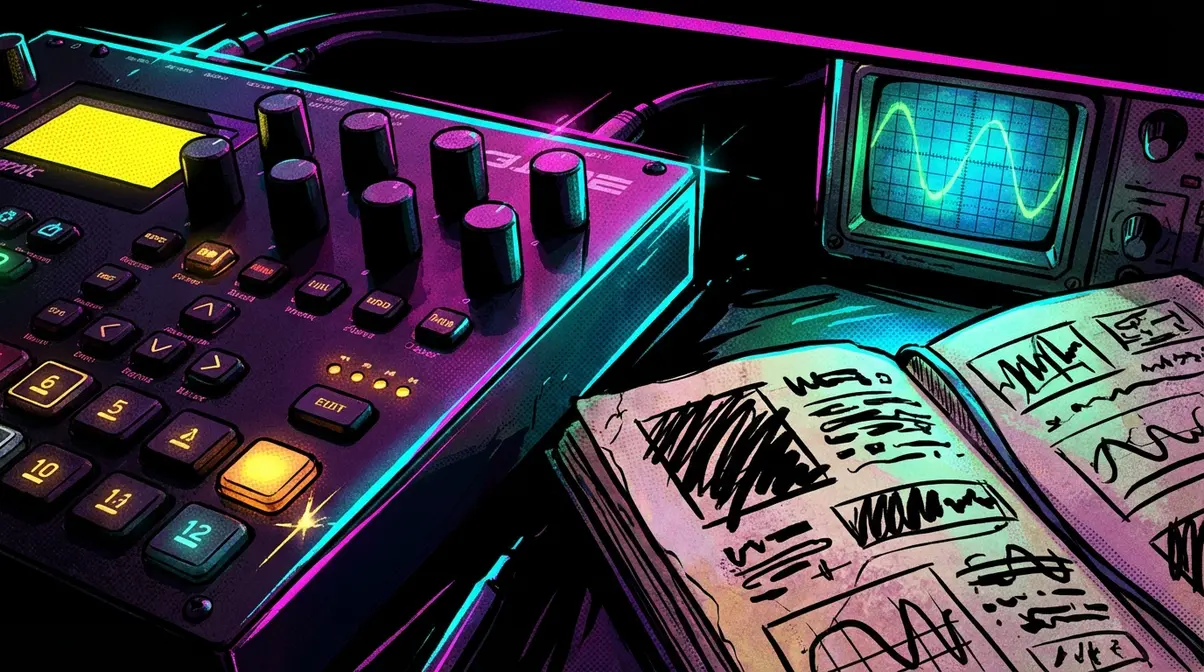

The Elektron Tonverk is a polyphonic multisampler and audio processor released in September 2025 by Swedish instrument maker Elektron Music Machines. Built on an entirely new hardware platform, it offers eight stereo audio tracks, bus/send/mix routing, granular and wavetable synthesis engines, and a 256-step sequencer. It is the first device in what Elektron has signaled will be a broader product family.
Elektron’s 27-Year Obsession With Doing Things Its Own Way
Elektron has been building instruments in Gothenburg since 1998, when three Chalmers University of Technology students turned a computer science project into a company. Their first product, the SidStation, ran on salvaged Commodore 64 SID chips and had to be discontinued when the virgin chip supply ran out. Even then, the ethos was clear: build something that nobody else would build, and make the user meet you halfway.
Tonverk heralds the arrival of another Elektron platform, the first device and certainly not the last. That’s corporate language for a pivot. For a quarter century, every Elektron product has demanded a kind of cognitive initiation. The Octatrack, released in January 2011, became the poster child for this tendency. Forum threads dating back a decade are full of users confessing they spent entire weekends reading the manual twice and still felt lost. One early adopter on the Elektronauts forum admitted to “several nights of watching tutorials” before concluding they had “no idea what I’m doing.” The Digitakt, launched in 2017 as a supposedly streamlined alternative, still inspired posts about patience-testing learning curves years after release.
This was the deal. You bought Elektron, you did the homework, and eventually you unlocked something that felt like no other hardware on the market. The question the Tonverk asks: what happens when Elektron tries to skip the homework?
What the Tonverk Actually Is (and Isn’t)
Swedish manufacturer Elektron’s new Tonverk has taken sampling to a whole new level while still delivering reassuringly fast results. This compact workstation combines polyphonic multisampling, flexible routing, and Elektron’s most expansive sequencer to date in a single, smooth workflow that gives the user 16 tracks. Eight of those are stereo audio tracks; the remaining eight handle buses, sends, and a master mix, each with its own sequencer running up to 256 steps.
The physical form factor sits somewhere between a stretched Digitakt and a landscape-oriented Roland SP-404MKII. An octave of piano-format keys lines the bottom edge, borrowed from the Analog Four’s playbook. 48 kHz/24-bit D/A and A/D converters, two USB-C ports, SD storage, and a robust steel casing round out the hardware. The street price has settled around €1,199 after the price dropped from 1399€ in late 2025.
What it is not: an Octatrack replacement. There is no crossfader. There is no time-stretching or BPM matching for rhythmic loops. Octatrack devotees have been vocal about this on every synth forum that exists. As one Elektronauts user put it, the Octatrack’s crossfader doesn’t just blend sounds; it morphs between parameter locks, making it a performance instrument in a category of one. The Tonverk is playing a different game entirely.
The Firmware Redemption Arc of the Elektron Tonverk
When the Tonverk shipped in September 2025, it was, by most accounts, unfinished. When Swedish development company Elektron released the Tonverk last year, the feature set was a bit underwhelming and unfinished. Good: many efforts have been made in recent months to correct this impression. MIDI timing was jittery. Key features were missing. Community sentiment was blunt: it came out of the oven too early.
Then the updates started arriving at a pace that surprised even Elektron veterans. Firmware 1.1 introduced granular synthesis, and 1.2 added more exciting effects. OS 1.1.0 in November 2025 brought Grainer, a granular machine that slices samples into tiny particles and reassembles them. A few days ago, Elektron released a major update for Tonverk that introduced a granular engine and numerous workflow improvements. This new version, 1.2.0, significantly expands Tonverk’s creative possibilities once again. The developers clearly listened to community feedback and delivered an update that benefits both the studio and live performances. It includes two new effects, expanded routing options, and a revamped arpeggiator feature.
The most recent update, OS 1.3.0, arrived in late March 2026 and might be the most significant yet. Tonverk 1.3.0 introduces Wavefinder, a new wavetable synthesis machine that transforms the multi-sampler into a Synthesizer. The engine offers two independent wavetable oscillators, each with controls over the WT position, tune, detune, and level. A batch of 75 tasty and varied wavetables created by Elektron staff and friends is included in the OS package.
Initial reactions to the 1.3.0 update on YouTube are largely positive, with many users highlighting the addition of wavetable synthesis as a major step forward. A significant portion of comments focus on the overall direction of the device, with users describing Tonverk as “getting better and better” and “the gift that keeps giving.” The introduction of Wavefinder is frequently mentioned as a key upgrade that expands the instrument beyond its original scope.
So Is the Notorious Elektron Workflow Learning Curve Actually Gone?
This is where the community splits into camps so distinct you could draw borders around them.
Camp one says the Tonverk is the most approachable Elektron box ever built. The mixer-style bus and send architecture reads like a DAW session, not a cryptic Swedish puzzle. One Sweetwater reviewer captured the feeling well: “Getting used to it feels more like unlocking it than learning to live with it.” Early adopters on synth forums echo this, with one user noting they had no prior Elektron experience and had previously found the Octatrack “hell to navigate,” yet picked up the Tonverk without cracking the manual. The Auto Sampler, which lets you multisample external MIDI instruments semi-automatically, has been singled out as a workflow triumph. Using the powerful Auto Sampler process, you can define a range of notes and velocities to capture from your favorite MIDI capable instruments, and let Tonverk quickly generate richly detailed multisample instruments.
Camp two says the bugs killed the vibe. Veteran users have complained about inconsistent button behavior, a manual that left critical information out, and the absence of the Func+Yes/No quick-save shortcut that is muscle memory on every other modern Elektron box. MIDI latency when using the Tonverk as a slave device remains a sore point. TV as master, midi works well. TV as slave works terrible. Lot of latency. Incredibile, first bad experience with elektron. The official release notes for OS 1.3.0 do list “reduced audio/MIDI latency” as an improvement, though reports on the Elektronauts forum remain mixed.
Camp three occupies the philosophical middle ground. These are the people who point out that squeezing this much functionality through a hardware interface with a small LED screen will always involve tradeoffs. The learning curve may be shorter, but it hasn’t vanished. As one Gearnews reviewer wrote, those who love sound architecture and modulation as a creative tool will thrive, but the curve “may seem steep for beginners or classic loop producers.”
The Tonverk’s Real Achievement Isn’t Simplicity
Here is the opinion I’ll put my name on: the Tonverk hasn’t killed the Elektron learning curve. It has changed the shape of it. The old curve was a cliff. You stood at the bottom of the Octatrack’s scene/part/track/slot architecture and looked up. The Tonverk’s curve is more like a hill with a view at every elevation. You can make sound on your first afternoon. You can spend six months discovering new routing possibilities.
The result is a setup that feels noticeably more flexible, especially in live situations or when sketching ideas on the fly. With this update, Tonverk moves further toward an instrument that blends sampling and synthesis in a way that actually changes how you work with sound. That’s the shift. Not from hard to easy, but from punishing to rewarding at every stage. One community member said they spent a weekend forcing themselves back into their DAW to prove the Tonverk was redundant. What they found was that they just got bored faster in the software.
The Tonverk now features six machines across its audio tracks: Single Player, Multi Player, Subtracks, Grainer, Wavefinder, and MIDI. Grainer cuts your sample into tiny grains and reassembles them into new textures, rhythms, and continuous tones. Control grain amount, size, density, randomness, spread, direction, and more. Wavefinder gives you two independent wavetable oscillators that can be modulated and blended. Dive in and shape your tone by picking your wavetables and using position to find the perfect wave, and level to find the perfect mix. That’s a sampler, a granular processor, and a wavetable synth sharing one steel chassis. Even the most enthusiastic Octatrack partisan has to admit that’s a lot of ground covered.
Where the Tonverk Goes From Here
Tonverk marks the debut of a brand-new Elektron platform. Elektron has all but confirmed that more devices in this form factor are coming. Community speculation suggests a future box that lives somewhere between the Digitakt and the Octatrack, filling the live-looping and crossfader-shaped hole that the Tonverk deliberately left open. For now, four firmware updates in seven months have transformed a promising but premature launch into something that increasingly justifies its price tag.
One enthusiast on a synth forum declared the Tonverk “our contemporary 303,” a machine whose quirks will define future genres. That’s hyperbole, probably. But it’s the kind of hyperbole Elektron has always inspired. The difference is that this time, you don’t need to read the manual twice to understand why someone would say it.
The Elektron Tonverk is available now. OS 1.3.0 is a free download from Elektron’s support page.
Frequently Asked Questions About the Elektron Tonverk
What is the Elektron Tonverk?
A versatile polyphonic multisampler with modern workflow, premium build, and official support. It features eight stereo audio tracks, four bus tracks, three send effect tracks, and a mix track, all with independent sequencers running up to 256 steps. It was released in September 2025 and is built on a new hardware platform distinct from Elektron’s Digitakt and Digitone line.
How much does the Elektron Tonverk cost?
The original launch price was $1,599 USD / €1,399 EUR. The price has dropped to 1199€ from 1399€. Instant Savings of $100 are available at some US retailers, with the original price listed at $1,599.
Is the Elektron Tonverk an Octatrack replacement?
No. The Tonverk lacks the Octatrack’s hardware crossfader, scene morphing, and real-time time-stretching for rhythmic loops. Elektron has positioned the Tonverk as a new platform alongside its existing product lines, not a direct successor to the Octatrack MKII.
What synthesis engines does the Tonverk include?
As of OS 1.3.0, the Tonverk offers six machines per audio track: Single Player for polyphonic sample playback, Multi Player for multisampled instruments, Subtracks for up to eight drum-style monophonic layers per track, Grainer, which cuts your sample into tiny grains and reassembles them into new textures , Wavefinder, which gives you two independent wavetable oscillators , and a MIDI machine for sequencing external gear.
Does the Elektron Tonverk have a steep learning curve?
Opinions vary. Its mixer-style routing and DAW-like bus/send architecture are more immediately legible than the Octatrack’s paradigm. Many users report making music on their first session. However, the depth of its modulation, effects routing, and sequencing features means there is still significant complexity to explore over time. Early firmware bugs also steepened the curve at launch, though updates have steadily improved stability.
What firmware version is the Elektron Tonverk currently on?
Tonverk 1.3.0 adds Wavefinder, as well as Subtrack Choking, Arp Parameter Locks and Random mode, Loop Pages, Prepare Mutes, and much more. There are also a number of major improvements and helpful bug fixes. This update was released in late March 2026 and is available as a free download from Elektron’s website.


'%3e%3cg id='Final-Copy-2_2_' transform='translate(1275.000000, 200.000000)'%3e%3cpath class='st0' d='M7.4,12.8h6.8l3.1-11.6H7.4C4.2,1.2,1.6,3.8,1.6,7S4.2,12.8,7.4,12.8z'/%3e%3c/g%3e%3c/g%3e%3c/g%3e%3cg id='final---dec.11-2020'%3e%3cg id='_x30_208-our-toggle' transform='translate(-1275.000000, -200.000000)'%3e%3cg id='Final-Copy-2' transform='translate(1275.000000, 200.000000)'%3e%3cpath class='st1' d='M22.6,0H7.4c-3.9,0-7,3.1-7,7s3.1,7,7,7h15.2c3.9,0,7-3.1,7-7S26.4,0,22.6,0z M1.6,7c0-3.2,2.6-5.8,5.8-5.8 h9.9l-3.1,11.6H7.4C4.2,12.8,1.6,10.2,1.6,7z'/%3e%3cpath id='x' class='st2' d='M24.6,4c0.2,0.2,0.2,0.6,0,0.8l0,0L22.5,7l2.2,2.2c0.2,0.2,0.2,0.6,0,0.8c-0.2,0.2-0.6,0.2-0.8,0 l0,0l-2.2-2.2L19.5,10c-0.2,0.2-0.6,0.2-0.8,0c-0.2-0.2-0.2-0.6,0-0.8l0,0L20.8,7l-2.2-2.2c-0.2-0.2-0.2-0.6,0-0.8 c0.2-0.2,0.6-0.2,0.8,0l0,0l2.2,2.2L23.8,4C24,3.8,24.4,3.8,24.6,4z'/%3e%3cpath id='y' class='st3' d='M12.7,4.1c0.2,0.2,0.3,0.6,0.1,0.8l0,0L8.6,9.8C8.5,9.9,8.4,10,8.3,10c-0.2,0.1-0.5,0.1-0.7-0.1l0,0 L5.4,7.7c-0.2-0.2-0.2-0.6,0-0.8c0.2-0.2,0.6-0.2,0.8,0l0,0L8,8.6l3.8-4.5C12,3.9,12.4,3.9,12.7,4.1z'/%3e%3c/g%3e%3c/g%3e%3c/g%3e%3c/g%3e%3c/svg%3e) Your Privacy Choices
Your Privacy Choices