

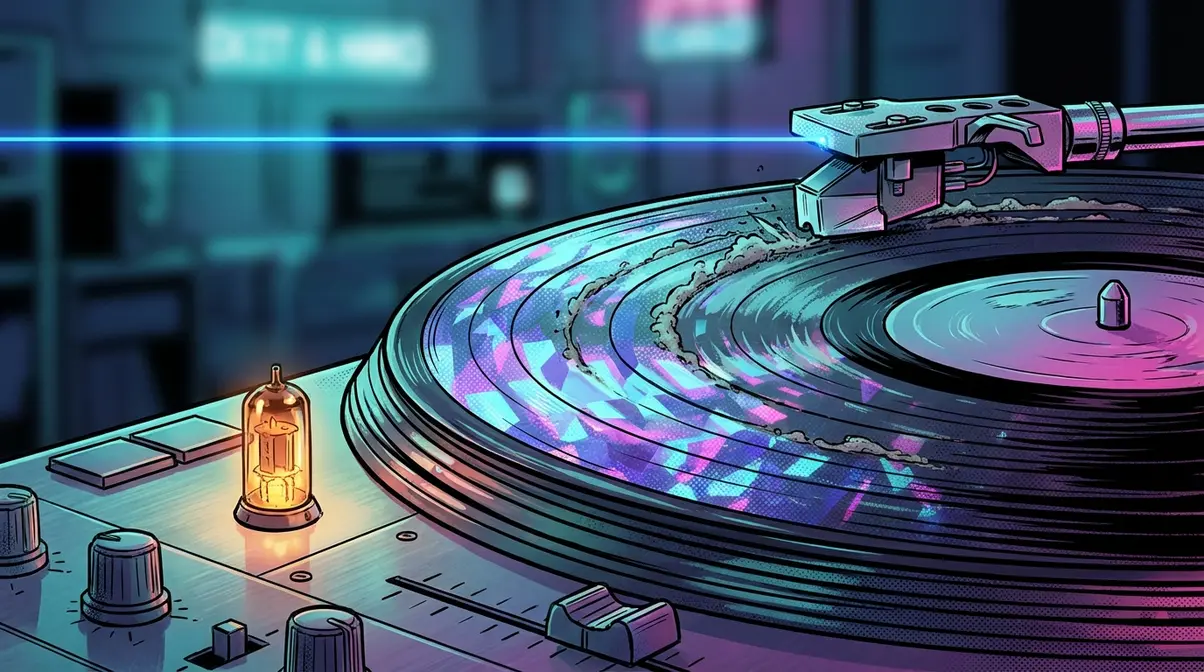

The AI “soul sample” is a production technique in which hip-hop beatmakers use generative AI platforms like Suno to create synthetic funk, soul, and R&B loops that mimic vintage recordings, bypassing traditional sample clearance, licensing fees, and live musicians entirely. As of early 2026, this practice has become one of the most divisive fault lines in music production.
Young Guru Sounds the Alarm on AI Soul Samples
Gimel “Young Guru” Keaton, Jay-Z’s longtime engineer, DJ, and producer, didn’t mince words in a March 2026 Rolling Stone feature. He said it’s become common for hip-hop producers to generate funk and soul samples using AI rather than license original music or hire musicians, estimating that “more than half” of sample-based hip-hop is now being made this way.
That number lands like a grenade. If Guru is even close to right, it means the bedrock ritual of hip-hop production, digging through dusty vinyl to find the perfect four-bar loop, has been quietly replaced by a text field and a loading bar.
Guru himself still pays for samples or hires musicians to interpolate them, but he described the sophistication of the new workflow with visible unease. Producers have moved well past vague prompts, he said. “Where before it was just ‘Give me soulful 1960s whatever,’ now it’s ‘Give me 1960s music as if it was recorded in Motown and this person wrote it,’ or ‘Give me 1970s music as if it was recorded at Stax if this person wrote it and this person played bass.’”
I’d argue that sentence alone captures the entire crisis. The prompt isn’t just generating sound. It’s cosplaying as cultural memory.
Suno’s Massive Scale Makes the Problem Impossible to Ignore
Suno, co-founded by Mikey Shulman, Martin Camacho, Georg Kucsko, and Keenan Freyberg, all former colleagues at Kensho Technologies, is headquartered in Cambridge, Massachusetts. As of February 2026, the company reported 2 million paid subscribers and $300 million in annual recurring revenue, according to TechCrunch. That revenue figure was $200 million just three months earlier, according to Music Business Worldwide.
Users create approximately 7 million tracks and stream 20 million minutes of music on the platform daily. Let that sit for a second. Seven million tracks a day. The entire Motown catalog is around 15,000 songs. Suno generates that volume before lunch.
The company raised $250 million in a Series C round in November 2025 at a post-money valuation of $2.45 billion, led by Menlo Ventures, with participation from NVentures (NVIDIA), Hallwood Media, Lightspeed, and Matrix. Arguably, this is not a toy anymore. It is a heavily capitalized infrastructure play on the future of music creation.
The Timbaland Flashpoint and Hip-Hop’s AI Civil War
If Young Guru is the conscience of this debate, Timbaland became its most polarizing accelerant. In June 2025, a widely viewed Instagram Live session saw Timbaland staunchly defend the merits of AI in music, while Young Guru and others attempted to protect what they described as the very soul of music.
In an Instagram comment, as reported by Variety, Young Guru wrote: “I swear I love you bro but this ain’t it. Do you not realize what is going on in the world. Your voice is powerful and way too important to do anything like this.” He added: “Human expression can never be reduced to this!!”
In my view, the sharpest argument anyone has made against AI music generation is simple: an algorithm trained on an artist’s past can only reproduce what was. It cannot grow. It cannot grieve, get sober, become a father, or record 4:44.
Timbaland, meanwhile, announced his AI music label Stage Zero and his first signee, an AI artist called TaTa, created with Suno, as reported by Music Business Worldwide. The TaTa project was covered by NPR in June 2025, though at that time no music had been released. Timbaland also caught heat online after allegedly using producer K Fresh’s music to train Suno AI; after K Fresh threatened legal action, Timbaland shared an apology on social media, as reported by Stereogum.
The “Don’t Ask, Don’t Tell” Culture Around AI in Production
The secrecy around AI in music production isn’t incidental. It’s structural. Admitting you used AI to generate your sample is, in many circles, an admission that you didn’t really produce the beat at all.
In a survey of more than 1,100 producers, engineers, and songwriters by Sonarworks, seven out of ten respondents said they were at least occasionally experimenting with AI tools, and one out of five were regular users. Most are using specific tools for narrow, time-saving tasks such as stem separation and mastering, according to Rolling Stone. But the gap between “I used AI to separate stems” and “I used AI to fabricate the entire musical foundation of my track” is enormous. The industry is collapsing that distinction on purpose.
Here’s what’s fascinating, though. In a survey of music producers by the sample library Tracklib, the youngest age group, respondents in their 20s, had the most negative opinions of AI, as noted in the same Rolling Stone feature. Songwriter Lauren Christy noted that her early-twentysomething daughters, who are also musicians, “feel very strongly about how plastic it all sounds” and are having what she called a “punk reaction” to these technologies.
Suno’s Legal Battles and the Copyright Question
In June 2024, the RIAA filed copyright infringement cases against both Suno, Inc. and Uncharted Labs (Udio), with plaintiffs including Sony Music Entertainment, UMG Recordings, and Warner Records, seeking damages of up to $150,000 per work infringed.
Warner Music Group settled its lawsuit and partnered with Suno in November 2025. As part of the deal, Suno agreed to retire its current model and launch a new one trained on licensed copyrights with opt-in, and to limit the number of AI songs a user can download per month. Suno dropped its fair use defense as part of that settlement, a detail reported by Rolling Stone.
But the war isn’t over. Suno’s licensing negotiations with Universal Music Group and Sony Music have stalled over user download rights for AI-generated songs. Universal wants AI-generated tracks confined within apps, while Suno insists users should freely export their creations. GEMA, the German collecting society, is also pursuing legal action before the Munich Regional Court, and Danish rights organization Koda sued Suno in Copenhagen City Court in November 2025.
My take is that Suno’s legal position has always been a gamble dressed up as principle. The company argues that music made on its platform doesn’t actually sample existing recordings, regardless of what music was used to train its AI model. That’s a hard position to defend when the industry consensus is that the underlying training data shaped every output.
The Streaming Fraud Dimension
Deezer detected and tagged over 13.4 million AI-generated tracks on its platform in 2025, with over 60,000 AI tracks uploaded per day, equal to roughly 39% of daily intake. Up to 85% of all streams on AI-generated music were detected as fraudulent, according to a Deezer press release. Deezer’s AI detection tool can identify 100% AI-generated music from the most prolific generative models such as Suno and Udio, and the system is now also used by Billboard to help identify AI-generated tracks when compiling its charts.
It feels like we’re watching two economies diverge in real time: one where humans make music for humans, and one where bots make music to game algorithms for ad revenue. The AI soul sample sits right at the fracture point between them.
What Young Guru Is Really Defending
Young Guru leads the Roc Nation School of Music, Sports & Entrepreneurship’s Music Technology, Entrepreneurship & Production program at Long Island University in Brooklyn. His advice to students is defiantly analog: focus on physical human interaction. Don’t email him. Meet in person.
I’d argue the right frame for this debate isn’t musical, it’s about labor. The question was never “Can AI make a convincing soul loop?” Of course it can. The question is what happens to the session musicians, the sample clearance lawyers, the crate diggers, the bedroom producers who learned music theory by chopping breaks, the entire human supply chain that turned a dusty Isley Brothers record into a Jay-Z classic.
In online music production communities, the debate rages with surprising nuance. Engineers and producers are deeply skeptical of Suno’s “no sample” legal defense, viewing it as technically dishonest. The comparison to the drum machine panic of the 1980s comes up constantly, but many push back hard on that framing. A drum machine was still played by a human with intent. An AI soul sample is a statistical average of thousands of someone else’s recordings, conjured by a sentence.
FAQ
What is an AI “soul sample” in hip-hop production?
An AI soul sample is a synthetically generated loop of funk, soul, or R&B music created by a generative AI platform like Suno, used in place of a traditional sample from a real recording. Producers type text prompts describing the era, style, and even specific studio aesthetics they want, and the AI generates audio that mimics vintage recordings.
Did Young Guru say more than half of hip-hop uses AI samples?
Yes. In a March 2026 Rolling Stone feature, Young Guru estimated that “more than half” of sample-based hip-hop is now being made using AI-generated samples rather than licensed original recordings or live musicians.
What happened between Young Guru and Timbaland over AI?
In June 2025, the two clashed during a widely viewed Instagram Live, with Timbaland defending AI as a creative tool and Young Guru warning it threatened the soul of music and the livelihoods of human artists. Timbaland went on to launch an AI music label called Stage Zero with an AI artist named TaTa, created using Suno.
Is Suno legal?
The RIAA filed copyright infringement lawsuits against Suno and Udio in June 2024 on behalf of the three major labels, seeking damages of up to $150,000 per work infringed. Warner Music Group settled and partnered with Suno in November 2025, but negotiations with Universal Music Group and Sony Music have stalled as of early 2026. Additional lawsuits are active in Germany and Denmark.
How big is Suno in 2026?
As of February 2026, Suno reported 2 million paid subscribers and $300 million in annual recurring revenue. The company was valued at $2.45 billion after a $250 million Series C round in November 2025. Users generate approximately 7 million tracks per day on the platform.
Are young producers embracing or rejecting AI music tools?
According to a survey by sample library Tracklib, the youngest respondents, those in their 20s, had the most negative opinions of AI among all age groups surveyed. However, a broader Sonarworks survey found that seven out of ten producers, engineers, and songwriters were at least occasionally experimenting with AI tools. The gap between experimentation and full adoption remains wide, and generational attitudes are more complex than simple acceptance or rejection.

'%3e%3cg id='Final-Copy-2_2_' transform='translate(1275.000000, 200.000000)'%3e%3cpath class='st0' d='M7.4,12.8h6.8l3.1-11.6H7.4C4.2,1.2,1.6,3.8,1.6,7S4.2,12.8,7.4,12.8z'/%3e%3c/g%3e%3c/g%3e%3c/g%3e%3cg id='final---dec.11-2020'%3e%3cg id='_x30_208-our-toggle' transform='translate(-1275.000000, -200.000000)'%3e%3cg id='Final-Copy-2' transform='translate(1275.000000, 200.000000)'%3e%3cpath class='st1' d='M22.6,0H7.4c-3.9,0-7,3.1-7,7s3.1,7,7,7h15.2c3.9,0,7-3.1,7-7S26.4,0,22.6,0z M1.6,7c0-3.2,2.6-5.8,5.8-5.8 h9.9l-3.1,11.6H7.4C4.2,12.8,1.6,10.2,1.6,7z'/%3e%3cpath id='x' class='st2' d='M24.6,4c0.2,0.2,0.2,0.6,0,0.8l0,0L22.5,7l2.2,2.2c0.2,0.2,0.2,0.6,0,0.8c-0.2,0.2-0.6,0.2-0.8,0 l0,0l-2.2-2.2L19.5,10c-0.2,0.2-0.6,0.2-0.8,0c-0.2-0.2-0.2-0.6,0-0.8l0,0L20.8,7l-2.2-2.2c-0.2-0.2-0.2-0.6,0-0.8 c0.2-0.2,0.6-0.2,0.8,0l0,0l2.2,2.2L23.8,4C24,3.8,24.4,3.8,24.6,4z'/%3e%3cpath id='y' class='st3' d='M12.7,4.1c0.2,0.2,0.3,0.6,0.1,0.8l0,0L8.6,9.8C8.5,9.9,8.4,10,8.3,10c-0.2,0.1-0.5,0.1-0.7-0.1l0,0 L5.4,7.7c-0.2-0.2-0.2-0.6,0-0.8c0.2-0.2,0.6-0.2,0.8,0l0,0L8,8.6l3.8-4.5C12,3.9,12.4,3.9,12.7,4.1z'/%3e%3c/g%3e%3c/g%3e%3c/g%3e%3c/g%3e%3c/svg%3e) Your Privacy Choices
Your Privacy Choices