

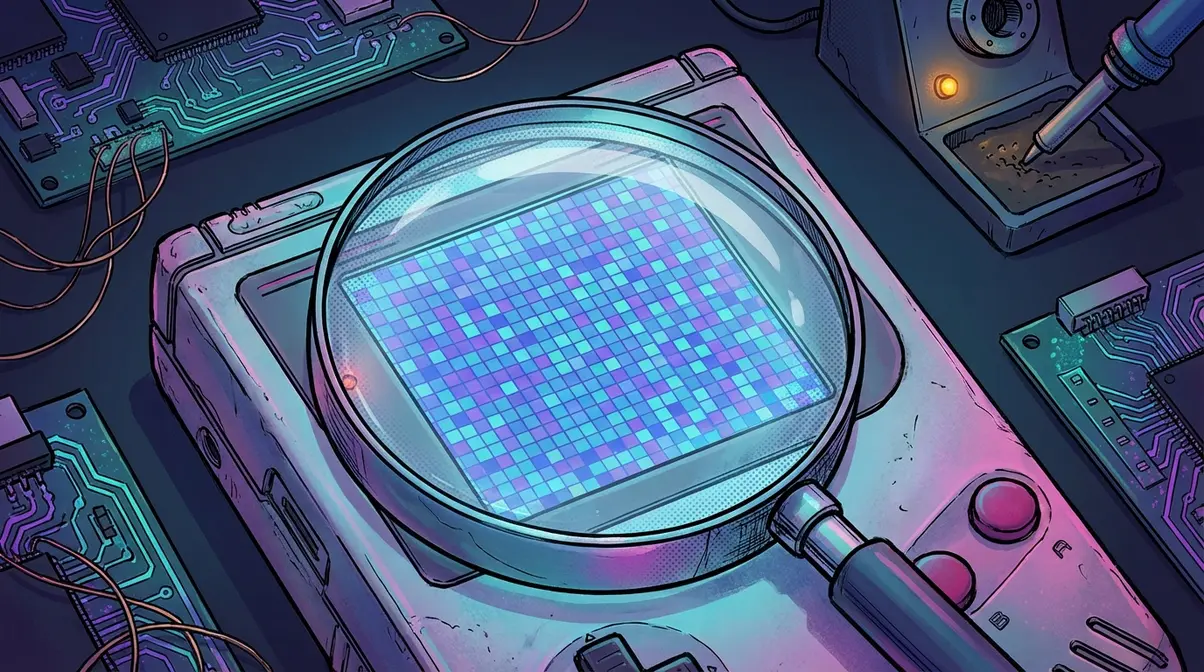

Somewhere in an LCD factory, probably in Shenzhen, a room full of engineers once laughed at Torin Herndon. He wanted them to build a display with a pixel pitch so absurdly large that it ran counter to every advancement the panel industry had made in the last two decades. “Developing an LCD involves first defining the thin film transistor glass which was extremely challenging due to the pixel pitch being so massively large in the modern day,” Herndon told Nintendo World Report. “I was laughed out of the room many times in trying to create this display.”
He kept walking into rooms until someone said yes.
Seventeen Years of Irrational Decisions
The ModRetro Chromatic didn’t arrive from nowhere. Palmer Luckey, the device’s founder and financial backer, had been working on a definitive Game Boy-inspired device “off and on as a hobby for almost seventeen years,” through dozens of modified systems and clean-sheet prototypes. You probably know Luckey as the founder of Oculus VR, which he sold to Facebook for $2 billion , and as the co-founder of Anduril Industries, the defense technology company. But before any of that, ModRetro was the first business he ever formed: an internet forum he started with friends when he was 15 years old that became the most active hub for hardware hackers combining vintage game consoles with modern technology.
Luckey started the company in 2009, with Torin Herndon as co-founder. In 2023, they re-established ModRetro as a hardware company, and on June 3, 2024, the Chromatic was announced. It shipped in December 2024 , priced at $199 . A Game Boy Color for adults with money and taste. But the story everyone keeps telling is about the screen.
A Panel Built Against the Grain
Here is the problem ModRetro was trying to solve: modern LCDs have introduced so many improvements designed to increase display capabilities that the resulting image can be very far from what the game designers of the ’90s intended for us to see. Every aftermarket IPS mod for the Game Boy Color uses a higher-resolution panel that scales down to match the original 160×144 pixel count. The pixels are approximated, not native. The colors are too vivid, the subpixel layout is wrong, and the whole image has a clinical sharpness that pixel artists of the late 1990s never designed for.
ModRetro’s answer was to build a fully custom LCD from scratch. From the TFT level up, they created a new panel at exactly the right pixel size and density, with a physical color correction layer. Luckey himself has said he spent heavily developing a custom display accurate all the way to the subpixel level, noting that the panel uses custom color filters to mimic the original GBC LCD.
When iFixit spoke with CEO Torin Herndon for their teardown of the Chromatic, much of the conversation was about the screen. The team layered a color correcting lens in the LCD stack, ensured the correct pixel density and sub-pixel layout, and even used a spectroradiometer to match the wavelengths of light. That last detail is the one that gets me. A spectroradiometer. For a Game Boy.
I’d argue this is the kind of obsession that separates a product from a project. You can hear it in how Herndon talked about the display to Nintendo World Report: “I’m very thankful that I ultimately found a TFT factory that was willing to work with us on this very long lead time development. If the Chromatic amounted to nothing, we are happy that the display itself exists to pass down to future generations.”
What the Purist Actually Gets
The result is the world’s only 160×144 pixel sunlight-readable backlit display , measuring 2.56 inches and housed behind either Gorilla Glass or lab-grown sapphire crystal glass, the type of scratch-resistant protection found on luxury watches. The shell is lightweight magnesium alloy , not plastic. The buttons are PBT semi-crystalline polymer. It runs on three AA batteries or an optional rechargeable Power Core, plays original Game Boy and Game Boy Color cartridges via FPGA hardware replication, and streams gameplay to Mac or PC via USB-C.
In my view, the AA battery choice is the most telling design decision of the whole device. It’s the one that will age best. Lithium-ion packs degrade. AAs will be manufactured until the heat death of the universe. Combined with 3D-printable CAD files for mechanical components and a repair guide on iFixit’s website , the Chromatic is built to be fixed, not replaced. That’s a philosophy, not a feature.
The Argument Against, and Why It Doesn’t Quite Land
The obvious comparison is the Analogue Pocket, which plays Game Boy, Game Boy Color, and Game Boy Advance cartridges on a gorgeous 3.5-inch, 1600×1440 display. It’s slightly more expensive at $219 MSRP, but that device plays Game Boy Advance titles too. The value-per-dollar argument is real and I won’t pretend otherwise.
But I think that argument misses the point of what ModRetro was doing. The Pocket is a multi-system Swiss Army knife. The Chromatic is a single-purpose instrument tuned to one thing. It plays original Game Boy and GBC cartridges on an IPS screen custom-made for the Chromatic, with no upscaling, no odd emulation artifacts, just an accurate 160×144 pixel screen that is a 1:1 alternative to the original consoles. To me, that’s not a limitation. That’s a commitment.
The political dimension is harder to sidestep. Luckey’s role as founder of Anduril Industries, a defense contractor, makes the Chromatic a polarizing purchase for some. The Verge’s Sean Hollister, reviewing the device, said it “might be the best version of a Game Boy ever made” but found it hard to separate from Luckey’s role at Anduril. That tension is real, and every buyer will draw their own line. I won’t draw it for you.
A Screen Worth Inheriting
What stays with me about the Chromatic isn’t the magnesium shell or the sapphire glass, although both feel extraordinary in-hand. It’s the screen. It’s the fact that a small team spent years and, by Luckey’s own admission, an irrational amount of money to build a display panel that the entire LCD industry had moved past. They went backwards on purpose, with scientific instruments and stubborn conviction, to make a 160×144 grid of light look exactly the way it did when you were ten years old, tilting a Game Boy Color under a lamp in the back seat of your parents’ car.
ModRetro is now reportedly shopping for capital at a $1 billion pre-money valuation, according to the Financial Times via TechCrunch, an ambitious number for a company that’s shipped exactly one product. A second device, the M64, an FPGA-based Nintendo 64 console, is in development. The ambitions are scaling fast.
But I keep coming back to that quote from Herndon. If the whole thing amounted to nothing, the team would still be glad the display exists. That’s not a business plan. That’s a liner note. And it’s the reason the Chromatic, for all its contradictions, feels like something worth holding onto.


'%3e%3cg id='Final-Copy-2_2_' transform='translate(1275.000000, 200.000000)'%3e%3cpath class='st0' d='M7.4,12.8h6.8l3.1-11.6H7.4C4.2,1.2,1.6,3.8,1.6,7S4.2,12.8,7.4,12.8z'/%3e%3c/g%3e%3c/g%3e%3c/g%3e%3cg id='final---dec.11-2020'%3e%3cg id='_x30_208-our-toggle' transform='translate(-1275.000000, -200.000000)'%3e%3cg id='Final-Copy-2' transform='translate(1275.000000, 200.000000)'%3e%3cpath class='st1' d='M22.6,0H7.4c-3.9,0-7,3.1-7,7s3.1,7,7,7h15.2c3.9,0,7-3.1,7-7S26.4,0,22.6,0z M1.6,7c0-3.2,2.6-5.8,5.8-5.8 h9.9l-3.1,11.6H7.4C4.2,12.8,1.6,10.2,1.6,7z'/%3e%3cpath id='x' class='st2' d='M24.6,4c0.2,0.2,0.2,0.6,0,0.8l0,0L22.5,7l2.2,2.2c0.2,0.2,0.2,0.6,0,0.8c-0.2,0.2-0.6,0.2-0.8,0 l0,0l-2.2-2.2L19.5,10c-0.2,0.2-0.6,0.2-0.8,0c-0.2-0.2-0.2-0.6,0-0.8l0,0L20.8,7l-2.2-2.2c-0.2-0.2-0.2-0.6,0-0.8 c0.2-0.2,0.6-0.2,0.8,0l0,0l2.2,2.2L23.8,4C24,3.8,24.4,3.8,24.6,4z'/%3e%3cpath id='y' class='st3' d='M12.7,4.1c0.2,0.2,0.3,0.6,0.1,0.8l0,0L8.6,9.8C8.5,9.9,8.4,10,8.3,10c-0.2,0.1-0.5,0.1-0.7-0.1l0,0 L5.4,7.7c-0.2-0.2-0.2-0.6,0-0.8c0.2-0.2,0.6-0.2,0.8,0l0,0L8,8.6l3.8-4.5C12,3.9,12.4,3.9,12.7,4.1z'/%3e%3c/g%3e%3c/g%3e%3c/g%3e%3c/g%3e%3c/svg%3e) Your Privacy Choices
Your Privacy Choices