

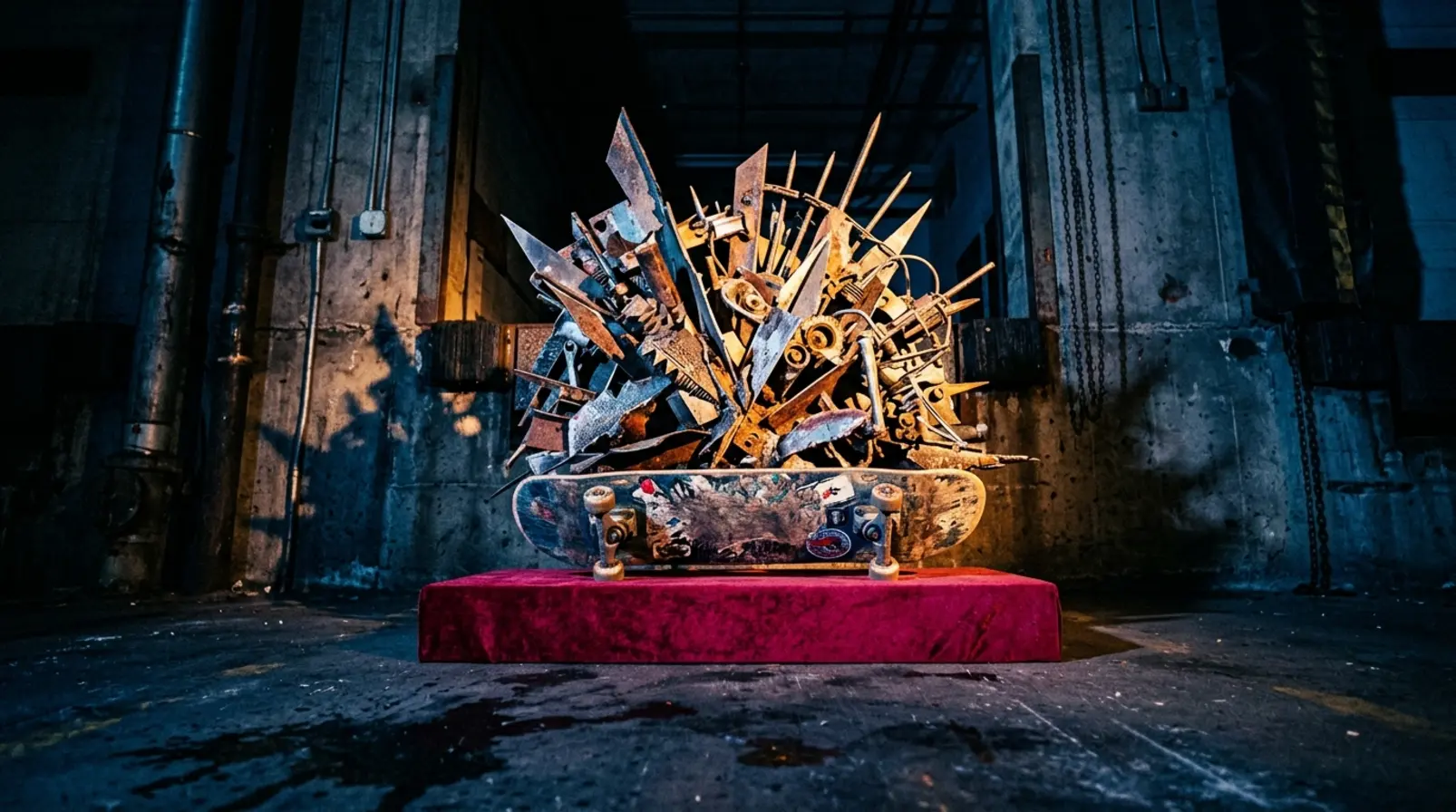

Start with the letters. That was always the instruction. Not the galleries, not the auction lots, not the six-figure hammer prices. The letters themselves, armed and volatile, hurtling through space on customized skateboards like warships in some post-apocalyptic alphabet. Rammellzee, born December 15, 1960, in Far Rockaway, Queens, was a visual artist, theorist, and myth-maker from Far Rockaway, Queens, who explored language, music, performance, sculpture, and philosophy (rammellzee.com) and spent his life building a cosmology so dense and self-sustaining that the art world is still, nearly sixteen years after his death, figuring out how to price it.
And price it they have. Since 2010, the record price for Rammellzee at auction is $504,000 for an untitled work, sold at Sotheby’s New York in 2020, with realized prices reaching up to $214,200 for works on paper. (mutualart.com) Auction databases list works appearing through 2025 and into 2026 (artnet.com), with pieces recorded at Christie’s, Sotheby’s, and smaller houses at a steady clip. The market is warm. The question that lingers, though, feels less like economics and more like theology: what happens to a weapon when you hang it on a white wall?
The Manifesto and the Machine
To understand why Rammellzee’s auction presence registers as both triumph and tension, it helps to go back to the source code. In 1979, Rammellzee wrote a manifesto commonly cited as the Iconic Treatise on Gothic Futurism, which asserts that letters separated from their literary function become weapons against oppressive linguistic systems. (radicalpresence.studiomuseum.org) His artistic practice was built on the theory of Gothic Futurism, which describes a battle between letters and the standardizing rules of the alphabet. (artforum.com) This was not decoration. It reads as insurgency conducted through typography.
Renowned in Manhattan’s 1980s downtown scene, Rammellzee called his esoteric cosmology “Gothic Futurism,” a term that aptly evokes his diverse influences: medieval scribes, hip-hop, comic books. (artreview.com) His transgressive storytelling began with his usage of “Wildstyle” lettering, an intricate, popular form of graffiti, the origins of which he associated with historical accounts of Gothic monks who developed a writing so unintelligible that their rulers could no longer read it. (artreview.com) The parallel lands with force: if monks could encrypt power away from kings, then a kid from Far Rockaway could encrypt meaning away from the systems that governed him.
The Battle Station and the Beat
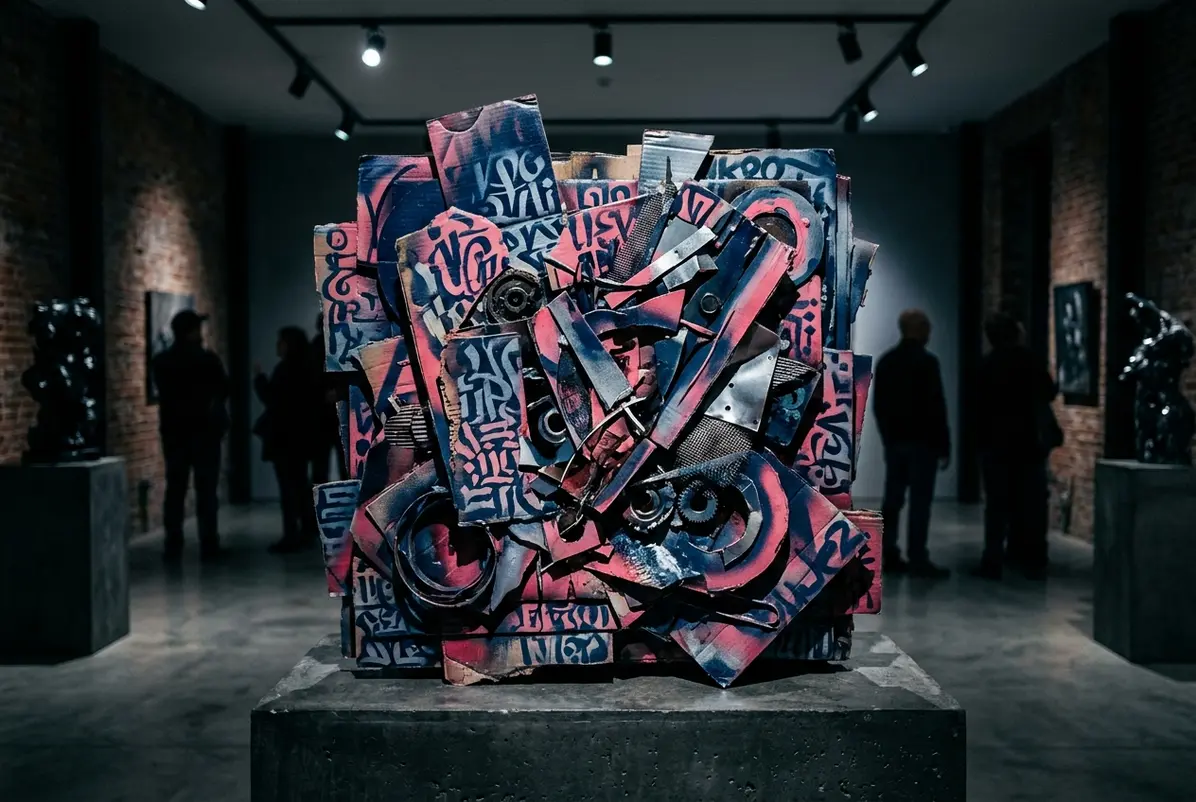
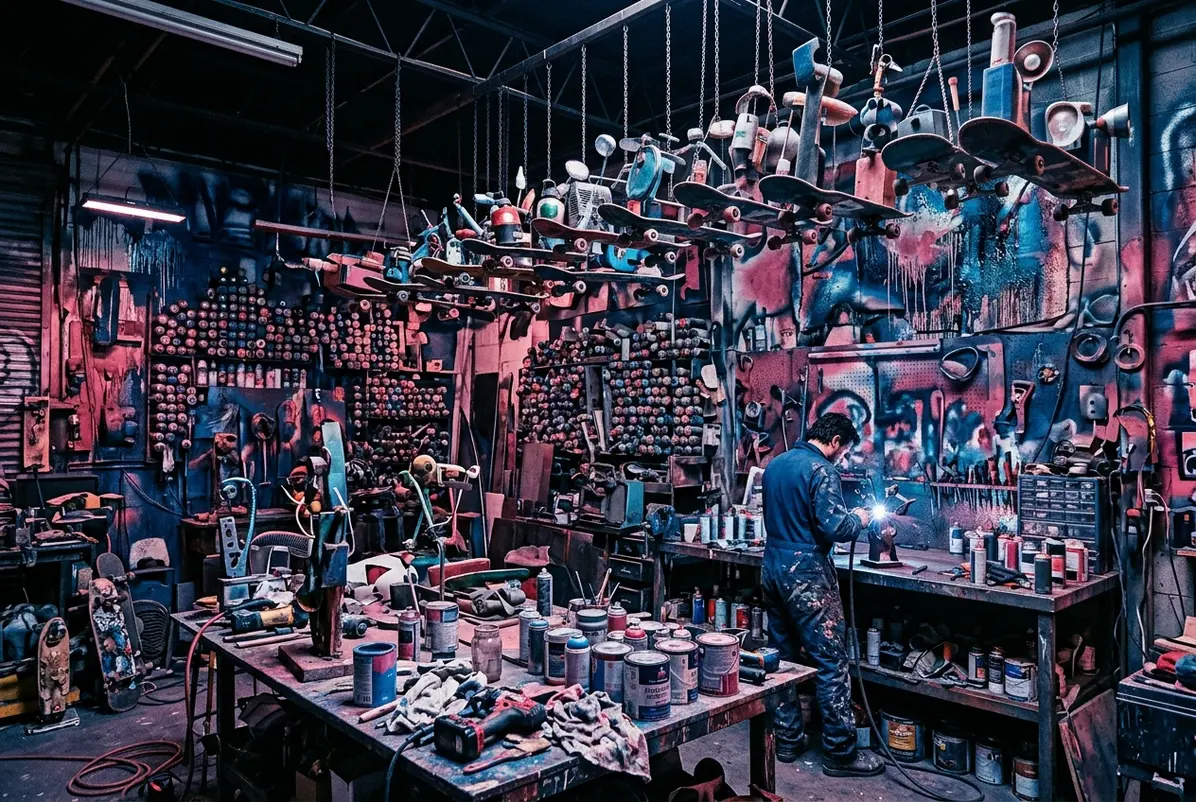
Rammellzee’s live/work loft studio space at 46 Laight Street in the TriBeCa neighborhood, which he shared with his wife Carmela, was named the Battle Station. (suzannegeiss.com) The New York Times later described entry to the loft as “like initiation into a secret society,” a place where graffiti, hip-hop, linguistics, and science fiction fused into a strange new category of art. (suzannegeiss.com) In those accounts, the space comes across as less a studio and more a functioning mythology. In the Battle Station, Rammellzee worked with found and repurposed materials to make Letter Racers, sculptures representing the alphabet as spacecraft-like combat vehicles. (anothermanmag.com) He created multiple alter egos for performing, 21 Garbage Gods each with an exoskeleton costume and backstory in Rammellzee’s canon. (latimes.com)
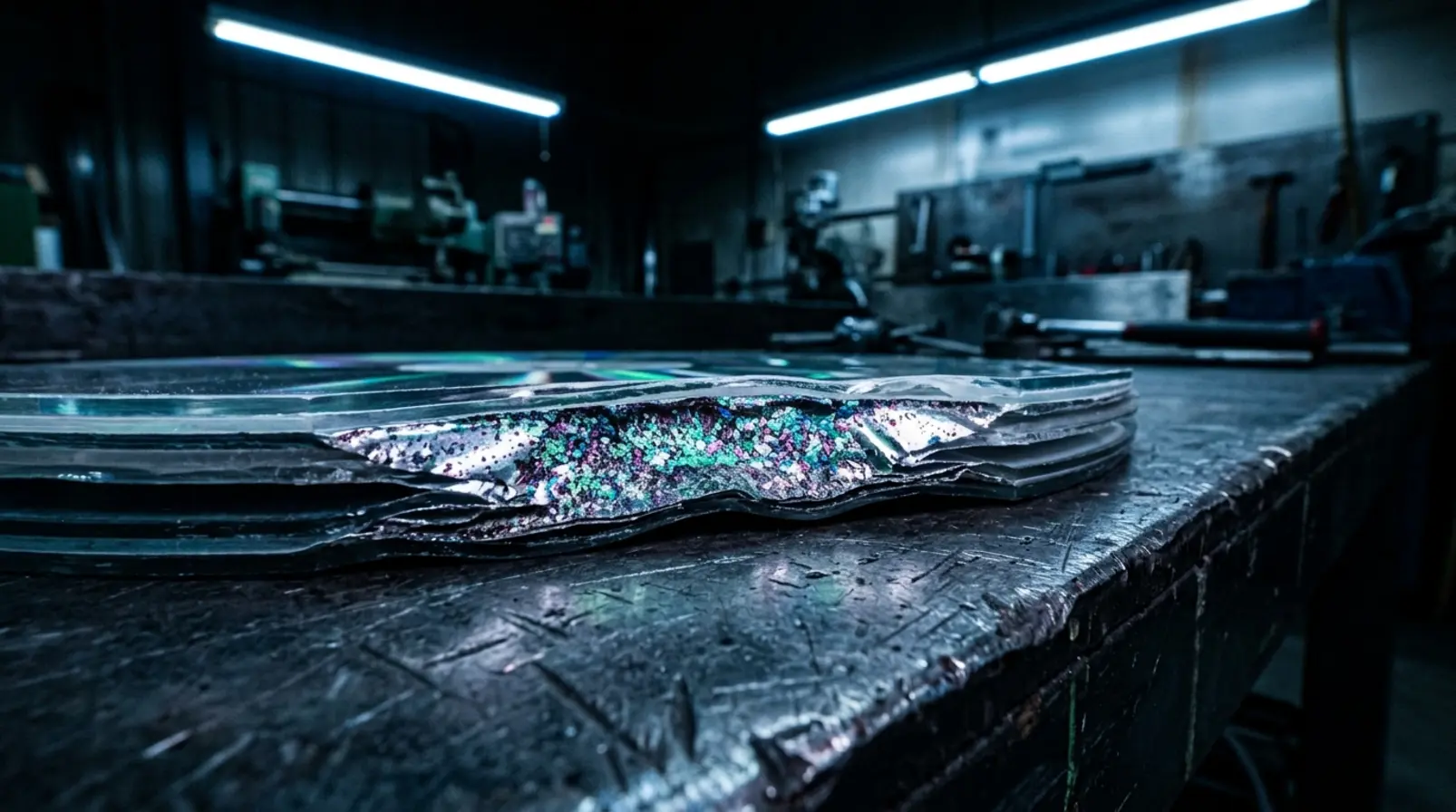
The music matters too, and it matters on vinyl. “Beat Bop” is a 1983 song by Rammellzee and K-Rob, produced by Jean-Michel Basquiat and released on Basquiat’s Tartown label with Basquiat’s cover art. (sothebys.com) Sotheby’s describes it as a rarity of only 500 copies and notes that another sealed copy sold for $126,000 in its inaugural 2020 Hip Hop sale. (sothebys.com) The track feels like a document from a parallel New York, ten minutes of sparring that reads as part of hip-hop’s early grammar. Rammellzee developed a nasal intonation, a vocal signature described as “gangsta duck,” which the Jeffrey Deitch exhibition materials describe as influential to artists such as the Beastie Boys and Cypress Hill. (artforum.com)
He appeared in Charlie Ahearn’s iconic film Wild Style, which was completed in 1982 and theatrically released in the United States in 1983 (redbullmusicacademy.com), and makes a cameo appearance near the end of Jim Jarmusch’s 1984 film Stranger Than Paradise. (suzannegeiss.com) There’s a case to be made that no other single artist of the period moved so fluidly between graffiti, gallery, film, vinyl, and live performance while maintaining such an uncompromising philosophical framework.
The Auction Problem
The Rammellzee estate is represented by Jeffrey Deitch Gallery. (fadmagazine.com) Deitch, who first met Rammellzee in 1980, has been a visible participant in bringing the artist’s legacy into gallery and institutional contexts. (artforum.com) Jeffrey Deitch Los Angeles showcased Rammellzee: Gothic Futurism, a solo exhibition featuring the works of the late artist, whose practice spanned graffiti, fine art, performance, and music. (hypebeast.com) Despite cult and institutional success, his acceptance into the commercial art world has been described as overdue. (artreview.com)
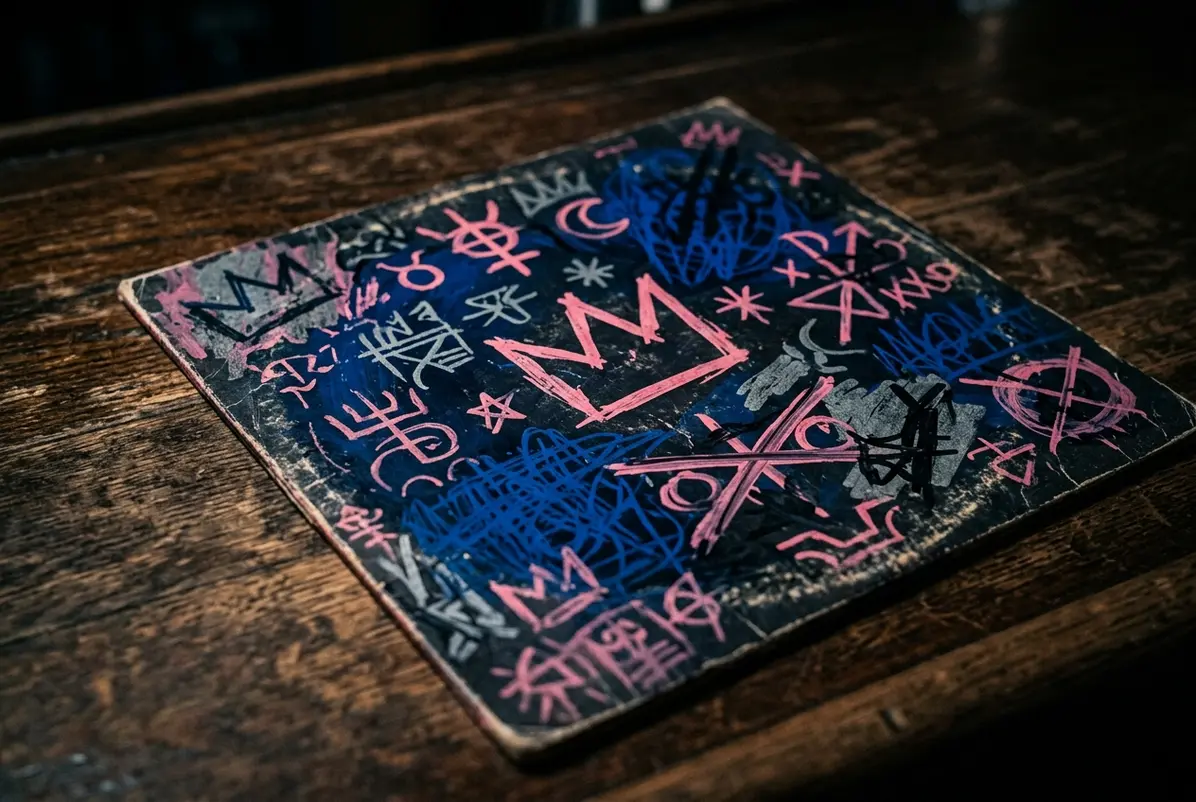
But the acceleration into the auction circuit brings a paradox that feels impossible to ignore. Rammellzee built a system often read as a theory of linguistic warfare: letters could be armed, deconstructed, and liberated from the standardizing power structures embedded in language. (radicalpresence.studiomuseum.org) As he wrote, “panzerism is the armament of the letter,” and, “panzerism is heavier than the Pentagon.” (hifructose.com) His project often reads as anti-systemic. The letters were weapons. The Garbage Gods were armor. The Battle Station was a bunker.
Now a spray-enamel-on-board piece titled Gothic Futurism: PLASom note A Sign of the Crime $ can sit in a Christie’s online sale, estimated at $60,000 to $80,000, and presented to a collector market that may encounter the object through sale text before theory. The disarmament, in this reading, is literal: the armed letters are stripped of some of their militant context and reframed as aesthetic objects. What reads as resistance to commodification is also treated as commodity.
Reasonable people might disagree, but the tension here does not diminish the work. It reveals something about the machinery surrounding it. According to a New York Times account republished by the Suzanne Geiss Company, soon after the September 11 attacks, the building housing the Battle Station was sold to make way for luxury apartments, and Rammellzee and Carmela Zagari were pushed out, relocated to a smaller place in Battery Park City, with almost 20 years’ worth of artwork moved into storage. (suzannegeiss.com) The displacement of the work from its living context into storage, and then into auction houses, registers as its own kind of narrative arc, one Rammellzee might have recognized as another battle in the ongoing war over who controls meaning.
Legacy as a Living System
The record auction price of $504,000 was set at Sotheby’s New York in 2020 (mutualart.com), and as of June 2026 his work is included in Hip Hop Is at the Groninger Museum, which lists the exhibition through August 16, 2026. (groningermuseum.nl) The museum’s press page says a gallery in the exhibition is fully dedicated to Rammellzee, with loans, iconic costumes, and film footage from the 1980s. (groningermuseum.nl) In 2018, The Art Newspaper reported prices for Rammellzee’s work ranging from £30,000 for a small work on card to £350,000 for large-scale sculptures in epoxy resin. The market presence feels unmistakable.
What stands out, though, is that the work itself has not changed. The Letter Racers still bristle with found-object shrapnel. The paintings still pulse with coded alphabetic warfare. The artist, who died in 2010, created his own universe, one meant to subvert power structures through iconoclastic writing and futuristic narrative. (artreview.com) That universe does not bend to accommodate a paddle number.
The profitable disarming of Gothic Futurism, then, comes across less as a betrayal and more as the inevitable collision between a system that reads as resistant to capture and a market that tends to absorb even the work made in opposition to it. Rammellzee was a revolutionary figure whose work defied categorization, exploring the intersections of language, music, performance, sculpture, and philosophy. (rammellzee.com) The auction houses can sell the objects. Whether they can sell the equation remains another question entirely.
By our reckoning, the most honest way to encounter Rammellzee is still on the terms he set: not as a blue-chip investment, but as a challenge to the very idea that letters, images, and sounds can be owned. The armed alphabet does not care about your estimate. It never did.
'%3e%3cg id='Final-Copy-2_2_' transform='translate(1275.000000, 200.000000)'%3e%3cpath class='st0' d='M7.4,12.8h6.8l3.1-11.6H7.4C4.2,1.2,1.6,3.8,1.6,7S4.2,12.8,7.4,12.8z'/%3e%3c/g%3e%3c/g%3e%3c/g%3e%3cg id='final---dec.11-2020'%3e%3cg id='_x30_208-our-toggle' transform='translate(-1275.000000, -200.000000)'%3e%3cg id='Final-Copy-2' transform='translate(1275.000000, 200.000000)'%3e%3cpath class='st1' d='M22.6,0H7.4c-3.9,0-7,3.1-7,7s3.1,7,7,7h15.2c3.9,0,7-3.1,7-7S26.4,0,22.6,0z M1.6,7c0-3.2,2.6-5.8,5.8-5.8 h9.9l-3.1,11.6H7.4C4.2,12.8,1.6,10.2,1.6,7z'/%3e%3cpath id='x' class='st2' d='M24.6,4c0.2,0.2,0.2,0.6,0,0.8l0,0L22.5,7l2.2,2.2c0.2,0.2,0.2,0.6,0,0.8c-0.2,0.2-0.6,0.2-0.8,0 l0,0l-2.2-2.2L19.5,10c-0.2,0.2-0.6,0.2-0.8,0c-0.2-0.2-0.2-0.6,0-0.8l0,0L20.8,7l-2.2-2.2c-0.2-0.2-0.2-0.6,0-0.8 c0.2-0.2,0.6-0.2,0.8,0l0,0l2.2,2.2L23.8,4C24,3.8,24.4,3.8,24.6,4z'/%3e%3cpath id='y' class='st3' d='M12.7,4.1c0.2,0.2,0.3,0.6,0.1,0.8l0,0L8.6,9.8C8.5,9.9,8.4,10,8.3,10c-0.2,0.1-0.5,0.1-0.7-0.1l0,0 L5.4,7.7c-0.2-0.2-0.2-0.6,0-0.8c0.2-0.2,0.6-0.2,0.8,0l0,0L8,8.6l3.8-4.5C12,3.9,12.4,3.9,12.7,4.1z'/%3e%3c/g%3e%3c/g%3e%3c/g%3e%3c/g%3e%3c/svg%3e) Your Privacy Choices
Your Privacy Choices