

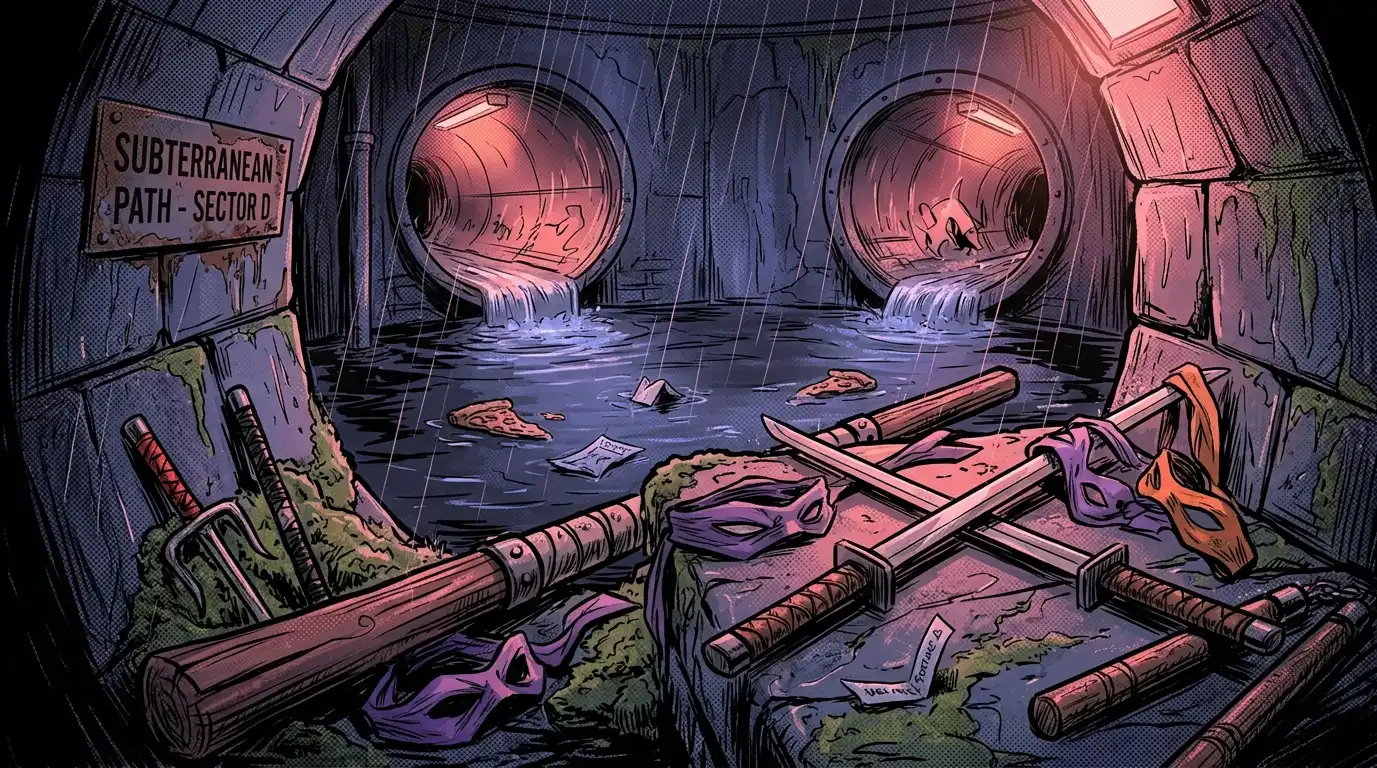


Jason Aaron’s 2024 relaunch of IDW Publishing’s Teenage Mutant Ninja Turtles was sold as a doorway. That was the promise: a new #1, a superstar writer, a back-to-basics setup, and four brothers scattered far enough apart that even the most continuity-buried reader could recognize the shape of the thing. Raphael in prison. Michelangelo in Tokyo. Leonardo wandering the world. Donatello trapped somewhere worse than nostalgia.
But the relaunch was never a clean reset. That is what made it interesting. IDW did not erase the 150-issue run that came before it. It built a new entrance into the same haunted house.
The result is a soft reboot with a strange assignment: make Teenage Mutant Ninja Turtles feel immediate again without pretending its last decade of comics never happened. The issue is not whether Jason Aaron made TMNT accessible. The issue is whether any franchise this layered can still promise accessibility without asking new readers to trust the ghosts in the room.
The Continuity That Would Not Stay Buried
IDW’s first main Teenage Mutant Ninja Turtles volume ran from 2011 to 2024 and ended with issue #150, closing the longest-running ongoing comic book series in TMNT history. Kevin Eastman and Tom Waltz helped shape the early IDW era, while Sophie Campbell took over writing duties with issue #101 and guided the book through its final long stretch.
That matters because IDW’s TMNT was not just a licensed comic with familiar toys moved around the board. It became a dense, mutated city of its own. Campbell’s era pushed the series into Mutant Town, a quarantined New York neighborhood formed after the fallout of a mutagen bomb. It was still a ninja comic, but it had also become a book about displacement, community, trauma, and the strange civic life of monsters. That period could feel messy, ambitious, overgrown, tender, or exhausting depending on the reader. Sometimes it felt like all of those things at once.
That is the problem Aaron inherited. Not a broken franchise. A successful one with too much memory.
When Aaron was announced as the new writer, IDW positioned the project carefully. The new series would begin with a 10-page prelude in Teenage Mutant Ninja Turtles: Alpha #1 before launching a new Teenage Mutant Ninja Turtles #1 in July 2024, and reporting at the time emphasized that the book was a relaunch, not a reboot. That distinction is the whole article hiding in three words.
A reboot says the past is gone. A relaunch says the past is still there, but the reader is allowed to enter through a different door.
Commercially, the door opened wide. Teenage Mutant Ninja Turtles #1 passed 300,000 orders before release, a huge number for a modern direct-market comics launch. Penguin Random House’s listing for the first Aaron trade later described the series as “a perfect jumping-on point for new fans” and noted that more than two million TMNT comics had been sold in 2024. Those numbers do not prove the relaunch worked as literature. They prove something just as important: readers wanted to believe the Turtles could feel newly dangerous again.
Four Brothers, Four Wounds
Aaron’s smartest decision was also his riskiest. He did not open with the family intact. He broke the image.
Raphael is in prison. Michelangelo is living in Tokyo as a television star. Leonardo is traveling the world in search of peace. Donatello is trapped in a mutant zoo, forced to fight for the entertainment of the ultra-rich. IDW’s own trade copy lays out the scattered premise plainly: the Turtles have all left New York, and gathering forces will pull them back together whether they are ready or not. The first collection gathers the prelude story “Long Way From Home” and issues #1 through #6, with Joëlle Jones, Rafael Albuquerque, Cliff Chiang, Chris Burnham, Darick Robertson, and Juan Ferreyra among the artists.
That structure turns the franchise’s most familiar image into an absence. TMNT is usually sold through togetherness: four silhouettes, four colors, four weapons, one pizza-box mythology of brotherhood. Aaron begins by withholding that comfort. He makes the reader miss the group before the book earns the reunion.
The solo-issue structure also solves a practical problem. A reader who has not followed 150 issues of IDW continuity may not know every faction, every death, every mutation, or every emotional scar. But the reader understands Raphael alone in a cage. Michelangelo hiding in performance. Leonardo trying to purify himself through distance. Donatello reduced to a spectacle for people rich enough to treat pain as entertainment.
That is where the relaunch becomes more than brand maintenance. It uses separation as translation. Instead of explaining the entire IDW continuity, it turns each Turtle into a readable wound.
Donatello is the harshest example. Alpha already placed him in a brutal captivity story, and Aaron’s run keeps returning to the sense that Donnie has been pushed past ordinary superhero suffering. The stronger reading is not that the book is punishing Donatello for shock value. It is that Aaron is using suffering as character excavation. Donatello, often flattened into “the smart one,” becomes the Turtle whose intellect cannot save him from being turned into an object. The engineer becomes the machine other people operate.
That is the relaunch at its sharpest. It is not asking, “What if TMNT got gritty again?” That question is too easy. The better question is what happens when the brothers are stripped of the family structure that usually tells them who they are.
The Alpha Problem
Teenage Mutant Ninja Turtles: Alpha #1 is where the relaunch’s contradiction becomes visible. The one-shot contains two stories designed to set up the future of IDW’s TMNT line: Aaron and Chris Burnham’s “Long Way From Home,” focused on Donatello, and Tom Waltz and Gavin Smith’s “Mutant Island,” focused on Old Hob and the supporting world around the Turtles. AIPT described the issue as groundwork for the next era while still building on the foundation of the previous series.
That is useful. It is also exactly the kind of thing that makes a “jumping-on point” feel like it has a reading list taped to the door.
Alpha is not impossible homework. It is not the kind of prologue that makes the new #1 collapse without it. But it does expose the delicate bargain of the soft reboot. New readers can begin with Aaron’s #1 and understand the emotional premise. Returning readers will feel more of the pressure under the floorboards. The book is accessible, but not innocent. It wants fresh eyes and institutional memory at the same time.
There is a case to be made that this is the only honest approach. A cleaner break might have been easier to market, but it would also have treated the IDW run like disposable scaffolding. Aaron has said he wanted to carry on threads from Tom Waltz, Sophie Campbell, and the larger IDW era while keeping the story accessible for anyone. In a 2025 exit interview, he framed the run as a bridge: action-driven, character-focused, and interested in who the brothers are when they are no longer kids but not yet settled adults.
The relaunch works best when it accepts that contradiction instead of hiding from it. The new series is not a clean slate. It is a pressure chamber. The past is still there, but Aaron compresses it into immediate, legible images: a prison yard, a Tokyo screen, a wandering swordsman, a zoo where rich men buy violence.
The continuity does not disappear. It becomes atmosphere.
The Handoff Was Not a Detour. It Was the Design.
Aaron’s run lasted 12 issues, with Juan Ferreyra becoming the main interior artist after the opening sequence of rotating artists. The ending was not a sudden collapse so much as a planned transfer of custody. Aaron described writing corporate icons like Thor, Wolverine, and the Turtles as a temporary guardianship: a creator holds the characters for a while, tells the story, and leaves them somewhere the next team can use. That framing is unusually useful here because it captures how modern franchise comics actually work.
The character is permanent. The creative team is temporary. The illusion is that each new run can be both a definitive statement and a hallway to the next one.
Gene Luen Yang and Freddie E. Williams II took over with issue #13, which The Beat reported was scheduled for December 10, 2025. Yang arrived with serious comics credibility: American Born Chinese, Superman Smashes the Klan, Shang-Chi, and Avatar: The Last Airbender are not minor résumé items. Williams brought a different kind of TMNT familiarity, having previously drawn crossover material involving the Turtles.
The handoff matters because it clarifies what Aaron’s run was doing. It was not trying to be the final word on IDW TMNT. It was trying to make the franchise movable again.
Yang’s opening status quo pushes the brothers back toward ensemble energy. The Turtles are reunited. New York is different. A deadly new assassin named Ujigami enters the frame. AIPT’s coverage described the new arc as beginning with the brothers back together and hopeful before that fragile peace is threatened. That is a very different rhythm from Aaron’s isolation structure, and that is the point. Aaron broke the family image apart so the next era could test what reunion means after the break.
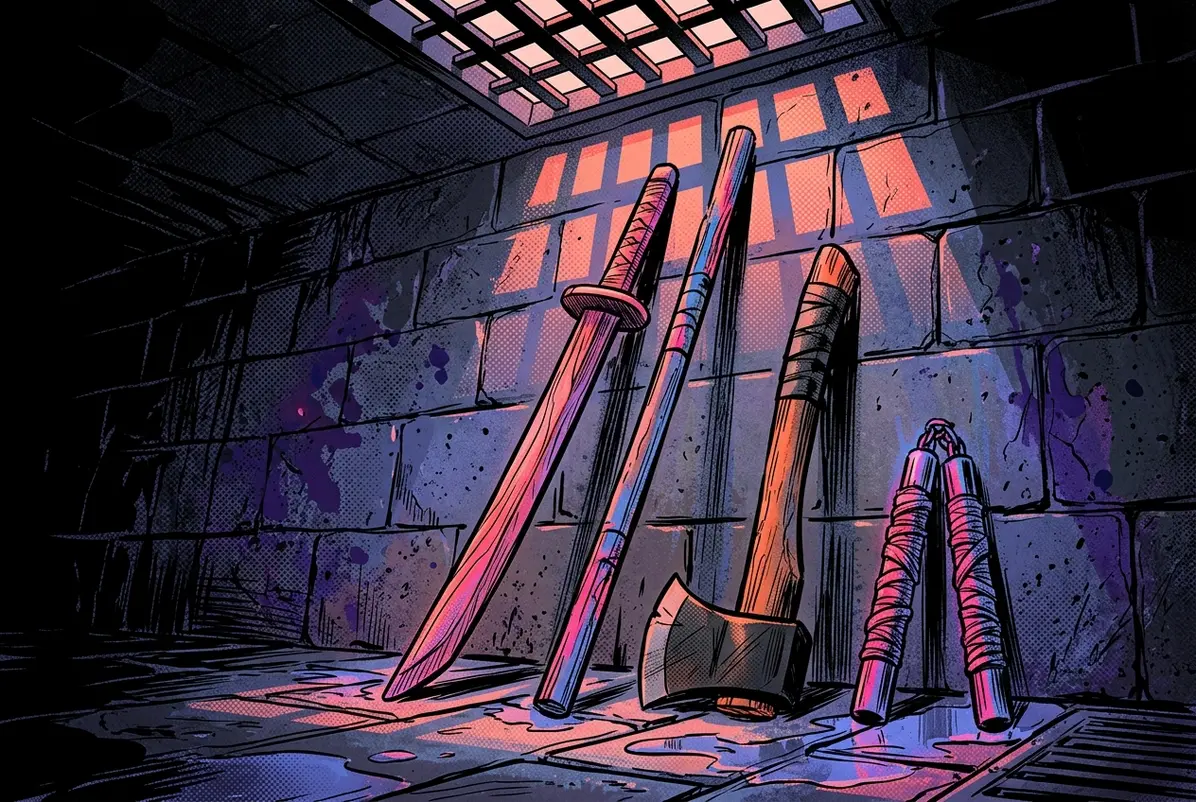
Even the collected editions underline the architecture. The first trade, Return to New York, collects the prelude story and issues #1 through #6. Penguin Random House also lists a Jason Aaron Deluxe Edition scheduled for October 13, 2026, collecting the first 12 issues and “Long Way From Home.” That future hardcover is not just a package. It turns the Aaron run into a contained object: the year TMNT was scattered so it could be reassembled.
What the Response Reveals
The response to the relaunch was broadly strong, but not frictionless. Comic Book Roundup’s page for Teenage Mutant Ninja Turtles #1 shows a strong critic average and a positive user average, while also preserving the split that matters most: some readers praised it as a strong new entry point, while at least one reader-review objection argued that the book was not a true jumping-on point because it continued a 150-issue run and its surrounding tie-ins.
That tension is more revealing than a simple good-or-bad verdict. A relaunch like this is not judged only by whether people like the first issue. It is judged by whether readers accept the terms of entry.
For new readers, the promise is freedom from homework. For longtime readers, the promise is that the homework still mattered. Aaron’s TMNT relaunch tries to satisfy both groups by changing the unit of meaning. It does not ask new readers to memorize every detail of Mutant Town, Jennika, Old Hob, Splinter’s death, the Foot Clan, or the broader IDW architecture. It asks them to care about four separated brothers and trust that the deeper history will surface when needed.
That is a smart compromise. It is also a fragile one.
The real test of the relaunch was never whether a new #1 could sell. It did. The real test was whether the book could make continuity feel like weight instead of clutter. Aaron’s best issues understand that difference. Continuity is clutter when it behaves like trivia. It becomes weight when it changes how a character stands, fights, grieves, or refuses to come home.
That is why the relaunch matters beyond TMNT fandom. It is a case study in the modern franchise problem. Every long-running property wants new readers, new viewers, new buyers, new believers. Every long-running property also wants to keep the old audience from feeling like their memory has been repossessed. The soft reboot is the industry’s compromise position: a fresh start with fingerprints all over the glass.
Aaron’s TMNT did not solve that problem forever. No relaunch can. But it understood the shape of the problem better than most. It did not pretend the past was gone. It made the brothers live with it separately before asking them to become a family again.
The shell was not wiped clean. It was cracked open just enough to let new light in.
Frequently Asked Questions About the TMNT Relaunch
Is Teenage Mutant Ninja Turtles: Alpha required reading before Jason Aaron’s relaunch?
No, but it helps. Alpha was designed to set up the future of IDW’s TMNT line, with Jason Aaron and Chris Burnham’s “Long Way From Home” serving as a direct prelude to Aaron’s run and Tom Waltz and Gavin Smith’s “Mutant Island” setting up other corners of the line. AIPT described the one-shot as groundwork for the next era. New readers can start with Teenage Mutant Ninja Turtles #1, but Alpha gives the relaunch more emotional and continuity context.
Is the Jason Aaron TMNT run a reboot or a sequel?
It is a relaunch, not a full reboot. When Aaron’s takeover was announced, reporting emphasized that the new series would exist in the current IDW universe rather than replacing it. That makes it a continuation of the prior IDW continuity, but with a new #1 and a reworked status quo meant to welcome new readers.
How many issues did Jason Aaron write?
Aaron’s main run lasted 12 issues. He also wrote the prelude story “Long Way From Home” in Teenage Mutant Ninja Turtles: Alpha #1. AIPT’s 2025 interview with Aaron discusses the completed 12-issue run, and Penguin Random House lists a Deluxe Edition scheduled for October 13, 2026, collecting the first 12 issues and the prelude.
Who took over TMNT after Jason Aaron?
Gene Luen Yang took over as writer with issue #13, joined by artist Freddie E. Williams II. The Beat reported that their run would begin with issue #13 on December 10, 2025.
Do new readers need to read all 150 issues of the original IDW run?
No. The Aaron relaunch was marketed as a new-reader-friendly entry point, and the first trade was described by Penguin Random House as “a perfect jumping-on point for new fans.” Reading the earlier IDW run adds depth, especially around Mutant Town, Jennika, Old Hob, and Splinter, but Aaron’s opening arc is built around clear character situations rather than a full continuity recap.
How many copies did Teenage Mutant Ninja Turtles #1 sell?
Before release, Teenage Mutant Ninja Turtles #1 passed 300,000 orders, according to ICv2. That made the launch one of the major direct-market comic stories of 2024 and signaled unusually strong retailer confidence in IDW’s new TMNT era.

'%3e%3cg id='Final-Copy-2_2_' transform='translate(1275.000000, 200.000000)'%3e%3cpath class='st0' d='M7.4,12.8h6.8l3.1-11.6H7.4C4.2,1.2,1.6,3.8,1.6,7S4.2,12.8,7.4,12.8z'/%3e%3c/g%3e%3c/g%3e%3c/g%3e%3cg id='final---dec.11-2020'%3e%3cg id='_x30_208-our-toggle' transform='translate(-1275.000000, -200.000000)'%3e%3cg id='Final-Copy-2' transform='translate(1275.000000, 200.000000)'%3e%3cpath class='st1' d='M22.6,0H7.4c-3.9,0-7,3.1-7,7s3.1,7,7,7h15.2c3.9,0,7-3.1,7-7S26.4,0,22.6,0z M1.6,7c0-3.2,2.6-5.8,5.8-5.8 h9.9l-3.1,11.6H7.4C4.2,12.8,1.6,10.2,1.6,7z'/%3e%3cpath id='x' class='st2' d='M24.6,4c0.2,0.2,0.2,0.6,0,0.8l0,0L22.5,7l2.2,2.2c0.2,0.2,0.2,0.6,0,0.8c-0.2,0.2-0.6,0.2-0.8,0 l0,0l-2.2-2.2L19.5,10c-0.2,0.2-0.6,0.2-0.8,0c-0.2-0.2-0.2-0.6,0-0.8l0,0L20.8,7l-2.2-2.2c-0.2-0.2-0.2-0.6,0-0.8 c0.2-0.2,0.6-0.2,0.8,0l0,0l2.2,2.2L23.8,4C24,3.8,24.4,3.8,24.6,4z'/%3e%3cpath id='y' class='st3' d='M12.7,4.1c0.2,0.2,0.3,0.6,0.1,0.8l0,0L8.6,9.8C8.5,9.9,8.4,10,8.3,10c-0.2,0.1-0.5,0.1-0.7-0.1l0,0 L5.4,7.7c-0.2-0.2-0.2-0.6,0-0.8c0.2-0.2,0.6-0.2,0.8,0l0,0L8,8.6l3.8-4.5C12,3.9,12.4,3.9,12.7,4.1z'/%3e%3c/g%3e%3c/g%3e%3c/g%3e%3c/g%3e%3c/svg%3e) Your Privacy Choices
Your Privacy Choices