

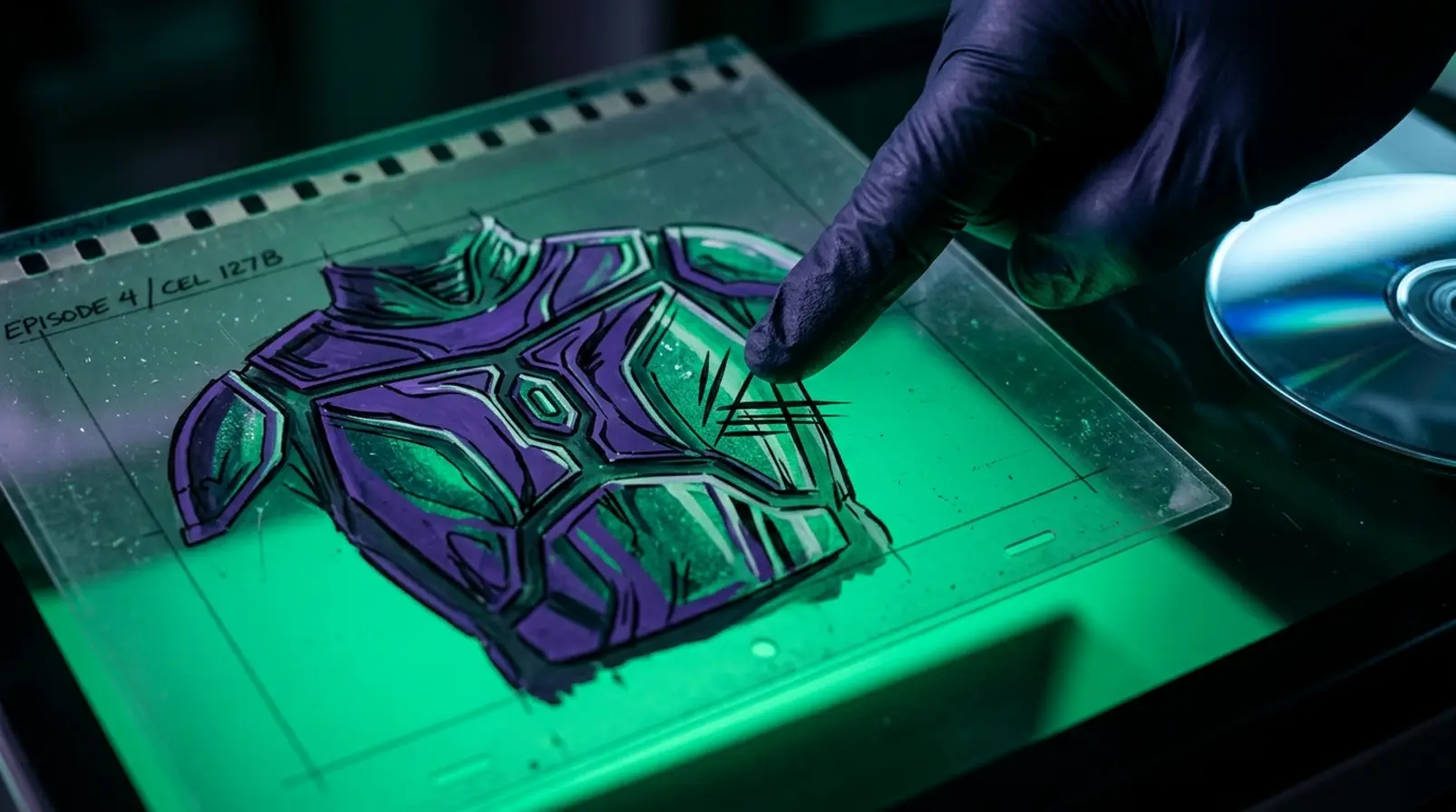


Universal released its Blu-ray edition of Filmation’s 1983 He-Man and the Masters of the Universe on August 25, 2026. Archivist James Eatock had disclosed his involvement on June 9, and release details followed on June 30: 13 discs, all 130 episodes, the animated movie The Secret of the Sword, the Christmas special and a stack of archival extras.
The timing made the set unusually interesting. Amazon MGM’s live-action Masters of the Universe had opened in theaters on June 5 before arriving on Prime Video on July 22. One production rebuilt Eternia as a modern studio tentpole. The other went back through an existing television series correcting playback speed, credits, logos and missing footage.
Those are completely different jobs. That is also what makes the comparison useful. A remake has to decide what He-Man should become. A restoration has to know exactly what He-Man already was.
What the He-Man Restoration Actually Fixes
The changes are unusually specific. According to Eatock’s account of the work, the episodes now play at their original NTSC speed instead of passing through the problematic standards conversion associated with earlier home-video masters. He also identified the restoration of the Westinghouse-era Filmation logo on the first 18 episodes, all six correct sets of end credits across the 130-episode run and missing footage from “Diamond Ray of Disappearance.”
That last correction is exactly the kind of thing restoration is good at making visible. Earlier editions were missing part of the sequence in which Orko escapes Skeletor’s Diamond Ray and goes to warn He-Man. It isn’t a lost episode or some legendary alternate ending. It is a small piece of connective action that belongs there.
The project also has an important technical limitation. This is not a new scan from surviving original camera negatives. Eatock described the work as restoration and upscaling of existing masters. The Blu-ray can correct content, timing and presentation without magically turning the series into newly photographed 35mm material.
That distinction makes the project more interesting, not less. Restoration is often a pile of decisions about things most viewers will never consciously identify: whether a logo belongs on episode 17, whether a credit sequence is the correct one, whether dialogue and music are running at the intended speed, whether several seconds disappeared somewhere between one master and another.

The German Import Was Already Doing the Heavy Lifting
Universal did not create this approach from scratch. German label Plaion Pictures had already released restored Blu-ray editions, with Eatock crediting Plaion’s work as part of the basis for the corrected presentation.
For American collectors, the practical difference was access. Plaion’s editions were German imports. Universal’s 13-disc domestic set put all 130 Filmation episodes into a standard U.S. release alongside The Secret of the Sword, the Christmas special, Power of Grayskull: The Definitive History of He-Man and the Masters of the Universe, two featurettes and a gallery of early concepts and illustrations.
That sounds mundane compared with rebuilding Castle Grayskull for a feature film. For physical-media collectors, mundane distribution problems are often the entire problem. A restoration can exist and still be inconvenient, expensive or obscure until somebody actually releases it where the audience lives.
The $170 Million Theatrical Run
Amazon MGM’s live-action adaptation, directed by Travis Knight, operated on another scale entirely. The Numbers lists a $170 million production budget, though other reporting has placed the cost higher. The film opened with $29.44 million domestically and finished with $64.83 million in North America and $113.79 million worldwide.
Its second domestic weekend brought in $8.93 million, a 69.7 percent decline from opening weekend.
The numbers establish a limited but important point. The film’s worldwide theatrical gross finished below even the lower published production-budget figure. That does not by itself establish the movie’s ultimate profitability, which also depends on marketing costs, exhibitor splits, home entertainment, licensing and other revenue. It does establish that the theatrical run did not generate anything close to a conventional blockbuster multiple on its production spending.
It also does not explain why.
Nostalgia fatigue, casting, development history, competition, ticket prices, reviews and the movie’s relationship to earlier versions of He-Man can all be argued about. The grosses cannot sort those explanations for anyone.
Then He-Man Found a Huge Audience at Home

The Prime Video numbers complicate any neat flop narrative. After arriving on the service July 22, Nielsen measured 1.17 billion minutes of U.S. television viewing during the July 20 through July 26 tracking week, enough to rank Masters of the Universe first among streaming titles.
Because it debuted on Wednesday, the movie accumulated that total across five days of availability.
That is not a retroactive theatrical win. Streaming minutes and movie-ticket revenue answer different questions. It does show that the expensive reinvention of He-Man eventually found a substantial audience. Plenty of people wanted to see it. They simply did not all choose to see it under the economic conditions of a theatrical release.
Restoration Has a Different Job
The Blu-ray never had to solve that problem. Its audience already knew which He-Man it wanted.
That changes the nature of the work. Travis Knight’s film had to translate a toy line, forty-plus years of franchise history and several competing versions of Eternia into a contemporary feature. It had to choose costumes, performances, production design, mythology and tone. Even a faithful adaptation necessarily replaces things.
Eatock and Plaion were solving almost the opposite problem. Don’t replace the old logo. Put it back. Don’t reinterpret the missing Orko scene. Restore it. Don’t modernize the cadence of the soundtrack. Make the episodes run at the intended speed. Don’t standardize six different credit sequences into something cleaner. Figure out which one belongs where.
None of that makes a Blu-ray restoration a greater production accomplishment than mounting a $170 million feature film. They are not comparable by manpower, money or technical scale.
But the restoration can be more exact about the object in front of it.
Filmation’s He-Man was built under the constraints of syndicated television animation: repeated movement, economical staging, stock transformations, limited animation and a visual language designed to make impossible fantasy worlds producible every weekday. Those limitations became part of its identity. The odd pauses, familiar poses, music cues, logos and credits are not debris surrounding the “real” He-Man. After four decades, they are part of what this particular He-Man is.
A blockbuster can spend nine figures trying to recover the feeling of an old property. Sometimes preservation takes a stranger route. Somebody notices that Orko lost a few seconds in an episode mastered decades ago, finds the missing footage, puts it back where it belongs, and suddenly Eternia is slightly more complete than it was the day before.


'%3e%3cg id='Final-Copy-2_2_' transform='translate(1275.000000, 200.000000)'%3e%3cpath class='st0' d='M7.4,12.8h6.8l3.1-11.6H7.4C4.2,1.2,1.6,3.8,1.6,7S4.2,12.8,7.4,12.8z'/%3e%3c/g%3e%3c/g%3e%3c/g%3e%3cg id='final---dec.11-2020'%3e%3cg id='_x30_208-our-toggle' transform='translate(-1275.000000, -200.000000)'%3e%3cg id='Final-Copy-2' transform='translate(1275.000000, 200.000000)'%3e%3cpath class='st1' d='M22.6,0H7.4c-3.9,0-7,3.1-7,7s3.1,7,7,7h15.2c3.9,0,7-3.1,7-7S26.4,0,22.6,0z M1.6,7c0-3.2,2.6-5.8,5.8-5.8 h9.9l-3.1,11.6H7.4C4.2,12.8,1.6,10.2,1.6,7z'/%3e%3cpath id='x' class='st2' d='M24.6,4c0.2,0.2,0.2,0.6,0,0.8l0,0L22.5,7l2.2,2.2c0.2,0.2,0.2,0.6,0,0.8c-0.2,0.2-0.6,0.2-0.8,0 l0,0l-2.2-2.2L19.5,10c-0.2,0.2-0.6,0.2-0.8,0c-0.2-0.2-0.2-0.6,0-0.8l0,0L20.8,7l-2.2-2.2c-0.2-0.2-0.2-0.6,0-0.8 c0.2-0.2,0.6-0.2,0.8,0l0,0l2.2,2.2L23.8,4C24,3.8,24.4,3.8,24.6,4z'/%3e%3cpath id='y' class='st3' d='M12.7,4.1c0.2,0.2,0.3,0.6,0.1,0.8l0,0L8.6,9.8C8.5,9.9,8.4,10,8.3,10c-0.2,0.1-0.5,0.1-0.7-0.1l0,0 L5.4,7.7c-0.2-0.2-0.2-0.6,0-0.8c0.2-0.2,0.6-0.2,0.8,0l0,0L8,8.6l3.8-4.5C12,3.9,12.4,3.9,12.7,4.1z'/%3e%3c/g%3e%3c/g%3e%3c/g%3e%3c/g%3e%3c/svg%3e) Your Privacy Choices