


There’s a specific wobble that used to follow independent 2D animation around like a calling card. Not always a deliberate stylistic choice, but a telltale tremor in every line, every held frame. It lived in student thesis films and micro-budget shorts and festival entries that punched above their weight but never quite shed the visual artifacts of their tooling. You could call it charm. You could also call it a limitation. Either way, it was the look of 2D animation made outside the studio gates, and for years it was practically inescapable.
That wobble has gotten quieter. In my view, the reason has a lot to do with a piece of free software, a Dutch nonprofit, and a developer named Falk David.
From Annotations to Auteur Cinema
In 2008, Joshua Leung implemented annotations in Blender directly in the 3D Viewport, calling the feature Grease Pencil. The first version was designed as a simple annotation tool, letting artists draw directly into the viewport. But the community that formed around Grease Pencil had bigger plans, and by 2019 it became its own object type and a dedicated workspace for 2D animation as part of the Blender 2.8 project. What started as a doodling tool had quietly become a production pipeline.
And then the films started coming. The critically acclaimed war fable Unicorn Wars, described as “Bambi meets Apocalypse Now,” was Spanish director Alberto Vázquez’s first feature fully made with Blender. The animation was made in Blender, specifically with Grease Pencil, allowing the team to work in 2D within a 3D environment. The result was vivid, unhinged, and beautiful. The film won Best Animated Film at the 37th Goya Awards. To me, that moment was a proof of concept for an entire mode of filmmaking: auteur animation built on free tools, coordinated across small studios in multiple cities and countries, with a budget of about 3 million euros.
Then came Flow. Directed by Gints Zilbalodis, the animated fantasy adventure won the Academy Award for Best Animated Feature, giving Latvia its first Oscar. Flow was not a Grease Pencil production in the same sense as Unicorn Wars; it was computer-generated animation made with Blender. But its success matters to the same larger story. Made with open-source software and a reported budget of about $3.4 million, Flow beat big-budget studio films including DreamWorks’ The Wild Robot and Pixar’s Inside Out 2. It feels like the kind of story that only makes sense in hindsight, but it was years in the making.
Enter Falk David
Behind these headlines sits unglamorous infrastructure work. Falk David was hired by the Blender Foundation to work full-time on the Grease Pencil 3.0 project. He is a software developer based in the Netherlands, and his public Blender Conference profile describes him simply as a Grease Pencil developer at Blender. Before the Foundation brought him on full-time, he received a Blender Foundation development grant to work on triaging and bug fixing, later joined the Grease Pencil module, and participated in Google Summer of Code 2020. It reads like a path carved by persistence more than pedigree.
The core team for the Grease Pencil 3.0 project included several key figures from Grease Pencil’s earlier development: developer Antonio Vázquez and artists Daniel Martínez Lara and Matias Mendiola. They were joined by Falk David and Amélie Fondevilla, a developer at French animation studio Les Fées Spéciales. What strikes me is how small that group was for a rewrite of this scope. A compact team was rebuilding the drawing engine for a tool used by artists, studios, and award-winning independent productions around the world.
While many aspects of the tool had improved over time, the core data structures of Grease Pencil had remained largely the same for about 15 years, and the team was facing the limitations of that initial design. Grease Pencil 3.0 was conceived as a full rewrite, aiming to lay a stronger foundation for the next decade of development.
What the Rewrite Actually Does
The new implementation is based on the same backend as Blender’s newer curves system, designed with multi-threading in mind, capable of handling much more data, and written in a more modern C++ style. That sentence is dense with implications. Multi-threading means the drawing engine can better use modern hardware. Geometry Nodes integration means procedural effects can now be applied to Grease Pencil data, opening the door to workflows that once required expensive proprietary tools, custom code, or a lot of manual workaround labor.
Grease Pencil was rewritten to remove deeper limitations and improve overall performance, with a focus on compatibility and feature parity with Blender 4.2. Layer Groups are a new way to group layers together, allowing for easier toggling of visibility, locking, and onion skinning across multiple layers, and they can be color-coded using color tags. The eraser was rewritten to allow strokes to be cut more accurately, correctly solving for intersections and creating new points on the stroke. The Soft eraser can now do this across multiple levels of transparency.
Grease Pencil data is now much more compact, leading to smaller file sizes, faster load times, and increased undo speed. For anyone who has wrestled with bloated animation files on a mid-range laptop, this matters enormously. My take is that these are not glamorous features. They’re the plumbing. But plumbing is what separates a tool you fight against from a tool that disappears under your hands.
Grease Pencil 3.0 was originally planned for an earlier release, but the rewrite was not ready for the main branch at that time. From Blender 4.3 onward, Grease Pencil objects are automatically converted to the new architecture on file load. The transition is meant to be mostly invisible to artists. Old files simply open in the new system, even as the underlying data model changes.
Why the Jitter Fades
Here’s where the cultural shift gets interesting. The “indie jitter” I mentioned at the top was never only about skill. It was often about tooling. When your drawing engine chokes on complex scenes, when strokes lag behind your stylus, when file sizes balloon and your undo stack crawls, the natural response is to simplify. Fewer frames. Fewer layers. Rougher lines. The limitations of the tool can become the aesthetic of the work.
There’s a case to be made that Grease Pencil 3.0 does not kill that aesthetic so much as it makes it more optional. Artists can still choose a rough, vibrating, handmade look. But when the software can handle denser drawings, longer timelines, faster undo, and more complex layer structures, the wobble becomes less of a technical tax. If you want your lines to shake, you can still make them shake. But you’re choosing it, not surrendering to it. That distinction matters.
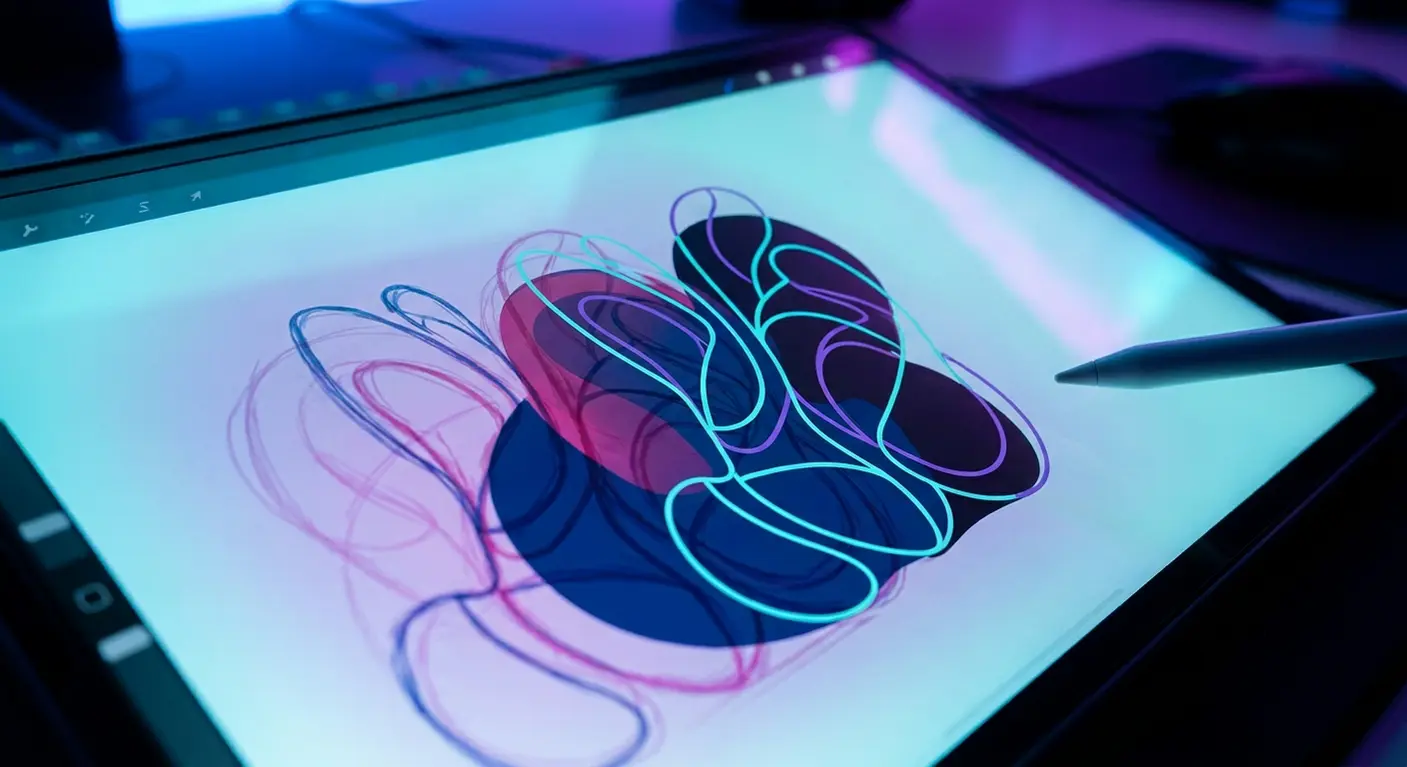
Online animation and Blender communities have been vocal about this shift. Some artists and add-on developers worry that the rewrite’s API-breaking changes will fracture parts of the add-on ecosystem. Add-ons written using the Grease Pencil Python API before Blender 4.3 are expected to break, and the team has provided migration documentation to help developers update. Others celebrate the performance gains and the Geometry Nodes pipeline as transformative. It feels like the kind of productive tension that signals a tool maturing past its hobbyist roots without abandoning the people who got it there.
What Comes Next
The Blender Foundation is an independent public benefit organization created to provide a complete, free, and open-source 3D creation pipeline. Its Development Fund receives support from companies and individual users, helping fund ongoing development of Blender itself. This funding model is part of what makes the story feel quietly radical. The tool that powered an Oscar-winning film and helped enable a Goya-winning feature is available to anyone with a laptop and an internet connection.
As of 2026, the Grease Pencil module continues to hold regular development meetings, with developers and artists still actively refining the toolset. Reasonable people might disagree about whether open-source software can sustain professional-grade animation tools indefinitely. But the evidence keeps accumulating. The jitter fades. The films get made. And a small open-source ecosystem keeps shipping code.
I think the most important thing Grease Pencil 3.0 proves is not only technical. It is philosophical. The best animation tools are not always the ones that cost the most. They are the ones that get out of the way.
'%3e%3cg id='Final-Copy-2_2_' transform='translate(1275.000000, 200.000000)'%3e%3cpath class='st0' d='M7.4,12.8h6.8l3.1-11.6H7.4C4.2,1.2,1.6,3.8,1.6,7S4.2,12.8,7.4,12.8z'/%3e%3c/g%3e%3c/g%3e%3c/g%3e%3cg id='final---dec.11-2020'%3e%3cg id='_x30_208-our-toggle' transform='translate(-1275.000000, -200.000000)'%3e%3cg id='Final-Copy-2' transform='translate(1275.000000, 200.000000)'%3e%3cpath class='st1' d='M22.6,0H7.4c-3.9,0-7,3.1-7,7s3.1,7,7,7h15.2c3.9,0,7-3.1,7-7S26.4,0,22.6,0z M1.6,7c0-3.2,2.6-5.8,5.8-5.8 h9.9l-3.1,11.6H7.4C4.2,12.8,1.6,10.2,1.6,7z'/%3e%3cpath id='x' class='st2' d='M24.6,4c0.2,0.2,0.2,0.6,0,0.8l0,0L22.5,7l2.2,2.2c0.2,0.2,0.2,0.6,0,0.8c-0.2,0.2-0.6,0.2-0.8,0 l0,0l-2.2-2.2L19.5,10c-0.2,0.2-0.6,0.2-0.8,0c-0.2-0.2-0.2-0.6,0-0.8l0,0L20.8,7l-2.2-2.2c-0.2-0.2-0.2-0.6,0-0.8 c0.2-0.2,0.6-0.2,0.8,0l0,0l2.2,2.2L23.8,4C24,3.8,24.4,3.8,24.6,4z'/%3e%3cpath id='y' class='st3' d='M12.7,4.1c0.2,0.2,0.3,0.6,0.1,0.8l0,0L8.6,9.8C8.5,9.9,8.4,10,8.3,10c-0.2,0.1-0.5,0.1-0.7-0.1l0,0 L5.4,7.7c-0.2-0.2-0.2-0.6,0-0.8c0.2-0.2,0.6-0.2,0.8,0l0,0L8,8.6l3.8-4.5C12,3.9,12.4,3.9,12.7,4.1z'/%3e%3c/g%3e%3c/g%3e%3c/g%3e%3c/g%3e%3c/svg%3e) Your Privacy Choices
Your Privacy Choices