


Vinyl came back faster than the infrastructure beneath it.
In 2025, U.S. vinyl revenue surpassed $1 billion after growing 9.3 percent, marking the format’s nineteenth consecutive year of growth. American sales reached 46.8 million units and accounted for nearly half of vinyl’s global value according to the RIAA’s year-end report.
Yet for records made through traditional lacquer mastering, that billion-dollar market still begins with a soft coating spread across an aluminum disc. The music is cut into that surface, converted into metal parts, and only then pressed into the plastic object sold in stores.
The comeback is mass-market. One of its most important production steps remains almost artisanal.
The Record Before the Record
A lacquer is not a record. It is the temporary object from which a record becomes possible.
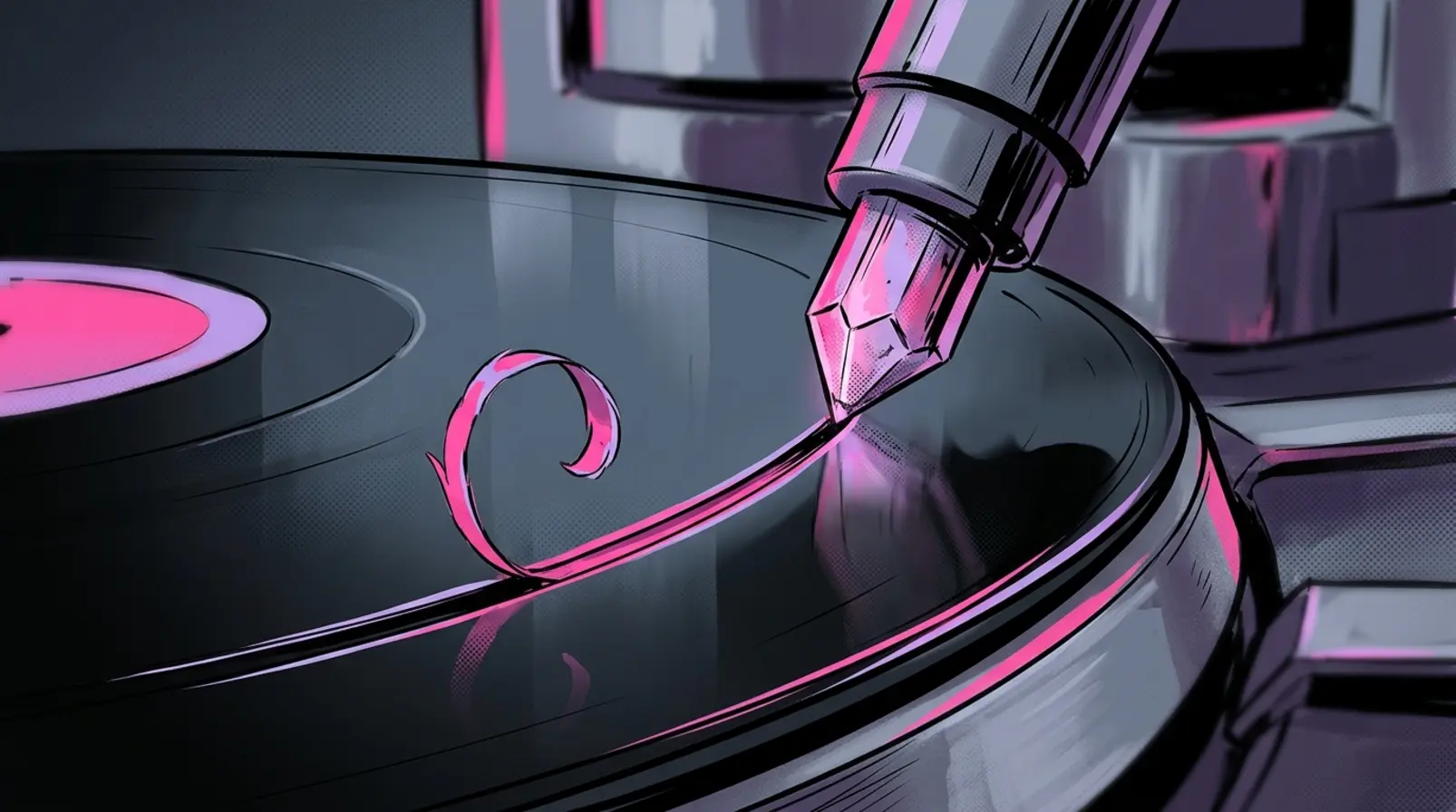
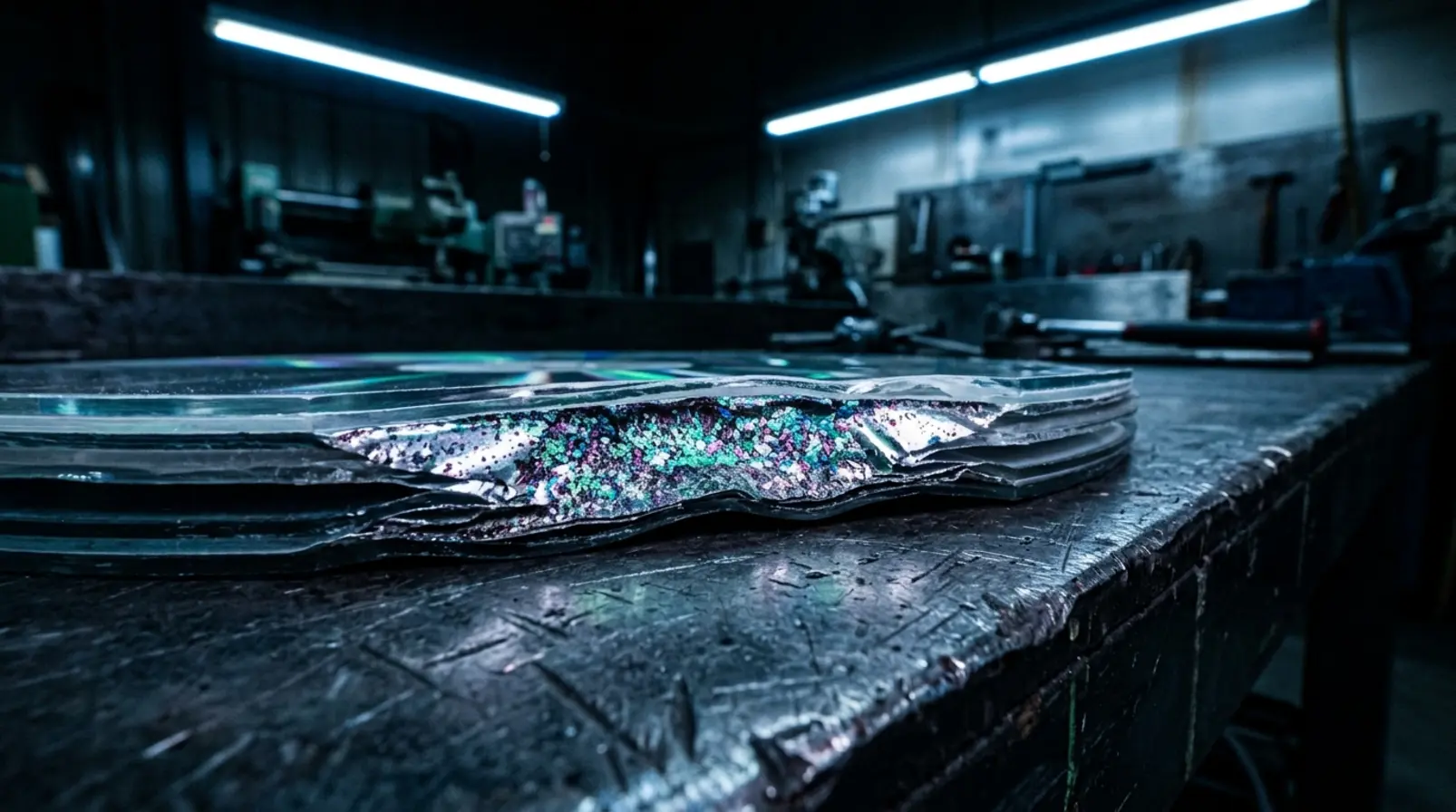
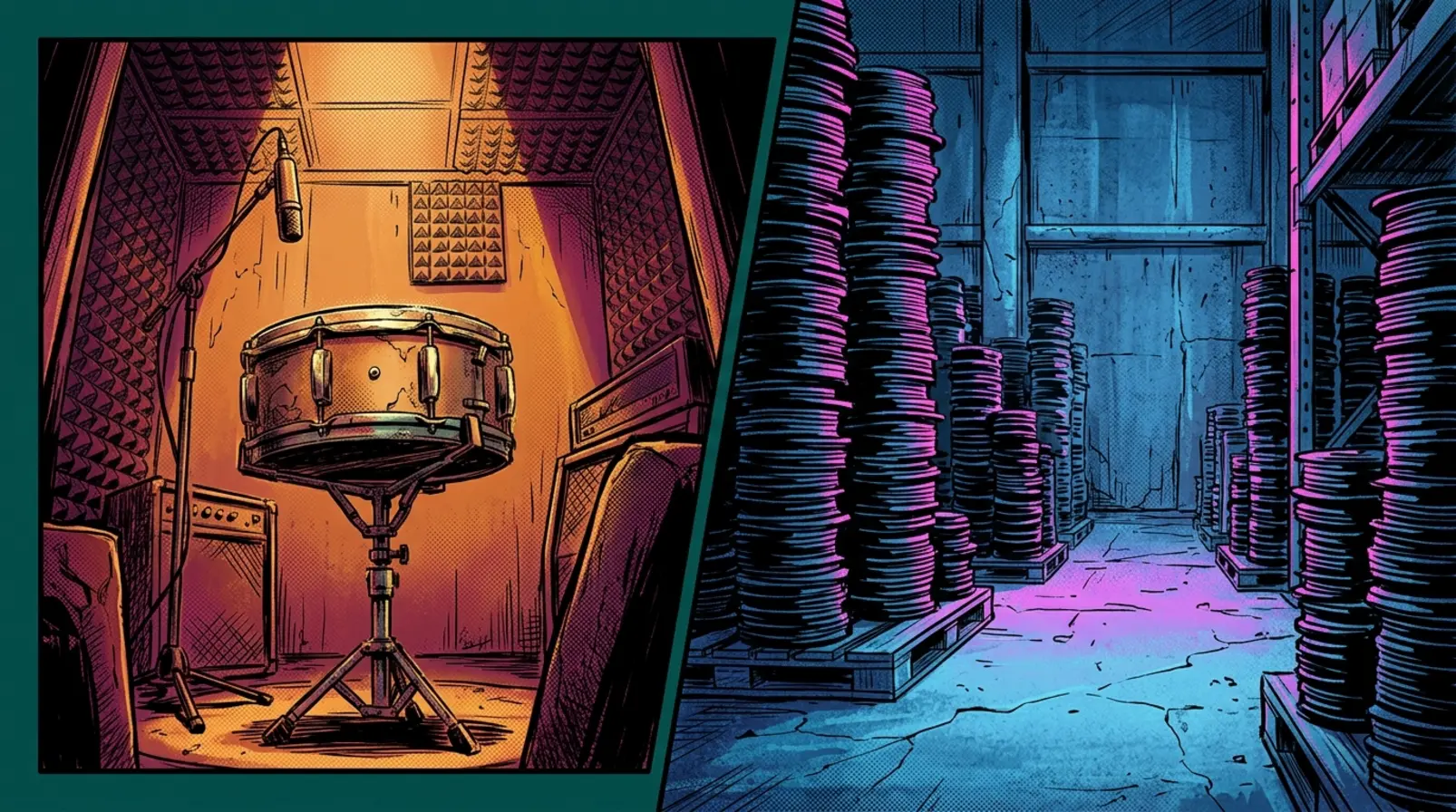
A cutting engineer uses a lathe to carve the audio into a soft lacquer coating applied over an aluminum base as Third Man Pressing describes its mastering process. The coating is traditionally made with nitrocellulose, a highly flammable material that must be dried, inspected, and kept free of imperfections before cutting according to a technical account of lacquer manufacturing.
Once cut, the lacquer is sprayed with a conductive layer of silver and electroplated with nickel. That process creates the negative and positive metal parts from which the final stampers are made under United Record Pressing’s documented workflow.
The lacquer disappears from the consumer story, but its surface has already decided what the consumer will hear. Noise, damage, or a flawed cut can travel forward into the metalwork and the records pressed from it.
The finished LP is durable enough to survive decades. Its manufacturing lineage begins on a surface soft enough to remember a mistake.

The Fire Exposed the Missing Layer
On February 6, 2020, a three-alarm fire caused catastrophic damage at Apollo Masters in Banning, California. No employees were injured, but the manufacturing and storage facility was destroyed according to local reporting.
At the time, Apollo was one of only two companies producing blank master lacquers for the international record industry. The other established source was the Japanese operation now identified as Public Record Co. Industry figures immediately warned that the loss had removed one side of an already narrow supply chain.
The fire did not end the vinyl revival. Pressing plants continued operating, labels continued ordering records, and demand continued climbing. What the fire destroyed was the illusion that a growing consumer format must also possess a growing and redundant industrial base.
Vinyl had more customers than it had in decades. It suddenly had one established commercial source for the blank surface on which much of its new music began.
The Boom Rebuilt Presses Faster Than Lacquers
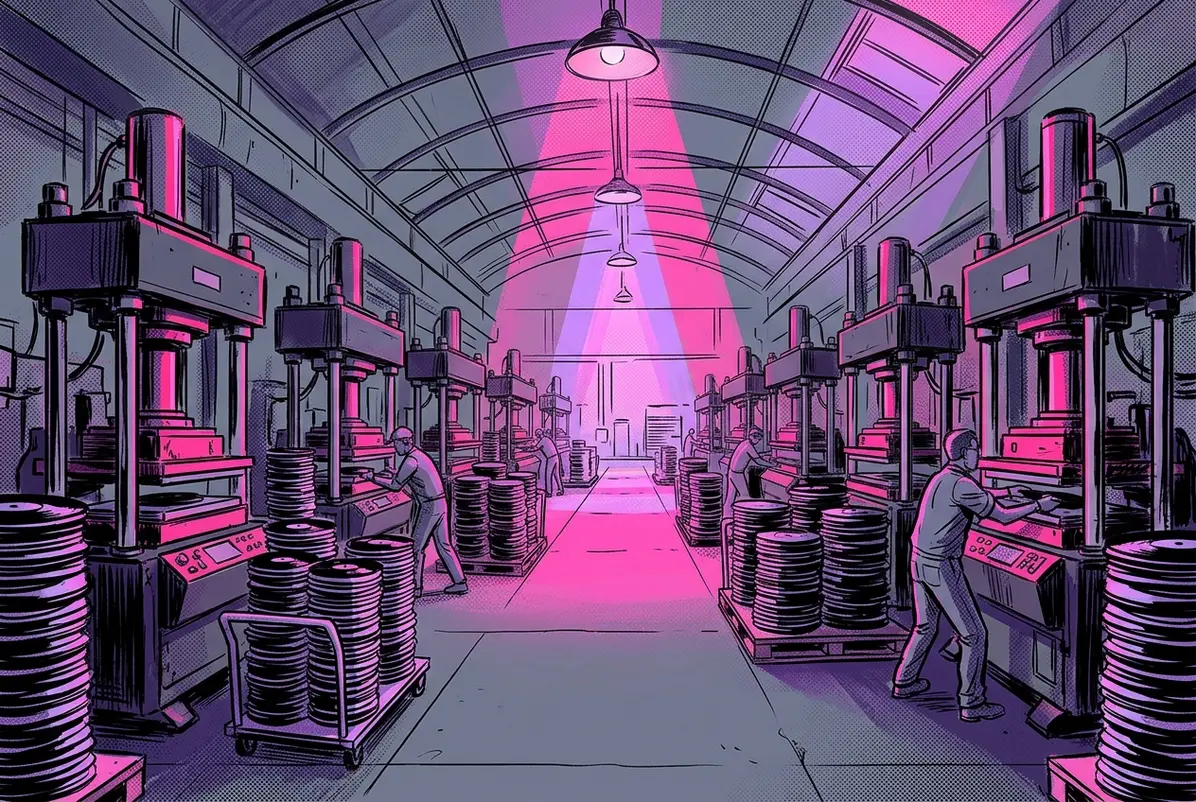
The vinyl comeback is usually measured at its visible end: new pressing plants, modern presses, crowded release calendars, colored variants, expanded record-store sections, and annual sales totals.
That expansion did not occur evenly across the production chain. Trade reporting after the Apollo fire noted that pressing capacity had increased and newly manufactured presses had become available, while lacquer production still depended on a process involving hazardous chemistry, carefully controlled drying, microscopic surface quality, aging machinery, and specialized knowledge that could not be recreated merely by purchasing another press.
A pressing plant can expand because the market demands more records. A lacquer operation must also reproduce a chemical and mechanical discipline that consumers almost never see.
The sensitivity of that process became visible after the 2011 Fukushima disaster disrupted power supplies in Japan. A 2020 report from The Vinyl Factory described the manufacturer raising the temperature in its proving room by one degree in an attempt to shorten drying time. When the resulting discs reached electroplating facilities, thousands were reportedly rejected because of surface noise and pre-echo according to the specialist account.
The anecdote does not mean every lacquer batch balances permanently on the edge of failure. It does show why the work is difficult to duplicate. The formula is only part of the knowledge. The process lives in temperatures, timing, inspection, maintenance, and the accumulated ability to recognize when a flawless-looking surface is not flawless enough.
Vinyl revived the object faster than it rebuilt the memory required to manufacture it.
A Second Path Is Finally Appearing
The market can no longer be described accurately as having only one lacquer manufacturer.
Public Record’s current English-language material says there are now two blank-lacquer manufacturing companies worldwide, while identifying itself as the only company to have achieved mass production in Japan on its official lacquer-disc page.
The newer pathway comes from Europe. AUDIOLAC says it developed and tested a lacquer formulation that Austrovinyl has begun using to coat and cut its own 14-inch lacquer blanks for electroplating and record production according to the project’s November 2025 update.
That is a meaningful technical breakthrough. It is not yet the same thing as a second worldwide supplier shipping finished blank discs at a scale comparable to Public Record. Austrovinyl’s system is described as in-house production at one pressing plant, not as a replacement global distribution network.
Public Record is also expanding. In January 2026, the company announced that it would establish another lacquer-disc production line at its East Plant during 2026 in response to increased demand. The line should add capacity and resilience within Public Record, but it does not create an independent supplier.
The monopoly has begun to crack technically. The concentration has not disappeared industrially.

Lacquer Is Not the Only Route
Not every newly pressed record depends on a lacquer master. Direct Metal Mastering, or DMM, uses a different style of lathe to cut directly into a copper-coated disc. The process bypasses the lacquer blank, the silvering stage, and part of the conventional electroplating sequence according to Precision Record Pressing’s comparison of the two methods.
DMM therefore prevents the lacquer supply chain from becoming an absolute bottleneck for every pressing plant and every release. But it is an alternative workflow, not a replacement material that can simply be loaded into conventional lacquer equipment. It requires different cutting hardware and carries its own production and aesthetic tradeoffs.
The stronger claim is not that every vinyl record waits on one Japanese factory. It is that a major branch of conventional record manufacturing remains unusually dependent on one established mass producer, even after nearly two decades of consumer growth.
Vinyl’s Comeback Still Has a Soft Center
Vinyl’s revival is often framed as a victory for physical media: listeners rejecting frictionless access in favor of sleeves, liner notes, shelves, weight, ritual, and ownership.
The lacquer supply chain reveals the less romantic side of that physicality. Objects do not return because consumers miss them. They return because factories, chemical processes, machine tools, maintenance knowledge, and trained workers remain capable of producing them.
The 2020 fire did not prove that vinyl was doomed. The industry adapted, Public Record continued manufacturing, DMM provided another route, and a new lacquer process has now emerged in Austria. The stronger lesson is that demand can recover much faster than industrial knowledge.
The record is the collectible. The lacquer is the dependency.
Vinyl rebuilt its audience, its retail presence, and much of its pressing capacity. It is still rebuilding the invisible layer beneath them.
The boom returned in plastic. The bottleneck remained soft enough to cut with a stylus.
'%3e%3cg id='Final-Copy-2_2_' transform='translate(1275.000000, 200.000000)'%3e%3cpath class='st0' d='M7.4,12.8h6.8l3.1-11.6H7.4C4.2,1.2,1.6,3.8,1.6,7S4.2,12.8,7.4,12.8z'/%3e%3c/g%3e%3c/g%3e%3c/g%3e%3cg id='final---dec.11-2020'%3e%3cg id='_x30_208-our-toggle' transform='translate(-1275.000000, -200.000000)'%3e%3cg id='Final-Copy-2' transform='translate(1275.000000, 200.000000)'%3e%3cpath class='st1' d='M22.6,0H7.4c-3.9,0-7,3.1-7,7s3.1,7,7,7h15.2c3.9,0,7-3.1,7-7S26.4,0,22.6,0z M1.6,7c0-3.2,2.6-5.8,5.8-5.8 h9.9l-3.1,11.6H7.4C4.2,12.8,1.6,10.2,1.6,7z'/%3e%3cpath id='x' class='st2' d='M24.6,4c0.2,0.2,0.2,0.6,0,0.8l0,0L22.5,7l2.2,2.2c0.2,0.2,0.2,0.6,0,0.8c-0.2,0.2-0.6,0.2-0.8,0 l0,0l-2.2-2.2L19.5,10c-0.2,0.2-0.6,0.2-0.8,0c-0.2-0.2-0.2-0.6,0-0.8l0,0L20.8,7l-2.2-2.2c-0.2-0.2-0.2-0.6,0-0.8 c0.2-0.2,0.6-0.2,0.8,0l0,0l2.2,2.2L23.8,4C24,3.8,24.4,3.8,24.6,4z'/%3e%3cpath id='y' class='st3' d='M12.7,4.1c0.2,0.2,0.3,0.6,0.1,0.8l0,0L8.6,9.8C8.5,9.9,8.4,10,8.3,10c-0.2,0.1-0.5,0.1-0.7-0.1l0,0 L5.4,7.7c-0.2-0.2-0.2-0.6,0-0.8c0.2-0.2,0.6-0.2,0.8,0l0,0L8,8.6l3.8-4.5C12,3.9,12.4,3.9,12.7,4.1z'/%3e%3c/g%3e%3c/g%3e%3c/g%3e%3c/g%3e%3c/svg%3e) Your Privacy Choices
Your Privacy Choices