

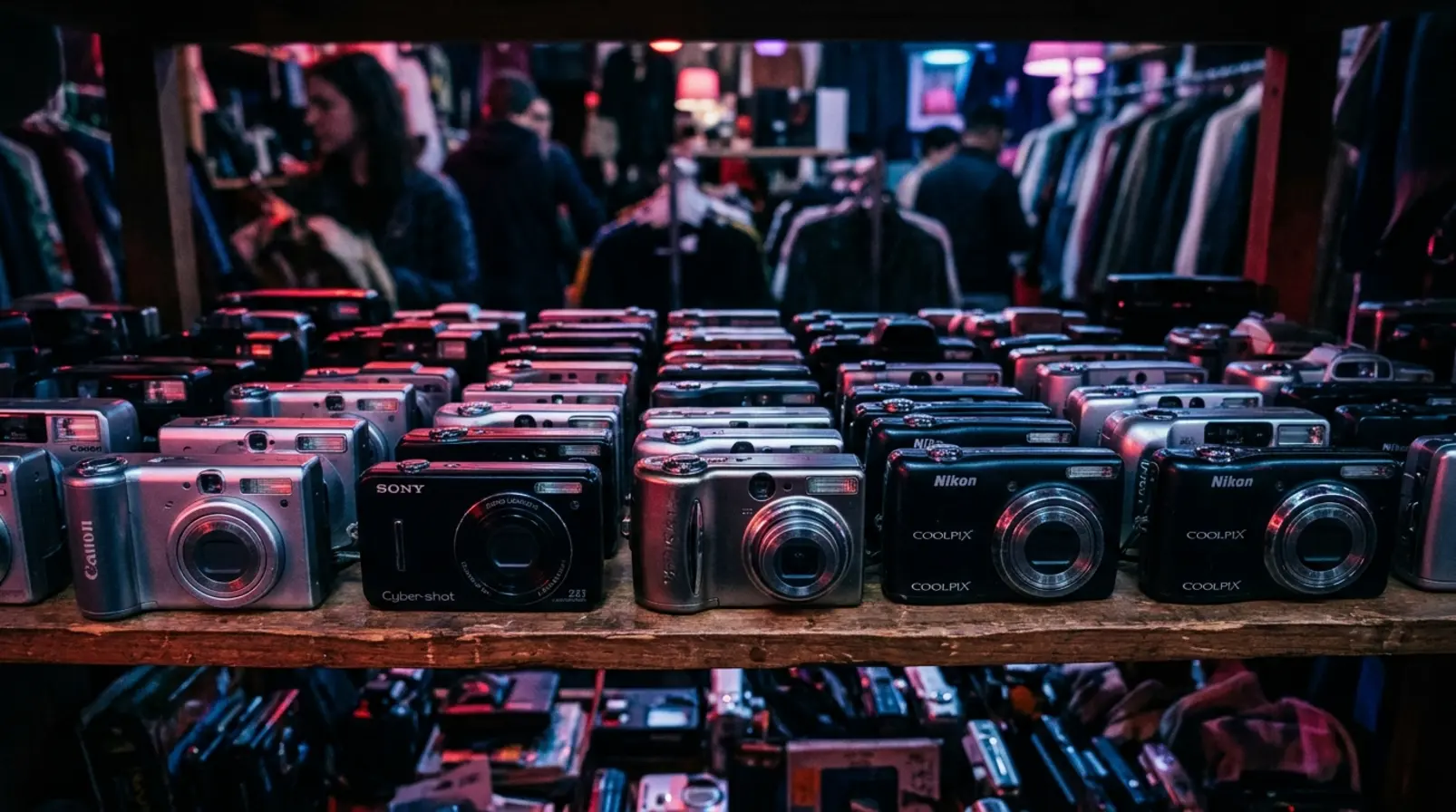

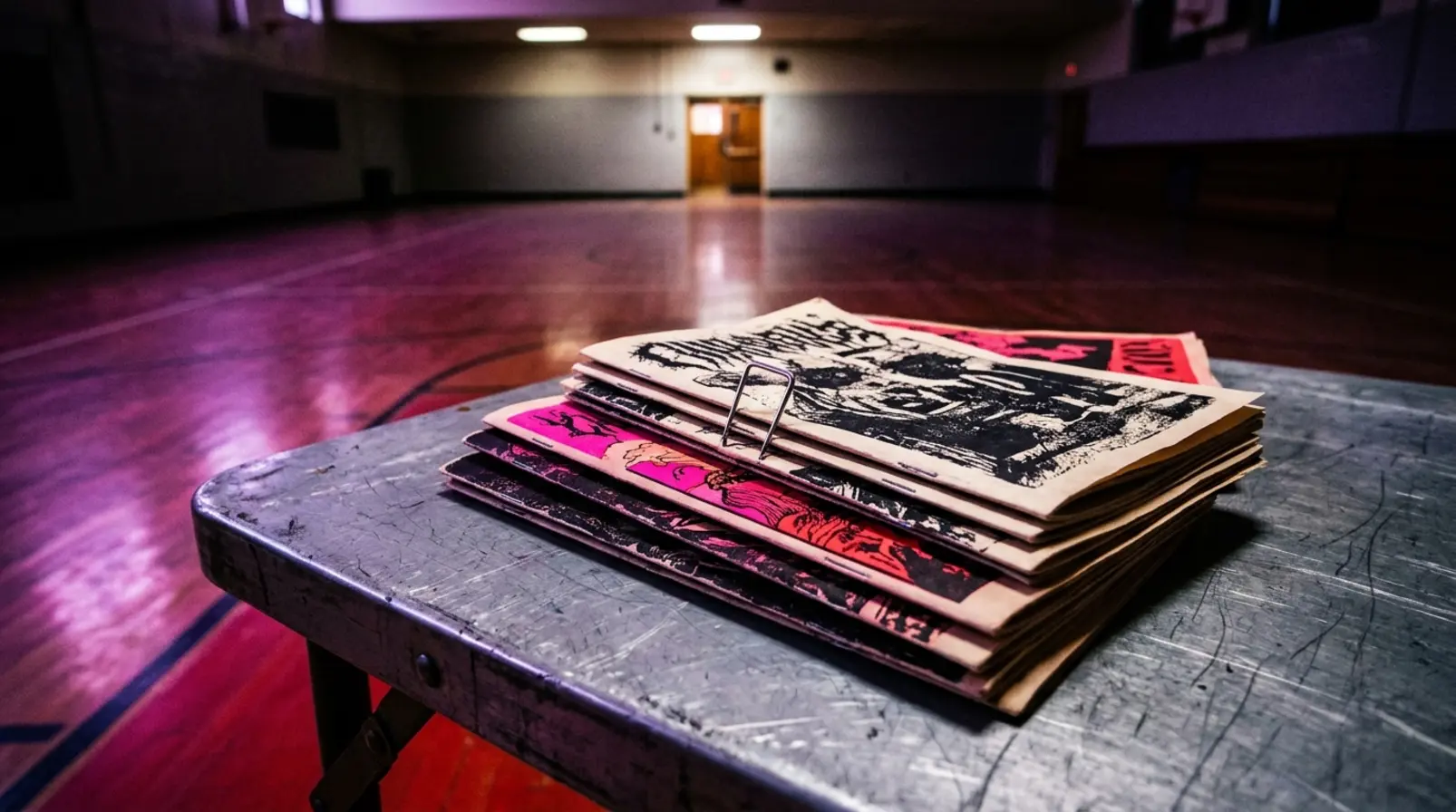
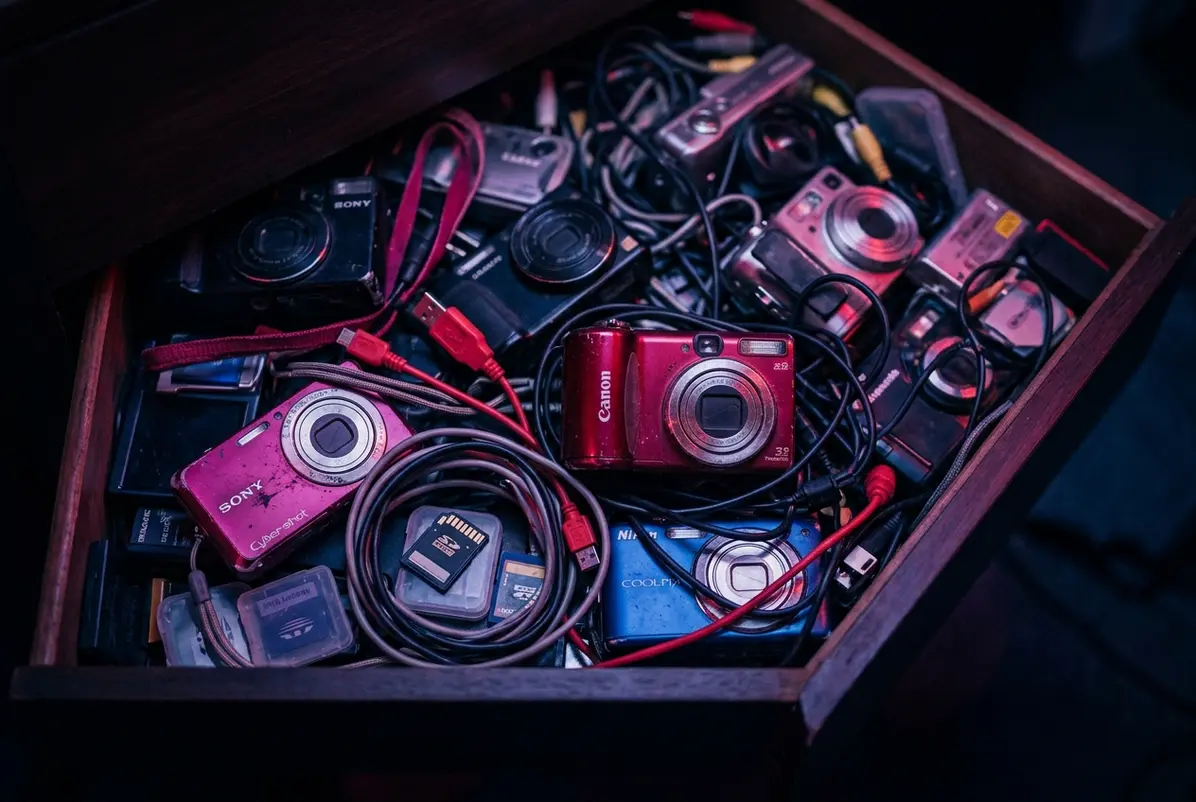
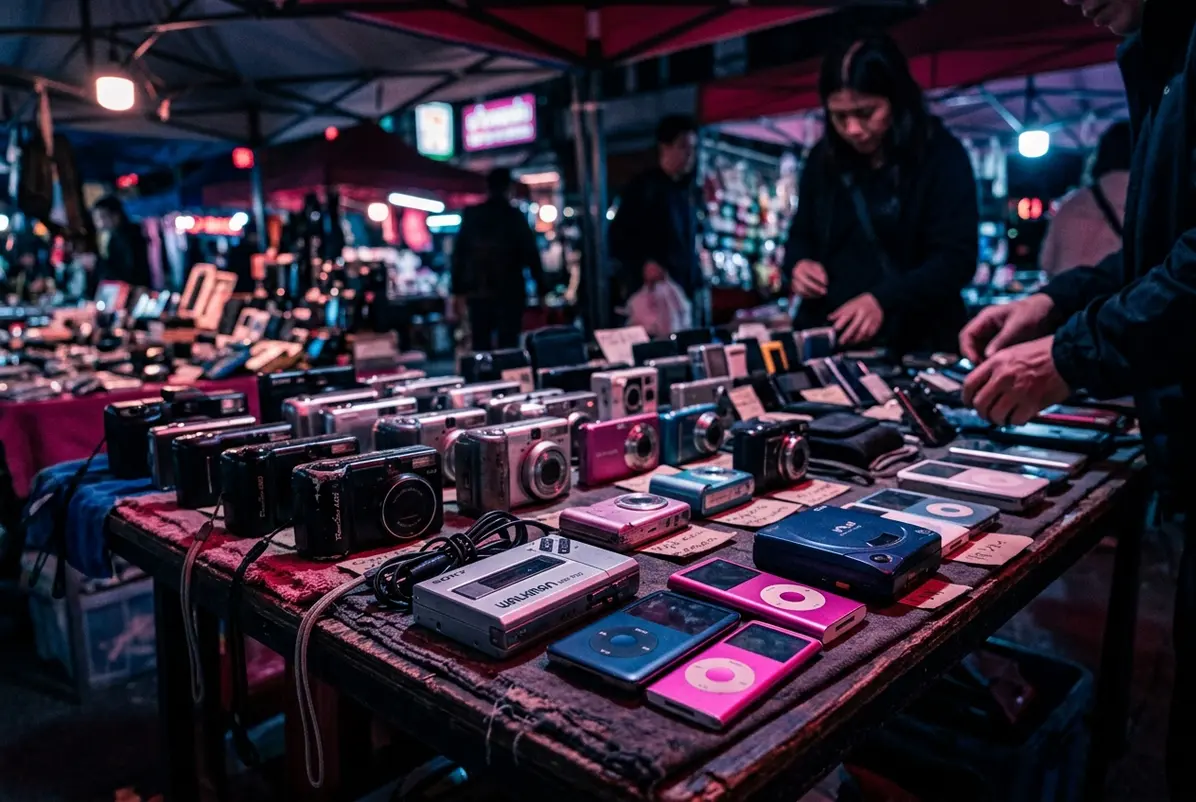
For years, the little silver digital camera was something to find at the back of a drawer, usually beside a dead battery and a cable nobody could identify. Now those same cameras are appearing at parties, concerts and festivals, producing photographs that look nothing like the carefully processed images coming out of modern smartphones.
The digicam revival has turned yesterday’s ordinary consumer electronics into sought-after objects. Under the Y2K label, compact cameras from the 2000s and sometimes well into the 2010s are being bought for their direct flash, imperfect color, modest resolution and the experience of carrying a camera that does little besides take pictures. The attraction isn’t necessarily better photography. It’s a different kind of photograph, produced by hardware that was never designed to be nostalgic.
What Is a Digicam, Anyway?
Digicam is simply shorthand for digital camera, although its contemporary use usually refers to older compact point-and-shoot models. The term Y2K camera is even looser. As Amateur Photographer explains, the label originally points toward the turn of the millennium, but resale listings frequently stretch it across a decade or more.
That means a 2002 Canon PowerShot, a 2007 Sony Cyber-shot and a later Fujifilm FinePix might all be advertised under the same nostalgic umbrella. They don’t necessarily share a sensor, lens, storage format or image-processing system. What unites them is their place in the era before smartphones absorbed everyday photography.
These were once practical devices. They were designed for family vacations, birthday parties, school events and casual snapshots. A pocket-sized digital camera let people take dozens or hundreds of pictures without buying film or paying for processing. That convenience, rather than any distinctive aesthetic, was the original selling point.
Before the Y2K Digicam Became Nostalgic
The compact digital camera’s history predates the 2000s. Casio’s QV-10, announced in November 1994, helped establish the idea of a consumer digital camera with a built-in screen for reviewing pictures. The Digital Camera Museum describes its 320-by-240-pixel imaging system, small CCD sensor and original price of roughly $799.
Those specifications look primitive now, but the rear LCD represented an important change. A photograph could be viewed immediately, deleted and replaced without consuming another frame of film. Digital photography was becoming something ordinary consumers could operate without a computer attached to the camera.
During the following decade, companies including Canon, Sony, Olympus, Casio and Fujifilm competed to make digital cameras smaller, faster and more convenient. Megapixel counts increased, zoom lenses improved, memory cards became more practical and LCD screens grew larger. Models that had once been expensive technology gradually became everyday accessories.
Many of the cameras now celebrated for their imperfections were built during that competition to eliminate them. Manufacturers wanted cleaner images, better exposure, more accurate color and faster operation. Today’s enthusiasts are rediscovering the visual side effects of those earlier technical compromises.
What Actually Creates the Digicam Look?
The familiar Y2K photograph often has a recognizable combination of qualities: bright foreground subjects, dark backgrounds, shiny skin, harsh shadows, slightly strange color and occasional motion blur. Date stamps in red or orange can make an otherwise ordinary picture look as though it came directly from a family photo archive.
CCDs, or charge-coupled devices, are frequently credited with producing this appearance. Many older compact cameras used them, and Gear Patrol describes their characteristic color rendering and blooming highlights. But CCD is a sensor technology, not a universal vintage filter. Different cameras using CCDs can produce substantially different images.
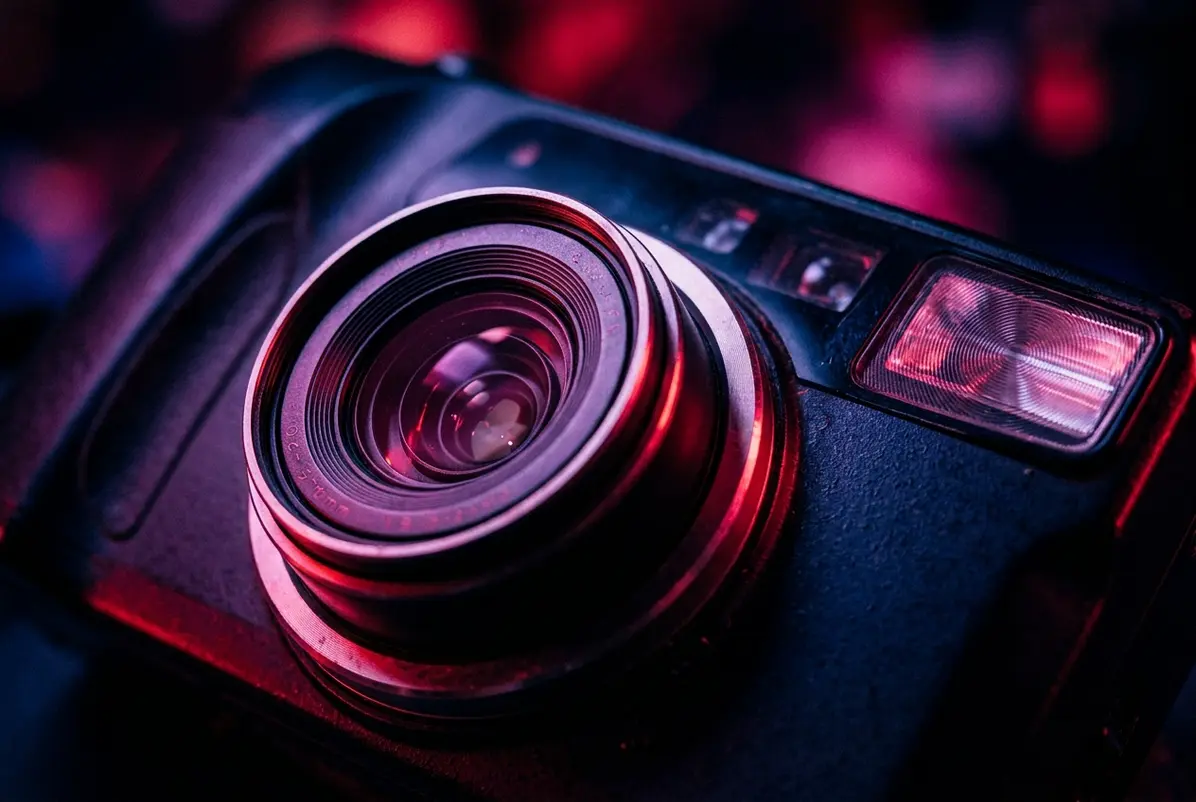
The look comes from the entire imaging system. Small sensors, lens quality, exposure metering, white balance, JPEG processing and flash behavior all matter. A compact camera that struggles with dim light may choose a slow shutter speed, introduce visible noise or fire its built-in flash directly at the subject.
That flash is especially important. Positioned close to the lens, it can brightly illuminate a face while leaving the surrounding room comparatively dark. The effect is familiar from countless birthday parties and nights out in the 2000s. It was a practical solution to inadequate available light, not a carefully designed photographic signature.
Modern smartphones handle many of these situations differently, using computational photography to combine exposures, control noise and preserve detail. An older compact often makes a simpler decision and commits it to a JPEG. Sometimes the result is awkward. Sometimes it’s exactly the photograph someone wants.
NPR’s July 2026 reporting found younger photographers embracing the grain, blur and overexposed flash that earlier generations might have considered flaws.
Why Digicams Are Popular Again
The revival is partly about appearance, but the appeal extends beyond what the pictures look like.
A smartphone camera is attached to a messaging device, entertainment platform, navigation system and constant stream of notifications. A compact camera separates photography from all of that. It can be carried to a party, switched on for a few pictures and returned to a pocket without inviting its owner into another app.
That distinction appeared repeatedly in NPR’s interviews with digicam users. Some preferred the softer appearance of older digital photographs. Others liked being able to take pictures without becoming distracted by their phones. The camera’s limited purpose was part of the attraction.
There’s also a social quality to using a separate camera. Someone has to bring it, take it out, aim it and sometimes gather friends into the frame. The results may not be inspected until later, particularly when the camera has an inconvenient screen or when its owner simply chooses not to review every shot.
These aren’t entirely new behaviors. They’re familiar routines from the period when digital cameras were common and smartphones weren’t. The revival gives them a different meaning because using a dedicated camera is now a choice rather than a necessity.
How Much Are Old Digicams Worth?
The enthusiasm has become visible in camera sales and resale prices. In July 2026, NPR reported that Canon’s PowerShot point-and-shoot sales had increased nearly sevenfold between 2022 and 2025, according to Canon. That figure concerns the PowerShot business, not specifically the resale of early-2000s cameras, but it demonstrates renewed interest in dedicated compact photography.
Some discontinued models have also become significantly more expensive. In October 2026, PhotoWorkout cited MPB pricing data showing a Canon PowerShot G12 rising from approximately £67 in 2023 to £370. The reported increase is substantial, although the figures concern particular Canon G-series cameras rather than the entire digicam market.
The category is too varied for a single price to mean much. A basic compact from an obscure product line may remain inexpensive, while a fashionable Canon, Sony or Fujifilm model attracts considerably more attention. Condition, included accessories and whether the camera actually works can matter as much as the name on the front.
For buyers, the important distinction is between an asking price and evidence of what comparable cameras are selling for. A high-priced listing doesn’t establish that a particular model has become valuable. Nor does an expensive collector favorite necessarily take better pictures than a forgotten alternative.
The Problem With Buying Twenty-Year-Old Electronics
The romance of the digicam meets a less glamorous reality when the battery won’t charge, the lens refuses to extend or the memory card cannot be read.
These cameras are aging consumer electronics. Some require proprietary batteries or chargers, while others depend on older storage formats that may be difficult to find or incompatible with modern high-capacity cards. Even cameras that use familiar SD cards can have capacity restrictions. A card that physically fits is not necessarily one the camera can recognize.
Some models also suffered documented manufacturing problems. In October 2005, Canon acknowledged CCD failures affecting several PowerShot and Digital IXUS cameras, including the A60, A70, A75, A300 and A310. Under high-temperature or high-humidity conditions, internal wiring could become disconnected, causing missing or distorted images. Canon offered free repairs for confirmed cases at the time.
That advisory concerned specific affected models and components. It doesn’t mean every old CCD camera is destined to fail in the same way. Nevertheless, it illustrates the kind of problem that can complicate buying electronics long after their original support period.
Before purchasing, a buyer should check that the camera powers on, the lens extends and retracts, the flash fires, the screen works and photographs can actually be written to and read from a compatible memory card. Testing the zoom and reviewing images for unusual distortion can reveal problems that a clean exterior won’t.
Gear Patrol also cautions that aging components and difficult repairs are part of the vintage digital-camera experience. An inexpensive purchase can become much less appealing when it needs a proprietary accessory or a repair that costs more than another working camera.
Can New Cameras Recreate the Digicam Experience?
The revival has also created an audience for new cameras that borrow from older photographic habits without requiring buyers to maintain aging electronics.
Camp Snap began with a screen-free digital camera intended for children attending summer camps. Its design uses a simple viewfinder and removes the ability to inspect every photograph immediately after taking it. The pictures are reviewed later, after connecting the camera to another device.
Adults became an unexpectedly important audience. Camp Snap president Trevor George told NPR that demand had expanded well beyond the original summer-camp market, while the company reported that sales had more than doubled over the preceding year.
Other manufacturers are experimenting with different kinds of photographic nostalgia. Fujifilm’s X half uses a vertically oriented 1-inch sensor, a frame-advance lever and a film-inspired mode that postpones image review until a simulated roll is completed. Its references lean toward film photography rather than early digital compacts.
Yashica has taken another approach. In October 2026, the company detailed its $119 Y16 digital camera, styled after a miniature camera from the late 1950s, with shipments expected in November. Its small sensor and simple optics prioritize a particular experience over competing with modern smartphone image quality.
These products aren’t exact substitutes for a 2003 PowerShot or Cyber-shot. They borrow different pieces of photographic history: the compact body, the viewfinder, the delayed reveal, the tactile controls or the deliberately limited imaging system.
What the Digicam Revival Is Really About
There’s a peculiar reversal in watching early digital cameras become nostalgic objects. They were originally sold as the convenient future of photography, freeing people from film processing and making photographs immediately available. Now they’re desirable partly because they feel less immediate than the devices that replaced them.
The technology hasn’t improved with age. Batteries have deteriorated, storage formats have become awkward and the image quality remains limited by the hardware. What has changed is the photographic environment around them.
A camera that once seemed ordinary now produces images noticeably different from the smartphone default. Its flash can be unforgiving, its exposure unpredictable and its files small enough to reveal the compromises of another technological era. For some photographers, those qualities are worth seeking out.
Perhaps the most interesting part of the revival is that the digicam doesn’t have to pretend to be analog. It belongs to digital photography’s own past, when a camera was still a separate object and every manufacturer was trying to figure out what a digital snapshot should look like. The pictures survived long enough for a new generation to decide that some of those supposedly obsolete answers were worth keeping.
Digicam FAQ
What is a CCD sensor?
A charge-coupled device, or CCD, is an image-sensor technology used in many early digital cameras. CCDs convert incoming light into electrical signals that can be processed into photographs. Some photographers associate older CCD cameras with distinctive color and highlight rendering, but the final image also depends on the lens, exposure system and camera processing. Gear Patrol discusses the appeal and limitations of older CCD cameras.
Is a Y2K camera worth buying?
A working older compact can be an enjoyable way to experiment with direct flash, early digital color and a simpler photographic routine. Amateur Photographer recommends paying attention to memory-card compatibility and the practical condition of older cameras. The best purchase isn’t necessarily the most fashionable model; it’s one that works reliably and produces pictures the buyer likes.
How much does a digicam cost?
Prices vary considerably by model, condition and demand. Reclaim’s August 2026 resale guide lists indicative ranges of $65–$115 for working Canon PowerShots, $125–$255 for Canon ELPH models and $30–$60 for Fujifilm FinePix cameras. These broad categories contain many different models, and the quoted ranges shouldn’t be treated as guaranteed completed-sale prices. Compare recent sales of the exact model and account for missing batteries, chargers and memory cards.
Do old digicams still break?
Yes. Lens mechanisms, buttons, batteries, screens and image sensors can fail with age. Canon’s 2005 CCD advisory documented a specific defect in several older models, while other failures depend on the individual camera and its history. A camera should be tested through a complete shooting and playback cycle before purchase whenever possible.
Frequently asked questions
What is a digicam?
Digicam is shorthand for digital camera. Today it usually refers to older compact point-and-shoot models from the 2000s and sometimes the 2010s, such as Canon PowerShot, Sony Cyber-shot and Fujifilm FinePix cameras, sold under the loose Y2K camera label.
What creates the Y2K digicam look?
The look comes from the whole imaging system: small sensors, often CCDs, simple lenses, basic exposure metering, white balance, JPEG processing and a direct flash close to the lens. Together they produce bright subjects, dark backgrounds, harsh shadows, odd color and occasional motion blur.
Why are digicams popular again?
Younger photographers like the grain, blur and overexposed flash that smartphones process away. Many also value a device that only takes pictures, letting them shoot at parties or concerts without being pulled into notifications and apps.
How much are old digicams worth?
Prices vary by model, condition and demand. One August 2026 resale guide listed roughly $65 to $115 for working Canon PowerShots, $125 to $255 for Canon ELPH models and $30 to $60 for Fujifilm FinePix cameras. Compare recent completed sales of the exact model rather than asking prices.
What should I check before buying a used digicam?
Confirm the camera powers on, the lens extends and retracts, the flash fires, the screen works and images can be written to and read from a compatible memory card. Check for proprietary batteries or chargers and test the zoom for distortion.
Are there new cameras that recreate the digicam experience?
Yes. Camp Snap makes a screen-free digital camera, Fujifilm's X half delays image review in a film-inspired mode, and Yashica's $119 Y16 uses a small sensor and simple optics. None exactly replicates a 2000s compact, but each borrows parts of that experience.


'%3e%3cg id='Final-Copy-2_2_' transform='translate(1275.000000, 200.000000)'%3e%3cpath class='st0' d='M7.4,12.8h6.8l3.1-11.6H7.4C4.2,1.2,1.6,3.8,1.6,7S4.2,12.8,7.4,12.8z'/%3e%3c/g%3e%3c/g%3e%3c/g%3e%3cg id='final---dec.11-2020'%3e%3cg id='_x30_208-our-toggle' transform='translate(-1275.000000, -200.000000)'%3e%3cg id='Final-Copy-2' transform='translate(1275.000000, 200.000000)'%3e%3cpath class='st1' d='M22.6,0H7.4c-3.9,0-7,3.1-7,7s3.1,7,7,7h15.2c3.9,0,7-3.1,7-7S26.4,0,22.6,0z M1.6,7c0-3.2,2.6-5.8,5.8-5.8 h9.9l-3.1,11.6H7.4C4.2,12.8,1.6,10.2,1.6,7z'/%3e%3cpath id='x' class='st2' d='M24.6,4c0.2,0.2,0.2,0.6,0,0.8l0,0L22.5,7l2.2,2.2c0.2,0.2,0.2,0.6,0,0.8c-0.2,0.2-0.6,0.2-0.8,0 l0,0l-2.2-2.2L19.5,10c-0.2,0.2-0.6,0.2-0.8,0c-0.2-0.2-0.2-0.6,0-0.8l0,0L20.8,7l-2.2-2.2c-0.2-0.2-0.2-0.6,0-0.8 c0.2-0.2,0.6-0.2,0.8,0l0,0l2.2,2.2L23.8,4C24,3.8,24.4,3.8,24.6,4z'/%3e%3cpath id='y' class='st3' d='M12.7,4.1c0.2,0.2,0.3,0.6,0.1,0.8l0,0L8.6,9.8C8.5,9.9,8.4,10,8.3,10c-0.2,0.1-0.5,0.1-0.7-0.1l0,0 L5.4,7.7c-0.2-0.2-0.2-0.6,0-0.8c0.2-0.2,0.6-0.2,0.8,0l0,0L8,8.6l3.8-4.5C12,3.9,12.4,3.9,12.7,4.1z'/%3e%3c/g%3e%3c/g%3e%3c/g%3e%3c/g%3e%3c/svg%3e) Your Privacy Choices