



In December 1957, Yoshihiro Tatsumi gave a name to a kind of Japanese comic that was already finding its audience. He called it gekiga, or “dramatic pictures,” using the term on the title page of Yūrei Taxi in issue 12 of Machi. The name helped distinguish darker, more cinematic stories from the manga associated with children’s entertainment. But Tatsumi hadn’t created that audience from nothing. Much of it was already paying to borrow comics from Japan’s rental bookshops.
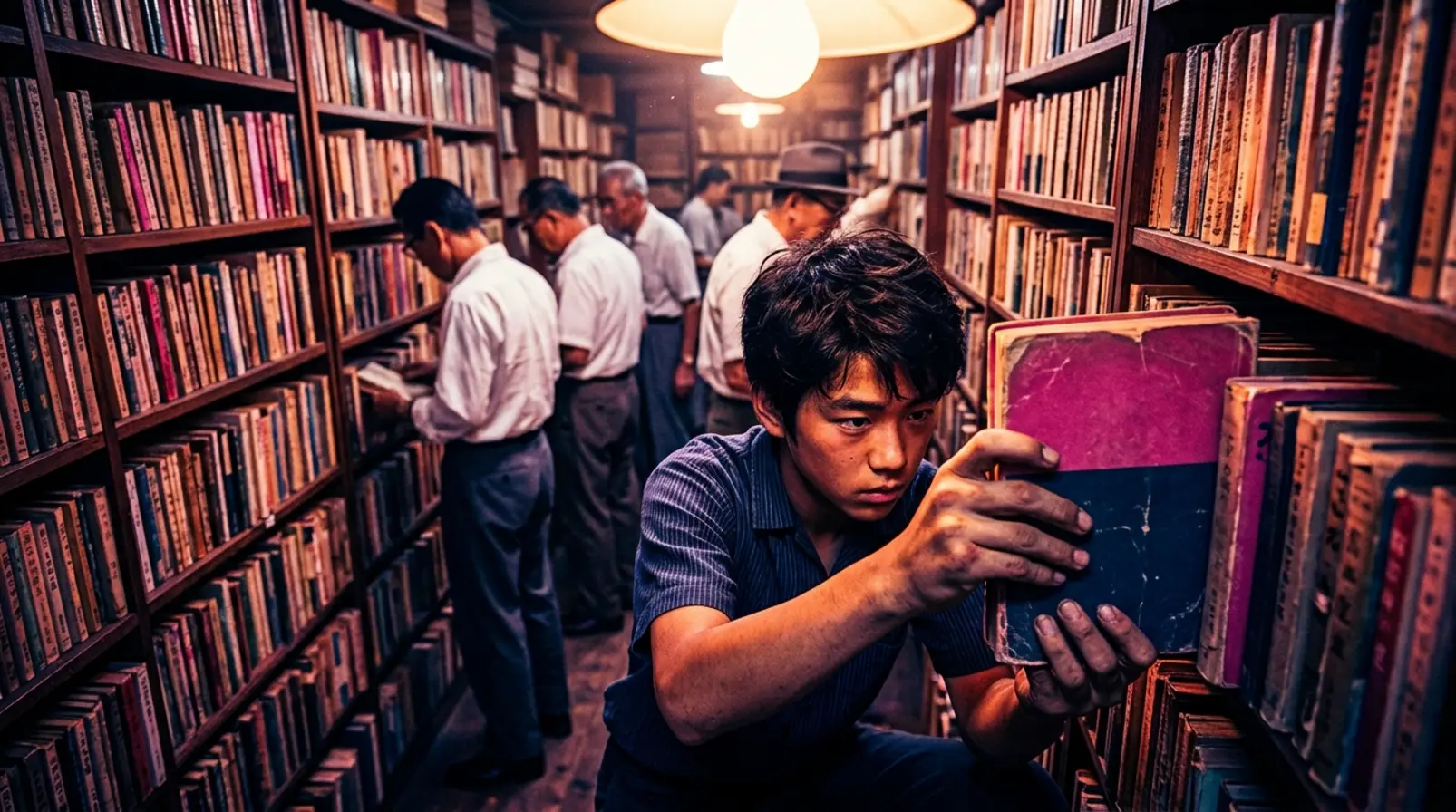
These shops were called kashihon-ya. They served readers who couldn’t necessarily afford to buy every book they wanted, including teenagers who worked in factories and had their own money to spend. Their shelves carried mysteries, crime stories, ghost tales, and comics about people living far from the comfortable worlds of children’s magazines. Gekiga emerged from this peculiar economy: an ambitious new approach to comics, supported by an inexpensive and thoroughly ordinary way of getting them into readers’ hands.
Gekiga’s Readers Were Renting Before the Word Existed
Rental bookshops had existed in Japan for centuries, but the business expanded rapidly after World War II. Books were expensive, money was scarce, and borrowing offered access to entertainment without the cost of ownership. A Japanese government account estimates that the country’s rental bookstores numbered approximately 30,000 at their peak during the manga boom of the 1950s.
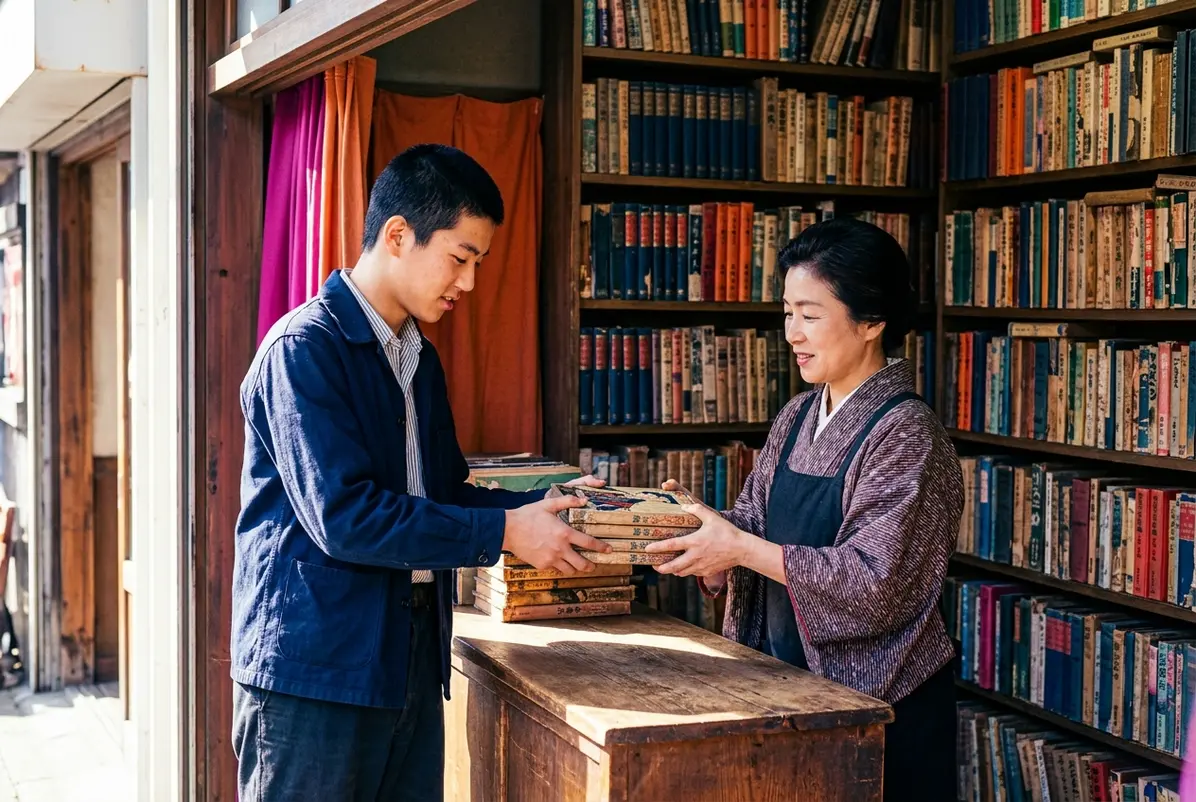
By 1953, publishers were producing manga specifically for this market. Many appeared as anthologies containing stories by several artists, bound in sturdy hardcover volumes designed to survive repeated circulation. A book might pass through dozens of hands before its covers finally gave out.
The geography of the shops mattered. In a 2023 Zoom Japan account, Shinzo Takano, a former editor of the alternative manga magazine Garo, recalled concentrations of rental shops in Tokyo’s working-class districts, particularly Shinagawa and Ota, where small factories employed young workers. Teenagers of 16 and 17 sometimes borrowed five or six books at once.
These were not necessarily adults, but neither were they the small children around whom much of the conventional manga business was organized. Some were already working for wages, and the stories available to them could reflect a harsher world of poverty, violence, disappointment, and social exclusion.
The rental system also had a modest social infrastructure. According to Takano, some comics printed readers’ addresses in correspondence columns, allowing fans to contact one another and their favorite artists. Rental books could circulate through sweet shops, barbershops, and stationery stores as well as dedicated bookshops. Manga culture was developing in places that did not look much like the offices of major publishers.
The Comics Were Changing Before Tatsumi Named Them
The distinction between manga and gekiga was never simply a matter of whether a story contained violence or addressed adults. Artists were experimenting with pacing, composition, suspense, and psychological tension. Cinema offered a particularly useful vocabulary. A sequence could linger on a face, cut to an empty street, or stretch a moment of hesitation across several panels. The action did not always need to be explained through dialogue.
The rental market had already made room for such experiments. In April 1956, the anthology Kage appeared with detective stories by Tatsumi and other artists. Researcher Roman Rosenbaum discusses its importance in Tatsumi’s development, including the influence of Masahiko Matsumoto’s work on his drawing style.
Matsumoto was also searching for a different identity for his comics. In September 1956, he was using the term komaga, rather than manga, to describe his work. His terminology was not identical to Tatsumi’s later gekiga, but it demonstrates that the desire to distinguish these stories from established manga conventions was not confined to one artist.
Tatsumi’s ambition was explicit. In an interview with The Comics Journal, he said, “I did want to create an older audience.” The rental business complicates that statement in an interesting way. Older readers were already there. What artists such as Tatsumi and Matsumoto were developing was a language of comics that could address them more deliberately.
It was not a clean break with everything that came before. Rental manga encompassed multiple genres, styles, and levels of craftsmanship. Nor did every artist working toward more dramatic storytelling share the same ambitions. Gekiga emerged from that variety rather than replacing it overnight.
The Gekiga Workshop Took Its Name to the Trade
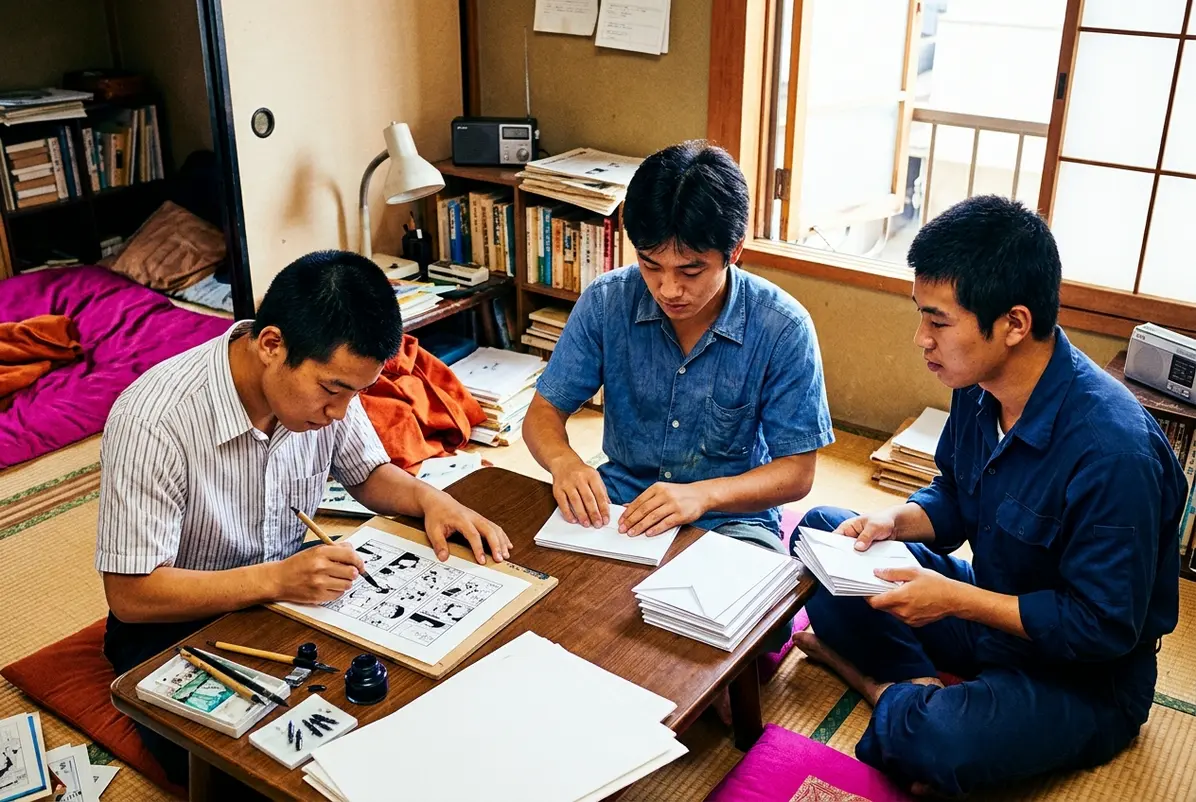
In 1959, Tatsumi, Matsumoto, Takao Saito, and five other artists formed the Gekiga Kōbō, usually translated as the Gekiga Workshop or Atelier. Their collective identity made the term more than a description of individual stories. It became a way to present a recognizable artistic movement.
The group also understood that a movement needed people in the publishing business to recognize its name. According to Rosenbaum’s account, the workshop distributed its announcement on postcards to 150 editors, newspapers, publishers, and manga artists. It was a declaration of artistic independence delivered through the industry’s existing channels.
That detail gives the story a useful practical dimension. The artists weren’t merely experimenting at their drawing tables. They were trying to establish a category that publishers, critics, and fellow creators could identify. A distinctive name could help separate their work from the broader manga market, even while they depended on that market to earn a living.
The workshop lasted only about a year. Its brief existence nevertheless helped establish a vocabulary that continued to circulate long after the collective dissolved. Tatsumi’s coinage was becoming something other artists and publishers could use.
The Rental Shops Also Attracted the Wrong Kind of Attention
Not everyone welcomed the stories circulating through kashihon shops. The same accessibility that made rental manga popular with young readers made the shops targets of criticism.
A Harvard Reischauer Institute lecture abstract describes accusations from parent-teacher associations, traditional publishers, and public intellectuals, who associated rental comics with truancy, delinquency, and sexual misconduct among minors. These were accusations directed at the medium and its distribution network, not established consequences of reading the books.
The criticism was not entirely detached from the material. Rental manga could contain graphic violence, sexuality, disturbing imagery, and subjects that mainstream children’s magazines generally avoided. Some stories explored discrimination, poverty, or social marginalization. Others relied on sensationalism. The industry was large and uneven enough to contain both serious experiments and disposable entertainment.
According to Zoom Japan, restrictions on selling and lending certain publications to minors were introduced in 1959 amid campaigns against supposedly harmful books. Japan’s youth-protection rules developed through local regulatory systems, so the episode should not be mistaken for a single nationwide ban on gekiga.
What made the rental shop controversial was partly its position between commerce and parental supervision. A teenager could walk into a neighborhood business and borrow stories that might never have appeared in a children’s magazine. The shopkeeper, rather than a major magazine editor, became one of the people determining what was available.
The disputes also exposed divisions within manga itself. Takano recalled that Osamu Tezuka regarded rental manga as inferior to the children’s comics he favored, a judgment that angered artists working in the rental industry. The disagreement was about more than drawing quality. It concerned what kinds of stories manga could tell, who should read them, and whether work outside the mainstream publishing system deserved serious consideration.
The Shops Declined, but Gekiga Found Other Places to Live
The rental manga business eventually encountered a competitor it could not easily defeat: cheap comics that readers could afford to buy.
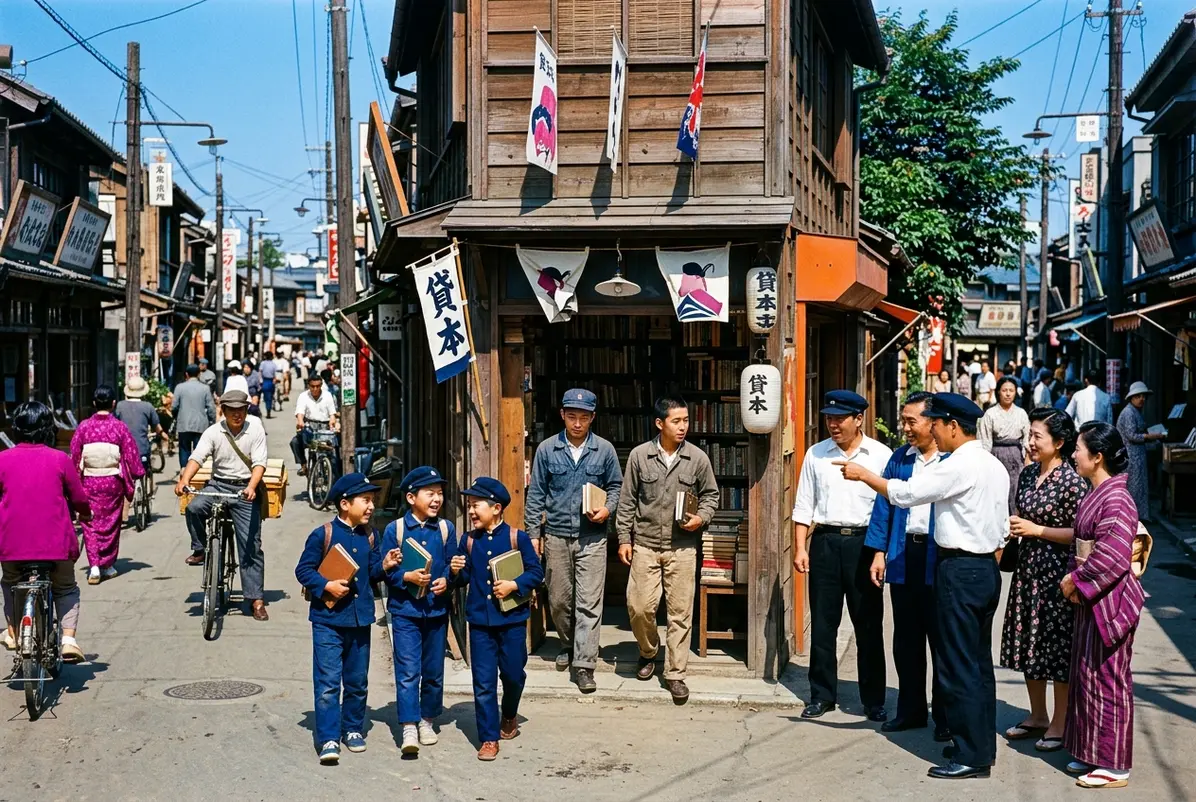
From the late 1950s onward, mainstream publishers expanded their weekly magazine offerings. Books became more affordable, public libraries grew, and the economic conditions that had made rental shops indispensable began to change. Many kashihon shops survived into the 1960s, but their numbers declined over the following decades.
For artists whose careers had developed through rental anthologies, the changing market meant finding other outlets. Gekiga was no longer tied exclusively to the shops that had helped establish it.
Founded in 1964, Garo became an important home for experimental and alternative manga, including work by artists associated with the rental-book tradition. Its readership included college students, giving these comics a different cultural setting. They could now circulate through a magazine identified with artistic experimentation rather than the inexpensive neighborhood rental trade.
The movement also affected the broader industry. In December 1967, Tezuka’s company launched COM, a magazine that Nippon.com describes as a response to Garo and the impact of Sanpei Shirato’s The Legend of Kamui. The growing prominence of these publications showed that serious, ambitious comics had become part of a larger competition for readers and artistic legitimacy.
Tatsumi continued developing his own approach, increasingly depicting ordinary people caught in humiliating jobs, sexual frustration, alienation, and the pressures of urban life. His stories were often bleak without being heroic. Their protagonists might be factory workers, laborers, or men trapped by circumstances they could barely understand, much less overcome. Rosenbaum identifies this focus on marginalized working people as a defining characteristic of Tatsumi’s mature work.
In 1968, Tatsumi published Gekiga College, documenting the movement he had helped name. By then, gekiga had traveled well beyond its original rental-book environment.
There is a temptation to tell this history as the moment Japanese comics grew up, with Tatsumi supplying the word that made adulthood possible. The actual development was less orderly. Artists experimented with new forms while publishers produced inexpensive books, shopkeepers circulated them, and working teenagers borrowed them by the armful. The name gave those experiments an identity, but the readers and the distribution network had helped make them possible.
Eventually the weekly magazines that competed with the rental shops became important homes for the kind of comics those shops had nurtured. Gekiga survived the decline of kashihon because its artistic possibilities were no longer dependent on a particular way of selling books. The rental counter disappeared from much of Japanese comics culture. The appetite it had helped reveal did not.
Frequently asked questions
What does gekiga mean?
Gekiga translates to dramatic pictures. Yoshihiro Tatsumi used the term to separate darker, more cinematic comics from the manga associated with children's entertainment.
Who coined the term gekiga?
Yoshihiro Tatsumi coined it in December 1957, using it on the title page of Yūrei Taxi in issue 12 of the rental anthology Machi.
What were kashihon rental shops?
Kashihon-ya were rental bookshops where readers paid to borrow books and comics. They expanded after World War II and numbered about 30,000 at their 1950s peak, serving readers such as working teenagers who could not buy every book.
What was the Gekiga Workshop?
The Gekiga Kōbō was a 1959 collective of eight artists, including Tatsumi, Masahiko Matsumoto, and Takao Saito. It mailed its announcement to 150 editors, publishers, newspapers, and artists, and lasted about a year.
How is gekiga different from manga?
Gekiga is a strand within Japanese comics rather than a separate medium. It favored cinematic pacing, psychological tension, and stories about poverty, violence, and alienation, aimed at older readers rather than children.
Why did rental manga shops decline?
From the late 1950s, publishers expanded cheap weekly magazines, books became more affordable, and public libraries grew. Many kashihon shops survived into the 1960s but declined over the following decades.



'%3e%3cg id='Final-Copy-2_2_' transform='translate(1275.000000, 200.000000)'%3e%3cpath class='st0' d='M7.4,12.8h6.8l3.1-11.6H7.4C4.2,1.2,1.6,3.8,1.6,7S4.2,12.8,7.4,12.8z'/%3e%3c/g%3e%3c/g%3e%3c/g%3e%3cg id='final---dec.11-2020'%3e%3cg id='_x30_208-our-toggle' transform='translate(-1275.000000, -200.000000)'%3e%3cg id='Final-Copy-2' transform='translate(1275.000000, 200.000000)'%3e%3cpath class='st1' d='M22.6,0H7.4c-3.9,0-7,3.1-7,7s3.1,7,7,7h15.2c3.9,0,7-3.1,7-7S26.4,0,22.6,0z M1.6,7c0-3.2,2.6-5.8,5.8-5.8 h9.9l-3.1,11.6H7.4C4.2,12.8,1.6,10.2,1.6,7z'/%3e%3cpath id='x' class='st2' d='M24.6,4c0.2,0.2,0.2,0.6,0,0.8l0,0L22.5,7l2.2,2.2c0.2,0.2,0.2,0.6,0,0.8c-0.2,0.2-0.6,0.2-0.8,0 l0,0l-2.2-2.2L19.5,10c-0.2,0.2-0.6,0.2-0.8,0c-0.2-0.2-0.2-0.6,0-0.8l0,0L20.8,7l-2.2-2.2c-0.2-0.2-0.2-0.6,0-0.8 c0.2-0.2,0.6-0.2,0.8,0l0,0l2.2,2.2L23.8,4C24,3.8,24.4,3.8,24.6,4z'/%3e%3cpath id='y' class='st3' d='M12.7,4.1c0.2,0.2,0.3,0.6,0.1,0.8l0,0L8.6,9.8C8.5,9.9,8.4,10,8.3,10c-0.2,0.1-0.5,0.1-0.7-0.1l0,0 L5.4,7.7c-0.2-0.2-0.2-0.6,0-0.8c0.2-0.2,0.6-0.2,0.8,0l0,0L8,8.6l3.8-4.5C12,3.9,12.4,3.9,12.7,4.1z'/%3e%3c/g%3e%3c/g%3e%3c/g%3e%3c/g%3e%3c/svg%3e) Your Privacy Choices