


Vinyl has a funny way of turning a simple pleasure into a technical education. Someone buys a record because they love the music, then discovers they need to understand tracking force, cartridge alignment, phono preamps, and why a $400 turntable might still need hundreds more in equipment before it makes a sound.
And then there’s the ritual. The careful placement of the needle, the faint noise before the music starts, the satisfaction of owning something mechanical in an increasingly invisible digital world. It’s part of vinyl’s appeal. It’s also a lot to ask of someone who just wants to hear an album.
That’s what makes the Audio-Technica AT-LP70X interesting. At $249, it handles the tonearm automatically, includes a phono preamp, and allows meaningful stylus upgrades later. Meanwhile, the identically priced U-Turn Orbit Basic asks its owner to do nearly everything manually, and reviewers have praised its sound.
Both are legitimate ways into vinyl. But they represent two different ideas of what owning a record player should feel like.
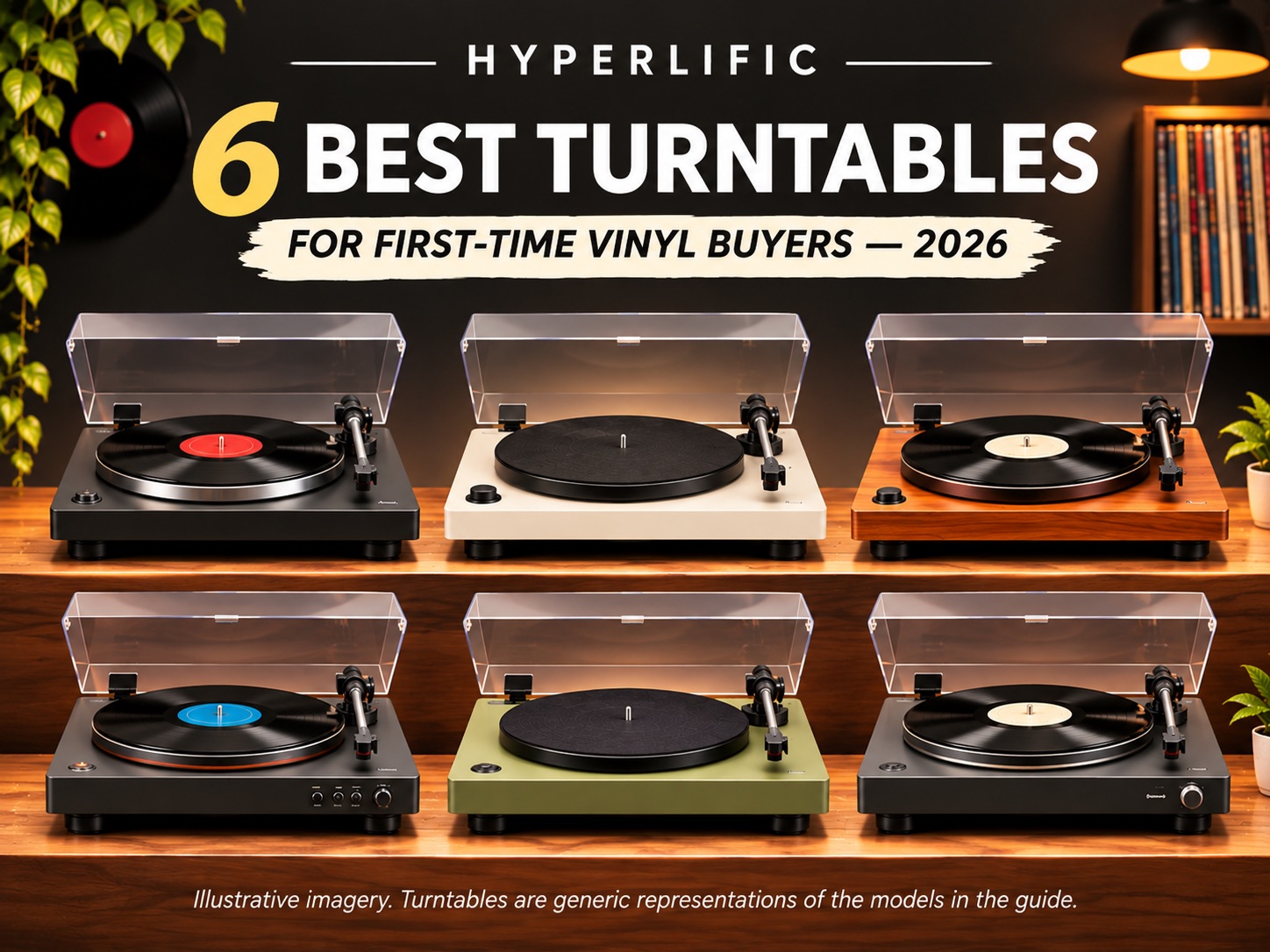
These six turntables, all starting under $400, show where the money goes, what convenience costs, and which compromises are worth making on a first setup.
Editorial disclosure: Hyperlific has not independently tested these turntables. Recommendations are based on manufacturer specifications, prices checked on November 14, 2026, and published reviews. Prices and availability may change.
The Best Beginner Turntables at a Glance
- Best overall: Audio-Technica AT-LP70X — $249. Fully automatic, with a built-in phono preamp and an unusually useful stylus upgrade path.
- Best for sound-focused buyers: U-Turn Orbit Basic — $249. A straightforward manual turntable with strong published listening reviews.
- Best for learning and upgrading: Fluance RT82 — $349.99. Adjustable tonearm settings, an Ortofon cartridge, and automatic stop.
- Best for Bluetooth: Sony PS-LX3BT — $399.99. Automatic playback, wireless connectivity, and computer recording capability on the U.S. model.
- Best upgraded manual turntable: U-Turn Orbit Plus — $399. An acrylic platter and elliptical stylus for buyers who prefer the Orbit’s hands-on approach.
- Best under $200: Audio-Technica AT-LP60X — $179. An inexpensive, uncomplicated entry into vinyl with automatic operation.
How the Picks Were Chosen
Turntable specifications can make fairly ordinary equipment sound exotic. Magnesium tonearms, servo-controlled motors, elliptical diamonds, and anti-resonance platters all have legitimate purposes, but they don’t necessarily tell a first-time buyer which machine will be easiest to live with.
The priority here is a turntable that performs its basic job properly, suits the owner’s existing equipment, and doesn’t demand an immediate replacement when that owner becomes more interested in the hobby.
- Price: Each turntable starts at $400 or less, using manufacturer or retailer prices checked on November 14, 2026. Optional accessories and other audio equipment are separate.
- Ease of use: Automatic operation, straightforward setup, a cue lever, and a built-in phono preamp all count in a beginner’s favor.
- Record care: A properly designed tonearm, suitable tracking force, and a replaceable stylus matter more than decorative features.
- Upgradeability: Some turntables accept improved styluses. Others allow the entire cartridge to be changed and the tonearm adjusted accordingly.
- Published reviews: Listening impressions from established reviewers supplement manufacturer specifications. They are attributed rather than presented as Hyperlific’s own testing.
The rankings favor a first-time buyer’s experience. They are not a claim that the first turntable will outperform the sixth in every listening system.
The 6 Best Turntables for First-Time Vinyl Buyers
1. Audio-Technica AT-LP70X — Best Overall
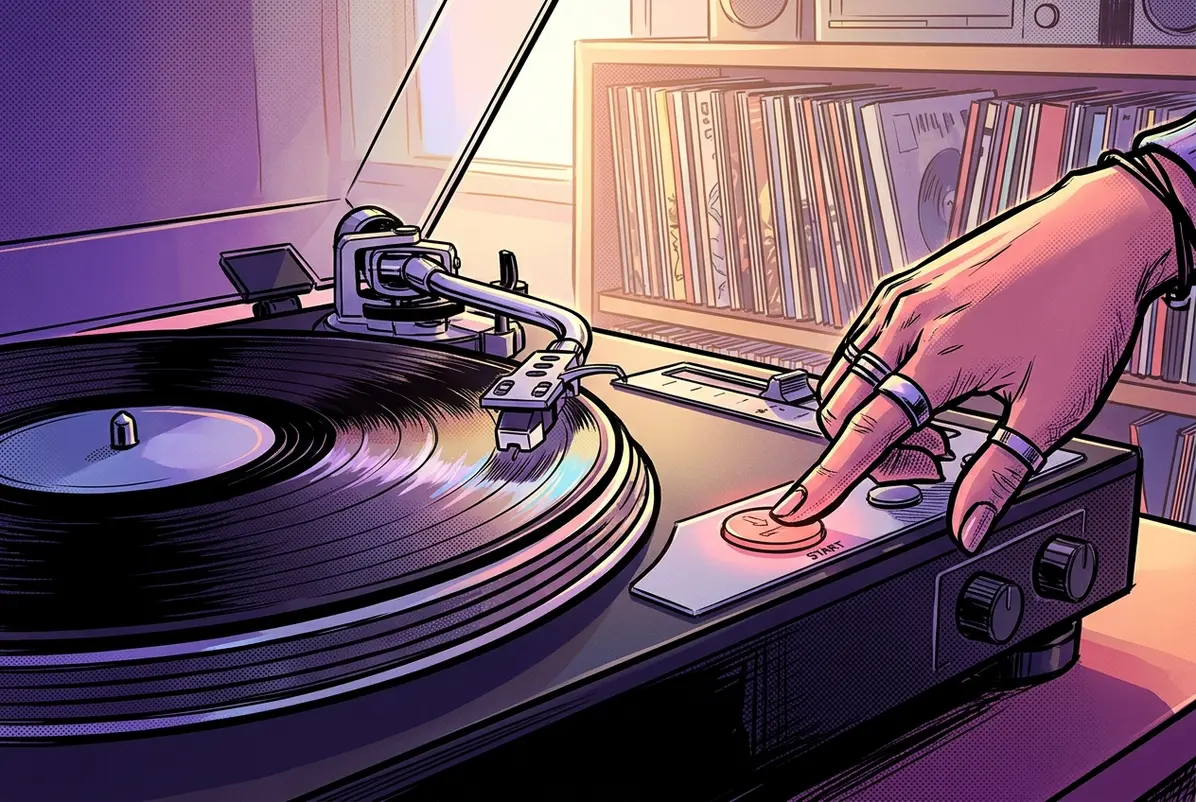
The Audio-Technica AT-LP70X removes much of the work from playing a record. It is a fully automatic belt-drive turntable with selectable 33 1/3 and 45 rpm speeds. Press start and the tonearm moves into position, lowers the stylus, and returns when the record finishes.
There’s also a built-in switchable phono preamp, which means it can connect directly to powered speakers or a suitable line-level input. For someone building a first setup, that’s one less box, one less cable arrangement, and one less purchase to figure out.
The more interesting engineering decision is its cartridge. Audio-Technica uses an integrated AT-VM95C moving-magnet cartridge body, but the stylus is replaceable. Better still, the company specifies compatibility with the wider VM95 stylus family, including elliptical, MicroLine, and Shibata options.
That means an owner can experiment with more sophisticated stylus profiles without replacing the entire cartridge or learning cartridge alignment. The limitation is that the cartridge body itself is fixed. Someone who eventually wants to experiment with different cartridge manufacturers will need another turntable.
Digital Trends chose the AT-LP70X as its best budget turntable, while noting its largely plastic construction and non-adjustable feet. Engadget and Louder have also recommended its Bluetooth-equipped sibling, the AT-LP70XBT. Those are related machines, although reviews of the Bluetooth version should not be mistaken for separate tests of the standard LP70X.
- Price: From $249.
- Best for: Someone who wants to press a button and listen without learning tonearm setup.
- Pros: Fully automatic; built-in switchable phono preamp; extensive VM95 stylus compatibility.
- Cons: Fixed cartridge body; limited adjustments; predominantly plastic construction.
Verdict: The AT-LP70X is the easiest recommendation because it handles the everyday details without making future stylus upgrades unnecessarily difficult. For most beginners, that’s a better starting point than an elaborate list of adjustments they may never use.
2. U-Turn Orbit Basic — Best for Sound-Focused Buyers
The U-Turn Orbit Basic is almost the philosophical opposite of the Audio-Technica. It is a fully manual belt-drive turntable assembled in Woburn, Massachusetts, with an Audio-Technica AT91B cartridge, an MDF platter, and a three-year warranty.
There is no automatic tonearm movement. No automatic stop. Even changing from 33 1/3 to 45 rpm means physically moving the drive belt between pulley grooves.
The cue lever is sold separately, which is an especially relevant omission for beginners. Without it, lowering the stylus requires a steady hand. An inexperienced owner can learn to do that, but it’s an odd place to save money on a product aimed partly at people purchasing their first turntable.
What the Orbit does offer is a serious approach to its playback hardware. Its current OA3 tonearm features a one-piece magnesium armtube, internal anti-skate, and an adjustable counterweight. The AT91B cartridge arrives preinstalled and ready for normal setup.
Engadget ranked the Orbit Basic as its runner-up beginner turntable and judged its audio performance especially highly among the models it tested at that price. That’s useful independent support for the Orbit, rather than simply assuming that manual operation produces better sound.
- Price: $249 from U-Turn Audio; the built-in preamp is an extra-cost option.
- Best for: Buyers who value a traditional manual turntable and already have suitable audio equipment.
- Pros: Strong published sound review; adjustable counterweight; replaceable cartridge; three-year warranty.
- Cons: No automatic stop; manual speed changes; cue lever sold separately; phono preamp optional.
Verdict: At the same price as the LP70X, the Orbit Basic puts its emphasis somewhere else. It rewards someone who likes operating a machine. The Audio-Technica makes more sense for someone who simply wants the machine to work.
3. Fluance RT82 — Best for Learning and Upgrading
The Fluance RT82 offers something the cheaper automatic turntables largely avoid: responsibility.
Its tonearm has an adjustable counterweight and anti-skate control, allowing the owner to set tracking force and compensate for the sideways force acting on the stylus during playback. It comes with an Ortofon OM 10 cartridge featuring an elliptical stylus, a cue lever, and an aluminum platter.
These controls become valuable when changing cartridges or learning how the mechanical parts of a turntable work together. They also mean the owner needs to pay attention to setup instructions. More adjustability is useful only when the adjustments are made correctly.
The RT82 is manually cued but includes an auto-stop function. An owner still places the stylus on the record, but the platter can stop turning after a side finishes.
Fluance’s servo-controlled motor is designed to regulate platter speed, and the manufacturer specifies wow and flutter at 0.07 percent. That figure describes a form of short-term speed variation; it is a published manufacturer specification rather than a measurement independently made for this article.
The biggest practical omission is the phono preamp. The RT82 does not include one, so buyers need a separate phono stage or an amplifier with a compatible phono input.
- Price: $349.99 from Fluance.
- Best for: Buyers who want to learn tonearm setup and potentially experiment with cartridges.
- Pros: Ortofon OM 10 cartridge; adjustable counterweight and anti-skate; cue lever; auto-stop; two-year warranty.
- Cons: No built-in phono preamp; manual cueing; greater setup responsibility.
Verdict: The RT82 is an appealing first step into traditional hi-fi equipment. Its adjustments give a curious owner more to work with, but buyers should budget for the phono preamp before treating $349.99 as the final price.

4. Sony PS-LX3BT — Best for Bluetooth
The Sony PS-LX3BT addresses a different problem: what if someone already owns a perfectly good Bluetooth speaker or pair of headphones and doesn’t want to build a traditional stereo system around a turntable?
Sony’s answer is a fully automatic belt-drive deck with Bluetooth transmission, a switchable built-in phono preamp, and conventional wired audio output. It supports 33 1/3 and 45 rpm playback and offers selectable output gain.
The wireless connection supports SBC, aptX, and aptX Adaptive codecs, subject to compatibility with the receiving device. It’s convenient, although Bluetooth playback involves digital encoding rather than a continuous analog signal path.
The documented U.S. model also supports recording records to a computer over USB. Sony’s U.S. support documentation explains the process, which requires third-party recording software. Buyers should check regional specifications, since Sony’s UK documentation and some reviews list different USB capabilities.
What Hi-Fi? selected the PS-LX3BT as its beginner recommendation in its 2026 budget-turntable guide, praising its accessible operation while noting limited cartridge upgrade potential. Engadget was more cautious about its value, suggesting the Sony would be more compelling at a substantially lower price.
- Price: $399.99 regular U.S. price; promotional pricing may differ.
- Best for: Buyers who already use Bluetooth speakers or headphones.
- Pros: Fully automatic; Bluetooth connectivity; switchable phono preamp; computer recording on the documented U.S. model.
- Cons: Most expensive turntable on this list; limited cartridge upgrade options.
Verdict: The Sony makes sense when wireless convenience is a priority. Someone planning to use a conventional wired stereo, however, can spend considerably less and still get automatic playback from the LP70X.
5. U-Turn Orbit Plus — Best Upgraded Manual Turntable
The U-Turn Orbit Plus takes the Basic’s minimalist design and spends the additional money on two changes: a machined acrylic platter and an Ortofon OM5E cartridge.
The OM5E uses an elliptical diamond stylus, a different groove-contact geometry from the conical AT91B stylus supplied with the Orbit Basic. U-Turn also credits the acrylic platter with improved speed consistency and lower unwanted resonance.
These are meaningful component differences, although they shouldn’t be confused with proof that the Plus will sound better in every system. The cartridge, setup, speakers, amplification, and listening conditions all contribute to the result.
The Plus retains the OA3 tonearm, internal anti-skate, and adjustable counterweight of the Basic. It also keeps the same manual operating philosophy. There is no automatic stop, speed changes require moving the belt, and the cue lever remains an optional purchase.
Popular Science named the Orbit Plus its best-value beginner turntable in April 2025, highlighting its design and customization potential.
- Price: $399 from U-Turn Audio without the optional preamp.
- Best for: Buyers who like the Orbit Basic but want its upgraded platter and cartridge from the start.
- Pros: Machined acrylic platter; Ortofon OM5E elliptical stylus; adjustable counterweight; three-year warranty.
- Cons: Manual belt speed change; no automatic stop; cue lever sold separately; optional preamp pushes the price above $400.
Verdict: The Orbit Plus is an attractive machine, but the $150 premium over the Basic deserves consideration. It is for someone who specifically wants its upgraded components, not simply someone who assumes spending more will make vinyl more enjoyable.

First-time buyers face a choice between convenience and room to upgrade
6. Audio-Technica AT-LP60X — Best Under $200
The Audio-Technica AT-LP60X is the cheapest turntable in this guide, but it isn’t a stripped-down manual machine. It includes fully automatic operation, selectable 33 1/3 and 45 rpm playback, and a built-in switchable phono preamp.
At $179, that is a useful combination. It makes the LP60X an approachable purchase for someone who wants to find out whether collecting and listening to records will become a lasting interest.
The compromises become apparent in the tonearm and cartridge arrangement. The LP60X uses an integrated moving-magnet cartridge with preset tracking force and anti-skate. The owner cannot swap cartridge bodies or adjust those settings in the same way as on a Fluance RT82.
Its stylus is replaceable, however. Audio-Technica specifies compatible replacements, including the standard ATN3600LC and the elliptical ATN3600LE. That is enough to address ordinary stylus wear and provide a limited upgrade option.
Tom’s Guide recommended the LP60X as an inexpensive beginner option while criticizing the lightweight feel of its tonearm. Engadget favored spending more on the LP70X to provide greater room for later upgrades.
- Price: From $179.
- Best for: Someone with a firm $200 limit who wants automatic playback.
- Pros: Inexpensive; fully automatic; built-in phono preamp; replaceable stylus.
- Cons: Integrated cartridge; preset tracking force and anti-skate; narrower upgrade path than the LP70X.
Verdict: The LP60X provides a perfectly reasonable entry into vinyl for buyers with a hard budget ceiling. But the additional $70 for the LP70X buys a more flexible stylus platform, making the newer model a better long-term recommendation when the difference is affordable.
What Else Do You Need to Play Records?
Here’s where buying a first turntable can become unexpectedly expensive.
The cartridge’s electrical output is not the same as the line-level signal expected by most amplifiers and powered speakers. A phono preamp boosts that signal and applies the required equalization. Without one somewhere in the system, a conventional turntable connected to an ordinary line input will not produce proper playback.
The Audio-Technica AT-LP70X, AT-LP60X, and Sony PS-LX3BT include switchable phono preamps. The U-Turn Orbit Basic and Orbit Plus offer them as extra-cost options. The Fluance RT82 requires a separate phono stage or an amplifier equipped with a suitable phono input.
Then come the speakers. Powered speakers include their own amplification and can work with a turntable that supplies a suitable line-level signal. Passive speakers require an amplifier. Sony’s Bluetooth turntable can transmit audio to compatible wireless speakers or headphones, simplifying the arrangement for buyers who already own them.
This makes the system a more useful starting point than the turntable alone. A $249 deck connected to decent powered speakers may be a more satisfying purchase than a $399 machine that leaves no money for anything to play it through.
Automatic or Manual: Does It Actually Matter?
For convenience, absolutely. For sound quality, the answer is more complicated.
An automatic turntable moves its tonearm into place and returns it when playback finishes. It saves the owner from lowering a stylus by hand and reduces the chance of mishandling the arm during normal use.
A manual turntable requires the owner to cue the record. Models such as the Orbit Basic and Orbit Plus also require the belt to be repositioned when changing playback speeds. The Fluance RT82 is manually cued but adds an automatic platter-stop function.
Manual operation is sometimes treated as a badge of audiophile seriousness. But removing an automatic mechanism does not automatically improve the cartridge, motor, bearings, or sound. Those are separate engineering questions.
There is also nothing wrong with wanting the ritual. Carefully lowering a stylus and watching the platter turn can be part of what makes vinyl enjoyable. The mistake is assuming everyone needs to enjoy the same part of the process.
Why No Suitcase Record Players?
Suitcase-style record players are tempting because they promise an entire listening system in one inexpensive package. They are portable, self-contained, and often look more appealing than a conventional turntable connected to separate audio equipment.
Unfortunately, that convenience can involve substantial mechanical compromises.
What Hi-Fi? documented tracking force exceeding seven grams on some all-in-one players it examined and raised concerns about accelerated record wear. Louder also cautions against many inexpensive suitcase models, citing poor sound and the possibility of record damage.
That doesn’t mean every portable player destroys records. Tracking force, stylus condition, and overall design matter more than whether the case has a handle. But a conventional turntable with a documented cartridge and available replacement stylus provides a more convincing foundation for building a record collection.
So Which Turntable Should You Buy?
For most beginners, the Audio-Technica AT-LP70X at $249 offers the best balance. It’s automatic, easy to connect, and has a sensible stylus upgrade path. It doesn’t demand much from its owner beyond putting on a record and pressing start.
The U-Turn Orbit Basic is an equally interesting choice for someone who wants manual operation and values the sound performance documented in independent reviews. The Fluance RT82 offers more adjustable hardware for buyers willing to learn proper setup. The Sony PS-LX3BT makes sense when Bluetooth connectivity is the deciding factor.
The Orbit Plus is worth considering for its upgraded cartridge and platter, while the Audio-Technica AT-LP60X remains the economical option for anyone determined to stay below $200.
None of these machines can make up for poorly matched speakers, incorrect setup, or a worn-out stylus. And none requires an owner to become an audiophile to enjoy a record.
Vinyl has always demanded a little more attention than pressing play on a streaming app. How much more is entirely up to the person listening.
Frequently Asked Questions
What is the best turntable for a beginner in 2026?
The Audio-Technica AT-LP70X, starting at $249, is Hyperlific’s recommendation for most first-time buyers. It combines automatic playback, a built-in phono preamp, and compatibility with upgraded VM95 styluses. Buyers who prefer manual operation should also consider the U-Turn Orbit Basic at the same starting price.
Does a first turntable need a phono preamp?
Yes, somewhere in the playback system. The AT-LP70X, AT-LP60X, and Sony PS-LX3BT include switchable phono preamps. The U-Turn Orbit Basic and Orbit Plus offer a built-in preamp as an optional upgrade, while the Fluance RT82 requires an external phono stage or an amplifier with a suitable phono input.
Is an automatic or manual turntable better for beginners?
An automatic turntable is generally easier to use because it handles tonearm movement. Manual turntables require the owner to cue the record, although a cue lever can make this easier. Neither type guarantees better sound quality. The choice depends on how much hands-on operation the listener wants.
Are cheap suitcase record players bad for records?
Some can cause excessive wear, particularly when they use heavy tracking force and unsuitable stylus assemblies. What Hi-Fi? has documented these problems in specific all-in-one players. Not every suitcase player is necessarily harmful, but a conventional turntable with a documented cartridge and replaceable stylus is a more dependable starting point.
Frequently asked questions
What is the best turntable for a beginner in 2026?
The Audio-Technica AT-LP70X, from $249, is the best pick for most first-time buyers. It combines fully automatic playback, a built-in switchable phono preamp, and compatibility with upgraded VM95 styluses. Buyers who prefer manual operation should consider the U-Turn Orbit Basic at the same price.
Does a first turntable need a phono preamp?
Yes, somewhere in the system. The AT-LP70X, AT-LP60X, and Sony PS-LX3BT have built-in switchable preamps, the U-Turn Orbit models offer one as a paid option, and the Fluance RT82 needs an external phono stage or an amplifier with a phono input.
Is an automatic or manual turntable better for beginners?
An automatic turntable is easier because it moves the tonearm for you. Manual turntables require cueing the record by hand. Neither type guarantees better sound; the motor, cartridge, and bearings matter more than the automatic mechanism.
What is the difference between the AT-LP60X and the AT-LP70X?
Both are fully automatic with built-in phono preamps. The $179 AT-LP60X has preset tracking force and a limited stylus upgrade path, while the $249 AT-LP70X accepts the wider VM95 stylus family, including elliptical, MicroLine, and Shibata options.
Can a turntable play through Bluetooth speakers?
Yes, if it has Bluetooth built in. The Sony PS-LX3BT transmits to compatible speakers and headphones using SBC, aptX, and aptX Adaptive, though Bluetooth adds digital encoding to the signal path.
Are suitcase record players bad for records?
Some can be. What Hi-Fi? documented tracking force above seven grams on some all-in-one players, raising concerns about record wear. A conventional turntable with a documented cartridge and replaceable stylus is a safer start.



'%3e%3cg id='Final-Copy-2_2_' transform='translate(1275.000000, 200.000000)'%3e%3cpath class='st0' d='M7.4,12.8h6.8l3.1-11.6H7.4C4.2,1.2,1.6,3.8,1.6,7S4.2,12.8,7.4,12.8z'/%3e%3c/g%3e%3c/g%3e%3c/g%3e%3cg id='final---dec.11-2020'%3e%3cg id='_x30_208-our-toggle' transform='translate(-1275.000000, -200.000000)'%3e%3cg id='Final-Copy-2' transform='translate(1275.000000, 200.000000)'%3e%3cpath class='st1' d='M22.6,0H7.4c-3.9,0-7,3.1-7,7s3.1,7,7,7h15.2c3.9,0,7-3.1,7-7S26.4,0,22.6,0z M1.6,7c0-3.2,2.6-5.8,5.8-5.8 h9.9l-3.1,11.6H7.4C4.2,12.8,1.6,10.2,1.6,7z'/%3e%3cpath id='x' class='st2' d='M24.6,4c0.2,0.2,0.2,0.6,0,0.8l0,0L22.5,7l2.2,2.2c0.2,0.2,0.2,0.6,0,0.8c-0.2,0.2-0.6,0.2-0.8,0 l0,0l-2.2-2.2L19.5,10c-0.2,0.2-0.6,0.2-0.8,0c-0.2-0.2-0.2-0.6,0-0.8l0,0L20.8,7l-2.2-2.2c-0.2-0.2-0.2-0.6,0-0.8 c0.2-0.2,0.6-0.2,0.8,0l0,0l2.2,2.2L23.8,4C24,3.8,24.4,3.8,24.6,4z'/%3e%3cpath id='y' class='st3' d='M12.7,4.1c0.2,0.2,0.3,0.6,0.1,0.8l0,0L8.6,9.8C8.5,9.9,8.4,10,8.3,10c-0.2,0.1-0.5,0.1-0.7-0.1l0,0 L5.4,7.7c-0.2-0.2-0.2-0.6,0-0.8c0.2-0.2,0.6-0.2,0.8,0l0,0L8,8.6l3.8-4.5C12,3.9,12.4,3.9,12.7,4.1z'/%3e%3c/g%3e%3c/g%3e%3c/g%3e%3c/g%3e%3c/svg%3e) Your Privacy Choices