

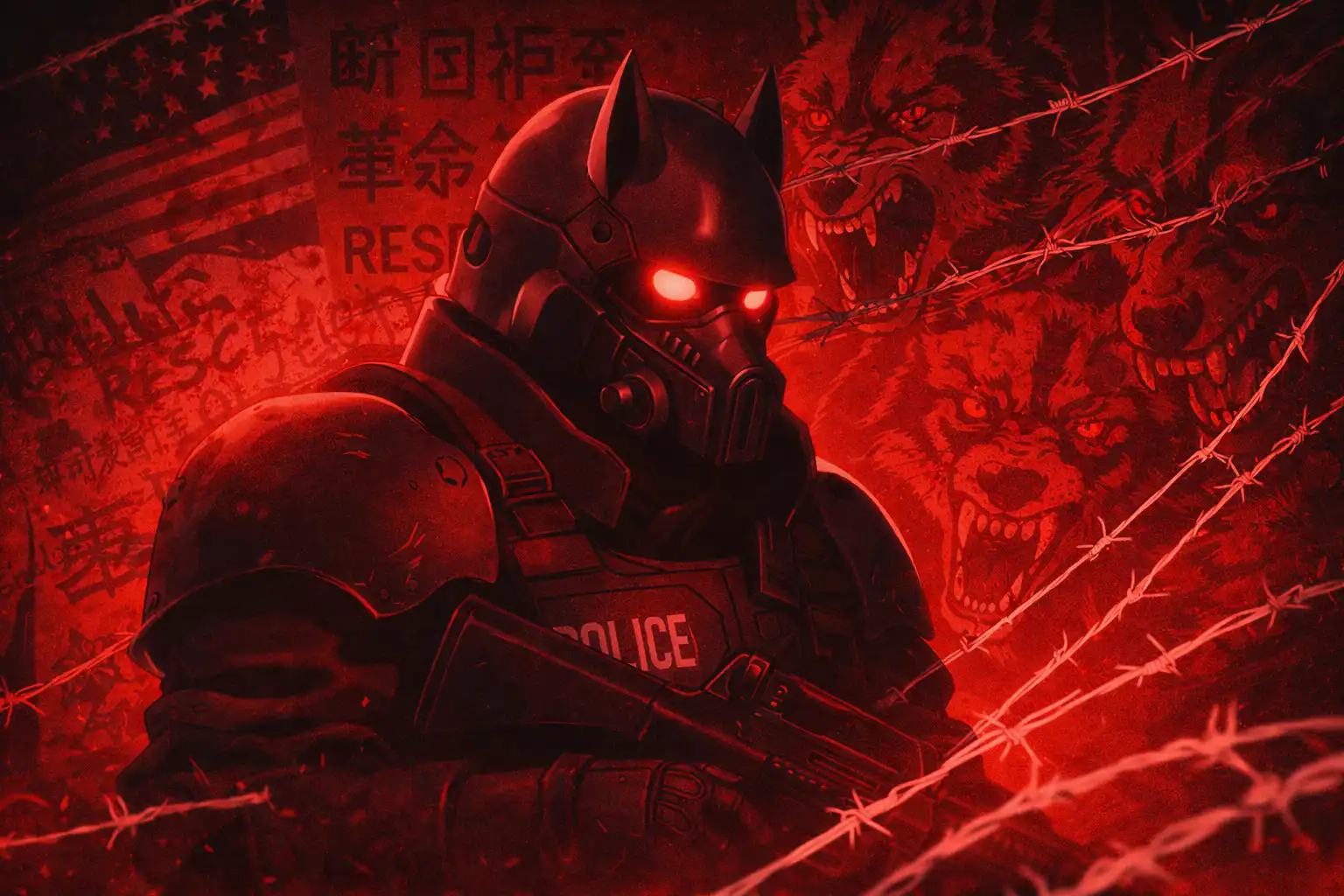

When Jin-Roh: The Wolf Brigade dropped in 1999, it landed like a shrapnel blast to the chest. —Most of us weren’t ready.
It wasn’t about mechas or schoolgirls or shōnen bravado. It was about the slow creep of authoritarianism, the death of idealism, and how a man in a metal mask can look more human than the state behind him.
In 2026, it feels uncomfortably prescient. Especially when jackbooted agents roam our streets with ICE stitched across their Kevlar. Especially when elected officials joke about annexing Greenland and call protestors —young mothers— domestic terrorists after gunning them down at point-blank range for complying with an order to move their vehicle. Watching Jin-Roh now isn’t escapism—it’s resistance.
The film, penned by Ghost in the Shell’s Mamoru Oshii and animated by Production I.G, doesn’t flinch. Its red-saturated palette bleeds into every frame. Its story—a parallel-reality Japan with echoes of Germany—forces you to ask whether the “good guys” are ever really that good.
In the film, elite paramilitary units enforce a state logic that treats civil unrest as existential threat, violently suppressing public dissent and blurring the lines between order and oppression. That narrative is eerily resonant with what’s unfolding on the ground in Minneapolis and across Minnesota right now.
Kazuki Fuse, the protagonist, is quiet, broken, loyal to a fault. And as the myth of the Red Riding Hood plays over his life, you start to see how the fairy tale was always a warning: this is not a dystopian future. This has happened and is happening. In Ireland, in Hong Kong, in Iran, and right here on suburban streets in small midwest hamlets where children used to play before the gestapo stole them away on their ride home from school.
This is essential viewing in 2026. Not because it’s pretty (although, it really is), but because it reminds you that uniforms are worn by humans, and humans can choose to stay complicit, or emerge as wolves among the sheep.
If you’re getting a hint of the Troubles but it’s hitting closer to home- it’s because this story isn’t new or old. It’s now. Good’s death — confirmed by independent autopsy to include multiple gunshot wounds — has galvanized public outrage, encouraged protests and strikes, and fueled national debates about the role and legitimacy of ICE as an institution. A Quinnipiac poll shows a majority of Americans see the shooting as unjustified, intensifying calls for dismantling oppressive enforcement structures rather than defending them.
Meanwhile, multiple stories have emerged of unwarranted, traumatic raids — including the forcible arrest of a U.S. citizen at gunpoint in his underwear and a five year old boy taken from his Preschool — illustrating a pattern of heavy‑handed tactics that evoke the sort of foggy “security state” Jin‑Roh depicts, where actions are justified in the name of protection but primarily inflict harm on communities and civil liberties.
This matters because Jin‑Roh is not just critiquing a fictional dystopia. It’s grappling with what happens when enforcement structures no longer protect society but mediate violence against the vulnerable. In Oshii and Okiura’s alternate history, paramilitary forces meant to defend national stability become instruments of control that blur justice with cruelty; dissent becomes a threat to order, and humanity gets strangled by bureaucracy and fear.

This matters because Jin‑Roh is not just critiquing a fictional dystopia. It’s grappling with what happens when enforcement structures no longer protect society but mediate violence against the vulnerable.
When Jin‑Roh was made, its subtext was a warning: trusting coercive institutions without accountability leads to systemic violence. In 2026, with ICE raids intensifying, protesters shutting down commerce, clergy and unions joining economic boycotts, and legal pushback against aggressive federal tactics, this warning feels hyper‑present — not distant.
So when you watch Jin‑Roh now, it’s not historical fiction — it’s a call to historical agency. It reminds us how authoritarian logic manifests in everyday life, how state violence is rationalized, and why cultural resistance — through art, protest, story, and community — matters.
This is the anime of our time, not a relic of a past decade.
Watch it and come to see the world we are standing idle as it is built before our eyes.

'%3e%3cg id='Final-Copy-2_2_' transform='translate(1275.000000, 200.000000)'%3e%3cpath class='st0' d='M7.4,12.8h6.8l3.1-11.6H7.4C4.2,1.2,1.6,3.8,1.6,7S4.2,12.8,7.4,12.8z'/%3e%3c/g%3e%3c/g%3e%3c/g%3e%3cg id='final---dec.11-2020'%3e%3cg id='_x30_208-our-toggle' transform='translate(-1275.000000, -200.000000)'%3e%3cg id='Final-Copy-2' transform='translate(1275.000000, 200.000000)'%3e%3cpath class='st1' d='M22.6,0H7.4c-3.9,0-7,3.1-7,7s3.1,7,7,7h15.2c3.9,0,7-3.1,7-7S26.4,0,22.6,0z M1.6,7c0-3.2,2.6-5.8,5.8-5.8 h9.9l-3.1,11.6H7.4C4.2,12.8,1.6,10.2,1.6,7z'/%3e%3cpath id='x' class='st2' d='M24.6,4c0.2,0.2,0.2,0.6,0,0.8l0,0L22.5,7l2.2,2.2c0.2,0.2,0.2,0.6,0,0.8c-0.2,0.2-0.6,0.2-0.8,0 l0,0l-2.2-2.2L19.5,10c-0.2,0.2-0.6,0.2-0.8,0c-0.2-0.2-0.2-0.6,0-0.8l0,0L20.8,7l-2.2-2.2c-0.2-0.2-0.2-0.6,0-0.8 c0.2-0.2,0.6-0.2,0.8,0l0,0l2.2,2.2L23.8,4C24,3.8,24.4,3.8,24.6,4z'/%3e%3cpath id='y' class='st3' d='M12.7,4.1c0.2,0.2,0.3,0.6,0.1,0.8l0,0L8.6,9.8C8.5,9.9,8.4,10,8.3,10c-0.2,0.1-0.5,0.1-0.7-0.1l0,0 L5.4,7.7c-0.2-0.2-0.2-0.6,0-0.8c0.2-0.2,0.6-0.2,0.8,0l0,0L8,8.6l3.8-4.5C12,3.9,12.4,3.9,12.7,4.1z'/%3e%3c/g%3e%3c/g%3e%3c/g%3e%3c/g%3e%3c/svg%3e) Your Privacy Choices
Your Privacy Choices