


A note from the editors: The originally pitched headline for this piece referenced “Corning Gorilla Shield 5” and “The Berlin Acid Etchers.” Neither exists. There is no Corning product called Gorilla Shield 5, and no identifiable Berlin-based collective known as “The Berlin Acid Etchers.” What does exist is something stranger and more interesting: a world in which the planet’s most advanced glass manufacturer and anonymous street vandals have converged on the same fundamental technique. This is that story.
The Lab and the Alley
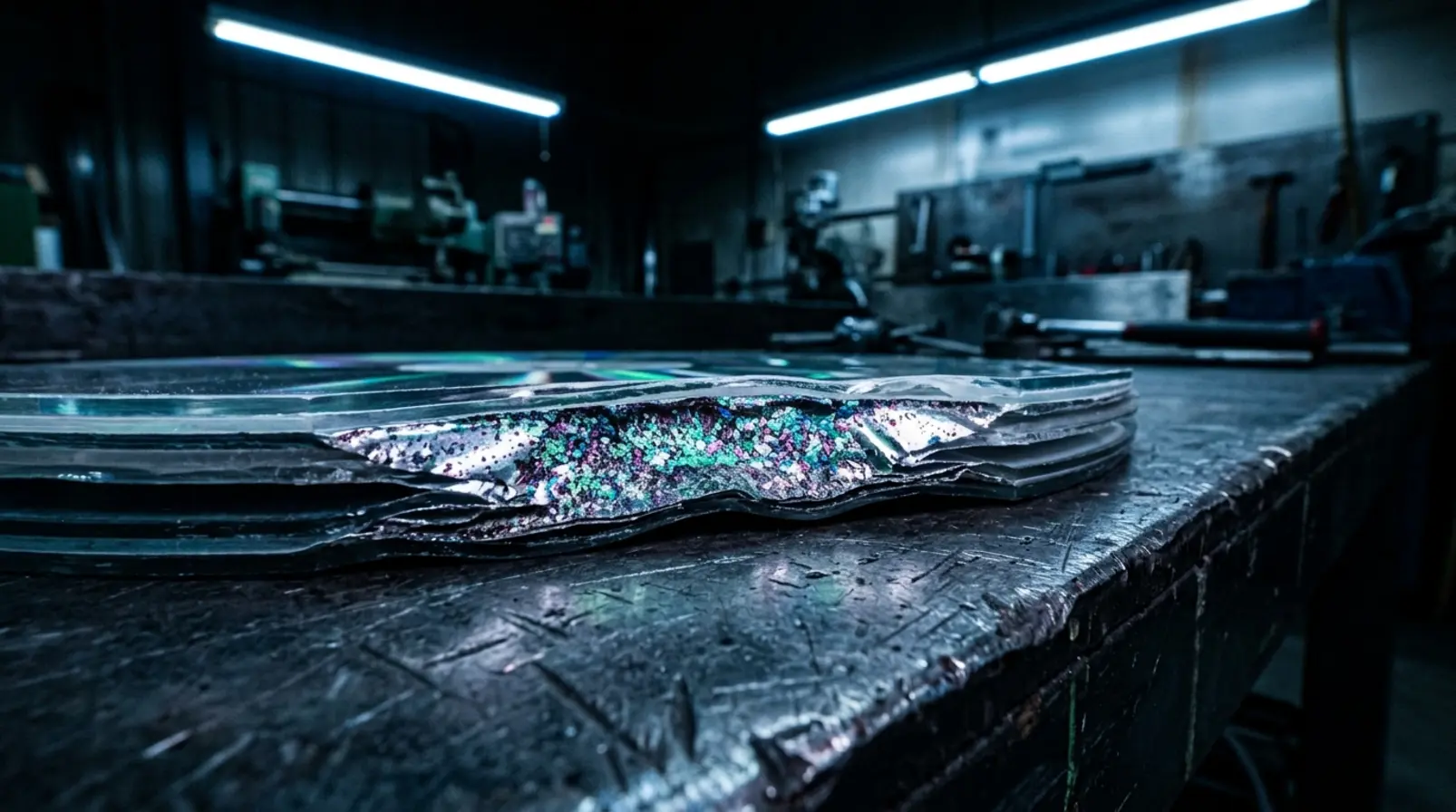
Somewhere in Corning, New York, a sheet of alkali-aluminosilicate glass sits in a controlled environment. Specialized chemistry and processes etch away microscopic bits of its surface, and exhaustive experiments and process controls help scientists consistently create tiny surface structures with the depth, width, and pitch to manipulate light to achieve desired results. The nanostructures are invisible to the naked eye. They scatter incoming light so you can read your phone screen in the sun without seeing your own face staring back at you. This is how Corning builds anti-glare glass. It is, at bottom, acid etching.
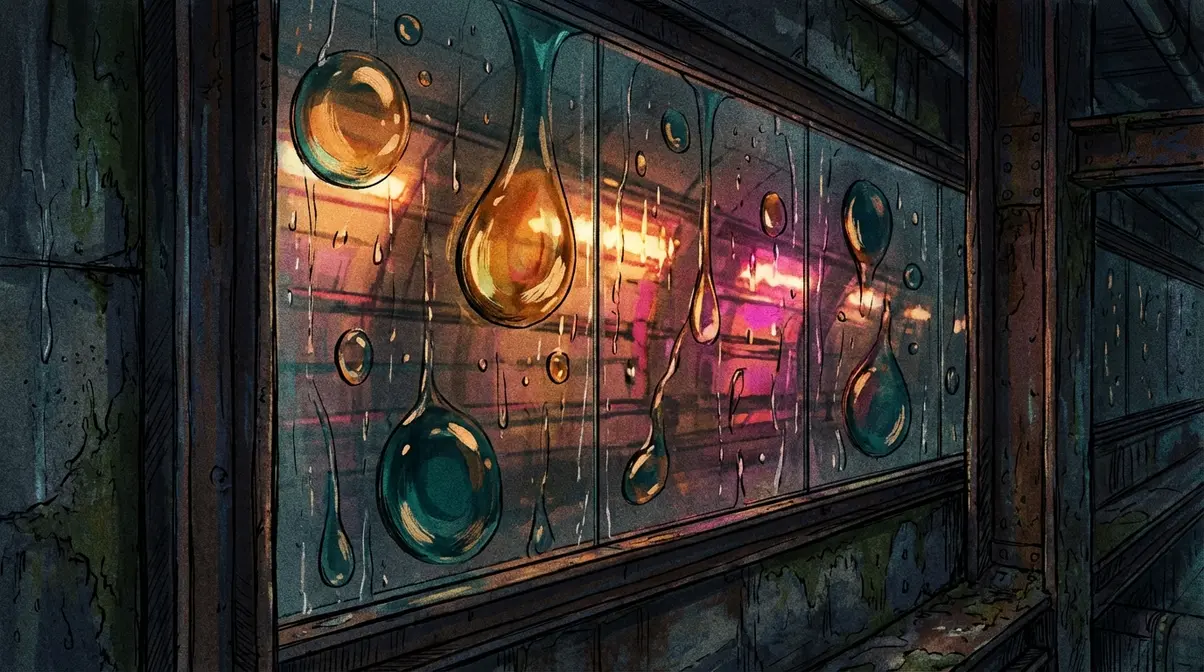
Somewhere else, in a city that could be Los Angeles or London or Melbourne or Chicago, a different person works at night. Hydrofluoric acid is loaded into a special marker equipped with a tip formed by a bed with a round footprint that runs down a vertical surface. The flow intensity can be influenced by pressing the marker. After applying the liquid to the glass surface, a permanent impression is formed, which cannot be removed by cleaning. The white, ghostly tag on a bus shelter window will still be there next week, next month, next year. This is also acid etching.
Same principle. Same element of the periodic table. Radically different intentions, separated by clean rooms and darkness, by patents and anonymity. But the glass doesn’t care who’s holding the applicator.
What Corning Actually Makes Now
There is no product called Gorilla Shield 5. There never was. What Corning does make, as of January 2025, is Gorilla Armor 2, and it is worth knowing about on its own terms. As the industry’s first scratch-resistant, anti-reflective glass ceramic cover material for mobile devices, Gorilla Armor 2 is a landmark achievement in glass ceramic technology.
Unlike traditional glass, Gorilla Armor 2 is a heat-treated, crystal-infused glass ceramic, enhancing its mechanical, optical, and thermal properties. The numbers are genuinely impressive. In Corning lab tests, Gorilla Armor 2 survived drops of up to 2.2 meters on a surface replicating concrete, while alternative glass ceramic materials failed when dropped from one meter. It maintains exceptional scratch resistance, demonstrating over four times more scratch resistance than competitive lithium-aluminosilicate cover glasses with an anti-reflective coating.
The way it gets there matters. The glass is placed in a hot bath of molten salt at a temperature of approximately 400°C. Smaller sodium ions leave the glass, and larger potassium ions from the salt bath replace them. These larger ions take up more room and are pressed together when the glass cools, producing a layer of compressive stress on the surface of the glass. Gorilla Glass’s special composition enables the potassium ions to diffuse far into the surface, creating high compressive stress deep into the glass. Think of it like tuning a drum head: the tighter the surface tension, the more punishment the skin can absorb before it gives.
This is a company founded in 1851 that now invests roughly ten percent of its revenue in R&D. Gorilla Glass is manufactured in Harrodsburg, Kentucky; Asan, South Korea; and Taiwan. As of October 2017, it was used in approximately five billion devices worldwide. The scale is staggering. The precision is almost absurd. The invisible structures on the surface measure only a few microns, but they are hard at work scattering incoming light in different directions.
What the Streets Actually Do
According to the Los Angeles Times, glass etching was first utilized as a method of creating graffiti by protesters during the Battle of Seattle. Within just a few years, use of the technique spread down the West Coast, occurring in cities across California. Within a decade, glass-etched graffiti was reported to have spread across the country. It was never a Berlin-specific phenomenon. It belongs to every city with plate glass and nightfall.
Taggers use chemical etching cream, like Armour Etch or similar acids, to burn designs directly into the surface of glass. Unlike spray-paint or marker tags that sit on the surface, acid-etched graffiti uses powerful chemicals to permanently alter building materials at a molecular level. There’s a reason building owners dread it. Because the acid actually etches into the glass, the stain cannot be washed off. The only way to remove the etching is to grind the glass down past the damage and buff and polish it until it is completely transparent.
The tools have gotten more sophisticated over time. Early acid etchers relied on brushes or sponges, but innovations borrowed from the cleaning and detailing industries have improved precision and speed: modified hobbyist airbrushes allow for fine lines and gradient effects, garden or industrial pump sprayers with narrow nozzles create consistent coverage, and gelled etchants adhere longer to vertical surfaces, increasing penetration without runoff. It reads like a gear review. In a way, it is one.
The Convergence
Here is the part that fascinates me. Corning’s anti-glare process and the vandal’s acid marker exploit the same underlying chemistry: a controlled reaction between a fluoride compound and silica. Etching creates micrometer-sized pits that can scatter light in all directions, converting specular reflection into diffuse reflection. That is exactly what Corning wants for a matte phone display. It is also exactly what happens to a bus stop window when someone tags it with hydrofluoric acid.
The difference, of course, is control. Finding the appropriate etchant solution ratios to achieve specific etching objectives, such as anti-glare, hole drilling, or surface modification, can be challenging. Moreover, etchant ratios should be adjusted to the type of glass used, making these ratios closely guarded trade secrets. Corning’s scientists operate at the nanostructure level, calibrating depth and pitch to manipulate specific wavelengths. A tagger with a squeeze bottle of Armour Etch is working with the same periodic table but none of the same guardrails.
One process creates a surface that Corning describes as “a chemically etched finish that’s actually part of the glass.” The other creates a scar that is also, undeniably, part of the glass. Permanence is the shared inheritance.
What Holds and What Breaks
I keep thinking about the word surface. In the glass industry, the surface is everything. Potassium ions in the solution migrate into the glass surface, replacing the smaller sodium ions within the structure of the glass. These larger potassium ions create a compressive stress layer that forms a tough surface. Strength lives in the first few microns. Damage lives there too.
Glass-etching chemicals work by reacting with silica, a mineral in glass. The chemicals essentially eat away the silica, leaving the permanent mark. Whether you are a materials scientist in upstate New York or someone with a marker full of acid on a dark street corner, you are negotiating with the same molecular reality. Silica gives. Silica takes.
There is something almost musical about it. Every piece of glass carries within it the potential for both outcomes: the pristine anti-reflective display that Samsung ships on a $1,300 phone, and the milky white scar on a storefront that makes for expensive property destruction that can lead to felony charges far more serious than the usual vandalism rap. The material is the same. The hands are different.
Corning experimented with chemically strengthened glass in 1960 as part of a “Project Muscle” initiative. Replacement of smaller sodium ions with larger potassium ones by chemical treatment to improve the compressive strength of the surface layer was first developed by Steven Kistler in 1962. Sixty-four years later, the conversation between acid and glass is still the most consequential one in the industry. Nobody called it a war. But it has always been one.
There is no “Gorilla Shield 5.” There are no “Berlin Acid Etchers.” But there is glass, and there is chemistry, and between them they have been telling the same story since the 1960s. I find that more compelling than any imaginary rivalry could ever be.
'%3e%3cg id='Final-Copy-2_2_' transform='translate(1275.000000, 200.000000)'%3e%3cpath class='st0' d='M7.4,12.8h6.8l3.1-11.6H7.4C4.2,1.2,1.6,3.8,1.6,7S4.2,12.8,7.4,12.8z'/%3e%3c/g%3e%3c/g%3e%3c/g%3e%3cg id='final---dec.11-2020'%3e%3cg id='_x30_208-our-toggle' transform='translate(-1275.000000, -200.000000)'%3e%3cg id='Final-Copy-2' transform='translate(1275.000000, 200.000000)'%3e%3cpath class='st1' d='M22.6,0H7.4c-3.9,0-7,3.1-7,7s3.1,7,7,7h15.2c3.9,0,7-3.1,7-7S26.4,0,22.6,0z M1.6,7c0-3.2,2.6-5.8,5.8-5.8 h9.9l-3.1,11.6H7.4C4.2,12.8,1.6,10.2,1.6,7z'/%3e%3cpath id='x' class='st2' d='M24.6,4c0.2,0.2,0.2,0.6,0,0.8l0,0L22.5,7l2.2,2.2c0.2,0.2,0.2,0.6,0,0.8c-0.2,0.2-0.6,0.2-0.8,0 l0,0l-2.2-2.2L19.5,10c-0.2,0.2-0.6,0.2-0.8,0c-0.2-0.2-0.2-0.6,0-0.8l0,0L20.8,7l-2.2-2.2c-0.2-0.2-0.2-0.6,0-0.8 c0.2-0.2,0.6-0.2,0.8,0l0,0l2.2,2.2L23.8,4C24,3.8,24.4,3.8,24.6,4z'/%3e%3cpath id='y' class='st3' d='M12.7,4.1c0.2,0.2,0.3,0.6,0.1,0.8l0,0L8.6,9.8C8.5,9.9,8.4,10,8.3,10c-0.2,0.1-0.5,0.1-0.7-0.1l0,0 L5.4,7.7c-0.2-0.2-0.2-0.6,0-0.8c0.2-0.2,0.6-0.2,0.8,0l0,0L8,8.6l3.8-4.5C12,3.9,12.4,3.9,12.7,4.1z'/%3e%3c/g%3e%3c/g%3e%3c/g%3e%3c/g%3e%3c/svg%3e) Your Privacy Choices
Your Privacy Choices