


Side A: The Lift
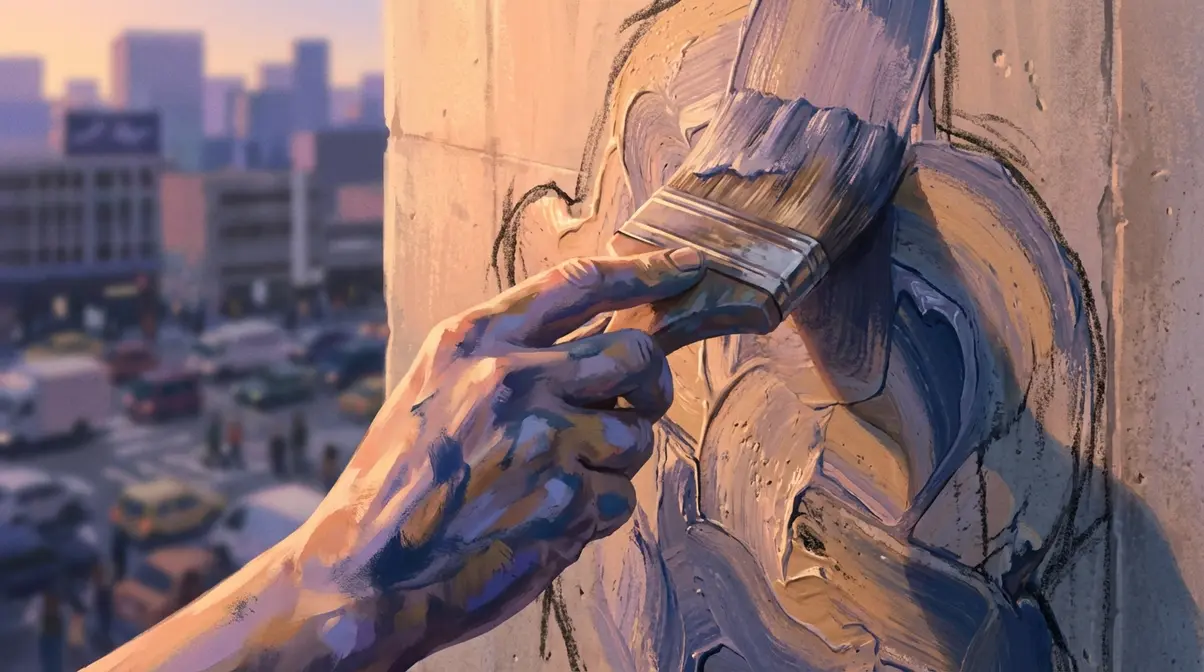
This morning, at 10 a.m. sharp, Robert Vargas unveils “Samurai of the Diamond” on the south-facing wall of the DoubleTree by Hilton in Torrance. The mural features the Dodgers’ trio of Japanese stars, Shohei Ohtani, Yoshinobu Yamamoto, and Roki Sasaki, rendered in larger-than-life fashion on a 12-story wall. The piece stands 130 feet tall by 50 feet wide. It was painted entirely freehand. No grid. No projector. No spray can. Because Vargas always works freehand and does not use spray paints, he has to carefully paint each section with a brush, as even a roller will not work on the hotel’s deeply corrugated surface.
Let that settle in. A man on a scaffold, twelve stories above Hawthorne Boulevard, painting brushstroke by brushstroke on a wall he has described as “the most difficult surface challenge” he has ever faced. Around midday last Saturday, high winds forced him to temporarily come down from the wall; he had already arranged to work through the night and was prepared to go nonstop to finish in time. This is how Robert Vargas has operated for decades. The deadlines are punishing, the surfaces are hostile, and the safety margins are thin.
A profile writer for the Downtown Los Angeles Art Walk once described arriving at the Pershing Square mural site and finding Vargas in paint-splattered black clothes, wearing straps and a wide-brimmed straw hat rather than a hard hat, prompting the observation: “This is physical, potentially dangerous work.” That was years ago. Nothing has changed. The hat is the same. The method is the same. The scale keeps getting bigger.
Side B: The Disappearance
Before any of this, Robert Vargas disappeared. Or rather, he let himself be disappeared by a career that had nothing to do with paint.
He’d been a prodigy. Sold his first piece at five years old. Began painting murals at the age of ten. His first mural at a museum was at the Autry Museum in Griffith Park when he was sixteen. At seventeen, he was commissioned to paint the Edmund D. Edelman Children’s Court. That same year, his father died. He graduated from the L.A. County High School for the Arts in 1996, then studied at Pratt Institute in Brooklyn.
And then the art stopped. Vargas pivoted into the music industry, eventually becoming the booking and marketing director at the Conga Room, the legendary Latin music venue backed by investors Jennifer Lopez and Jimmy Smits. He booked Tito Puente, Celia Cruz, Buena Vista Social Club, Los Lobos. It was, by any measure, a wildly successful run. It was also a detour. In 2005, he walked away from the Conga Room and returned to oil bars, charcoal, canvas, and the figure. He became a fixture of the monthly Downtown Los Angeles Art Walk. He’d grown up on a street called City View, with a clear sight line to the downtown skyline, and he says he was “always destined to dream big and to paint big.”
By 2011, L.A. Weekly had identified him as downtown L.A.’s best-known artist. The lost years were over. The brush had won.
Side C: The Wall That Watches the Sun
The Torrance mural is extraordinary. But the real opus is still “Angelus,” the colossus overlooking Pershing Square. For the last few years, Vargas has been painting a 60,000-plus-square-foot piece at Pershing Square that will result in the largest mural by one artist in the world, logged in the Guinness World Records. He is nearing completion in 2026.
The numbers alone are staggering. The previous Guinness record holder painted 18,066 square feet in Mazatlán, Mexico. Vargas is aiming for more than three times that. But the numbers don’t capture the strangest, most beautiful thing about “Angelus”: it has a secret.
Vargas studied the wall for four years before he began the mural, observing how sunlight and shadows moved across it. He determined that February 9th is the apex point of that interplay. The sub-narrative, visible through light and shadow, was inspired by the ascending and descending serpent seen on pyramids in Mexico, as well as temples in Cambodia and Egypt that placed storytelling, architecture, and light in conversation with each other. One day a year, the building reveals a second story hidden inside the first. Vargas engineered a painting that collaborates with the earth’s orbit.
The visible narrative is staggering enough. The face of a four-year-old child anchors the base, representing the Tongva Indian Natives, the original inhabitants of the Los Angeles basin. The arm was modeled by Oscar De La Hoya, who came from Vargas’s own neighborhood in Boyle Heights. One of the angels at the very top is a portrait of his mother, the first person to introduce him to downtown L.A. Another angel is an African American homeless woman who modeled for him and often sits nearby at the Pershing Square intersection. The girl’s hands, shaped in American Sign Language, came from a collaboration with Marlton School for deaf and hard of hearing children, where Vargas demonstrated how he communicates without sound and words.
Before a single brushstroke landed, Vargas invited a Tongva tribal council chief to the mural site for a ceremony. “He blessed the wall and my hands. There was burning sage and blowing of the conchshell.”
Side D: The Bridge
Vargas keeps building connections between communities, literally. In 2024, he painted a towering Shohei Ohtani on the Miyako Hotel in Little Tokyo. “It took me nine days to paint that mural, completely freehand. No grids, no projections, all with a brush, hanging off the side of that building.” Later that year, Fernando Valenzuela died, and Vargas painted a memorial mural the very day Valenzuela passed away. The Ohtani mural in Little Tokyo and the Valenzuela mural in Boyle Heights sit about a mile apart, connected by the 1st Street Bridge. Vargas has said this was intentional, representing the bridge between two communities and two eras of Dodger history.
Now comes Torrance. “This is not just another mural, or even another tribute to the Dodgers,” Vargas said. “This mural is about these three ambassadors of Japan that came here to Los Angeles and brought greatness, and shared their culture with our city to bridge unity.” Torrance signed friendship city agreements with Bizen, Yamamoto’s hometown, in August 2024, and Oshu, Ohtani’s hometown, in October 2024. Vargas, who has a home in Japan because of the frequent mural work he does there, came up with the idea around that time.
The civic honors keep accumulating. In 2021, the Los Angeles City Council proclaimed September 8 as Robert Vargas Day. In 2022, the City Council designated an intersection in Boyle Heights as Robert Vargas Square. In January 2026, the Los Angeles County Board of Supervisors proclaimed January 24 as Robert Vargas Day in Los Angeles County. In 2024, he received an honorary Doctor of Humane Letters from ArtCenter College of Design. ArtCenter President Karen Hofmann said at the ceremony: “What makes him important is not just his technique. What makes him important is the way his work bridges different cultures.”
The Locked Groove
Here is what disappeared and what came back. A kid from Boyle Heights who could paint before he could read lost his father, lost a decade to the music industry, and then returned to the only thing that was ever truly his. He paints the way a vinyl record plays: one continuous groove, no skipping, no digital correction, no undo button. “I scale it in my head. I come up on the lift and I figure that right about here is where I want to be, and then I start painting.”
There is no Photoshop on a 14-story building. There is no ctrl-Z on a corrugated hotel wall in Torrance while the Santa Ana winds try to peel you off the scaffold. Vargas has estimated he renders 30 to 40 strokes per square foot, painting the wall 40-plus times over because of the layering. Multiply that across 60,000 square feet and you begin to understand the physical commitment of “Angelus” as something closer to endurance sport than studio practice.
“My time frames are pretty ambitious, but I also know what I’m capable of when it comes to my speed,” Vargas has said. “My process is really charged by my intention of why I’m creating these pieces, and that is what fuels me to completion.”
Freehand muralism at this scale is an analog act in a world that has largely abandoned analog risk. No algorithm can catch you if you fall. No software can fix a misplaced eye on the seventh floor. The only tool between Robert Vargas and gravity is a four-inch brush, a three-foot-wide platform, and the nerve to keep going. Today in Torrance, he pulls back the curtain on another one. Tomorrow, he climbs again.
Further reading: Downtown LA Art Walk’s profile of Vargas and Angelus · LAist on the world record bid · Daily Breeze on “Samurai of the Diamond”
'%3e%3cg id='Final-Copy-2_2_' transform='translate(1275.000000, 200.000000)'%3e%3cpath class='st0' d='M7.4,12.8h6.8l3.1-11.6H7.4C4.2,1.2,1.6,3.8,1.6,7S4.2,12.8,7.4,12.8z'/%3e%3c/g%3e%3c/g%3e%3c/g%3e%3cg id='final---dec.11-2020'%3e%3cg id='_x30_208-our-toggle' transform='translate(-1275.000000, -200.000000)'%3e%3cg id='Final-Copy-2' transform='translate(1275.000000, 200.000000)'%3e%3cpath class='st1' d='M22.6,0H7.4c-3.9,0-7,3.1-7,7s3.1,7,7,7h15.2c3.9,0,7-3.1,7-7S26.4,0,22.6,0z M1.6,7c0-3.2,2.6-5.8,5.8-5.8 h9.9l-3.1,11.6H7.4C4.2,12.8,1.6,10.2,1.6,7z'/%3e%3cpath id='x' class='st2' d='M24.6,4c0.2,0.2,0.2,0.6,0,0.8l0,0L22.5,7l2.2,2.2c0.2,0.2,0.2,0.6,0,0.8c-0.2,0.2-0.6,0.2-0.8,0 l0,0l-2.2-2.2L19.5,10c-0.2,0.2-0.6,0.2-0.8,0c-0.2-0.2-0.2-0.6,0-0.8l0,0L20.8,7l-2.2-2.2c-0.2-0.2-0.2-0.6,0-0.8 c0.2-0.2,0.6-0.2,0.8,0l0,0l2.2,2.2L23.8,4C24,3.8,24.4,3.8,24.6,4z'/%3e%3cpath id='y' class='st3' d='M12.7,4.1c0.2,0.2,0.3,0.6,0.1,0.8l0,0L8.6,9.8C8.5,9.9,8.4,10,8.3,10c-0.2,0.1-0.5,0.1-0.7-0.1l0,0 L5.4,7.7c-0.2-0.2-0.2-0.6,0-0.8c0.2-0.2,0.6-0.2,0.8,0l0,0L8,8.6l3.8-4.5C12,3.9,12.4,3.9,12.7,4.1z'/%3e%3c/g%3e%3c/g%3e%3c/g%3e%3c/g%3e%3c/svg%3e) Your Privacy Choices
Your Privacy Choices