

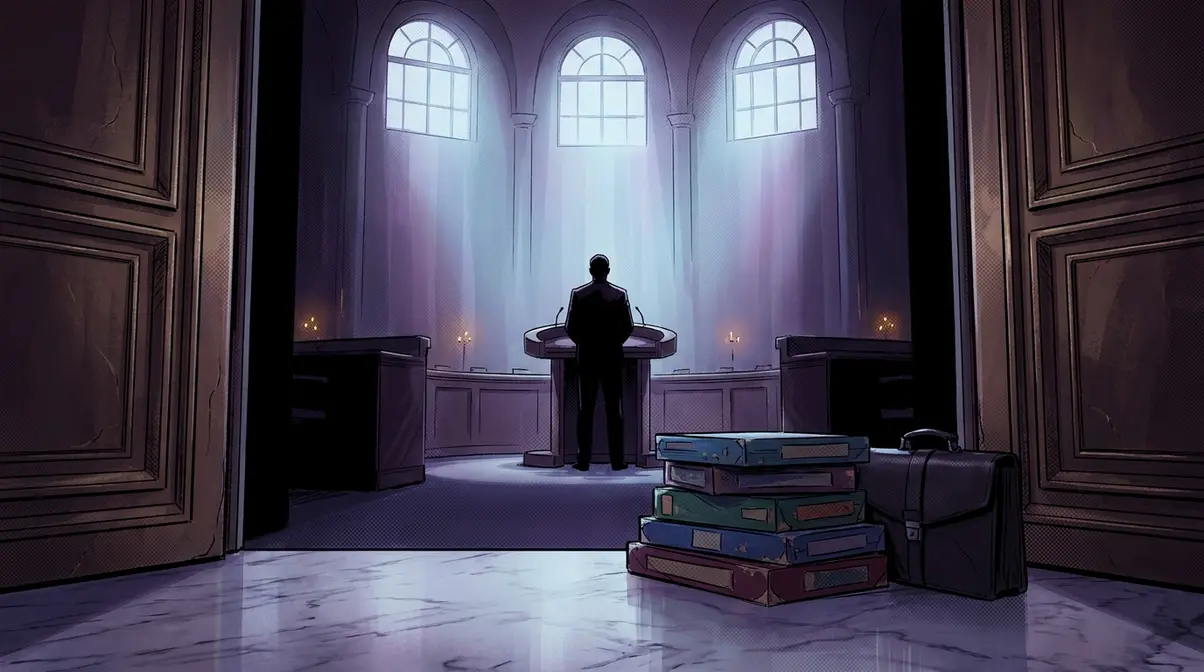


Picture this. A committee room in the SPAAK building in Brussels, fluorescent-lit, dry as parliamentary procedure demands. Three EU committees sit across from a man who spent a decade voicing the inner monologue of a fictional physicist in a video game.
Ross William Scott, born December 28, 1982, is an American YouTuber and video game preservation activist, primarily known for his Half-Life machinima series Freeman’s Mind and Civil Protection, as well as for starting the Stop Killing Games movement. On April 16, 2026, he was speaking to the European Parliament.
It’s the kind of trajectory that, even a few years ago, would have sounded improbable.
The Room
The European Parliament convened a public hearing in Brussels, organized jointly by the Committee on the Internal Market and Consumer Protection (IMCO), the Committee on Legal Affairs (JURI), and the Committee on Petitions (PETI). Scott, along with organizer Moritz Katzner, presented their case before the European Parliament. Consultant Daniel Ondruška served as spokesperson for the initiative’s formal petition, titled “Stop Destroying Videogames.”
The petition behind it was no small thing. The European Citizens’ Initiative “Stop Destroying Videogames” finished verification with 1,294,188 confirmed signatures, clearing the EU’s one-million threshold. Few such initiatives have ever reached that mark since the program launched in 2012. The ECI was successfully submitted to the European Commission in January 2026.
That number is what changed the room. This wasn’t a niche gaming complaint anymore—it was a verified, cross-border consumer issue with over a million backers.
Scott didn’t hold back. He weighed in on the business side, saying that when end-of-life planning is included in a game’s development budget, the impact is “very small,” and added that some estimates for end-of-life costs by game studios may be “faulty,” because they factor in features that are no longer needed in an offline game. He cited Sony’s Concord as a case study, pointing out that the game cost at least 370 million euros to develop but shipped without any publicly known plan for what happens after shutdown.
An amateur study examining over 1,100 networked games demonstrated the extent of the problem: under the strictest interpretation, out of over 400 discontinued titles, publishers disabled a customer’s purchase 93.5% of the time when ending support.
Ondruška said the movement “is not trying to be unreasonable,” and isn’t seeking eternal online support or retro reactivation for games that have already been shut down — just legal requirements to keep it from happening in the future.
The Response
What happened next is what makes this story notable.
MEP Anna Cavazzini, chair of the Committee on the Internal Market and Consumer Protection, thanked and congratulated the speakers “for the great work you have done,” and said she’d “heard a lot of support from basically all the political groups.” MEP Ilhan Kyuchyuk shared similar sentiments, reiterating “the broad support” from the relevant committees. Committee vice chair Nils Ušakovs called it a “concern for […] probably hundreds of millions of European citizens.”
Giuseppe Abbamonte of the European Commission confirmed that the body would review current copyright laws related to digital ownership. The Commission has until July 27, 2026 to discuss the initiative in detail and present an official reply, “outlining the actions it intends to take, if any.”
During a post-hearing Twitch press conference, the tone was noticeably upbeat. Katzner called the hearing “absolutely incredible,” adding: “I think that everyone that watched it might have noticed that there was no MEP that wasn’t responding positively. Even the commission was pretty positive, I’d say.” He outlined the next possible development: MEPs may proceed to adopt a resolution expressing political support for the initiative and calling on the Commission to act. “I think we’re going to see that resolution. And for this stage I’d say — mission accomplished.”
Who Is Ross Scott, and How Did He Get Here?
Scott was born in Baton Rouge, Louisiana, and grew up in Southwest Virginia, first in Roanoke, then in Blacksburg. He earned a bachelor’s degree in criminal justice with a minor in psychology. He started making videos in 2007. Freeman’s Mind used the Source remake of the 1998 video game Half-Life, following the protagonist Gordon Freeman as a narrator offering running commentary, satirizing the game world’s conventions. The series ran from 2007 to 2014 and consisted of 71 episodes. Scott runs the YouTube channel Accursed Farms, which hosts Freeman’s Mind, its sequel Freeman’s Mind 2, Civil Protection, and a video game review series called Ross’s Game Dungeon.
Part of what makes Scott a notable figure in this space is how atypical his path is. He currently resides in Poland with his wife Magda and has said publicly that he may not see himself as the ideal person to lead a campaign of this scale—but he’s the one who stepped into that role.
In April 2019, Scott released a video titled “Games as a service is fraud,” arguing that many modern games may mislead consumers. In April 2024, he launched the Stop Killing Games campaign in response to Ubisoft shutting down the online servers for The Crew.
The triggering event was simple and, for many players, frustrating. Ubisoft’s The Crew was a racing game that required a constant internet connection despite being mainly single-player. In late 2023, Ubisoft delisted the title from digital stores. Servers were officially shut down on March 31, 2024, rendering the game, including any purchased DLC, completely inaccessible.
The Bigger Fight
The April 16 hearing didn’t happen in isolation. It capped off a broader escalation in early 2026 for Stop Killing Games.
In February, the org announced it was launching NGOs in the EU and US “to do long-term counter lobbying” on the issue of game shutdowns. French consumer group UFC-Que Choisir, with support from the Stop Killing Games initiative, filed a lawsuit against Ubisoft over the 2024 shutdown of The Crew. As reported by Reuters, UFC-Que Choisir argues that it is “unacceptable that Ubisoft considers… [games] a ‘license’… revocable at any time.” The suit was filed in Créteil court on March 31, 2026.
Meanwhile, in the U.S., the campaign is tied to proposed legislation like California’s Protect Our Games Act.
Taken together, this starts to look less like a single campaign and more like a coordinated push across multiple fronts: EU regulation, national courts, and U.S. legislation.
What SKG Actually Wants
The specifics matter, because the campaign has been persistently mischaracterized. What SKG is actually pressing for maps to four concrete policy changes: a legal requirement to release offline patches before servers are retired; server code held in escrow so third-party operators can keep games running after a shutdown; minimum guaranteed service periods disclosed at point of sale; and clear labeling at checkout whenever a purchase is structured as a time-limited license rather than permanent ownership.
The proposal does not demand that every online title be maintained forever. It asks that players retain some meaningful way to access what they paid for.
What Comes Next
The European Commission’s July 27 deadline is the next key milestone. The Commission didn’t commit to specific actions, but confirmed the issue is under review, with potential links to upcoming legislation like the Digital Fairness Act.
Katzner suggested that MEPs may adopt a resolution expressing political support for the initiative and encouraging the Commission to act.
What’s clear is that this is no longer just an online debate.
A creator who built an audience on niche gaming videos is now helping drive a conversation that lawmakers across multiple regions are engaging with. With over 1.29 million verified signatures, the issue has reached a level where it’s difficult to ignore.
Ross Scott wasn’t supposed to be here. He’s said that himself. But games keep disappearing—and increasingly, that’s becoming a policy question, not just a community complaint.


'%3e%3cg id='Final-Copy-2_2_' transform='translate(1275.000000, 200.000000)'%3e%3cpath class='st0' d='M7.4,12.8h6.8l3.1-11.6H7.4C4.2,1.2,1.6,3.8,1.6,7S4.2,12.8,7.4,12.8z'/%3e%3c/g%3e%3c/g%3e%3c/g%3e%3cg id='final---dec.11-2020'%3e%3cg id='_x30_208-our-toggle' transform='translate(-1275.000000, -200.000000)'%3e%3cg id='Final-Copy-2' transform='translate(1275.000000, 200.000000)'%3e%3cpath class='st1' d='M22.6,0H7.4c-3.9,0-7,3.1-7,7s3.1,7,7,7h15.2c3.9,0,7-3.1,7-7S26.4,0,22.6,0z M1.6,7c0-3.2,2.6-5.8,5.8-5.8 h9.9l-3.1,11.6H7.4C4.2,12.8,1.6,10.2,1.6,7z'/%3e%3cpath id='x' class='st2' d='M24.6,4c0.2,0.2,0.2,0.6,0,0.8l0,0L22.5,7l2.2,2.2c0.2,0.2,0.2,0.6,0,0.8c-0.2,0.2-0.6,0.2-0.8,0 l0,0l-2.2-2.2L19.5,10c-0.2,0.2-0.6,0.2-0.8,0c-0.2-0.2-0.2-0.6,0-0.8l0,0L20.8,7l-2.2-2.2c-0.2-0.2-0.2-0.6,0-0.8 c0.2-0.2,0.6-0.2,0.8,0l0,0l2.2,2.2L23.8,4C24,3.8,24.4,3.8,24.6,4z'/%3e%3cpath id='y' class='st3' d='M12.7,4.1c0.2,0.2,0.3,0.6,0.1,0.8l0,0L8.6,9.8C8.5,9.9,8.4,10,8.3,10c-0.2,0.1-0.5,0.1-0.7-0.1l0,0 L5.4,7.7c-0.2-0.2-0.2-0.6,0-0.8c0.2-0.2,0.6-0.2,0.8,0l0,0L8,8.6l3.8-4.5C12,3.9,12.4,3.9,12.7,4.1z'/%3e%3c/g%3e%3c/g%3e%3c/g%3e%3c/g%3e%3c/svg%3e) Your Privacy Choices
Your Privacy Choices