


A Christmas Tree, a Sprite Pack, and a Broken Promise to Quit
When Vampire Survivors began, Luca Galante did not have a grand theory about reinventing action games. He had a rough prototype, a purchased sprite pack and the visual language of Castlevania rattling around in his head.
That should have produced a disposable imitation. Instead, it produced one of modern game development’s stranger reversals: an outsider borrowed the silhouette of a dormant giant, built the game that made a new form impossible to ignore and eventually became important enough for the giant to enter his world.
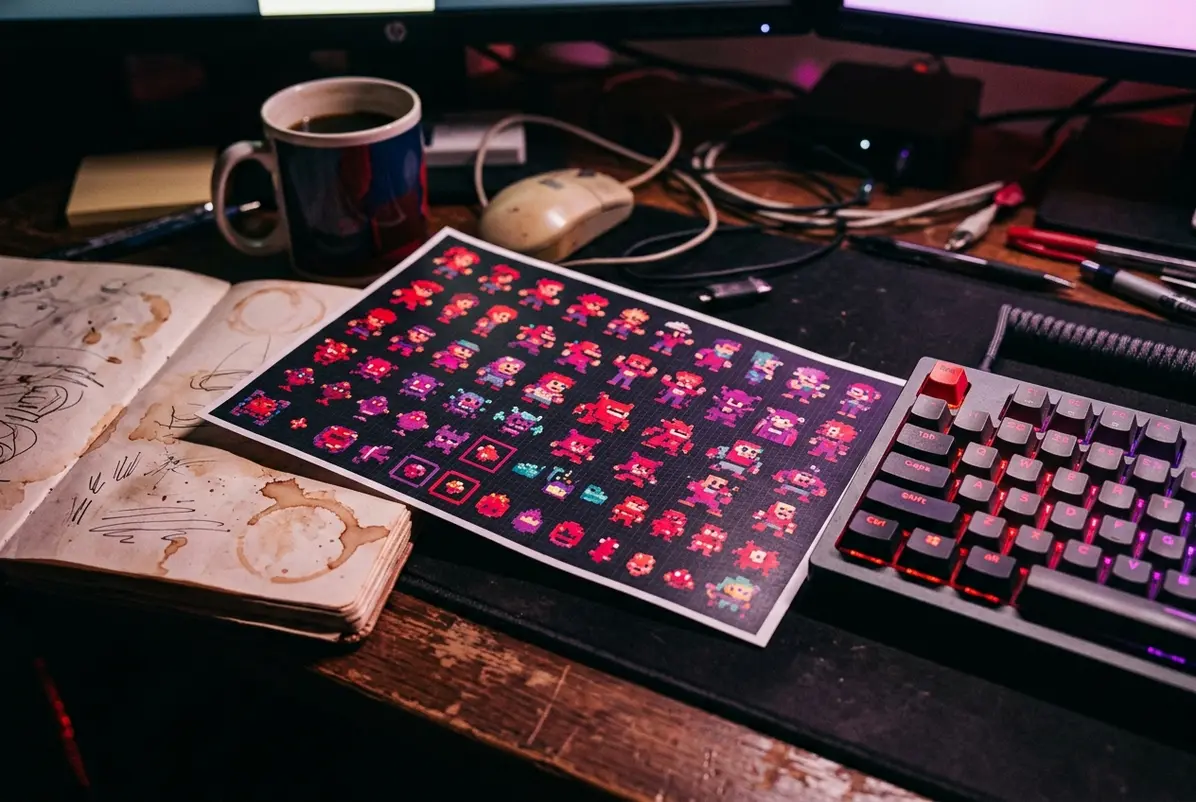
Galante began developing Vampire Survivors in 2020, when his ambitions in independent game development appeared to be fading. He had made other prototypes before, many using the same inexpensive, Castlevania-inspired asset pack he had purchased years earlier. The earliest version was reportedly little more than a background and monochrome dots. Replacing those dots with gothic monsters and tiny heroes gave the chaos a visual grammar.
The sprites did not merely decorate the prototype. They revealed what kind of world the mechanics wanted to inhabit. Galante later recalled that once the assets were added, he “fell in love” with what appeared on the screen.
The roughness was part of the discovery. Enemies arrived in absurd numbers. Sprites appeared at inconsistent sizes. The screen looked less like a carefully staged action game than a supernatural slot machine breaking under pressure. What should have looked cheap instead looked alive.
Development of the initial early-access version took roughly a year. Galante later told PC Gamer that he spent around £1,100 on assets, music and other production costs. By then, he had largely abandoned the idea of becoming an independent developer and returned to work connected to mobile gambling.
Vampire Survivors entered Steam Early Access on December 17, 2021. The launch was quiet. Then YouTuber SplatterCat published a video about it, and the numbers began moving.
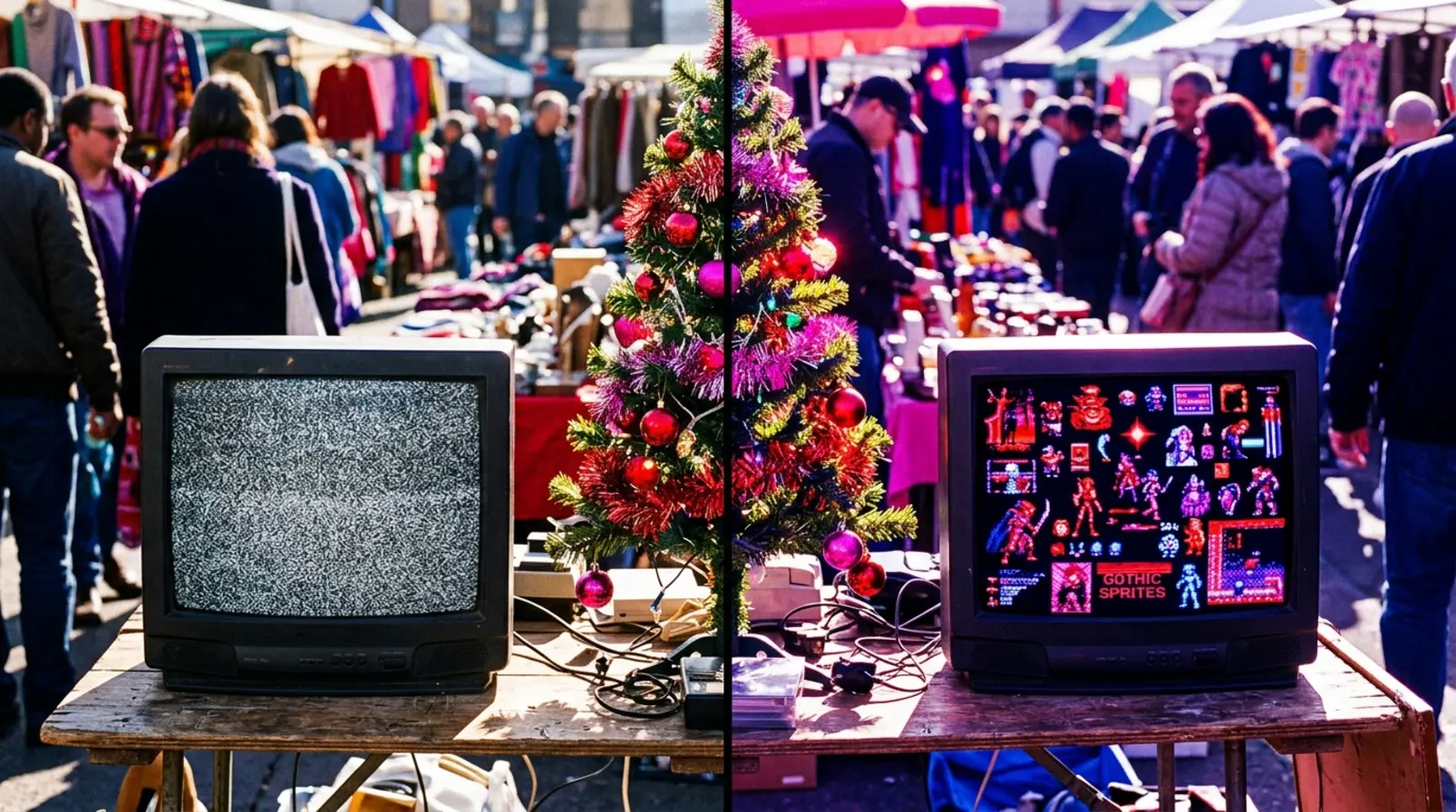
A friend messaged Galante to tell him sales were suddenly accelerating. Galante was taking down his Christmas tree. He became distracted, left it standing and eventually decided not to remove it at all. The tree later entered the game’s mythology as the stationary character Peppino.
The detail is almost too neat. The game Galante made after giving up on making games became the game that allowed him to leave his job. The temporary assets became the permanent identity. The Christmas tree he forgot to remove became a playable joke.
Vampire Survivors was not constructed like a monument. It accumulated like clutter. That was why it worked.
The Castlevania Question
The Castlevania influence was impossible to miss. The title invoked vampires. The weapons included whips, holy water and crosses. The purchased sprite pack contained designs that evoked recognisable Castlevania creatures and character types.
For some players, the resemblance went beyond affectionate homage. As PC Gamer reported in 2022, critics alleged that certain early assets resembled Konami’s work too closely and, in some cases, had been copied directly.
Galante disputed the copying claim. He said he had checked the commercially available asset pack before release and found no evidence that the sprites had been lifted directly from Castlevania. “Honestly, there was nothing like a copy-paste,” he told the publication.
That did not make the optics comfortable. Even without literal copying, some designs echoed familiar Castlevania archetypes closely enough that Galante replaced the most contentious sprites. Finding artists who could match the strange texture of the existing pack proved difficult, because the borrowed aesthetic was no longer merely decoration. It had become the game’s skin.
The controversy faded partly because the game became too distinct to remain legible as a simple Castlevania imitation. Its monsters may have arrived wearing gothic hand-me-downs, but its central pleasure was different. The player did not explore a castle room by room. The player stood inside an accelerating system and watched it collapse beautifully under the weight of its own excess.
Vampire Survivors borrowed Castlevania’s silhouette, then filled it with a different machine.
That machine helped make automatic attacks, escalating enemy swarms and run-based upgrade systems commercially legible as a genre. The terminology remains unsettled—“survivors-like,” “bullet heaven” and “auto-shooter” all circulate—but the design lineage is clear.
Galante soon faced the same problem from the other side. Developers began producing games that resembled Vampire Survivors, ranging from thoughtful variations to near-replicas. The project built from a familiar visual vocabulary had generated a mechanical vocabulary for others to borrow.
The Three-Dollar Game That Beat the Giants
The scale of the reversal became undeniable at the 2023 BAFTA Games Awards. Vampire Survivors received five nominations and won both Game Design and Best Game.
The Best Game victory placed Galante’s tiny production ahead of nominees including Elden Ring and God of War Ragnarök. One was a monumental open-world production. The other was a lavish PlayStation blockbuster built by hundreds of specialists. Vampire Survivors began with dots, open-source technology and a sprite pack bought online.
The result mattered not because a cheap game embarrassed expensive ones, but because it recognised how much design can emerge from subtraction.
Vampire Survivors removed aiming, minimised direct attacks and reduced navigation to movement across broad spaces. It relocated complexity into timing, positioning, upgrade combinations and the escalating pressure of the horde.
The player appeared to be doing almost nothing. Underneath, the game was constantly asking what kind of machine the player wanted to become.
Full Circle at Dracula’s Castle
On October 31, 2024, the circle closed. Poncle and Konami released Vampire Survivors: Ode to Castlevania, an official crossover built around the characters, monsters, weapons and music of the series that had haunted Galante’s game from the beginning.
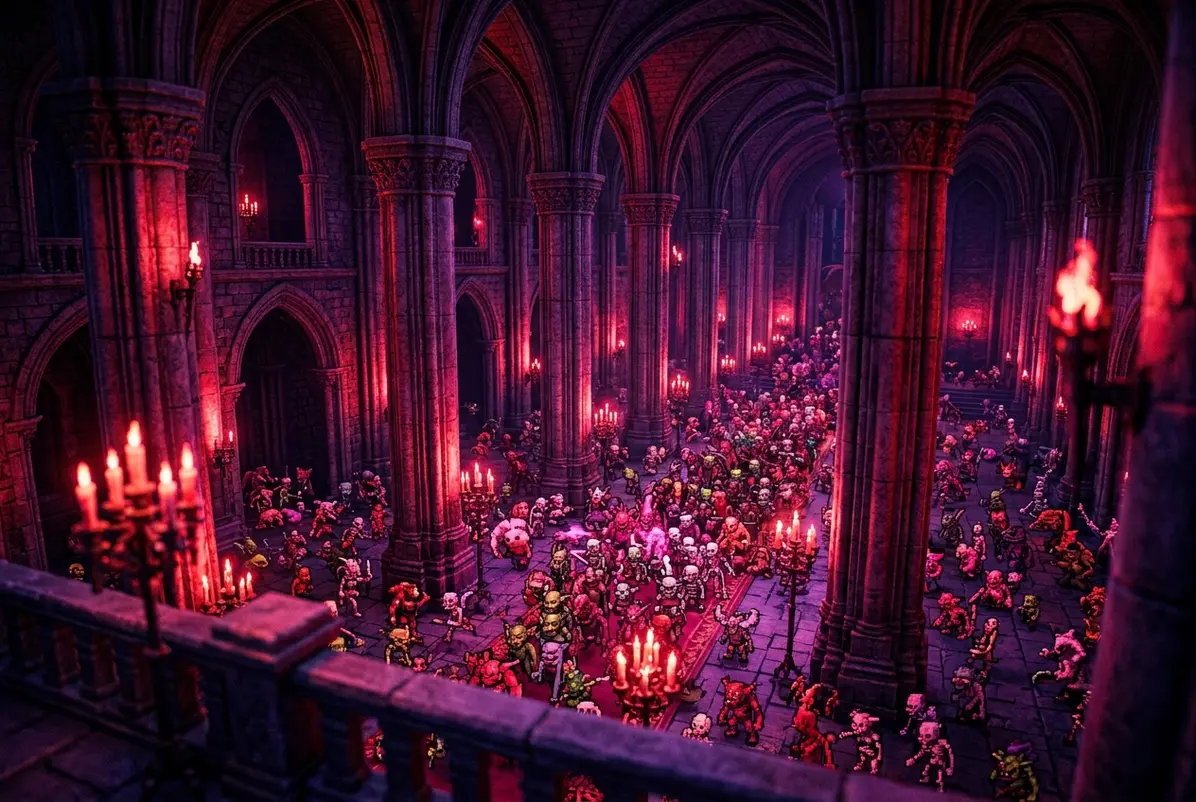
The expansion was not coy about the relationship. Poncle called it a celebration and a “full-circle moment.” Dracula’s Castle became the largest stage the game had featured at the time. The launch version advertised more than 20 playable characters, over 40 weapons and more than 30 music tracks for $3.99. Poncle estimated that the expansion contained approximately 70 to 80 percent as much content as the original base game.
That statistic deserves a moment of silence.
The DLC includes Belmonts, Belnadeses, Alucard, familiar monsters and enough whips to turn a weapon class into a family tree. It translates Castlevania history into Vampire Survivors logic: heroes become unlockable variables, relics become upgrade paths and Dracula’s Castle becomes an arena designed to be flooded with enemies.
The collaboration did not retroactively settle every argument about the original game’s influences. A licensing agreement in 2024 cannot rule on every resemblance in an asset pack used years earlier.
What it did was make the old argument feel culturally obsolete.
The question was no longer whether Vampire Survivors looked suspiciously like Castlevania. The question was what happened when Castlevania willingly submitted itself to the system that resemblance had helped create.
The answer was abundance. The crossover became less a cameo than a conversion. Castlevania was reprocessed through escalating crowds, absurd weapon evolutions, cascading numbers and secrets buried beneath secrets.
In October 2025, version 1.14 expanded the crossover again with 16 additional characters, three weapons with evolutions, 13 weapon unions, another Adventure chapter and 12 music tracks. The tribute had become large enough to contain its own sequel.
This was no longer a small indie game borrowing prestige from a famous license. Castlevania had entered Galante’s house and agreed to live by his rules.
What Castlevania’s Absence Made Possible
The collaboration landed so powerfully because it arrived during a peculiar period in Castlevania’s history. The franchise remained visible through collections, animation, merchandise and licensed appearances, but for years it lacked a major new exploration-focused 2D game of its own.
That absence created space around the brand. Other studios and fan communities kept different pieces of the Castlevania promise alive: the castle, the melancholy, the whip, the pleasure of entering a hostile place and slowly mastering it.
Vampire Survivors preserved none of those things faithfully. It preserved their charge.
The real legacy of Castlevania’s long absence was not only nostalgia. It was permission. With the original series no longer defining what its imagery had to do, outsiders were free to make the castle mean something else.
Galante replaced deliberate exploration with accumulation. The castle became a crowd. Progress became excess. The lone hunter became a walking catastrophe.
That makes Ode to Castlevania more than brand synergy. It demonstrates that cultural inheritance does not always travel cleanly from an original creator to an authorised successor. Sometimes the important mutation happens elsewhere, inside an inexpensive project made by someone without the license, the budget or any expectation of success.
Konami has since announced Castlevania: Belmont’s Curse, a new exploration-based 2D action game developed with Evil Empire and advisory involvement from Motion Twin. The game is scheduled to launch on October 15, 2026 for PlayStation 5, Xbox Series X|S and Steam, with a Nintendo Switch version also planned for 2026.
That announcement changes the historical position of Ode to Castlevania. The crossover now looks less like the franchise’s future than an extravagant closing ceremony for an era in which Castlevania survived most visibly through collections, adaptations and other people’s games.
Galante did not resurrect Castlevania. The series was never dead. He demonstrated that its dormant energy could still mutate into something mechanically new.
The Outsider’s Tribute
Before Vampire Survivors, Galante’s route into the industry had been indirect. He studied and worked in Italy at a time when formal game-development education was difficult for him to access. He later earned a certification from the Italian Academy of Video Games and moved to London in 2010 to pursue a career in the industry.
Much of his professional work before Vampire Survivors involved gambling-related software, including mobile slots. Game development continued around the edges: prototypes built after work, reused assets and experiments that did not appear to lead anywhere.
In retrospect, it is tempting to turn this into a clean fable about perseverance. That would make the story less interesting. Galante was not steadily climbing toward an inevitable breakthrough. He had already begun stepping away.
Vampire Survivors emerged from the remains of an abandoned ambition: old tools, old sprites, unfinished prototypes and a developer who no longer expected the work to rescue him.
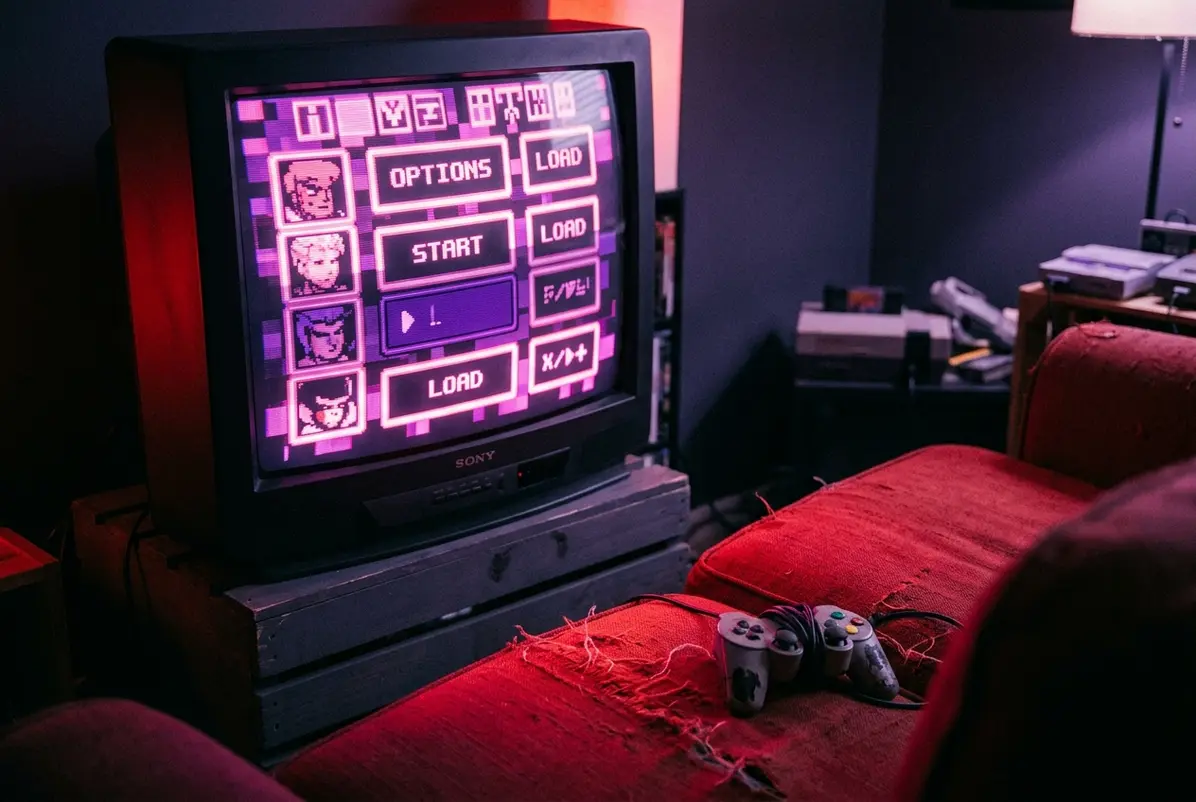
That may be why the game feels so different from a carefully engineered nostalgia product. It does not treat Castlevania as a sacred object to be reconstructed perfectly. It treats it as usable material: a mood, a monster vocabulary, a whip cracking across the memory of another game.
Preservation is not always faithful reproduction. Sometimes a cultural object survives because someone misunderstands it productively.
Galante took the lonely hunter, the gothic castle and the escalating arsenal, then removed the corridors. He did not preserve how Castlevania played. He preserved the sense that its imagery could still open a door.
Years later, Konami walked through it.
Galante began by borrowing Castlevania’s silhouette because it gave his chaos a shape. Castlevania eventually entered his game because his chaos had given the series somewhere new to live.
The sprites were never the real inheritance. The real inheritance was momentum.
Frequently Asked Questions
Was Vampire Survivors made with stolen Castlevania sprites?
There is no established evidence that the game directly copied Castlevania sprite files. Luca Galante said he used a commercially available asset pack and checked it before release. However, some early designs resembled Castlevania characters and monsters closely enough to attract criticism, and several contentious sprites were later replaced.
When was Vampire Survivors first released?
Vampire Survivors entered Steam Early Access on December 17, 2021. Its full 1.0 release followed in October 2022.
What awards did Vampire Survivors win?
At the 2023 BAFTA Games Awards, Vampire Survivors won Best Game and Game Design. It received five nominations.
Is Ode to Castlevania an official Konami collaboration?
Yes. Vampire Survivors: Ode to Castlevania is an officially licensed collaboration between Poncle and Konami. It was released on October 31, 2024.
How much content is in Ode to Castlevania?
At launch, Poncle advertised more than 20 playable characters, over 40 weapons and more than 30 music tracks. Poncle estimated that the expansion contained roughly 70 to 80 percent as much content as the original base game. A later update added more characters, weapons, music and an additional Adventure chapter.
Is Konami making a new Castlevania game?
Yes. Konami has announced Castlevania: Belmont’s Curse, an exploration-based 2D action game developed with Evil Empire and advisory involvement from Motion Twin. It is scheduled for October 15, 2026 on PlayStation 5, Xbox Series X|S and Steam, with a Nintendo Switch release planned separately for 2026.

'%3e%3cg id='Final-Copy-2_2_' transform='translate(1275.000000, 200.000000)'%3e%3cpath class='st0' d='M7.4,12.8h6.8l3.1-11.6H7.4C4.2,1.2,1.6,3.8,1.6,7S4.2,12.8,7.4,12.8z'/%3e%3c/g%3e%3c/g%3e%3c/g%3e%3cg id='final---dec.11-2020'%3e%3cg id='_x30_208-our-toggle' transform='translate(-1275.000000, -200.000000)'%3e%3cg id='Final-Copy-2' transform='translate(1275.000000, 200.000000)'%3e%3cpath class='st1' d='M22.6,0H7.4c-3.9,0-7,3.1-7,7s3.1,7,7,7h15.2c3.9,0,7-3.1,7-7S26.4,0,22.6,0z M1.6,7c0-3.2,2.6-5.8,5.8-5.8 h9.9l-3.1,11.6H7.4C4.2,12.8,1.6,10.2,1.6,7z'/%3e%3cpath id='x' class='st2' d='M24.6,4c0.2,0.2,0.2,0.6,0,0.8l0,0L22.5,7l2.2,2.2c0.2,0.2,0.2,0.6,0,0.8c-0.2,0.2-0.6,0.2-0.8,0 l0,0l-2.2-2.2L19.5,10c-0.2,0.2-0.6,0.2-0.8,0c-0.2-0.2-0.2-0.6,0-0.8l0,0L20.8,7l-2.2-2.2c-0.2-0.2-0.2-0.6,0-0.8 c0.2-0.2,0.6-0.2,0.8,0l0,0l2.2,2.2L23.8,4C24,3.8,24.4,3.8,24.6,4z'/%3e%3cpath id='y' class='st3' d='M12.7,4.1c0.2,0.2,0.3,0.6,0.1,0.8l0,0L8.6,9.8C8.5,9.9,8.4,10,8.3,10c-0.2,0.1-0.5,0.1-0.7-0.1l0,0 L5.4,7.7c-0.2-0.2-0.2-0.6,0-0.8c0.2-0.2,0.6-0.2,0.8,0l0,0L8,8.6l3.8-4.5C12,3.9,12.4,3.9,12.7,4.1z'/%3e%3c/g%3e%3c/g%3e%3c/g%3e%3c/g%3e%3c/svg%3e) Your Privacy Choices
Your Privacy Choices