

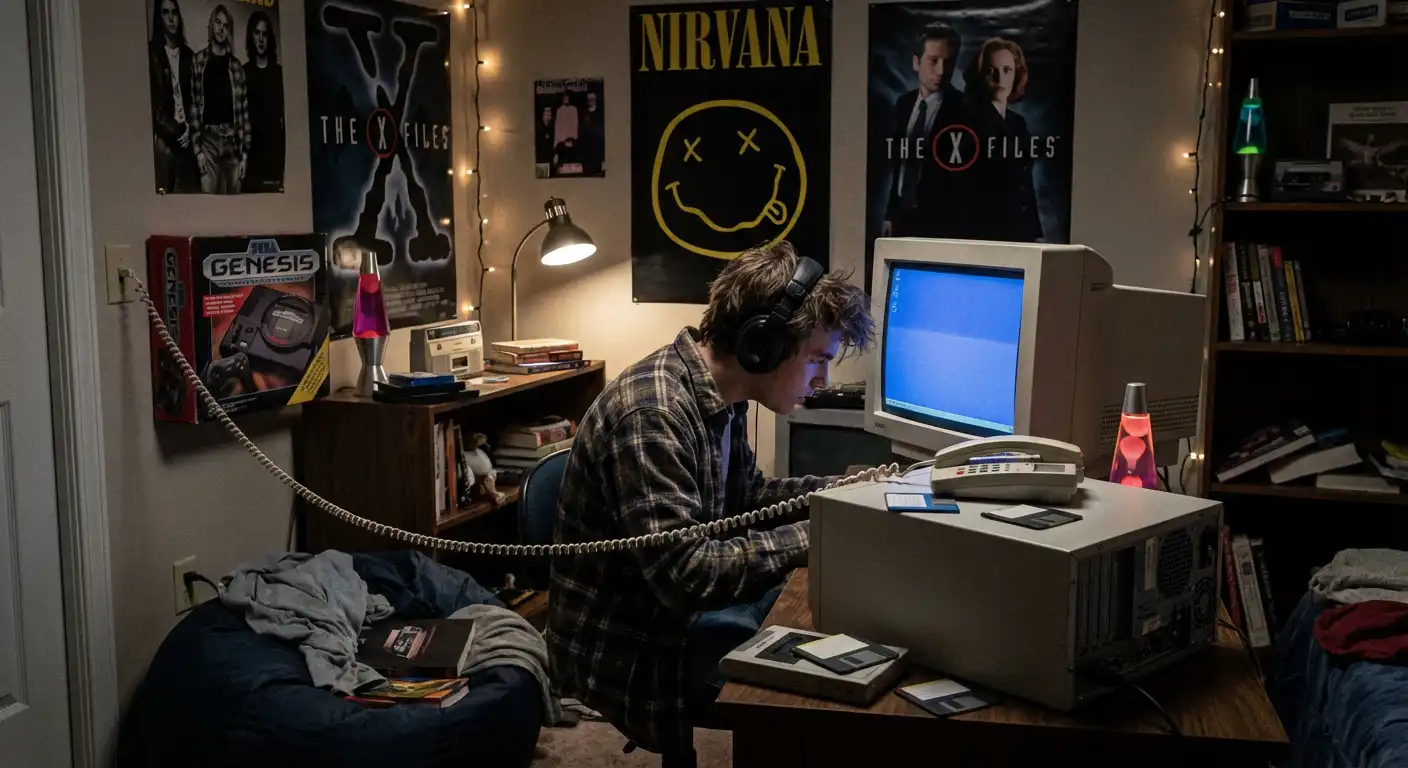

The Digital Underground That Changed Everything
Before Facebook, before Reddit, before the internet became the always-on utility we know today, there were BBSes. At their peak in 1994, an estimated 60,000 bulletin board systems served 17 million users across the United States alone. These weren’t slick, corporate platforms. They were digital speakeasies, each one running on a personal computer in someone’s home or office, accessible through a single phone line, one caller at a time.
Each BBS was a world unto itself. When you dialed in, you weren’t just accessing information. You were entering a curated space with its own personality, its own rules, its own community. The sysop (system operator) was part curator, part bouncer, part community leader. They set the tone, chose the aesthetic, and fostered the culture that made each board unique.
ANSI Art: When Constraints Bred Creativity
The moment you connected, you’d be greeted by something magical: ANSI art. Created using just 256 text characters and 16 colors, these intricate artworks transformed login screens into digital galleries. Enthusiast communities often describe ANSI art as “hacker graffiti,” and that’s exactly what it was. Artists worked within severe technical limitations to create stunning visual experiences that announced, “You’ve arrived somewhere special.”
The ANSI art scene became its own subculture. Artists formed groups (or “crews”) with names like ACiD and iCE, releasing monthly art packs that showcased their latest work. In 1997 alone, over 900 ANSI art packs were released. These weren’t just pretty pictures; they were signatures, status symbols, and currency in the underground economy of the BBS world.
For those who couldn’t crack software or supply the latest warez, creating ANSI art became their ticket to higher status on elite boards. It was a pure meritocracy of creativity, where your skill with ASCII characters could earn you respect and access.
The Sound That Meant You Belonged
Online forums dedicated to retro computing culture often wax poetic about the modem handshake sound. One enthusiast described it perfectly as “a sonic wall which kept the real and the virtual apart.” Unlike today’s seamless, invisible connectivity, logging into a BBS was an intentional act. You had to want it. You had to wait for it. And when that connection finally established, you knew you were entering something meaningful.
That sound meant something. It meant you were part of a community that required effort to access, that valued your presence because you’d made the deliberate choice to be there.
Community Before Algorithms
Here’s what made BBSes fundamentally different from modern social media: geography mattered. Most callers were local, paying long-distance charges if they ventured beyond their area code. This created tight-knit communities where online interactions often translated into real-world friendships. Sysops organized regular meetups at parks, bars, or gaming shops. You couldn’t be a jerk online without consequences, because you might run into that person at next month’s gathering.
Discussion threads in tech nostalgia communities frequently highlight this as the most significant loss from the BBS era. When you dialed into your local board, the same people were there night after night, week after week. You built relationships. You knew voices, personalities, quirks. The barrier to entry (you needed technical knowledge, equipment, and dedication) meant that everyone who showed up was invested.
Compare that to today’s algorithmic feeds, where you’re shown content designed to maximize engagement, where communities span the globe but connections feel ephemeral, where you can scroll for hours without actually connecting with anyone.
The Warez Scene and Digital Rebellion
Let’s be honest about the elephant in the room: the underground software scene. BBSes were where the warez scene thrived, where pirated software circulated, where text files like The Anarchist Cookbook became legendary. Groups competed to crack and release software first, creating elaborate .NFO files adorned with ASCII art to take credit for their work.
Was it illegal? Absolutely. Was it also a crucial part of the culture and a response to the very real need for accessible software among young computer enthusiasts? Also yes. The warez scene drove innovation in file compression, secure communication, and distributed networks. Many concepts we take for granted today (peer-to-peer sharing, distributed systems, anonymous communication) have roots in this underground culture.
The Collapse and What We Lost
Then came 1995. The Mosaic web browser. Inexpensive dial-up internet. The World Wide Web with its point-and-click simplicity and global reach. Within months, the BBS market collapsed. From 45,000 active systems in 1995 to just 10,000 by 1997. The software companies went bankrupt. The boards went dark. An entire culture evaporated almost overnight.
What died wasn’t just a technology. It was an approach to digital community that prioritized intimacy over scale, curation over algorithmic feeds, intentionality over passive consumption. We gained the world but lost something precious in the process.
Bringing Back What Mattered
Today, as of 2026, few BBSes remain active, and enthusiast groups note that less than 30 of these are traditional dial-up systems. But there’s a growing movement to recapture what made that era special. Modern sysops are setting up telnet-accessible boards, not out of pure nostalgia, but because they recognize something important was lost.
Forums and message boards, as tech communities often point out, are “ancient holdovers of a pre-algorithmic civilization.” They don’t optimize for engagement. They don’t show posts out of order to keep you scrolling. They’re linear, human-scaled, and authentic.
That’s why we built bbs.hyperlific.com. We wanted to recreate the magic of the BBS era with modern reliability. No busy signals. No long-distance charges. But all the intimacy, all the visual creativity of ANSI art, all the sense of entering a curated space where community matters more than metrics.
The Future Looks Like the Past
The internet has spent 30 years optimizing for scale, reach, and engagement. We’ve built platforms that connect billions but often leave us feeling more isolated than ever. Meanwhile, a growing number of people are rediscovering that smaller, intentional communities offer something algorithms never can: genuine connection.
The BBS era taught us that constraints breed creativity, that barriers to entry create investment, that local communities have value, and that the ritual of connecting matters. These aren’t outdated ideas. They’re timeless principles of human community that we abandoned in our rush to connect everyone to everything all the time.
So fire up your browser. Point it at bbs.hyperlific.com. Experience the BBS energy. Navigate menu-driven interfaces. Leave messages for other users. Join a community that values quality over quantity, curation over chaos, intention over infinite scroll.
The dial-up may be gone, but the magic doesn’t have to be. Welcome back to the BBS. We’ve been waiting for you.


'%3e%3cg id='Final-Copy-2_2_' transform='translate(1275.000000, 200.000000)'%3e%3cpath class='st0' d='M7.4,12.8h6.8l3.1-11.6H7.4C4.2,1.2,1.6,3.8,1.6,7S4.2,12.8,7.4,12.8z'/%3e%3c/g%3e%3c/g%3e%3c/g%3e%3cg id='final---dec.11-2020'%3e%3cg id='_x30_208-our-toggle' transform='translate(-1275.000000, -200.000000)'%3e%3cg id='Final-Copy-2' transform='translate(1275.000000, 200.000000)'%3e%3cpath class='st1' d='M22.6,0H7.4c-3.9,0-7,3.1-7,7s3.1,7,7,7h15.2c3.9,0,7-3.1,7-7S26.4,0,22.6,0z M1.6,7c0-3.2,2.6-5.8,5.8-5.8 h9.9l-3.1,11.6H7.4C4.2,12.8,1.6,10.2,1.6,7z'/%3e%3cpath id='x' class='st2' d='M24.6,4c0.2,0.2,0.2,0.6,0,0.8l0,0L22.5,7l2.2,2.2c0.2,0.2,0.2,0.6,0,0.8c-0.2,0.2-0.6,0.2-0.8,0 l0,0l-2.2-2.2L19.5,10c-0.2,0.2-0.6,0.2-0.8,0c-0.2-0.2-0.2-0.6,0-0.8l0,0L20.8,7l-2.2-2.2c-0.2-0.2-0.2-0.6,0-0.8 c0.2-0.2,0.6-0.2,0.8,0l0,0l2.2,2.2L23.8,4C24,3.8,24.4,3.8,24.6,4z'/%3e%3cpath id='y' class='st3' d='M12.7,4.1c0.2,0.2,0.3,0.6,0.1,0.8l0,0L8.6,9.8C8.5,9.9,8.4,10,8.3,10c-0.2,0.1-0.5,0.1-0.7-0.1l0,0 L5.4,7.7c-0.2-0.2-0.2-0.6,0-0.8c0.2-0.2,0.6-0.2,0.8,0l0,0L8,8.6l3.8-4.5C12,3.9,12.4,3.9,12.7,4.1z'/%3e%3c/g%3e%3c/g%3e%3c/g%3e%3c/g%3e%3c/svg%3e) Your Privacy Choices
Your Privacy Choices