

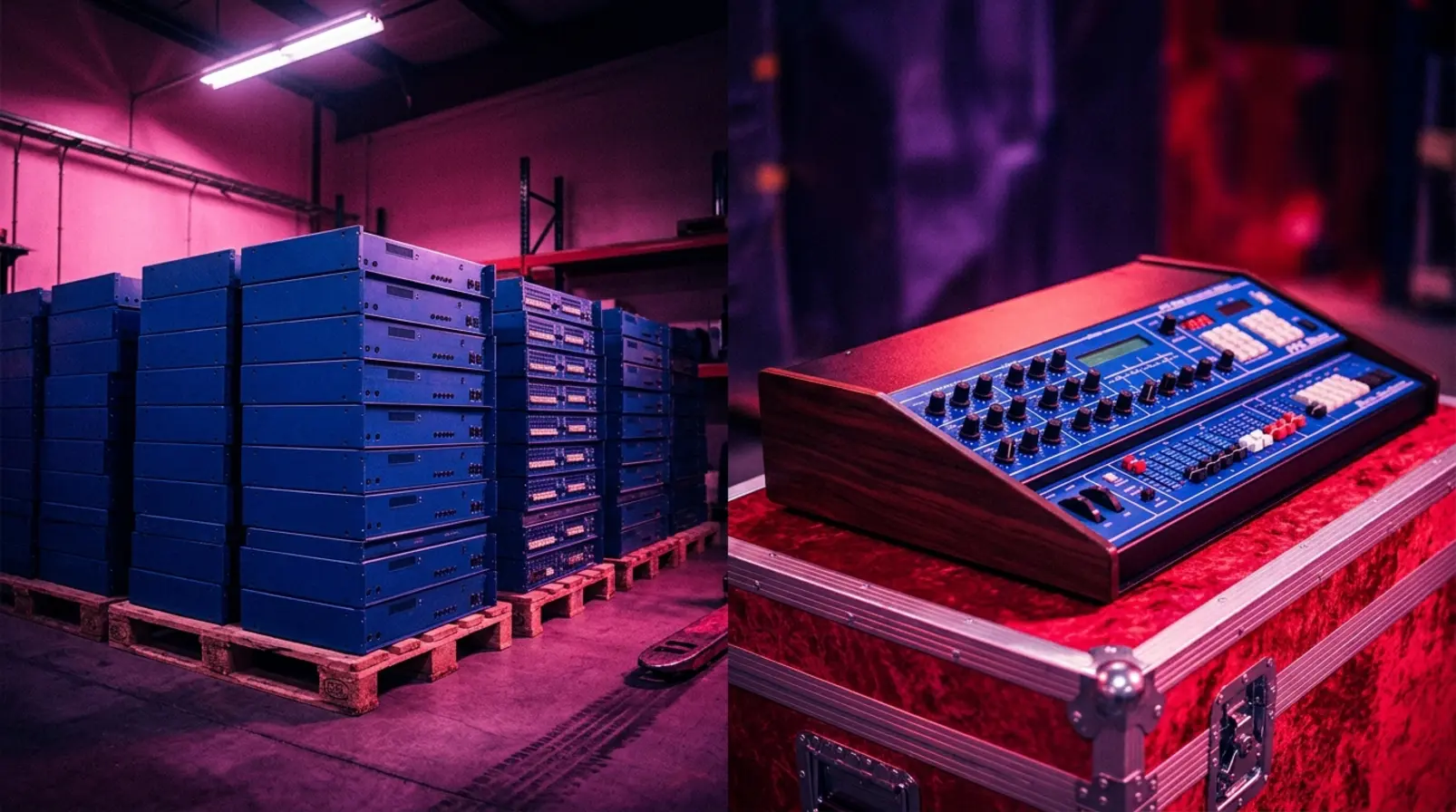

When the PPG Wave 2.3 arrived in 1984, its retail price was about $10,000. Wolfgang Palm’s instrument put digital wavetable oscillators through analog filters, letting players move through stored waveforms instead of being locked to the comparatively limited oscillator shapes of a conventional subtractive synth. In 2026, that basic idea no longer requires a five-figure machine. Behringer sells its Wave for hundreds of dollars, while a separate PPG Wave Anniversary Edition is being built around a very different proposition: legacy compatibility, old-school construction and a worldwide allocation of just 23 units.
The interesting divide is no longer whether musicians can get PPG-style wavetable movement. They can. It is what remains valuable once the synthesis method itself is no longer scarce.
What Ten Thousand Dollars Bought in the 1980s
The Wave 2.3 was the mature version of an architecture PPG had been developing for years. Sound On Sound’s history of the instrument describes the 1984 model as an eight-voice hybrid that added 16-bit sample playback, 12-bit DACs, eight-part multitimbrality and MIDI as standard. Its digital tone generation still passed through analog filtering, giving PPG’s changing waveforms a signal path distinct from the increasingly affordable digital instruments arriving from Japan.
The sound had already made itself conspicuous before the 2.3 appeared. A January 1982 Electronics & Music Maker feature on Tangerine Dream’s Exit described “Kiew Mission” as dominated by digital PPG waveform shaping, referring to the earlier Wave 2. The distinction matters: it was not evidence of the Wave 2.3 two years before that model existed. It was evidence that Palm’s wavetable approach already had a recognizable musical character, one that PPG would keep refining.
The Mass-Market Version Already Does Much of the Job
Four decades later, the architecture has become dramatically cheaper to approach in hardware. Behringer announced factory shipping of the Wave in December 2024 at $599. The company’s current instrument is an eight-voice hybrid with wavetable generation and analog VCF and VCA stages, plus modern conveniences the original did not have in the same form: user-importable wavetables, a polyphonic sequencer, dual arpeggiators, CV and gate connections and individual outputs for all eight voices.
As of August 22, 2026, Sweetwater lists the Behringer Wave at $689. It has 30 factory wavetables and 64 user-defined wavetable slots. It is not a component-for-component reproduction of a 1984 Wave 2.3, and those extra functions make the comparison less tidy than simply calling it the same instrument for less money. But it demonstrates something important: hardware built around the old PPG concept no longer has to be exotic or financially inaccessible.
The Other Revival Is Limited to 23
A second 2026 project went almost completely the other direction. In April, Wolfgang Palm appeared in a video unboxing a rackmount Wave 2.3 that he said had been given to him by developer Daniel Saxlid. Contemporary coverage reported that Palm described the machine as a 1:1 clone and said its boards were interchangeable with vintage units.
The project’s own site now calls the planned version the PPG Wave Anniversary Edition. Its claims are unusually physical. The site says the machine is 99.99% through-hole construction, that Anniversary Edition boards can be installed in legacy Wave 2.3 and EVU hardware, that original boards can run in the new rack, and that the system remains compatible with a legacy Waveterm B. It also says changes were made to address reliability problems in the old design.
Only 23 units are planned worldwide.
The site also claims the Anniversary Edition has the same sound and functionality as a legacy Wave 2.3. That is the maker’s claim, not the result of an independent controlled comparison. More importantly for buyers, one crucial number is still missing: as of August 22, the project says it is not yet ready to announce a price.
What Authenticity Measures Now
Putting the two machines beside each other exposes a strange consequence of successful preservation. Behringer’s Wave makes the broad PPG idea accessible: wavetable scanning, analog filtering, eight voices and a control surface shaped around the old architecture, with considerably more modern storage and connectivity. The Anniversary Edition emphasizes different measurable things: through-hole construction, circuit-board interchangeability, Waveterm compatibility and an allocation of 23 machines.
None of that establishes that one instrument sounds better than the other. It does show that they are selling access to different parts of the PPG story.
In 1984, access to Palm’s wavetable architecture came attached to a roughly $10,000 synthesizer. In 2026, a musician can buy hardware built around the same basic idea for $689, while software has pushed the underlying synthesis method even further from scarcity. Recreating the behavior of the instrument is no longer the impossible part.
What can still be made scarce is the object: the boards that fit the old machine, the construction method, the connection to legacy hardware and the decision to stop after 23 examples. The PPG Wave’s most exclusive feature is no longer the wavetable. It is the increasingly expensive idea of being close to the thing that made it famous.
'%3e%3cg id='Final-Copy-2_2_' transform='translate(1275.000000, 200.000000)'%3e%3cpath class='st0' d='M7.4,12.8h6.8l3.1-11.6H7.4C4.2,1.2,1.6,3.8,1.6,7S4.2,12.8,7.4,12.8z'/%3e%3c/g%3e%3c/g%3e%3c/g%3e%3cg id='final---dec.11-2020'%3e%3cg id='_x30_208-our-toggle' transform='translate(-1275.000000, -200.000000)'%3e%3cg id='Final-Copy-2' transform='translate(1275.000000, 200.000000)'%3e%3cpath class='st1' d='M22.6,0H7.4c-3.9,0-7,3.1-7,7s3.1,7,7,7h15.2c3.9,0,7-3.1,7-7S26.4,0,22.6,0z M1.6,7c0-3.2,2.6-5.8,5.8-5.8 h9.9l-3.1,11.6H7.4C4.2,12.8,1.6,10.2,1.6,7z'/%3e%3cpath id='x' class='st2' d='M24.6,4c0.2,0.2,0.2,0.6,0,0.8l0,0L22.5,7l2.2,2.2c0.2,0.2,0.2,0.6,0,0.8c-0.2,0.2-0.6,0.2-0.8,0 l0,0l-2.2-2.2L19.5,10c-0.2,0.2-0.6,0.2-0.8,0c-0.2-0.2-0.2-0.6,0-0.8l0,0L20.8,7l-2.2-2.2c-0.2-0.2-0.2-0.6,0-0.8 c0.2-0.2,0.6-0.2,0.8,0l0,0l2.2,2.2L23.8,4C24,3.8,24.4,3.8,24.6,4z'/%3e%3cpath id='y' class='st3' d='M12.7,4.1c0.2,0.2,0.3,0.6,0.1,0.8l0,0L8.6,9.8C8.5,9.9,8.4,10,8.3,10c-0.2,0.1-0.5,0.1-0.7-0.1l0,0 L5.4,7.7c-0.2-0.2-0.2-0.6,0-0.8c0.2-0.2,0.6-0.2,0.8,0l0,0L8,8.6l3.8-4.5C12,3.9,12.4,3.9,12.7,4.1z'/%3e%3c/g%3e%3c/g%3e%3c/g%3e%3c/g%3e%3c/svg%3e) Your Privacy Choices
Your Privacy Choices